Stop Renewing Tableau Licences You Can Replace with Power BI
Tableau to power bi migration services that cover every workbook, every calculated field, and every row-level security rule. A written scope before development starts, and parallel validation before your Tableau licence goes offline.
Submit your brief → call within 48 hours → scoped proposal in 3 days → Sprint 1 within 1 week of sign-off
Hero · Analytics lead presenting Power BI migration plan to team

Conference room, wide shot from the side, natural light, no direct eye-contact · 1200 × 630
Tableau is still a capable tool. Your licence bill is not.
Most organizations exploring tableau to power bi replacement are not abandoning analytics capability. They are choosing to stop paying a separate per-user licence when Power BI ships inside the Microsoft 365 stack they already own. The tableau to power bi replacement decision is usually a financial one, not a capability one.
Staying on Tableau
- Per-user Creator and Explorer licences that cost more than the analytics value delivered to most users
- Tableau Server infrastructure you maintain on-premises while your data has moved to Azure or Fabric
- Connectors that do not integrate cleanly with Dynamics 365, SharePoint, or Microsoft Teams
- Upgrade cycles that require Server downtime and break custom extensions
- Calculated field logic understood by only one or two analysts who are responsible for the whole estate
After a tableau to power bi migration
- Power BI Pro included in Microsoft 365 E3 and E5 plans your organization already purchases
- Native connectors to Azure, Fabric, SharePoint, Dynamics 365, and Teams without gateway overhead
- A broader pool of analysts who can build in Power BI Desktop compared to Tableau Desktop
- Row-level security and workspace governance built into the migration scope from the first sprint
- A governed semantic model that any author can use, not calculated fields locked to individual workbooks
The same analytics capability at a fraction of the ongoing cost
Toggle between the environments to see how the same reporting problem looks before and after a tableau to power bi migration consulting engagement.
Current Tableau Environment
Annual licence and infrastructure cost running at approximately $100,800 across a user base that could be served by Power BI Pro at a fraction of the price.
What this environment costs
- 135 workbooks archived for years still count against your licence count
- Calculated fields locked inside individual workbooks with no shared semantic layer
- Server upgrade scheduled for Q3 requiring two weeks of analyst time and a weekend downtime window
After Migration to Power BI
All 52 active reports rebuilt and number-matched. Calculated fields promoted to a shared semantic model. Governance documentation and training delivered at go-live.
What this environment delivers
- Calculated fields rebuilt as governed DAX measures reusable across all reports, not isolated per workbook
- Scheduled refresh runs as a managed cloud service with no Server maintenance window
- Full code and documentation ownership transferred to your team at project close
From Tableau workbook inventory to Power BI go-live in four phases
A credible tableau to power bi migration company documents the full scope before any DAX is written. No surprises mid-project, no scope additions after sign-off.
Workbook Inventory Output
Scope signed off before Sprint 1 begins. Archive candidates excluded from migration cost.
Semantic Model Build Status
Every Tableau calculated field becomes a documented DAX measure in a shared semantic model, not buried inside individual reports.
Parallel Validation Log
Both environments run in parallel for a minimum of two weeks. No cutover without written sign-off.
Governance Handoff Package
Your team owns the environment on day one after go-live.
Migration Approach · Analyst comparing Tableau and Power BI workbooks

Over-the-shoulder, two laptops, natural desk light · 720 × 540
Every deliverable named in writing before development starts
A credible tableau to power bi migration partner gives you a line-by-line proposal before any build work begins. Here is what every engagement with a proven tableau to power bi migration partner delivers.
Workbook Audit and Usage Data
Complete inventory of published workbooks with last-accessed dates, user counts, data sources, and calculated field complexity. You decide what moves before any build begins.
Shared Semantic Model with DAX
Every Tableau calculated field rebuilt as a documented DAX measure in a centralized semantic model. All authors reference the same governed logic, not isolated workbook calculations.
Report Rebuild, Not Screenshot
Every active workbook rebuilt as a functional Power BI report with layout review, filter logic validation, and row-by-row number-matching against its Tableau source before sign-off.
Row-Level Security Rebuilt
Tableau user filters and data source permissions audited and rebuilt as Power BI row-level security roles. Workspace access policies documented and implemented as part of scope.
Two-Week Parallel Run
Both environments run simultaneously for at least two weeks. Business owners sign off on each report before Tableau is decommissioned. No cutover without confirmation.
Training and Governance Handoff
Four training sessions for report authors and admins, plus a written workspace governance guide and admin runbook. Your team owns the environment on day one after go-live.
Migrating from a different platform?
Manual Excel reporting replaced with a governed Power BI analytics platform
A manufacturing and distribution enterprise ran financial and operational reporting on manual Excel workflows. Slow, error-prone close cycles and no single source of truth across finance and operations teams made confident decision-making difficult.
Manual Excel workflows slow to produce, difficult to reconcile, and impossible to audit reliably across finance and operations teams
Close cycles delayed by manual data assembly, reducing confidence in period-end performance reporting for leadership
A centralized Power BI data model built on a SQL data warehouse integrated finance and operations data. Key performance indicators standardized across departments with DAX measures designed for reconciliation and auditability.
Dashboards served both financial oversight and operational decision-making, eliminating the need for manual spreadsheet assembly across departments.
Reduction in close cycle time
Manual Excel reports remaining at go-live
Case Study · Power BI financial dashboard on manufacturing operations monitor
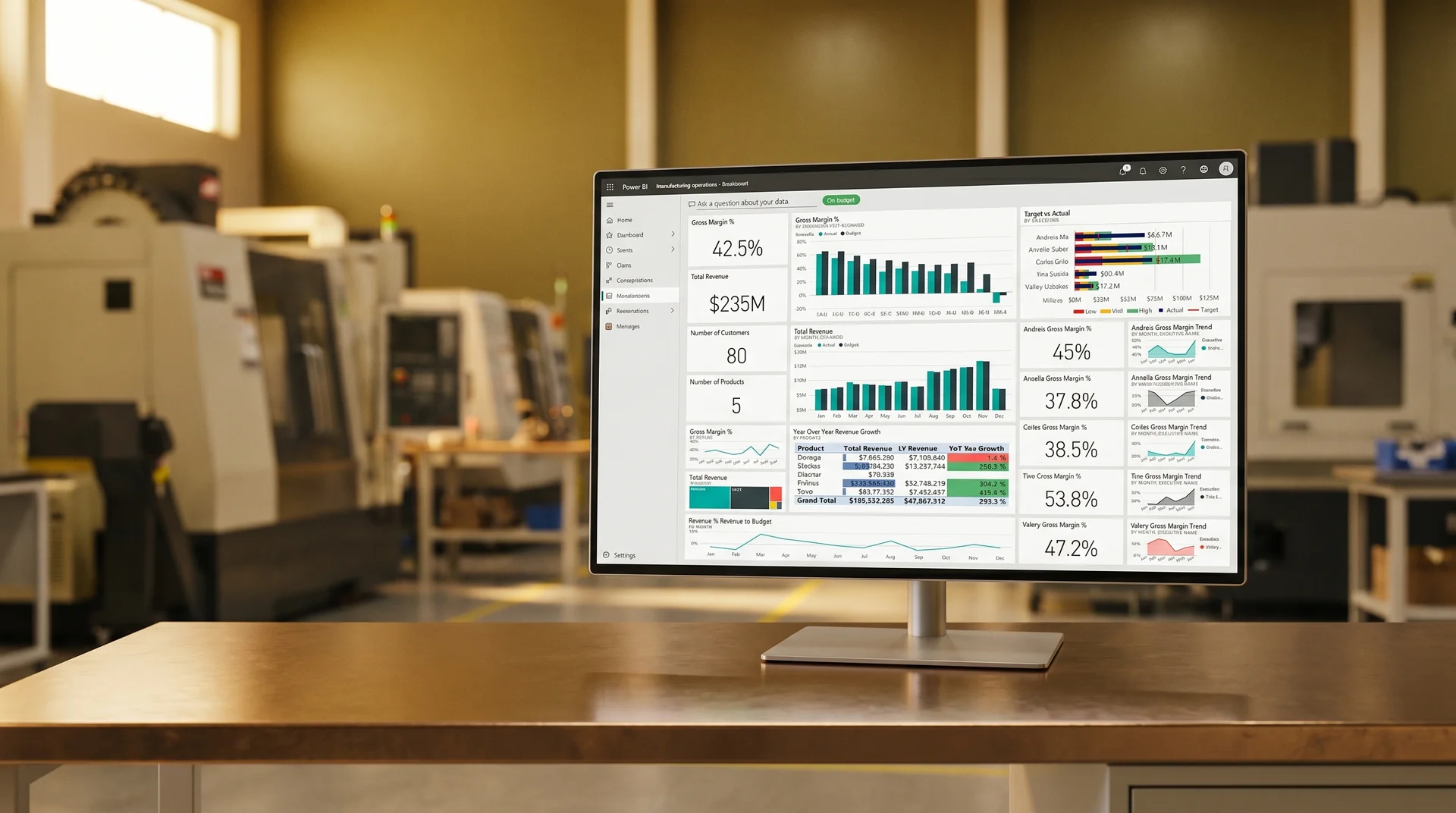
Power BI dashboard on manufacturing operations monitor, wide angle, warm office light · 960 × 540
Explore Power BI implementation servicesMigration risks unique to Tableau that other partners discover mid-project
A tableau to power bi migration consulting engagement that does not address these in the written scope is not quoting you the real project cost. Any tableau to power bi migration consulting partner skipping Phase 1 audit is giving you an estimate, not a scope.
LOD Expression Translation
Tableau level-of-detail expressions (FIXED, INCLUDE, EXCLUDE) do not have a direct DAX equivalent. Each LOD requires individual design and validation. We identify and cost every LOD expression in Phase 1 before the proposal is signed.
Tableau Extract and Live Connection Split
Workbooks using Tableau Live connections require a different refresh architecture in Power BI than those using extracts. Import mode, DirectQuery, and Composite Model tradeoffs are evaluated per data source in Phase 2 before any builds begin.
Workbook Inflation from Archived Reports
Tableau Server environments commonly have three to four times more published workbooks than active ones. Migrating the full inventory inflates cost and timeline significantly. Usage data identifies archives before any rebuild work begins.
Embedded Data Source Credentials
Tableau workbooks often embed data source credentials directly. Power BI uses gateway-managed or service principal connections. Each data source connection strategy is mapped and configured in Phase 2 before report builds begin.
Subscription and Alert Replacement
Tableau Server subscriptions and data-driven alerts require redesign as Power BI subscriptions or data alerts. Subscription patterns are inventoried in Phase 1 and rebuilt equivalents designed before Tableau is decommissioned.
Licence Overlap Window
The parallel validation period runs both Tableau and Power BI simultaneously, creating a window of double licence cost. Tableau renewal dates and Power BI capacity planning are reviewed in the scoped proposal so you know the exact overlap period in advance.
What separates a documented migration from a typical tableau to power bi migration company
Most migrations underrun scope estimates because the workbook audit was skipped. A proven tableau to power bi migration partner audits before quoting, every time. The right tableau to power bi migration company scopes risk before it becomes your problem mid-sprint.
How this engagement works
Workbook audit before scope. Every active workbook, calculated field, LOD expression, and subscription pattern is documented before a line of DAX is written.
Row-by-row number-matching during the parallel run, not a visual comparison and a verbal sign-off from a developer.
Governance documentation, workspace naming standards, a training programme, and an admin runbook are part of scope, not charged separately.
Full ownership of all code and documentation transferred at project close. No retainer required to keep reports working after go-live.
How other implementation partners typically work
Quote from a rough workbook count, then discover LOD complexity and scope additions after Sprint 1 is already in progress.
Validate reports visually and move to cutover, leaving metric discrepancies to be found by business owners after Tableau is gone.
Deliver working reports without governance standards, leaving your team unable to maintain or extend the environment independently.
Frequently asked questions about Tableau to Power BI migration
Most Tableau to Power BI migrations complete in 6 to 14 weeks. Small environments with fewer than 40 active workbooks and two or three data sources often finish in 6 to 8 weeks. Complex environments with hundreds of workbooks, nested calculated fields, and multiple row-level security groups typically run 10 to 14 weeks. We scope the exact timeline in writing before any work begins.
Tableau calculated fields do not have a direct import path into Power BI. Each calculation must be reviewed, translated into DAX, and validated against its source output. We audit every calculated field in Phase 1 and produce a documented DAX library before any report rebuild begins. Calculated fields with complex LOD expressions require additional design time, which we account for in the scoped proposal.
Power BI import mode handles most enterprise data volumes with strong query performance when the semantic model is designed correctly. Very large data sets may benefit from DirectQuery or hybrid modes, which we evaluate per data source during Phase 2. Import mode, DirectQuery, and Composite Model tradeoffs are documented in your scoped proposal before development begins.
Published Tableau Server workbooks are inventoried in Phase 1 using usage data to separate active reports from archives. Active workbooks are rebuilt as Power BI reports published to a governed workspace. Archived workbooks are excluded from scope with your approval, reducing migration cost and timeline significantly.
The assessment covers your full Tableau environment: published workbook inventory with usage data, calculated field complexity, LOD expressions, data source connections, row-level security rules, and Tableau Server subscription patterns. You receive a written scope with phase milestones, an effort estimate, a risk register, and a licensing recommendation before any development begins.
Is this the right tableau to power bi replacement engagement for your organization? Find the right tableau to power bi migration company below.
Good fit for organizations that
- Have a live Tableau Server environment and a target date to decommission it within the next 12 months
- Can assign one internal reviewer to sign off on migrated reports during the parallel run period
- Want a governed semantic model and training delivered, not just reports that open without errors on go-live day
- Are on Microsoft 365 E3 or E5, or are planning to consolidate onto the Microsoft stack
Not a fit if you
- Need the full Tableau environment migrated in under four weeks with no workbook audit or discovery phase
- Have no executive sponsor or business reviewer available to sign off on migrated reports before cutover
- Are evaluating the idea without a firm decision to move, and want a free proof-of-concept before committing to a written scope
Not sure? Tell us your situation and we will be straight with you. Share your setup here and get a direct assessment.
Get a scoped tableau to power bi migration services proposal
Submit your brief and receive a written scope, phased timeline, effort estimate, and risk register within three business days. Scoped before work starts, line by line, no commitment required.
Where are you in the process?
Call within 48 hours · proposal in 3 days · Sprint 1 within 1 week of sign-off
Brief received
We will review your Tableau environment details and send a scoped proposal within 3 business days.
Response within 48 hours of brief submission
Written scoped proposal in 3 business days
60 plus projects completed across Power BI and analytics
Full code ownership transferred at project close
Pre-footer · Team reviewing final migrated Power BI reports at standing desks

Your Tableau licence renews again soon. Make this one the last.
No commitment. No pitch. A written scope in three business days so you know exactly what your tableau to power bi migration services engagement costs, what it includes, and when it ends.
Your team's time investment is typically 3 to 4 hours per week. One sprint review, async feedback, and a final sign-off. We handle everything else.