Power BI semantic model development company. Every report agrees.
Our Power BI semantic model development delivers a certified model where revenue, margin, customer, and stock-keeping unit mean the same thing in every report on every team. Star-schema design, governed DAX library, row-level security, and full Tabular Editor source control from one Microsoft partner team.
Brief submitted › discovery call within 48 hours › model audit and scoped roadmap in 5 business days › first certified semantic model live within 6 weeks
Your team's time investment is typically 2 to 3 hours per week: one data validation call, async sign-off on dimension designs, and a final user acceptance testing session. We handle all engineering, governance, and source control.

Reports lie when the model is wrong.
You do not have a Power BI problem. You have a semantic layer problem. Twelve PBIX files each build their own joins, their own DAX, and their own version of revenue. The chief financial officer opens three reports and gets three different numbers. The fix is not another dashboard. The fix is one certified model behind every report.

- Every PBIX file is its own world.Twelve report authors, twelve copies of fact_sales, twelve definitions of "net revenue". Nobody is wrong. Nobody is the same.
- DAX measures live in nobody's source control.Critical logic lives inside an analyst's PBIX. Open it on a different machine and refresh fails. Change a column upstream and every report breaks silently.
- Star schema is missing entirely.Snowflakes, many-to-many relationships, and bidirectional filters everywhere. DirectQuery is unusable. Aggregations cannot be added. The model fights you.
- Row-level security is "we trust the workspace".Sales reps can see every region's pipeline. HR salary data sits in a workspace 47 people can browse. Audit will ask, and the answer will be embarrassing.
- A new report takes 3 weeks because there is no model to point at.Every request restarts with "where does the data live and which definition of margin do you want this time?" That is not analytics. That is rework.
- One published, certified dataset behind every report.Every author connects live to the same model. Revenue is revenue. Margin is margin. The chief financial officer and the regional sales lead read the same number from the same source.
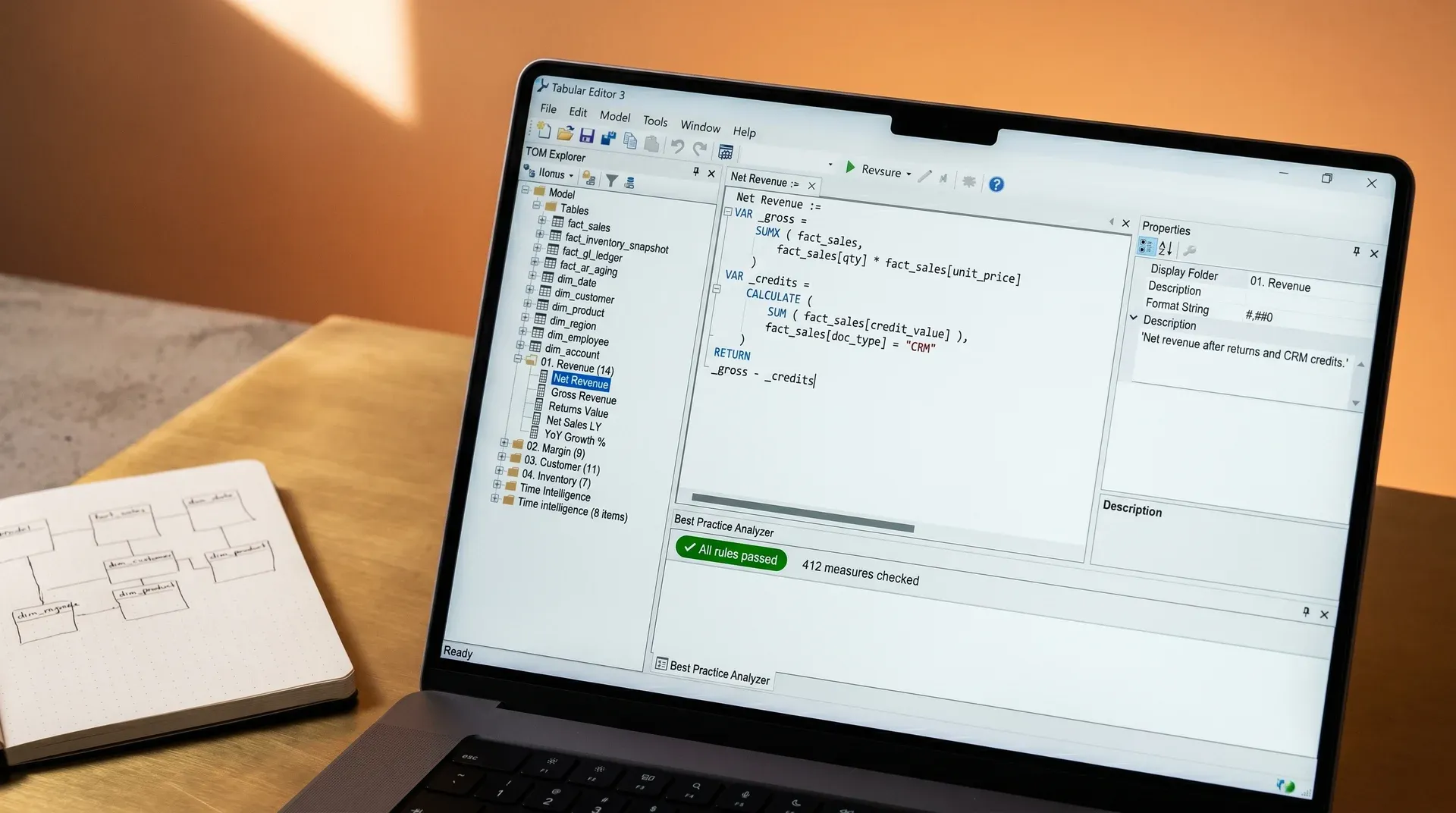
- DAX library in Tabular Editor with Git source control.Every measure has a folder, a description, and a pull request history. Calculation groups handle time intelligence. Best practice analyzer runs on every change.
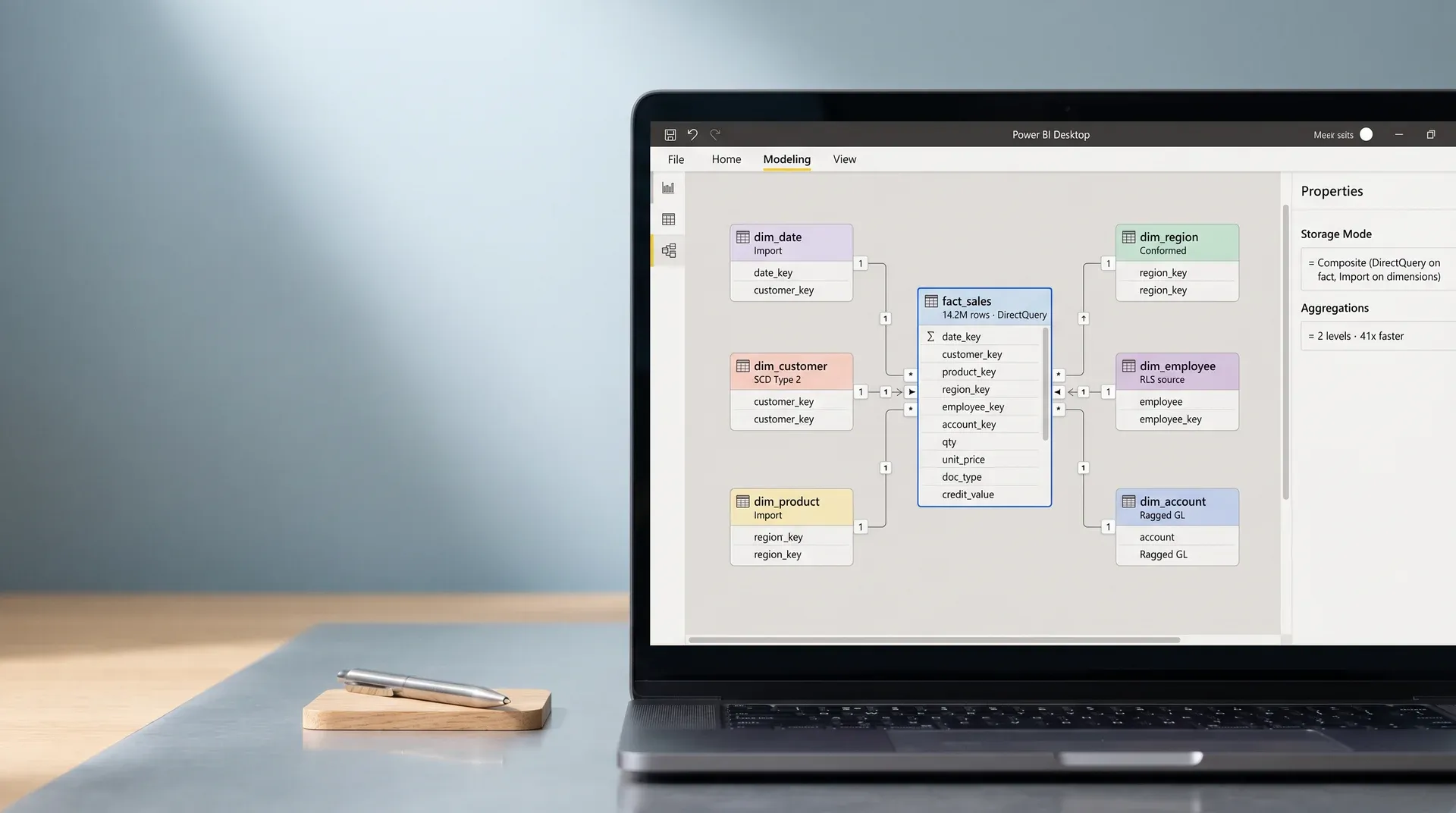
- Strict star schema with conformed dimensions.Fact tables at the center. Dimension tables for date, customer, product, region, employee. Single direction filters. DirectQuery, aggregations, and composite models become real options again.
- Row-level security enforced in the model itself.DAX roles tied to Microsoft Entra ID groups. Region managers see their region. HR data sees one person. Audit logs prove who saw what, on which day.
- New reports take hours, not weeks.Authors connect to the certified model and drag fields. The hard work is already done. A board ad-hoc question gets answered in the same meeting it was asked.
Five layers of Power BI semantic model development behind one trusted model.
Click any tab to inspect the layer. The tour auto-advances every 4 seconds and loops. Click any item to jump to that layer.
- fact_sales14.2M rows
- fact_inventory_snapshot38.1M rows
- fact_gl_ledger6.8M rows
- fact_ar_aging412k rows
- 01. Revenue14
- 02. Margin9
- 03. Customer11
- 04. Inventory7
- Calculation group: Time Intelligence8
Net Revenue :=
  VAR _gross =
    SUMX (
      fact_sales,
      fact_sales[qty] * fact_sales[unit_price]
    )
  VAR _credits =
    CALCULATE (
      SUM ( fact_sales[credit_value] ),
      fact_sales[doc_type] = "CRM"
    )
  RETURN
_gross - _credits- Regional ManagerDynamic
- Sales RepresentativeDynamic
- Finance Read-onlyStatic
- HR CompensationStatic
- External AuditorRead snapshot
[region_id] IN
  CALCULATETABLE (
    VALUES ( dim_employee[region_id] ),
    dim_employee[email] = USERPRINCIPALNAME ()
)Microsoft Power BI semantic model development, every deliverable.Nothing implied.
Fixed-fee scope per phase. Source code in your Git. PBIX, Business Intelligence Model, and runbook in your tenant on day one.
Star-schema model architecture
A documented model design before a single line of DAX. Grain decisions, conformed dimension list, slowly-changing-dimension policy per dimension, storage mode strategy, and the kill-list of legacy tables that do not enter the model.
Tabular model (Business Intelligence Model)
Built in Tabular Editor. Source-controlled in Git. Best practice analyzer green. Calculation groups for time intelligence. Standalone value $14,200.
Row-level security pack
DAX roles bound to Entra ID groups. Dynamic row-level security for hierarchies. Test-as-user framework. Audit log shipped to your tenant. Standalone value $6,800.
Certified DAX library
Every business measure named, folded, and documented. Calculation groups handle year-to-date, month-to-date, prior year, and rolling 12. Performance Analyzer baseline captured for every measure.
Refresh and gateway runbook
Incremental refresh on fact, on-premises data gateway sized, refresh schedule documented, monitoring webhooks into Teams. Standalone value $4,600.
Handover and enablement
Two enablement workshops for your authors. Recorded walkthrough of every measure folder. 30-day post go-live support window. Standalone value $5,800.
$52,200 of work
Delivered as a fixed-fee programme from $38,000 for a single-source model, or scoped line by line for multi-source warehouses.
Submit your brief › call within 48 hours › scoped proposal in 3 days › Sprint 1 begins within 1 week of sign-off
Get My Scoped QuoteFrom 30 disconnected stores to $120M of unified reporting.
Parsons Kellogg, a promotional products and corporate apparel leader, operated 30+ storefronts and over one million inventory items across fragmented backend systems. Manual processes and disconnected analytics held annual revenue at $14M. A unified Power BI semantic model on top of Dynamics 365 enterprise resource planning changed the operating model. Revenue scaled to $120M.

A model pays for itself in analyst hours saved.
Three analysts at $95k each, spending 60% of their week reconciling reports and rebuilding the same logic, is $171k a year of pure rework. A certified semantic model lands between $38k and $78k as a one-time fixed fee. The build pays back inside the first quarter, every time.
And that is before you count the cost of bad decisions made on numbers that did not match. We have never seen that line item land below six figures.
Three things other Power BI semantic model development partners will not commit to.
Your tenant. Your Git. Your DAX. Day one.
Every model artifact lands in your Microsoft tenant, your Azure DevOps or GitHub, and your Power BI workspace from the first commit. No partner-owned PBIX files. No "you can have the Business Intelligence Model when the contract ends". You can sack us in week 4 and the model keeps running.
Best Practice Analyzer must pass before we invoice.
Every measure, every relationship, every storage mode choice runs through Tabular Editor's Best Practice Analyzer and passes before the final invoice goes out. Other partners ship a model that works on the surface and fails the audit six months later. We do not.
Your team writes the next 50 measures, not us.
A semantic model is only useful if your analysts can extend it. Two enablement workshops, a recorded walkthrough of every measure folder, and a 30-day post go-live window where we sit alongside your authors are baked into every build. The opposite of vendor lock-in.
Need a sibling build?
A semantic model is one phase of a Power BI engagement. The rail auto-scrolls through related services. Hover to pause and open any card before your discovery call.
The questions chief financial officers ask first.
A semantic model is the published Power BI dataset that holds your tables, relationships, and business measures. It is the single layer between raw data and every report your team builds. Without it, every report author rebuilds the same logic differently, and every executive report tells a slightly different story. Invest in the model and every downstream report becomes faster, cheaper, and consistent.
A single-source model, for example Dynamics 365 Business Central or Finance and Operations alone, ships in 4 to 6 weeks. A multi-source model spanning enterprise resource planning, customer relationship management, and finance applications is typically 8 to 12 weeks. We scope it line by line in the first 5 business days and quote a fixed fee.
No. Existing PBIX files are re-pointed to the new published model using "Live connection". The visuals and layout you already have are preserved. The only thing that changes is where the data and measures come from. We rebuild the broken ones; you keep the good ones.
Yes. Every measure has a folder, a plain-English description, and a documented use case. Two enablement workshops walk your analysts through the library. The model lives in Git, so every change has a pull request history. Most clients are extending the model independently within 60 days.
A single-source semantic model with up to 40 measures starts at $38,000 fixed-fee. A multi-source model with row-level security, 60 or more measures, and aggregations lands between $58,000 and $84,000. We quote line by line after the discovery call so the price reflects your actual data estate, not an average.
Row-level security roles are defined in the model using DAX expressions bound to Microsoft Entra ID security groups. For hierarchical access, dynamic row-level security uses USERPRINCIPALNAME to filter by employee, region, or business unit. Every role is tested using "Test as user" in Power BI Service and the test results are signed off by your security or audit lead before go-live.
Yes. About a third of our semantic model engagements start as a rescue. We run a Best Practice Analyzer audit first, classify every measure and relationship as keep, refactor, or rebuild, and quote a remediation plan. In some cases we save more than we rebuild. No judgement about how it got there.
Three questions. Real answer at the end.
Click the option that matches your situation. We will read it back honestly. No email required.

Not sure? Tell us your situation and we will be straight with you.

Submit your brief. Get a scoped model plan in 3 days.
Tell us about your reporting estate, your data sources, and what is failing. As your Power BI semantic model development company, we will book a 45-minute discovery within 48 hours, send a line-by-line scoped model plan within 3 business days, and have your first certified semantic model live within 6 weeks of sign-off.
No commitment. No pitch. If a model is not what you need, we will say so on the call.
Submit your brief › call within 48 hours › scoped proposal in 3 days › first certified model within 6 weeks of sign-off