01DAX
Senior Data Analysis Expressions Engineer
Optimises measure code, time intelligence, and calculation groups. Owns Data Analysis Expressions standards and code review.
- Performance tuning
- VertiPaq optimisation
- Tabular Editor scripting
Get on a call with us to see how we can help you
Get a QuoteMicrosoft-certified Data Analysis Expressions engineers, semantic modellers, and report developers plug into your existing team, your Git repository, and your tenant. Billable from week one. No agency layer. No statement of work renegotiations every two weeks.




Every quarter you carry an open Power BI requisition, finance still waits on Excel exports, the data warehouse still has no semantic layer, and the dashboards your chief financial officer actually asked for stay on a backlog.
Tap a label to switch the view. The toggle pauses when you interact.

Augmented engineers do not just close tickets. They leave your semantic model documented, your Data Analysis Expressions measures testable, your workspace governance tightened, and your in-house analysts faster than they were the month before.
Once in lost output (reports that do not get built, decisions that do not get made), and once in overflow (your existing analysts burning hours covering the gap). Pick a scenario below or watch them rotate.
Estimates use United States blended cost data for senior Power BI engineers ($165k fully loaded) and a 1.4x overflow multiplier on existing analyst time. Swap in your own numbers on a capacity call.
Augment your team with any Power BI role on the rail below. Each role is a fully loaded Microsoft-certified engineer, billed weekly, terminable on two-week notice, and replaceable inside 24 hours if the fit is wrong.
Optimises measure code, time intelligence, and calculation groups. Owns Data Analysis Expressions standards and code review.
Designs star schemas, role-playing dimensions, and certified datasets that scale across the business.
Builds reports executives actually use. Themes, bookmarks, drill-through, and accessibility-compliant layouts.
Owns ingestion, dataflows, Lakehouse, and pipelines feeding your semantic model. SQL, Power Query, PySpark.
Locks down workspaces, deployment pipelines, gateways, and capacity. Owns governance and Fabric capacity tuning.
Owns the roadmap inside your stand-ups. Code reviews, sprint planning, mentoring your in-house analysts.
Reconciles report totals to the source system, automates regression tests, signs off every release into production.
For multi-engineer pods. Runs the engagement, reports status to your chief financial officer, escalates risk before it costs you a quarter.
The rail auto-scrolls through all eight roles. Hover to pause. Every role is available from the same contract.

A live engagement timeline from a recent Redefine staff augmentation. Two engineers embedded with a textile manufacturer that needed Power BI capacity alongside a Navision upgrade.
Chief financial officer joins. We confirm the gap is one senior Data Analysis Expressions engineer plus one report developer for 12 weeks, with a possible extension.
Pre-vetted bench, not a cold curriculum vitae pile. Client meets engineers over a 30-minute working session, not a behavioural interview.
Security review, non-disclosure agreement, and master services agreement all completed in parallel. Engineers shadow a sprint planning call before code is touched.
Time intelligence rewrite cuts a monthly close report from 40 seconds to under 5. Existing analyst signs off the pull request.
Replaces a manually emailed Excel that the operations director had been chasing weekly for six months.
In-house analyst time freed up by 9 hours per week, redirected to a new sales-by-region semantic model.
Chief financial officer approves a Fabric data engineer to join the pod. Knowledge transfer documents handed to the in-house team alongside continued delivery.

A growing textile processor running fragmented enterprise resource planning, manual Excel reporting, and limited analytical insight across Finance, Production, Sales, and Inventory.
Fragmented and slow enterprise resource planning. Data duplication, reporting errors, and no analytical layer. The team was carrying continued growth on Excel exports.
Two augmented engineers embedded alongside the Navision 2013 R2 to NAV 2016 upgrade. They built the Power BI semantic layer, unified Finance, Production, Sales, and Inventory, and replaced manual workflows with governed dashboards.
Items now reported on through one centralised Power BI layer. Operational overhead reduced, decision-making accelerated, and the platform now scales with continued textile-sector growth.
Source: Redefine engagement records. Numbers attributable to this staff augmentation engagement.

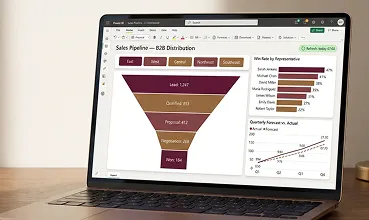

Sample outputs only. Engagements run inside your tenant against your data sources, never against a partner demo workspace.
Two-week notice on every contract. 24-hour replacement on every engineer. You only pay for billable, in-stack work, validated by pull requests merged into your own Git repository.
No commitment. No pitch.
Most implementation partners sell you a body, mark it up, and disappear from your stand-ups. Here is the line-by-line difference, written from the perspective of an in-house business intelligence lead who has worked with both.
The full Redefine Power BI service catalogue at a glance.
Long-term dedicated developers, individually contracted, for ongoing internal builds.
Architecture, governance, and roadmap advisory before you hire or build.
End-to-end build from data sources to certified reports, run by Redefine.
Project-priced builds for specific dashboards, models, and integrations.
Outsourced run-the-platform retainer covering admin, support, and small enhancements.
Health check on your tenant, model, and Data Analysis Expressions before you scale the team.
Single-dashboard builds scoped and delivered against a fixed price.
Reactive break-fix, service level agreement, and rescue cover when production breaks.
Services auto-scroll in a loop. Hover to pause.
Seven business days from signed master services agreement to the first pull request merged in your Git repository. The first capacity call happens inside 48 hours of intake. The first candidate is presented inside three business days. Tenant access, non-disclosure agreement, and security review run in parallel so onboarding does not become the bottleneck.
24-hour replacement service level agreement. You raise the concern, we present a new candidate the next business day, and onboarding for the replacement runs in parallel with the current engineer. You only pay for billable, in-stack work. No statement of work reopening, no penalty for the swap.
You do. Work-for-hire from day one. All PBIX files, semantic models, Data Analysis Expressions, deployment pipelines, and documentation live in your tenant and your repository. We never publish to a partner workspace and export at exit. If you cancel tomorrow, the work is already yours.
Weekly invoice, line by line, blended rate per engineer disclosed up front. Senior Data Analysis Expressions engineers and semantic model architects sit at the top of the range. Report developers and quality assurance engineers sit lower. No agency markup on top, no block-of-hours retainer that disappears if unused. Compared to a full-time senior hire (loaded cost, recruitment, ramp), the year-one saving averages 38%.
Every engagement ends with a structured handover: written Data Analysis Expressions standards, semantic model documentation, deployment pipeline runbooks, and a recorded walk-through with your in-house business intelligence lead. Standard exit notice is two weeks; we recommend four for a clean handover. No penalty for early end.
Yes. A typical pod is a tech lead plus two to four engineers (Data Analysis Expressions, modelling, reports, sometimes a Fabric data engineer). Pods run their own stand-ups, share a sprint board with your team, and report into a single business intelligence delivery lead. Replacement service level agreement applies per engineer, not per pod.
"The clients who get the most out of augmentation already know what they want shipped. They just need senior hands to ship it. We are not a strategy consultancy in disguise. If you need a roadmap, start there. If you need throughput, start here."
Not sure where you fall? Submit the form below and we will be straight with you.
A 30-minute call with our delivery lead. We confirm fit, the skills you need, and the shape of the engagement. No commitment. No pitch.
Capacity call within 48 hours → candidates in 3 days → first pull request merged in week one
Onboarding an augmented engineer takes 2 to 3 hours in week one: one access provisioning call, one architecture walkthrough, and Slack onboarding. We handle everything else.
Microsoft-certified Power BI engineers, billed weekly, replaceable in 24 hours, code in your repository from day one.