An ecommerce ai agent that detects, decides, and acts across your entire platform
Every ecommerce ai agent spans product information management, order management, marketplace, and catalog. No manual trigger. No human initiation. This is agentic ai ecommerce, where agents wake up, diagnose, generate a fix, route for approval, and execute. End to end.
Your team's involvement is typically 2 to 3 hours per week, reviewing agent action logs, approving high-confidence actions, and tuning thresholds. Agents handle everything else.
Submit your brief → call within 48 hours → scoped proposal in 3 days → Sprint 1 within 1 week of sign-off

Your team spots problems 3 days after they start costing you
Without Agentic AI
- A marketplace listing is suppressed Friday. Your team notices Monday. Revenue lost: 3 days.
- Inventory drops below reorder threshold. Nobody drafts the purchase order until the buyer escalates.
- 350 new products arrive from a supplier. Your team spends a week manually extracting attributes and writing content.
- A suspicious business-to-business order pattern sits in the queue. Nobody flags it until it ships.
With Redefine Agentic AI
- Suppression detected in 4 minutes. Agent identifies the missing product information management attribute, generates the fix, routes it for one-click approval.
- Threshold breach triggers agent instantly. Draft purchase order generated, supplier matched, routed for approval before stockout.
- Supplier data sheet arrives. Agent extracts attributes, creates product information management record, generates channel content, and publishes in under 2 hours.
- Anomalous order flagged immediately. Agent holds the order, surfaces a risk summary, and waits for your decision.

Watch retail ai agents think and act in real time
Every entry below is an autonomous agent action happening right now across the platform. Each action shows the module it touched, the confidence level, and a one-click human control. Click any action to expand the agent's reasoning chain. Click Approve or Dismiss to override.
0
Agent types active
0
% auto-resolved
0
Min average response
Agent types in this swarm
Every agent works because your data is unified
Agentic ai ecommerce that spans product information management, order management, marketplace, and commerce is only possible when all data lives in one platform. Each ecommerce ai agent below requires signal from at least three modules simultaneously.
Catalog completeness agent
This commerce ai autonomously monitors your full catalog, detects products missing channel-required attributes, generates the missing content, and routes it for one-click publish approval.
Suppression fix agent
Detects a suppressed listing the moment it is pulled. Identifies the missing or invalid product information management attribute. Generates the correction. Resubmits after your one-click approval. All within minutes.
Inventory reorder agent
Monitors inventory thresholds in real time. When velocity plus open orders signals a stockout risk, the agent generates a supplier reorder recommendation, drafts the purchase order, and routes it for approval before you run out.
Margin protection agent
Proactively detects competitor price drops, channel margin erosion, and underperforming products. Generates price adjustment recommendations with margin impact modelled, ready for your approval.
Product onboarding agent
Receives a supplier data sheet. Extracts attributes. Creates the product information management record. Generates channel-optimized content for Amazon, Google Shopping, and your business-to-business catalog simultaneously. Routes for approval and publishes.
Order anomaly agent
Detects anomalous order patterns (potential fraud, bulk business-to-business orders outside credit terms, unusual delivery addresses). Holds the order, surfaces a risk summary, and waits for your decision before it ships.
What unified commerce ai actually delivers

Client
DrivingI
Business-to-Business Promotional ProductsWhat they do
An established business-to-business promotional products company with complex catalogs, customer-specific pricing, and approval-based purchasing workflows across multiple accounts.
The problem
Inventory syncing was unreliable, customer approvals were manual, and system data was fragmented across enterprise resource planning, customer relationship management, and marketing tools, creating operational bottlenecks that blocked growth.
The outcome
0%
real-time inventory accuracy
Real-time inventory and pricing synchronized directly from Microsoft Dynamics. Manual approval flows replaced with automated routing. Operational friction reduced so internal teams could scale without rework.
Agents require cross-module data. That is the only platform that has it.
Other platforms ship an ai shopping assistant that lives inside a single module. It can generate content inside a product information management system. It can suggest pricing inside a pricing tool. But it cannot act across modules because it cannot see across modules.
A suppression fix agent needs to read the marketplace rejection reason, look up the product information management record, understand the channel content rules, generate a correction, and route through the approval workflow. That is four modules in one action. No point solution has that data.
Redefine's product information management, order management, content management, marketplace, and commerce are all native. Every ecommerce ai agent runs on a single unified data graph. That is why agents here can complete tasks that are impossible everywhere else.
Unified data graph
Product information management, order management, content management, marketplace, and commerce share one data model. Agents query all of it.
Human-in-the-loop by design
Every agent action is reviewable, reversible, and auditable. You decide which actions auto-execute and which require approval.
Confidence scoring on every action
These retail ai agents report a confidence level on each action. Low-confidence actions always route for human review before execution.
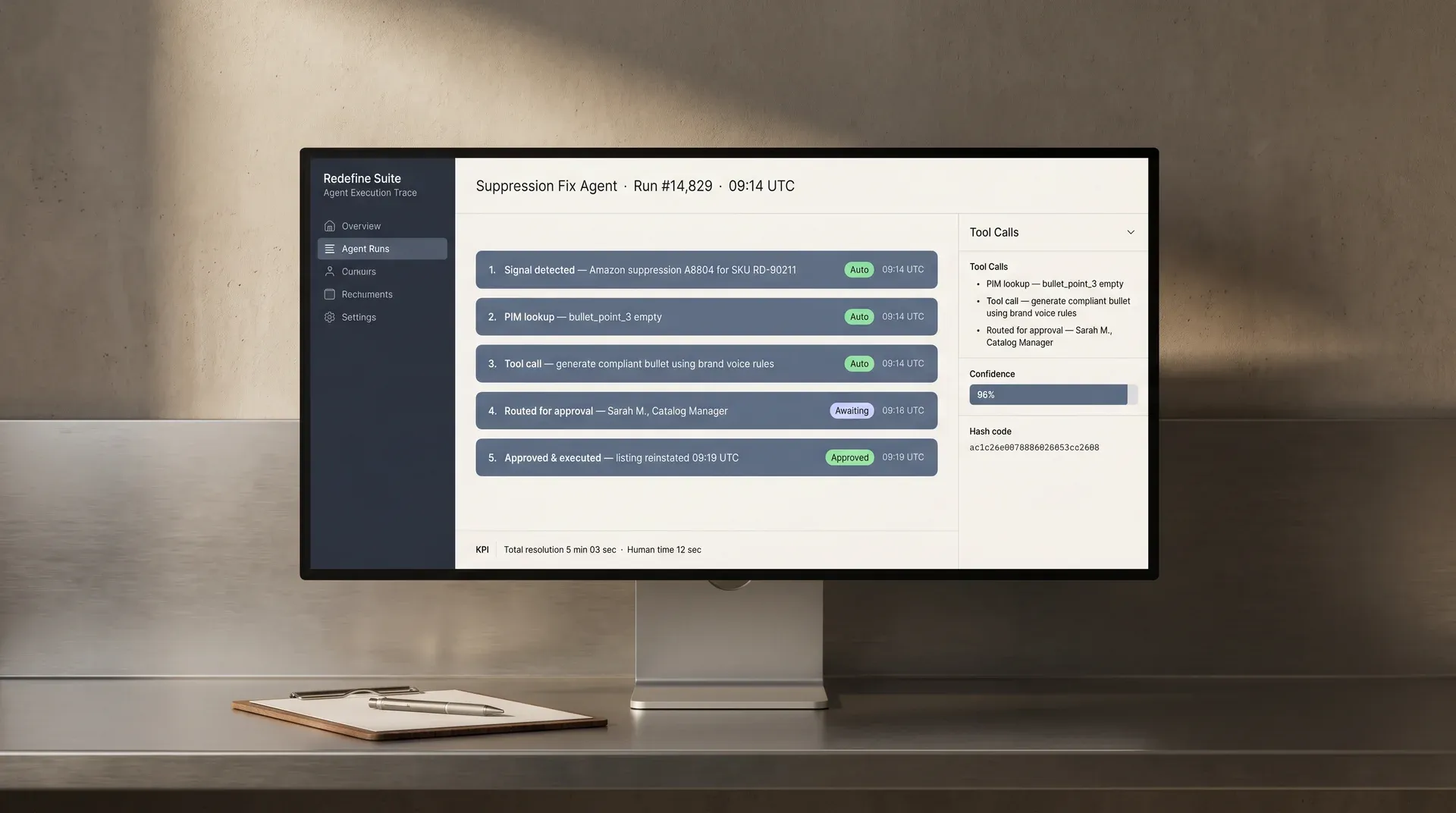
Signal detected
Amazon returned suppression code A8804 for product RD-90211 at 09:14 UTC
Product information management lookup
Queried product information management record. Found: bullet_point_3 field empty. Amazon requires minimum 5 bullet points.
Content generated
Generated compliant bullet point using existing product attributes and brand voice rules. Confidence: 96%.
Routed for approval
Action sent to Sarah M. (Catalog Manager): approval required before resubmission.
Approved and executed
Listing resubmitted to Amazon at 09:19 UTC. Total time: 5 minutes. Listing reinstated.
Agent confidence
96%
Total resolution time: 5 min 03 sec · Human time required: 12 seconds

Human-in-the-loop: 12 seconds of your team's time per action
How the agent infrastructure works
Event-driven trigger layer
Retail ai agents wake on platform events: inventory threshold crossed, listing status changed, supplier data received, order pattern anomaly. No polling, no scheduled jobs, no manual triggers.
Unified data graph query
Each ecommerce ai agent queries across product information management, order management, content management, marketplace, and commerce data simultaneously. Cross-module context is what makes multi-step reasoning possible.
Confidence-gated execution
Every ecommerce ai agent scores its confidence before acting. Actions above your configured threshold auto-execute. Below threshold, they route to the approval queue. You set the threshold per agent type.
Full audit trail on every action
Every agent action (attempt, reasoning, confidence score, approval state, execution result) is written to an immutable audit log. Every action is reversible.
Agent data flow: live
Product Information Management
Attribute lookup
Marketplace
Rejection code
Content Management
Brand guardrails
Generated action
96% confidentUpdated bullet_point_3: "Weather-resistant ABS polymer casing rated for IP67 submersion, designed for outdoor and industrial use."
Other platforms ship an ai shopping assistant. We have AI agents.
The Typical Problem
AI that lives inside one module cannot take cross-module action.
Why It Happens
Other implementation partners bolt an ai shopping assistant onto separate point solutions. No shared data model means no cross-module reasoning.
Redefine's Position
Because product information management, order management, content management, and marketplace are all native, agentic ai ecommerce can query all of them in a single reasoning step and act across them in a single execution.
The Typical Problem
Ungoverned AI creates compliance and brand risk.
Why It Happens
Most AI tools auto-generate and auto-publish without a governance layer. Incorrect content or off-brand language ships before anyone reviews it.
Redefine's Position
Every agent action passes through the confidence threshold. Brand voice guardrails and compliance rules apply to every output. Every action is auditable and reversible.
The Typical Problem
AI that requires manual prompting is just a faster assistant, not an agent.
Why It Happens
A copilot-style ai shopping assistant waits for a human to ask a question. It cannot monitor, detect, or act without being called.
Redefine's Position
Redefine's retail ai agents are event-driven. They wake on platform signals, reason without prompting, and act without waiting for a human to start the conversation.

Questions buyers ask before deploying agents
Yes. Every agent has a configurable confidence threshold. Actions that score above your threshold auto-execute. Actions below route to the approval queue for one-click review. You set thresholds per agent type, per module, and per action category. High-stakes actions (like cancelling an order or republishing a listing) can be configured to always require approval regardless of confidence.
Every agent action is logged and reversible. If an agent publishes incorrect content or modifies a product information management attribute incorrectly, you can roll back to the previous state in one click from the audit log. The audit log records the agent's reasoning chain, confidence score, data inputs, and output so you can understand exactly why it acted as it did.
Agents ship with sensible defaults: conservative confidence thresholds, all high-stakes actions routed to approval, brand guardrails applied globally. You tune thresholds as you build confidence in the outputs. Most teams start with everything in review mode for the first 2 to 4 weeks, then progressively enable auto-execution on action types they have validated.
You could query multiple application programming interfaces, but each call adds latency, each system has its own authentication model, and the data schemas rarely align cleanly. For an agent to reason in milliseconds across product information management, order management, marketplace, and commerce, all of that data needs to live in a single queryable graph, not behind four separate application programming interface calls with schema translation in between. Latency and data inconsistency make real-time agentic action impractical on a stitched-together stack.
2 to 3 hours per week for a team managing a mid-size catalog. That time goes to reviewing the approval queue, validating auto-executed actions periodically, and tuning thresholds. The agents handle detection, reasoning, content generation, and routing. Your team handles judgment calls, which is where human expertise is irreplaceable.
Agentic ai ecommerce works best in specific operating environments
Good Fit
- You manage a catalog of 500 or more products across two or more channels
- Your team currently catches marketplace suppressions hours or days after they occur
- Your operations team spends significant time on repetitive catalog, inventory, or order management tasks
- You want AI that governs itself: auditable, reversible, and brand-safe
- You are building on Redefine's unified platform where product information management, order management, and marketplace are native
Not The Right Fit
- You sell fewer than 50 products on a single channel with no operational volume
- Your data lives in multiple disconnected tools that cannot be unified. Agents need a shared data model to reason across
- You want AI that operates with zero governance (no approval queue, no audit log, no human review)
- Your operations are entirely manual by design and not ready for event-driven automation
Not sure? Tell us your situation and we will be straight with you about fit. Submit your brief here.

Tell us what your team is doing manually that agents should handle
Describe your current operations. We will map which agents apply to your catalog, order management, and channel stack and send a scoped proposal within 3 days.
Scoped before work starts · line-by-line pricing · no commitment to receive a proposal
Related AI capabilities
AI and Automation Platform Hub AI Content Assistance AI Product Data Enrichment AI Workflow Assistance AI Marketplace Assistance AI Operational Intelligence Automation Engine AI GovernanceCall within 48 hours
Proposal in 3 days
50+ brands served
Your IP, your data
Brief received
We will review your situation and send a scoped proposal within 3 business days.
Submit Your Brief
Call within 48 hours · proposal in 3 days · Sprint 1 within 1 week of sign-off
Watch agents solve a real problem in your catalog
We will run a live ecommerce ai agent demo on a real suppression scenario, inventory threshold, or catalog completeness issue relevant to your operation. No sales pitch. No commitment.
No commitment. No pitch. Submit brief → call within 48 hours → proposal in 3 days.