AI Catalog Intelligence
Your catalog's revenue gaps found and fixed automatically
Redefine AI scans every stock-keeping unit, scores channel readiness, extracts missing attributes from product images, and generates optimized content for every channel simultaneously. No manual triage. No stale spreadsheets.

The problem with your catalog right
now
Your best products are invisible because the data is wrong
How most
teams manage catalog data
Quarterly spreadsheet audits miss gaps between review cycles. Revenue is lost every day in between.
Copywriters brief each channel separately. The same product gets four different titles with zero search engine optimization alignment.
Missing size, material, or color data blocks products from Amazon and Google Shopping categories entirely.
Duplicate supplier records cause inventory miscounts and split listing authority across Amazon Standard Identification Numbers.
With
Redefine AI Catalog Intelligence
Continuous AI scanning surfaces every revenue-blocked stock-keeping unit the moment a data gap appears, not 3 months later.
One content generation pass creates Amazon titles, Google Shopping descriptions, and direct-to-consumer copy simultaneously.
Visual AI reads product images and fills in color, material, dimension, and style attributes automatically.
AI deduplicates supplier feeds, product information management records, and marketplace Amazon Standard Identification Numbers into a single authoritative product identity.

AI Catalog Health Scan Engine
Watch the AI scan a real catalog in real time
Select a catalog category below. The AI scores each stock-keeping unit across four dimensions, surfaces revenue-blocked products, and queues enrichment actions. This is exactly how Redefine processes your live catalog.
Scanning catalog...
0 of 8 stock-keeping unitsCatalog
coverage0%
Revenue
Ready
0
Stock-keeping units fully optimized
Needs
Enrichment
0
Stock-keeping units with fixable gaps
Channel
Blocked
0
Stock-keeping units not listing anywhere
$0
Estimated monthly opportunity
AI Enrichment
QueueQueuing...
AI scanning catalog...
Unit
ContentImagesSearchChannel
Score
Initializing scan...
What AI Catalog Intelligence includes
Every capability your catalog needs to earn its keep
Revenue-impact catalog health scoring
Every stock-keeping unit in your catalog gets a live health score across four dimensions: content completeness, image quality, search engine optimization strength, and channel readiness. Scores are ranked by revenue at risk, so your team always knows which products to fix first.
Top
revenue-blocked stock-keeping units3 critical
AP-7841-BLK-M22Blocked
AP-3302-WHT-L48Partial
AP-9910-NAV-S91Ready
Visual attribute extraction
Upload a product image. AI reads colour, material, style, dimensions, and finish from the image itself and populates your product information management record. No brief to write. No photography reshoots.
ColorMaterialDimensionsStyleFinish
Multi-channel content generation
A single generation pass produces channel-optimized titles, bullets, and descriptions for Amazon, Google Shopping, your direct-to-consumer store, and wholesale portals simultaneously. Each output matches the exact character count, keyword density, and format rules of its destination.
AI taxonomy suggestor
When a new product is added to the product information management system, AI recommends the correct category path, required attributes, and channel mapping. Your merchandising team gets a pre-filled record instead of a blank form.
Product matching and deduplication
AI matches products across supplier feeds, product information management records, and marketplace Amazon Standard Identification Numbers. Duplicate identities are merged with a confidence score. You review only the edge cases; the AI handles the rest.
Competitor catalog monitoring
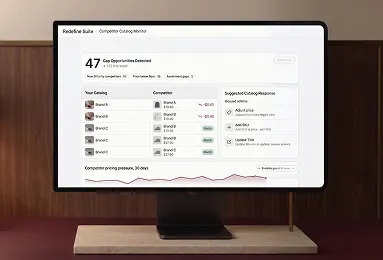
AI tracks competitor product launches, pricing changes, and assortment gaps. When a competitor adds a product you don't stock, or prices below your floor, Redefine flags the gap and suggests a catalog response. No manual monitoring needed.
Governed AI enrichment approvals
Every AI enrichment action goes through a configurable approval workflow. Auto-approve high-confidence changes. Route low-confidence edits to your merchandising team. Maintain a full audit trail of every AI action applied.
Platform architecture
Only possible because product information management, order management, and channels are one
Standalone catalog tools score completeness in isolation. Redefine scores revenue readiness because it can cross-reference live channel performance, order velocity, and marketplace eligibility rules at the same time.
Native product information management
data layer
AI reads the full product information management record: attributes, variants, digital assets, taxonomy path, and supplier metadata. No integration required. All data is already in one place.
LiveNo
extract-transform-load required
Channel performance signals
Catalog scores factor in live channel data: impressions, click-through rates, conversion, and suppression reasons from Amazon, Google, and your direct-to-consumer store.
Real-timeAll
channels
Order management system velocity
data
High-velocity stock-keeping units with poor catalog data are flagged as the highest-priority gap. The AI knows what is selling because the order management system is native, not polled via application programming interface.
Native Order ManagementPriority
scoring
AI processing
pipeline, live
Input
Supplier Feeds
Product information management + Images
AI Layer
Match + Dedupe
Confidence scored
AI Layer
Score + Rank
Revenue-impact order
AI Layer
Enrich + Generate
Content + Attributes
Review
Approval Queue
Human in the loop
Output
Published
All channels live
Proof it works
$120M in revenue. Catalog and data intelligence at scale.

Corporate
Gear
Live
Company
Corporate Gear
Corporate ApparelCorporate branded merchandise and apparel platform serving enterprise clients across North America.
The problem
Fragmented product data across a large stock-keeping unit catalog was limiting visibility, personalization, and conversion. Manual data operations could not keep pace with catalog growth or channel expansion.
The approach
Unified product data, automated enrichment workflows, and data-driven channel optimization. AI-powered testing and personalization aligned catalog data with buyer behavior across every touchpoint.
The result
$0
annual revenue at scale
Catalog data quality and automated operations enabled Corporate Gear to scale to over $120M in annual revenue while maintaining catalog integrity across every channel.
Why Redefine is different
No other platform connects catalog health to revenue impact
Other product information management tools measure completeness. Redefine measures what incomplete data is costing you. That difference is why other platforms generate reports while Redefine generates revenue-ready catalogs.
Completeness scores versus revenue-impact ranking
Other platforms score how complete a record is. Redefine scores how much revenue each incomplete record is blocking, and sorts the action list by dollar impact, not alphabetical order. Your team always fixes the most expensive gap first.
Other
tools: completeness percentage
Redefine:
revenue blocked
Visual attribute extraction is unique to Redefine
No competing product information management system has native visual AI that extracts attributes from product images. Other platforms require you to import attributes from a data sheet. Redefine reads the product itself. This eliminates the most time-consuming part of new product onboarding for most catalog teams.
Unique
capability
Platform-native AI versus bolted-on intelligence
Other platforms add AI as a module on top of a siloed data structure. Because Redefine's AI reads from a unified product information management, order management system, and channel layer simultaneously, its intelligence is structurally deeper. It knows what is selling, what is suppressed, and what is incomplete all at once.
Is this the right fit?
AI Catalog Intelligence works best for teams like these
Built
for you if...
You manage more than 5,000 stock-keeping units and catalog audits currently happen on a schedule, not continuously.
Your team writes product copy for each channel separately and the process takes more than 2 hours per stock-keeping unit.
You receive supplier feeds from multiple sources and reconciling them into a single record is a manual process.
Products are being suppressed on Amazon or Google Shopping and you don't have a systematic way to find and fix the cause.
Probably
not the right tool if...
Your catalog has fewer than 500 stock-keeping units and you sell on one channel only. The return on investment on automation at that scale is limited.
You need a standalone content writing tool with no catalog data layer. There are lighter tools built specifically for that use case.
You have no approval process requirement and want AI to publish changes directly without any human review step.
Not sure? Tell us your situation and we'll be straight with you. Share your details and we'll give you an honest recommendation.
Frequently asked questions
Real questions from catalog teams
A completeness score measures how many fields are filled in. A catalog health score measures how much revenue you are losing because of what is missing. Redefine cross-references your product information management record with live channel performance data, order velocity, and marketplace eligibility rules to calculate the actual revenue blocked by each data gap. That means your team works on the $14,000 problem before the $200 problem.
You control the approval policy per change type and per confidence threshold. High-confidence enrichments such as adding a missing Global Trade Item Number or populating a standard size field can auto-approve. Low-confidence edits such as rewriting a product title route to your merchandising queue for review. Every AI action is logged in a full audit trail regardless of approval path.
When a product image is attached to a product information management record, the AI analyses the image and extracts structured attributes: colour, material, style, finish, approximate dimensions, and product category cues. The extraction fires automatically on upload for JPG, PNG, WebP, and TIFF files. Extracted attributes are proposed as suggestions and mapped to your existing attribute schema before any field is updated.
Yes. Content generation templates are configured per channel with that channel's exact format rules, character limits, and keyword guidelines. You can generate and stage channel-ready content for a new marketplace before you activate the listing. When you go live, the content is already optimized and waiting. This is how teams launch on a new channel in days rather than weeks.
The AI compares product identifiers (European Article Number, Global Trade Item Number, Universal Product Code, Manufacturer Part Number), titles, descriptions, and image hashes across supplier feeds, your product information management records, and marketplace Amazon Standard Identification Numbers. Matches above a configurable confidence threshold are flagged as duplicates with a merge recommendation showing which record has the highest data quality. Your team reviews and confirms the merge. The system then consolidates the record and routes the authoritative version to all channels.
Related AI capabilities
AI Catalog Intelligence works alongside the full suite
AI Content Assistance
AI-generated content for campaigns, product pages, and email, informed by your catalog data and brand voice.
ExploreAI Product Data Enrichment
Bulk-enrich product information management records with structured attribute data sourced from your supplier feeds, images, and web sources.
ExploreAI Workflow Assistance
AI-powered routing and automation for catalog approval workflows, exception handling, and task assignment.
ExploreAI Marketplace Assistance
AI monitors listing health, detects suppression causes, and recommends fixes across every marketplace automatically.
ExploreAI Operational Intelligence
AI surfaces anomalies in order flow, inventory, and fulfillment before they become revenue problems.
ExploreAI and Automation Hub
The full AI layer for Redefine Commerce: every module, every use case, every integration point in one place.
View All AI ModulesGet started
See AI scanning your catalog
Tell us about your catalog and we'll show you exactly what the AI would find and what it would fix first.
What happens when you submit
1
We review your catalog scope within 24 hours
2
Live demo of AI scanning a sample of your catalog
3
Scoped proposal with implementation timeline in 3 days
4
Sprint 1 begins within 1 week of sign-off
Tell us about your catalog
Form
Call within 48 hours · catalog demo in 2 days · proposal in 3 days
Brief received
We'll review your catalog situation and send a scoped proposal within 3 business days. Expect a call from the team within 48 hours to confirm your brief and schedule a live demo.
Response
within 48 hours
Proposal
in 3 days
340+
catalog projects
You
own all data and intellectual property
No commitment. No pitch.
Your catalog is losing revenue today. Find out how much.
Submit your catalog brief and we'll show you the exact gaps the AI would surface, ranked by revenue impact. No commitment required. No sales pitch until you ask for one.
average stock-keeping units enriched per sprint
average catalog health score lift in 30 days
weekly catalog operations time saved per team
channels content generated simultaneously