AI and Automation
Your catalog enriched by AI that knows your data
AI product data enrichment that extracts attributes from specs, classifies taxonomy automatically, and scores every product for quality gaps. Approve suggestions and publish to every channel in one click.
Under 4 hours per week from your team
Governed enrichment: you approve before it publishes

The Real Cost of Manual Enrichment
From weeks of copy-paste to one-click publish
Manual catalog enrichment keeps your team stuck in spreadsheets while incomplete product data silently kills conversion on every channel you sell on.
Problem
Incomplete attributes kill listings
Products missing size, material, or spec fields get suppressed by marketplaces or buried in search. Your team finds out after the listing goes live.
Problem
Data entry drowns your team
Copying specs from PDFs and supplier sheets into product information manager fields takes hours per product. At scale, this becomes the bottleneck that delays every launch.
Problem
Taxonomy chaos breaks discovery
Products filed under the wrong category or missing taxonomy tags never surface in filtered search, faceted navigation, or channel-specific browse paths.
After AI Enrichment
Attributes extracted automatically
AI reads your specs, PDFs, and supplier sheets and populates every attribute field. You review and approve. Incomplete product data stops slipping through.
After AI Enrichment
Team effort cut to 4 hours per week
Your team approves AI suggestions instead of typing them. Bulk enrichment that took days now takes minutes, freeing your people for higher-value work.
After AI Enrichment
Taxonomy classified from day one
AI classifies every product into the right category and applies the correct taxonomy tags. Channel browse paths, filters, and marketplace feeds all receive clean, consistent data.

AI Enrichment by Role
How every team uses AI-powered enrichment
The same module serves different goals depending on who is using it. Switch between roles to see the exact workflows your team would run.
Merchandising team: launch-ready catalogs without the manual grind
Your team manages hundreds of new products every season. AI attribute extraction pulls color, size, material, and spec values directly from supplier PDFs so your team can review and approve rather than type.
- Bulk attribute extraction from PDFs, spec sheets, and images
- One-click approve and push to all connected channels
- Quality score per product so nothing launches incomplete
Your team spends roughly 4 hours per week reviewing AI suggestions and approving bulk publishes. We handle extraction, classification, and quality scoring.
Pending AI Suggestions47
items awaiting review
PRD-00441: Alpine Hiking BootQuality: 94%
Material: Full-grain leather (AI)
Sole: Vibram
OrthoLite (AI)
Category: Hiking
/ Trail (AI)
Weight: 520g (AI)
PRD-00442: Trail Running ShoeQuality: 71%
Material: Mesh
upper (AI)
Drop: Missing (Gap)
AI flagged: 2 required attributes
missing. Add manually or upload spec sheet.
Data operations: govern enrichment at scale without losing control
Data teams need audit trails, duplicate detection, and quality thresholds. Every AI suggestion is logged, scored, and requires approval before it reaches any channel.
- Duplicate detection and product deduplication across your catalog
- AI-driven data quality scoring with per-field confidence levels
- Full audit log of every AI suggestion, approval, and override
98.2%
Average Quality Score
14
Duplicates Found
3,241
Fields Enriched
AI suggestion approvedPRD-00441 · material · 2 min agoLogged
Override recordedPRD-00388
· color · 8 min agoOverride
Duplicate mergedPRD-00310 +
PRD-00087 · 15 min agoMerged
Channel manager: channel-ready data from the moment it is enriched
Approved enrichment syncs to every connected channel simultaneously. No copy-paste between tools. Marketplace attribute requirements are mapped and validated before publish.
- One-click publish to all channels after approval, no copy-paste
- Channel attribute mapping validated before data leaves the product information manager
- Visual image tagging auto-populates alt-text and search tags
Storefront
PublishedAmazon
PublishedWalmart
Pending: gtin missingB2B Portal
PublishedEcommerce director: AI that drives measurable operational savings
You need to see time saved, data quality lifted, and launch velocity improved. AI enrichment produces all three from day one, with full governance so you stay in control of every decision.
- Enrichment throughput metrics: fields processed, time saved, quality delta
- AI recommendations require human approval before any live change
- Launch velocity: new product to live channels in days, not weeks
12,840
Fields enriched this month
340h
Estimated team hours saved
97.4%
Average approval rate
4.2 days
Average item time-to-live
All AI changes require human approval before
publishing to any channel.
How AI Enrichment Works
From raw product data to channel-ready in days
Four governed steps take your unstructured product data and turn it into complete, consistent, publishable catalog records without removing your team from the loop.
Step 01
Ingest specs and documents
Upload PDFs, supplier sheets, images, or structured data files. The AI reads unstructured content and identifies all extractable product attributes automatically.
Step 02
AI extracts and classifies
Attributes are mapped to your product information manager schema. Taxonomy is classified against your category tree. Quality score is calculated per field with confidence levels flagged for review.
Step 03
Your team reviews and approves
Every AI suggestion sits in an approval queue. Your team reviews, edits, or approves individual fields or entire products in bulk. Nothing publishes without sign-off.
Step 04
Publish to every channel at once
One approval triggers a synchronized push to your storefront, marketplaces, business-to-business portal, and any other connected channel. No copy-paste. No re-entry. Just live.
Key Capabilities
Every enrichment capability your catalog needs
These are not bolt-on AI tools. They are built into the same product information manager, order management system, and channel infrastructure your team already uses, so approved enrichment moves through your full commerce stack automatically.
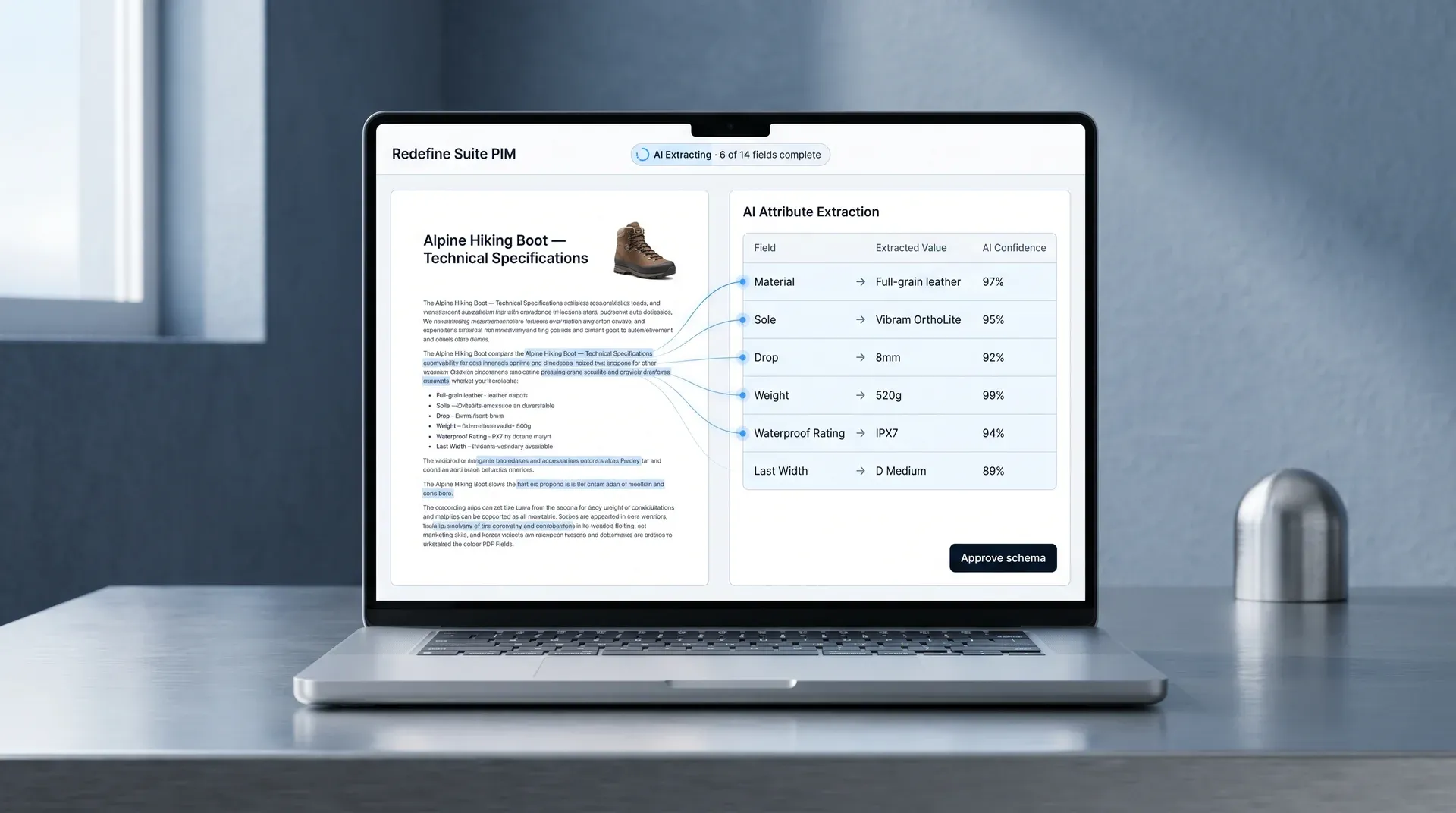
AI attribute extraction from specs and documents
Parse PDFs, data sheets, and raw text to pull structured attributes into your product information manager schema. Works across materials, dimensions, certifications, compatibility, and any custom fields you define.
Automated taxonomy classification
Products are matched to your category tree and tagged with the correct taxonomy. Consistent classification means better faceted search, cleaner channel feeds, and fewer manual corrections.
Duplicate detection and deduplication
AI identifies near-duplicate product records before they reach channels. Merge candidates are surfaced for team review so your catalog stays clean as supplier data volume grows.
AI-driven data quality scoring and recommendations
Every product receives a completeness and quality score. Missing required fields, low-confidence extractions, and inconsistent values are flagged with specific remediation suggestions your team can act on immediately.
A+
Complete
B
2 gaps
C
5+ gaps
Automated image tagging and visual attribute extraction
AI scans product images for visible attributes such as color, shape, style, and surface finish. Image alt-text and visual search tags are generated automatically and added to your product information manager record.
Supplier data normalisation and attribute standardisation
Incoming supplier sheets arrive with inconsistent units, casing, abbreviations, and value formats. AI maps every raw supplier value to your controlled vocabulary before it enters the product information manager — so "RED", "red", and "Rd." all resolve to the same canonical attribute value.
Raw
input
- Rd. · RED · red
- L · Lge · Large
- 10 in · 25.4cm
Normalised
output
- Red
- Large
- 25.4 cm
Approve once. Publish everywhere.
AI enrichment suggestions that are approved in your product information manager publish to every connected channel in one click. No copy-paste across tools. Storefront, marketplaces, business-to-business portal, and partner feeds all update from a single approval action. This is what sets governed AI apart from shallow enrichment bolted onto a standalone tool.
Proven in Production
Operational efficiency that scales revenue

Client
Sleek Shop
High-volume
retailA multi-marketplace retailer operating a complex catalog across dropshipping and direct inventory with high product velocity and frequent product data updates.
Operational Problem
Manual product data processes created visibility gaps across marketplaces. Inventory, product attributes, and channel listings required constant manual updates as product count grew, limiting the team's capacity to scale operations without adding headcount.
Result
$30M+
in annual revenue achieved through centralized, automated product data management. Operations became significantly more efficient through automation. Customer engagement improved through a faster, more seamless shopping experience with consistent product data across all channels.
AI and Automation Platform
Built into your commerce stack
AI enrichment is not a separate tool. It runs inside the same infrastructure as your product information manager, order management system, marketplace feeds, and workflow engine. Approved enrichment flows downstream automatically.
AI extraction engine
Reads PDFs, images, HTML, and raw text. Extracts structured values. Maps to your product information manager schema automatically.
Product information manager integration layer
Every enrichment result writes back to your product record. Field-level versioning and rollback at any point.
Channel publish layer
One approval triggers synchronized publish to storefront, marketplaces, business-to-business portals, and partner feeds simultaneously.
Governance and audit
Every AI action is logged. Full approval chain, override history, and confidence scores retained for every field on every product.
Input
Spec / PDF / Image
Process
AI Extraction
Process
Quality Score
Human step
Team Approval
Output
Live on All Channels
Best-Fit Use Cases
Who gets the most value from AI enrichment
Good Fit
- Distributors and manufacturers onboarding high volumes of supplier products regularly
- Teams selling across 3 or more channels who need consistent attributes everywhere
- Merchants with 1,000 or more items where manual enrichment creates launch bottlenecks
- Operations teams that need governed AI: suggestions that require human approval before publishing
- Brands managing seasonal catalog refreshes with unstructured supplier data in PDFs or spreadsheets
Not the Right Fit
- Catalogs of fewer than 200 items that rarely change. Manual entry is faster to set up.
- Single-channel businesses with no plans to expand. The multi-channel publish value does not apply.
- Teams that want fully automated publishing with zero human review. We require approval by design.
Not sure? Tell us your situation and we will be straight with you. Tell us your situation →
Why This Is Different
AI enrichment that is governed, connected, and practical
Other AI tools produce suggestions in isolation. You copy results manually into your product information manager, your listings, your channel tools. Every approval is a separate step in a separate system. Here, it is one step and it moves your entire stack.
Governed by design
Every AI suggestion requires human approval. Your team stays in control of what reaches any channel. Overrides and approval history are logged per field, per product, forever.
Other tools: AI publishes automatically or requires manual copy-paste to apply results elsewhere
Connected to your full stack
Enrichment data does not live in a silo. An approved suggestion writes to your product information manager, triggers downstream channel sync, and updates marketplace listings without additional steps from your team.
Other tools: enrichment output stays in the tool; your team manually re-enters it elsewhere
Practical, not a showcase
You see specific use cases: attribute extraction, taxonomy classification, quality scoring, image tagging, and one-click publish. Not a demo of AI potential. An operational module your team uses on day one.
Other tools: AI positioned as a future roadmap feature, not a working module today
Related AI Modules
Enrichment is one part of the AI suite
All modules run in the same platform. Data enriched here feeds directly into content assistance, marketplace optimization, and workflow automation without extra configuration.
AI and Automation Hub
All AI modules in one place: enrichment, content,
workflow, marketplace, and governance.
AI Content Assistance
Generate product descriptions, search engine optimization
copy, and alt-text grounded in your enriched product information manager data.
AI Workflow Assistance
Route enrichment tasks, approvals, and downstream actions
through automated workflow logic.
AI Marketplace Assistance
Use enriched product data to optimize listings, fix
rejections, and improve marketplace ranking automatically.
AI Operational Intelligence
Surface enrichment throughput, quality trends, and
catalog health insights from your live data.
Product Data Enrichment
Manual and assisted enrichment workflows, task
assignment, and progress tracking inside the product information manager.
Frequently Asked Questions
Objections we hear before teams decide to move forward
It replaces the manual work, not the team. Your data team shifts from typing attributes to reviewing AI suggestions and approving bulk publishes. The cognitive workload drops significantly while the quality outcome stays human-supervised. No new tool ecosystem to manage. It runs inside the same platform as your product information manager.
Nothing publishes automatically. Every AI suggestion sits in an approval queue. Low-confidence fields are flagged separately so your team knows to look closely. If a suggestion is wrong, your team edits it before approving. Overrides are logged and feed back into the model's confidence scoring going forward.
The AI enrichment module works best when it runs on the same platform as your product information manager, order management system, and channel management because the one-click publish capability depends on those connections. If you are evaluating a product information manager migration, this module is part of the broader case for consolidation. We can scope what a phased approach would look like for your situation.
The automated image tagging and visual attribute extraction module handles image-only products. It scans images for visible attributes such as color, texture, shape, and form factor and populates relevant fields. Quality scoring will flag confidence levels so your team knows which image-derived attributes need a second look.
Yes. Channel publish targets are configurable at the approval step. You can approve and push to all connected channels in one click, or approve and hold for specific channels while you complete additional marketplace-specific validation. Channel attribute requirements are validated before publish so errors do not reach live listings.
Get a Scoped Proposal
Tell us your catalog situation and we will be straight with you
Submit your brief and we will review your product data operation, identify where AI enrichment would save the most time, and send a scoped proposal within 3 business days.
1
Submit your brief: describe your catalog
situation and current enrichment process
2
Call within 48 hours to confirm fit and
scope
3
Scoped proposal delivered in 3 business
days
4
Sprint 1 begins within 1 week of
sign-offSubmit Your Brief
Brief received
We will review your catalog situation and send a scoped proposal within 3 business days. You will receive a call within 48 hours to confirm fit and scope.
form
No commitment. No pitch. Call within 48 hours · proposal in 3 days.
Call within 48 hours
Proposal in 3 days
500+ projects completed
You own all code and data
See AI Enrichment in Action
Your catalog enriched and channel-ready in days, not weeks
Book a live walkthrough of the AI enrichment module on your own product data. See attribute extraction, quality scoring, and one-click publish in one session.