Audit Trail Software
Every change. Every user. One searchable log.
Redefine's audit trail software captures every action across your entire commerce stack: product updates, order approvals, content publishes, and listing changes. All in one unified, searchable log.

The Hidden Cost of Scattered Logs
Fragmented audit trails slow every investigation.
When change history is split across five systems, finding who modified a price, approved a quote, or published a page takes hours. Redefine consolidates all of that into one log.
Five separate logs
Product information management has one log, order management system has another, content management system a third. No single view of who changed what.
High frictionHours to investigate
A single pricing error triggers a cross-system forensic exercise. Teams spend 4 to 6 hours per incident.
Time lostCompliance gaps
Auditors ask for a change record. You can only produce partial exports from disconnected systems.
Audit riskOne unified log
Every module writes to the same audit trail. Search by user, record, date, or action type across your entire platform.
Full visibilitySeconds to find answers
Filter by user, timestamp, record type, and before/after value. Any change found in under a minute.
Instant resultsAudit-ready exports
Export structured event logs for your Security Information and Event Management or compliance team in one click. No manual assembly.
Compliance-ready
How It Works
From action taken to audit record in milliseconds.
Every user action across product information management, order management system, content management system, marketplace, and program stores writes a structured event to the unified audit log. Click any node to see how each module feeds the trail.
Product Information
Management: product data
changes
Field edits, bulk imports, attribute changes, category reclassifications.
Order Management System: order
and fulfillment
events
Quote approvals, order status changes, price overrides, fulfillment modifications.
Content Management System:
content publishes and
edits
Content drafts, approval gate passages, publishing actions, rollback events.
Marketplace: listing
changes
Listing updates, price syncs, channel enable/disable, feed modifications.
Access and permissions
changes
Role assignments, permission template changes, login history, session tracking.
Select a module to see its audit trail record
Recent events across platform
PIM: SKU-1089 price
updated
2 min
agoOMS: Quote Q-4421
approved
7 min
agoCMS: Blog post
published
12 min
agoMarketplace: Amazon
listing updated
18 min
ago
Product Information Management Audit Record
Event typeField update
RecordSKU-1089: Winter Jacket
XL
Fieldsale_price
Before$89.00
After$74.99
Timestamp2026-05-19 ·
09:42 UTC
Order Management System Audit Record
Event typeQuote approval
RecordQuote #Q-4421
CustomerAcme Corp, Account #8821
BeforePending review
AfterApproved
Approved by[email protected]
Timestamp2026-05-19 ·
09:35 UTC
Content Management System Audit Record
Event typeContent publish
ContentSummer Sale Landing Page
Stage passedApproval gate 2 of 2
BeforeDraft
AfterLive
Published by[email protected]
Timestamp2026-05-19 ·
09:30 UTC
Marketplace Audit Record
Event typeListing price sync
ChannelAmazon: US Marketplace
SKUWJ-XL-BLK-US
Before$89.00
After$74.99
Triggered bySystem auto-sync (PIM change
#9981)
Access Control Audit Record
Event typeRole assignment change
Before roleMerchandiser (read-only)
After roleMerchandiser (write)
Changed by[email protected]
Timestamp2026-05-19 ·
08:55 UTC
Security Information and Event
Management export active:
streaming to your security stack
What You Get
Every capability your compliance team needs,
Every capability your compliance team needs,
built into one connected layer.
Five core capabilities that work together across your entire ecommerce stack. Each one ships configured for your systems, not bolted on as an afterthought.
Immutable Event Logging
Every change to every record, across every connected system, written once and never altered. Timestamps, user identifiers, before-and-after field values, system source, and session context captured in a tamper-evident ledger. No patch can rewrite it. No admin override can delete it. The log is the source of truth.
Cross-System Query Engine
Search any event, any field, any time window across all connected platforms in a single query. Filter by user, system, record type, or change category. Export findings to your compliance team or legal counsel in seconds.
Role-Based Access Controls
Define who can view, export, or act on audit data. Granular permission tiers for finance, operations, security, and executive stakeholders. Every access event is itself logged, so the audit trail audits itself.
Compliance Report Generation
Pre-built report templates aligned to SOC 2, International Organisation for Standardisation 27001, and Payment Card Industry standards. Run an audit-ready package for any date range with one click. Formatted for external auditors, not just internal dashboards.
Real-Time Anomaly Alerts
Configurable rule sets that fire an alert the moment a suspicious pattern appears: bulk deletions, off-hours admin access, permission escalations, price changes above a defined threshold, failed login sequences. Alerts route to Slack, email, or your security stack. You catch the incident before it becomes a breach report.
Case Study
From audit-failure risk to clean compliance in 90 days.
A Business-to-Business wholesale brand running Shopify Plus, Dynamics 365, and a custom Order Management System could not produce a coherent change log when their SOC 2 auditor asked for one. Here is what happened next.

The situation
A 120-person Business-to-Business wholesale brand came to us three weeks before a SOC 2 Type II audit. Their Shopify Plus store, Dynamics 365 order management module, and a legacy custom Order Management System each had their own logs: in different formats, on different retention schedules, with no cross-system correlation. The auditor needed a unified change record. The team had none.
What we built
We connected all three platforms to a unified audit layer within the first two weeks. Every change event normalised to the Open Cybersecurity Schema Framework schema, enriched with user context and correlated across systems. The SOC 2 auditor received a clean, exportable change log covering the full 12-month review period on day one of fieldwork.
0%
Audit findings related to missing evidence
0 days
From kick-off to first unified log available
3
Legacy systems unified under one query interface
"Our auditor told us it was the cleanest evidence package they had received from a company our size. That would not have been possible without the unified audit layer Redefine built."
Related Services
Security Integration
Feeds your Security Information and Event Management stack without any extra work.
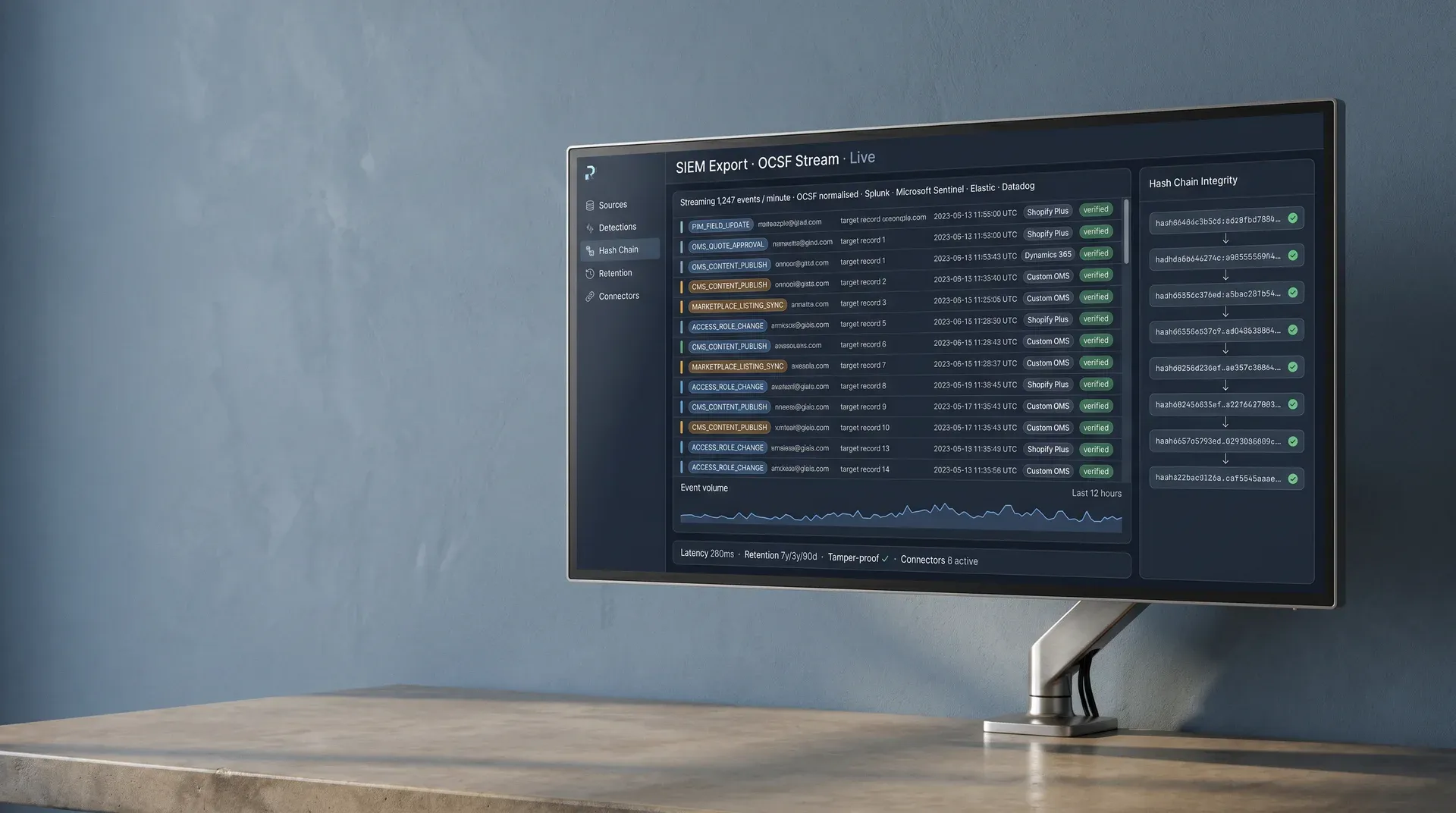
The audit layer normalises every ecommerce event to the Open Cybersecurity Schema Framework and streams it in real time to your security platform. Your Security Information and Event Management tool gets richer ecommerce context. Your security team stops chasing down platform-by-platform logs.
Real-Time Event Streaming
Events stream to your security stack within seconds of occurring. No nightly batch jobs. No morning lag. Incidents surface in your Security Information and Event Management dashboard as they happen.
Open Cybersecurity Schema Framework Normalisation
Every ecommerce event mapped to a consistent Open Cybersecurity Schema Framework taxonomy before it reaches your security platform. Splunk, Microsoft Sentinel, Elastic, and Datadog all receive data in a schema they already understand.
Platform Connectors Ready to Use
Pre-built connectors for Shopify, Shopify Plus, Dynamics 365, Salesforce Commerce Cloud, Adobe Commerce, BigCommerce, and custom Order Management Systems. Configuration, not custom code, for every supported platform.
Application Programming Interface and Webhook Delivery
Every audit event available via a versioned Application Programming Interface and webhook delivery endpoint. Feed your data warehouse, your security platform, and your compliance tooling simultaneously from one stream.
Retention Policies Per Data Type
Configurable retention periods per event category. Financial records on a seven-year schedule. Access control logs on a three-year schedule. Short-lived session data on a 90-day schedule. Each policy enforced automatically with no manual archiving process.
Immutable Storage with Cryptographic Verification
Audit records are written once to immutable storage and signed with a cryptographic hash chain. Any tampering attempt breaks the chain. Your legal team can verify the integrity of any record without trusting your infrastructure team's word for it.
How We Compare
Built for ecommerce operations. Not retrofitted from a generic compliance tool.
Most audit tools are built for enterprise IT. They capture server events and system calls. They do not understand a Shopify order, a Dynamics 365 quote approval, or a Product Information Management bulk-update. We do.
CapabilityGeneric Audit ToolsRedefine Audit Trail
Ecommerce platform event capture (Shopify,
BigCommerce, Adobe
Commerce)Partial or requires custom
code
Enterprise Resource Planning and Order
Management System change
capture (Dynamics 365, custom Order Management Systems)Rarely supported out of the
box
Cross-system event correlation (link a price
change in the
Product Information Management to the downstream order in the
Order Management System)Not available
Open Cybersecurity Schema Framework
normalisation and Security
Information and Event Management exportVaries by vendor
Pre-built SOC 2, International Organisation
for Standardisation
27001, and Payment Card Industry report templatesGeneric templates only
Implementation configured for your specific
stack, not a
self-service integrationSelf-service with
documentation
Who It Is For
The right fit, and the honest answer about when it is not.
Audit trail infrastructure is not the right investment for every ecommerce operation. Here is a straight answer about where it fits.
Good Fit For
- Brands operating under SOC 2, International Organisation for Standardisation 27001, or Payment Card Industry compliance requirements who need audit-ready evidence packages on demand.
- Operations teams of 30 or more people where multiple staff members can make changes to pricing, inventory, access permissions, or order records across different platforms.
- Companies running two or more connected platforms (for example, Shopify plus Dynamics 365, or BigCommerce plus a custom Order Management System) where cross-system traceability is currently impossible.
- Finance and legal teams who regularly face the question "who changed this, and when?" and currently cannot answer it quickly or confidently.
- Businesses preparing for acquisition due diligence, external audit, or regulatory review where a clean change history is a material requirement.
Not a Fit If
- You are a solo operator or a team of three or fewer people where a single person makes most changes and accountability is managed through direct conversation rather than system records.
- You only need a one-time log export for a single audit and have no ongoing compliance requirement. A point-in-time export from your existing platforms may be sufficient.
- Your entire operation runs on a single platform with no integrations. That platform's native audit log may be adequate for your current compliance level.
- You are pre-revenue or in early beta. Invest in audit infrastructure once your stack is stable and your compliance requirements are clear.
Not sure where you land? Tell us your situation and we will give you a straight answer.
Frequently Asked Questions
Straight answers to the questions we hear most.
We connect via read-only webhooks, event subscriptions, and Application Programming Interface integrations where available. Nothing writes back to your source systems. The audit layer is a listener, not a participant. Connection is non-destructive: your platforms continue operating normally while every event is forwarded to the audit layer in real time. For platforms without native event streaming (certain legacy Order Management Systems, for example), we use periodic delta polling with a sub-five-minute window, which your operations team will not notice. Configuration typically takes two to four weeks depending on the number of platforms and the complexity of custom fields that need to be captured.
Immutable means the record cannot be altered after it is written, including by us. Records are written to append-only storage and signed with a cryptographic hash chain. Any modification to a stored record would break the hash chain, which is detectable by any party with access to the verification key. We do not hold a master key that bypasses this. If a record is incorrect (for example, a platform sent us a malformed event), we write a correction record alongside the original. Both records are visible. The original is never deleted. This architecture is the basis on which audit findings can be contested or verified by an external party, including your legal counsel, without relying on our word.
No. The audit layer sits upstream of your Security Information and Event Management tool. It captures, normalises, and enriches ecommerce events that your Security Information and Event Management tool currently cannot parse or does not receive. Those events are then forwarded to your Security Information and Event Management platform in Open Cybersecurity Schema Framework format, where your existing detection rules, dashboards, and alert logic continue to apply. You get richer ecommerce context inside the tools your security team already operates. You do not have to replace or retrain for a new security platform.
The build engagement is scoped before any commitment. We review your platform footprint, the number of event categories you need captured, your retention requirements, and your compliance targets. We then produce a line-item proposal with a fixed build fee covering implementation, configuration, and a 30-day post-launch support window. Ongoing infrastructure costs depend on event volume and retention period. We present this as a separate figure so you can see build cost and run cost independently. There are no undisclosed platform fees. Submit your brief using the form below and we will produce a scoped proposal within three business days.
The query engine lets you define any time window, any event category, any user or system, and export the results as a structured data file or a formatted report. For legal proceedings, we can produce a hash-verified export package that includes the cryptographic integrity proof alongside the data, so the receiving party can confirm the records have not been altered. For acquisition due diligence, the compliance report templates produce auditor-formatted packages aligned to the standards the acquiring party's team will check against. Export is self-service for standard queries. For complex legal export packages, we provide a one-time assisted export service included in the post-launch support window.
Get a Scoped Proposal
Tell us what you are tracking, and we will scope exactly what it takes to capture it.
No vague scoping calls. Submit your brief and receive a line-item proposal within three business days.
Form
48-hour response
We call within 48 hours of your brief
3-day proposal
Scoped, line-item, no vague estimates
180+ integrations built
Across Shopify, Dynamics 365, and custom stacks
You own the code
Full handoff, no vendor lock-in
The Audit-Ready Operation
Stop answering "who changed that?" with a shrug.
Every change that happened across your ecommerce operation, traceable in seconds. Your next SOC 2 audit package, ready before the auditor asks.