Data quality software that stops revenue loss from invisible product data problems
Most data quality software tells you a product is incomplete. Redefine tells you which incomplete products are currently suppressed on Amazon, what revenue they would generate if fixed, and which team member owns the gap.

Your completeness score looks fine. Your revenue does not.
- Product information management shows 87% completeness. No one knows which 13% is causing channel suppression.
- Enrichment team fixes attributes, but no one sees whether the fix restored the listing.
- Syndication errors appear in a separate tool. Revenue impact lives in a different one. Nobody joins the dots.
- Weekly pim reporting takes hours of manual export and spreadsheet joins from three platforms.

- Every incomplete product shows its downstream impact: which channel suppressed it, how long, estimated revenue lost.
- Enrichment task completion feeds directly into listing recovery tracking. Closed loop, one view.
- Product information management score, syndication error rate, and channel revenue live in a single data quality dashboard by product and by channel.
- Scheduled reports go out automatically. No exports, no manual joins, no waiting for someone to pull the data.
See exactly what changes when data quality improves
Toggle between a catalog with quality problems and one where those problems are fixed. The numbers you care about move in the right direction.
| Product | Score | Missing Attributes | Suppressed On | Revenue Impact | Owner |
|---|---|---|---|---|---|
| Classic Oxford Shirt #4421 | 52% | Size guide, care label | Amazon, Walmart | $3,200/month | Sarah M. |
| Linen Blazer #8830 | 68% | Material composition | Amazon | $1,800/month | James K. |
| Summer Dress #2207 | 44% | Images, description, size | Amazon, Etsy, Walmart | $4,600/month | Priya S. |
| + 44 more suppressed products... | |||||
| Product | Score | Missing Attributes | Status | Revenue Restored | Owner |
|---|---|---|---|---|---|
| Classic Oxford Shirt #4421 | 97% | None | Live | $3,200/month | Sarah M. |
| Linen Blazer #8830 | 96% | None | Live | $1,800/month | James K. |
| Summer Dress #2207 | 91% | None | Live | $4,600/month | Priya S. |
| + 6 more products with active quality alerts (assigned, in progress)... | |||||
Four capabilities that turn data quality into channel revenue
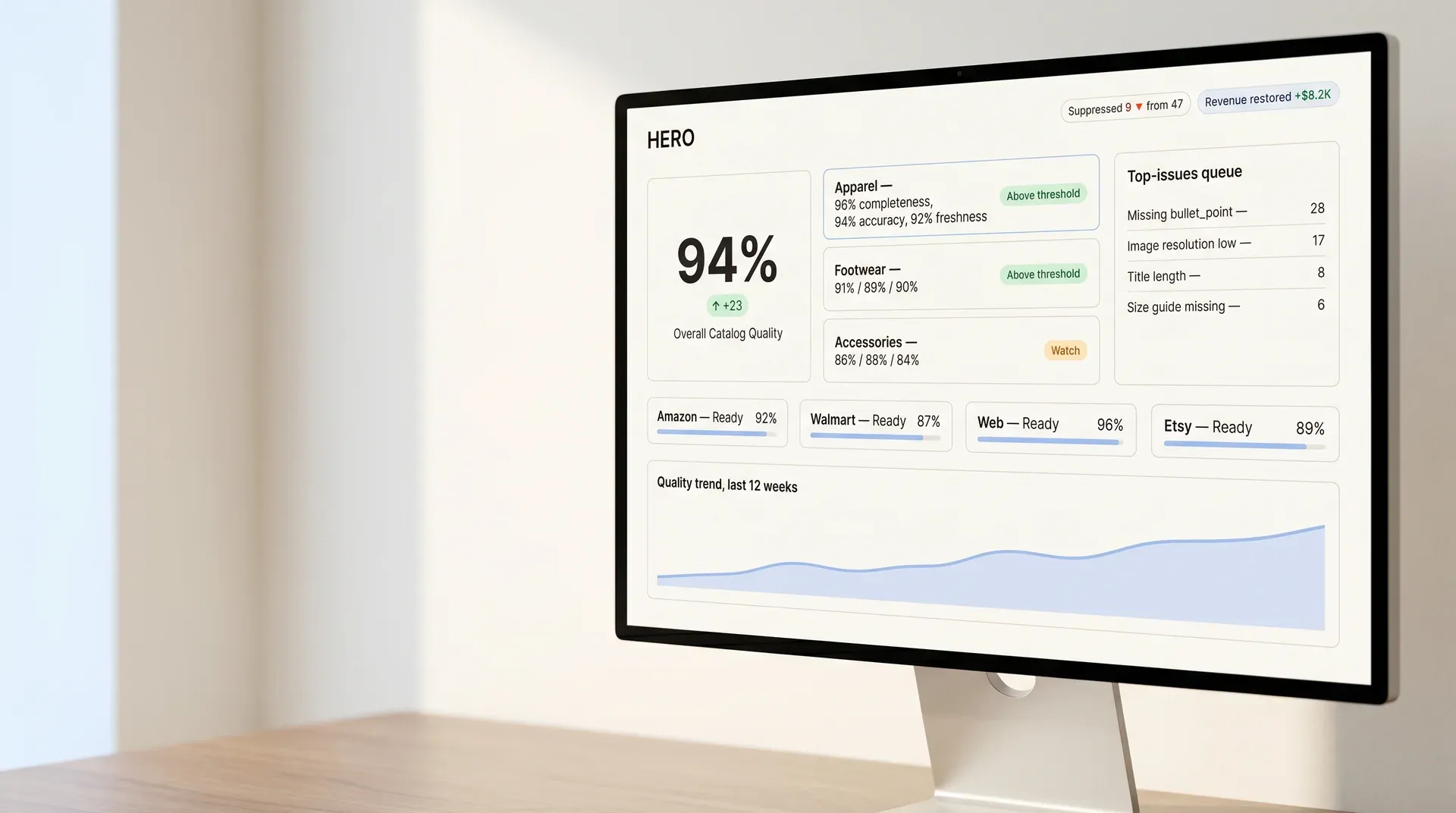
Product completeness and data quality dashboard
Every product in your catalog gets a structured quality score across required attributes, images, descriptions, and channel-specific rules. Scores update as enrichment tasks complete. Filter by category, channel, or team member to prioritize the highest-impact gaps first.
- Score by channel rule set, not just generic completeness
- Real-time updates as enrichment tasks close
- Threshold alerts when scores drop below channel minimums
Enrichment progress and task completion tracking
See how much of the current enrichment sprint is complete, who owns outstanding tasks, and which completions have already restored live listings. Sprint views give team leads a clear picture of velocity and backlog without chasing status updates.
- Per-person task completion rate and velocity
- Link from completed task to restored listing confirmation
- Sprint-over-sprint trend reporting
Syndication success and error rate reporting
Track what percentage of your catalog syndicated successfully to each channel, which products triggered feed errors, and what type of error stopped them. Error categories map to the exact product information management attribute missing, so the fix is visible alongside the failure.
- Success rate by channel and by product category
- Error taxonomy linked to specific missing attributes
- Trend view: error rate over the last 12 syndication runs
Product data quality software that shows downstream revenue impact
Other data quality software stops at completeness. Redefine connects low data quality scores to the exact revenue they are costing you: poor product information management score leads to suppressed listing leads to lost revenue, all in one view. This is only possible because product information management, marketplace, and commerce share one unified data layer.
- Revenue attribution per suppressed product, not just error count
- Unified data layer: no extract-transform-load, no middleware, no sync lag
- Governance and attribute coverage reports with ownership mapping
Proof that data quality software pays for itself

One data layer. No sync required.
Other platforms stitch together product information management, marketplace, and analytics with API calls and scheduled syncs. Redefine stores all of it in a single data layer. When a product attribute changes in product information management, the channel feed and the quality score update immediately. No pipeline, no delay.
Product information management attributes, marketplace feeds, order revenue, and enrichment tasks all live in the same data store. No sync. No middleware. No lag.
Mandatory field enforcement, validation rules, and attribute coverage reports give data governance teams a clear picture of what is required, what is missing, and who is accountable.
Automated reports deliver the right metrics to the right roles. Executives see revenue impact. Operations teams see task queues. Channel managers see suppression counts and error types.
Other pim data quality tools show completeness. Redefine shows revenue.
| Capability | Typical product information management platform | Redefine |
|---|---|---|
| Product completeness score | ||
| Enrichment task tracking | Limited | |
| Syndication error tracking | Separate tool | |
| Channel suppression visibility | Not available | |
| Revenue impact per suppressed product | Not available | |
| Unified data layer (no extract-transform-load or sync) | Separate platforms |
Who gets the most out of pim reporting
Brands selling on multiple channels
You need to know which products are live on which channels, which are suppressed, and what fixing each gap is worth in recovered revenue each month.
Product data and enrichment teams
You manage sprints of enrichment work and need to show the business what that work is actually restoring in terms of live listings and recoverable revenue.
Merchandising and ecommerce operations
You are responsible for catalog health across the entire assortment and need a governance view that shows attribute coverage, ownership, and compliance by category.
Executives tracking catalog return on investment
You want a single number: how much revenue is currently locked up in suppressed listings, and what is the trend week over week as the enrichment team works through the backlog.
Teams migrating from standalone product information management
You are moving off a point-solution product information management platform and need to demonstrate that the new product data quality software gives you more than completeness scores. It gives you actionable revenue data.
Agencies managing client catalogs
You manage pim data quality on behalf of clients and need pim reporting that proves your enrichment work's commercial value in terms that the client's finance team understands.
Questions before you go further
Other product information management platforms measure whether your product data is filled in. Redefine connects that completeness score to whether the product is actually live on each channel, how long it has been suppressed, and how much revenue that suppression has cost you. The insight is not "this product is 52% complete." It is "this product's missing attributes have suppressed it on Amazon for 14 days, costing an estimated $3,200 in lost revenue."
No. Data quality software is built into the Redefine platform. Because product information management, marketplace, and commerce all share one data layer, quality scores, syndication errors, and revenue data are all available in the same dashboard without any extract-transform-load pipeline, middleware, or third-party analytics tool.
Suppression tracking covers any channel your catalog syndicates to through Redefine: Amazon, Walmart, Etsy, and other marketplace and retail feed destinations. The specific channels visible in your dashboard depend on which integrations are active in your account.
Yes, and it goes significantly further. The platform delivers scheduled automated reports to the right roles, replaces manual export-and-join workflows, and adds the revenue attribution layer that spreadsheets cannot provide. Most teams see reporting preparation time reduce by 40% or more in the first sprint.
Submit your brief, we will call within 48 hours, deliver a scoped proposal in 3 days, and Sprint 1 begins within 1 week of sign-off. Most teams are seeing live quality dashboards within the first sprint. Your team's required time investment is 2 to 3 hours per week.
Tell us what your team needs from data quality reporting
We will review your catalog situation and send a scoped proposal within 3 business days. No commitment required to receive it.
Submit brief · call within 48 hours · scoped proposal in 3 days · Sprint 1 within 1 week of sign-off
Call within 48 hours · Proposal in 3 days · Sprint 1 in 1 week of sign-off
See the revenue your product data is leaving on the table
In one session, we will show you what our data quality software and its data quality dashboard look like for your actual catalog: suppressed listings, enrichment gaps, and the revenue estimate tied to each one. No commitment. No pitch.
No commitment. No pitch.
Submit brief · call within 48 hours · scoped proposal in 3 days · Sprint 1 within 1 week of sign-off