
A software discovery phase typically takes 4 to 6 weeks for a mid-market project in 2026, with the full range running from 2 weeks for a narrowly scoped feature build to 12 weeks or more for enterprise ERP and AI programs. That estimate covers structured discovery work only, not the vendor selection and procurement cycle that usually happens before it starts, which can add several more weeks to the calendar than the phase itself.
- A software discovery phase typically takes 2 to 12 weeks depending on project scope in 2026.
- Mid-market ecommerce and custom software projects average 4 to 6 weeks of discovery.
- Enterprise ERP and AI programs run 8 to 12 weeks because of data mapping and stakeholder count.
- Skipping discovery to save time usually adds cost later through scope changes and rework.
- Redefine Innovations scopes discovery as a fixed engagement tied to the project type, not an open-ended workshop.
Why this matters
A discovery phase sets the fixed price, the scope document, and the go-live date for everything that follows it. Get the timeline wrong at this stage and you inherit that error through the entire build.
Redefine Innovations scopes discovery as a defined engagement with a start date and an end date, not an open-ended workshop that drags because nobody owns the decision to close it. CIOs, CTOs, and ecommerce directors comparing vendors should treat discovery length as a signal: a vendor that cannot tell you how long discovery will take probably cannot tell you how long the build will take either.
How long does a software discovery phase take?
Discovery duration tracks directly with project scope, stakeholder count, and how much legacy system data needs to be mapped before development starts. The table below breaks out typical ranges by project type for 2026.
| Project type | Typical discovery duration | Best for |
|---|---|---|
| Scoped feature or integration project | 2 to 3 weeks | Single system add-on, small stakeholder group |
| Mid-market ecommerce or custom software platform | 4 to 6 weeks | Multi-team replatform or new build |
| Enterprise ERP (Dynamics 365, NetSuite alternative) | 8 to 12 weeks | Multi-department rollout, complex data migration |
| AI or automation pilot scoped for production | 3 to 5 weeks | Model scoping, data readiness assessment |
A software discovery phase that runs longer than 12 weeks usually signals unresolved stakeholder disagreement, not thoroughness.
Scoped feature project discovery: 2 to 3 weeks
A scoped feature or single-system integration project takes 2 to 3 weeks of discovery because the stakeholder list is short and the data model is already known. This tier fits projects like adding a payment gateway, building a single API integration, or extending an existing ecommerce storefront.
At this scope, discovery mostly confirms requirements and technical constraints rather than uncovering new ones. Verdict: fast-track this tier, a discovery phase over 3 weeks here is over-scoped.
Mid-market platform discovery: 4 to 6 weeks
A mid-market ecommerce rebuild or custom software platform runs 4 to 6 weeks of discovery because it usually touches multiple teams: operations, finance, and customer service all have requirements that need documenting before development starts. This is the range most Shopify, BigCommerce, and Adobe Commerce replatform projects fall into.
Companies weighing whether to build a custom platform instead of buying an off-the-shelf tool should read the trade-offs before committing to a discovery scope; see is custom software worth it for a mid-market business for the cost and risk comparison. Verdict: budget 6 weeks, not 4, if more than three departments are involved.
Enterprise ERP discovery: 8 to 12 weeks
An enterprise ERP discovery phase, whether the project is a Microsoft Dynamics 365 implementation or a migration off NetSuite, takes 8 to 12 weeks because it requires a full audit of financial data, integration points, and role-based access requirements across departments. Data migration complexity is the single biggest driver of length at this tier.
Teams evaluating ERP options as part of this process often compare platforms before discovery even starts; see NetSuite alternatives in 2026 for a platform-level comparison. Verdict: treat anything under 8 weeks for enterprise ERP discovery as a red flag, not a shortcut.
Why discovery timelines vary
- Stakeholder count. More departments means more requirements sessions and more conflicting priorities to resolve before scope is final.
- Legacy system complexity. Old databases, undocumented customizations, and manual workarounds all add mapping time.
- Integration count. Every third-party system (payment processor, CRM, warehouse management) adds a technical dependency to document.
- Data migration volume. Historical order, inventory, and customer data need to be assessed for quality before a migration plan can be written.
- Procurement and approval structure. Enterprise buyers with multi-stage sign-off add calendar time even when the technical work is done.
- Whether AI or automation is in scope. Model scoping and data readiness assessments run as a parallel workstream and can extend the phase by 1 to 2 weeks.
What happens during a software discovery phase?
A structured discovery phase moves through the same core steps regardless of project size, just at different depth. Stakeholder interviews come first, followed by a technical and data audit, then a documented scope and a fixed-price proposal.
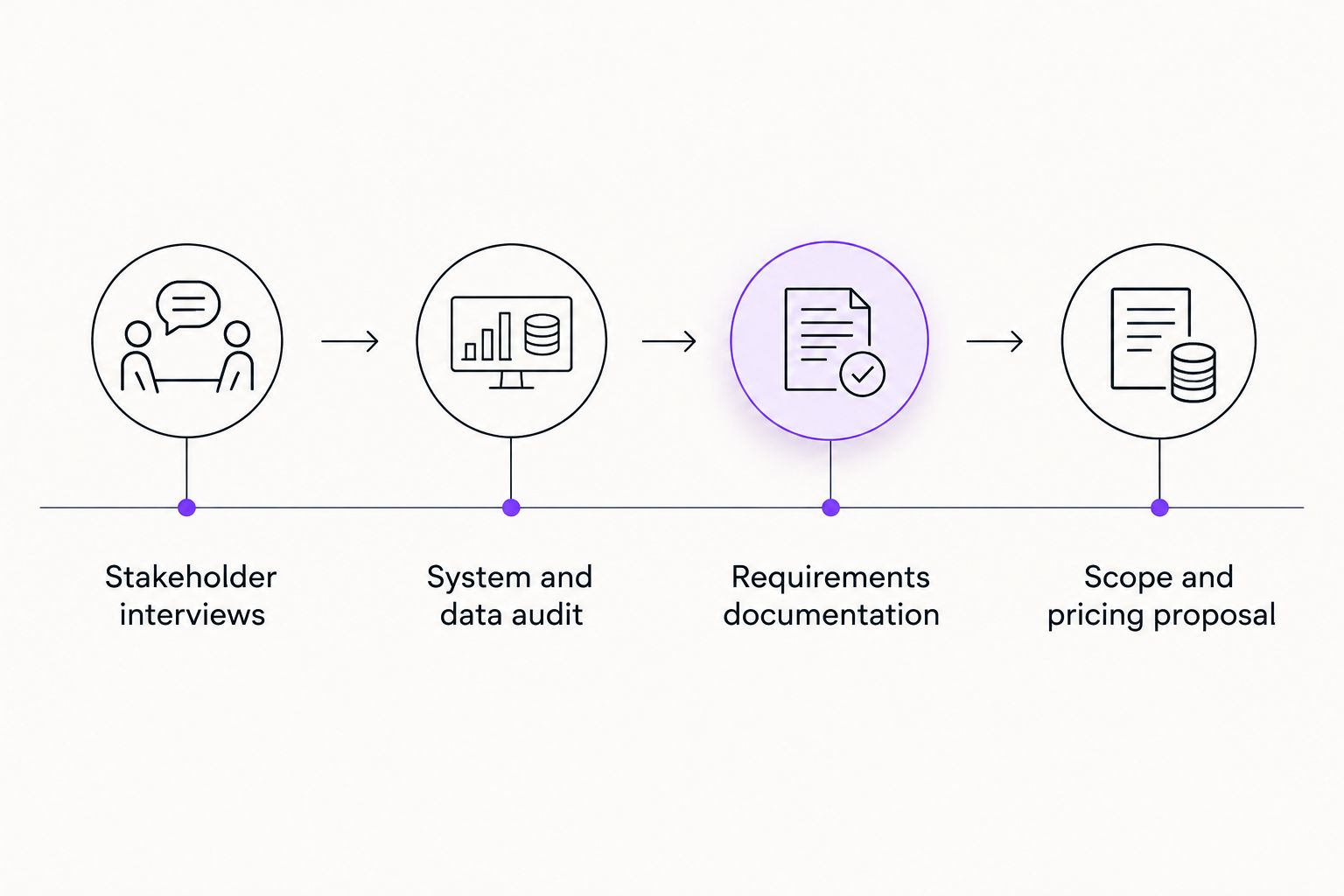
The output of a well-run discovery phase is a written scope document and a fixed price, not a slide deck. If a vendor's discovery phase ends without either, the phase did not actually finish.
“A discovery phase that skips the data audit isn't discovery, it's a guess with a start date.”
Is a paid discovery phase worth it?
A paid discovery phase is worth it for any project involving more than one system integration or more than 4 to 6 weeks of estimated build time. The fixed scope and price it produces protect both sides from change orders that come from requirements nobody wrote down.
What comes after discovery?
After discovery closes, the project moves into a scoped build phase governed by the documented requirements and the fixed price set during discovery. Projects that skip a formal discovery close usually see their build timeline extend by weeks once undocumented requirements surface mid-build.
Scope your discovery phase
Get a fixed-scope discovery timeline for your project.
Frequently asked questions
How long does a software discovery phase typically take?
A software discovery phase typically takes 4 to 6 weeks for a mid-market project in 2026, ranging from 2 weeks for a scoped feature build to 12 weeks for enterprise ERP or AI programs. The exact length depends on stakeholder count and data migration complexity.
What is included in a software discovery phase?
A discovery phase typically includes stakeholder interviews, a technical and data audit, a documented requirements list, and a fixed-price scope proposal. It ends with a written scope document, not just a presentation.
Is a paid discovery phase worth it?
A paid discovery phase is worth it for any project with more than one system integration or a build estimated over 4 to 6 weeks. The fixed scope it produces prevents change orders from undocumented requirements.
How long does ERP discovery take compared to custom software discovery?
ERP discovery takes 8 to 12 weeks, longer than the 4 to 6 weeks typical for a mid-market custom software platform, because ERP projects involve financial data audits and multi-department role mapping.
Can a discovery phase be shortened?
A discovery phase can be shortened when the stakeholder list and integration count are small, but compressing an enterprise-scale discovery below 8 weeks usually pushes unresolved requirements into the build phase instead.
What happens if a company skips discovery entirely?
Skipping discovery entirely usually means the build starts against an undocumented scope, which leads to change orders and timeline extensions once requirements surface mid-project.
Does an AI or automation project need its own discovery phase?
An AI or automation project typically needs a 3 to 5 week discovery phase to assess data readiness and scope the model, separate from any broader platform discovery running alongside it.
One last thing
The most common discovery phase delay in 2026 is not technical complexity, it is unclear ownership of the sign-off decision on the client side. Projects with a single named decision-maker close discovery on schedule far more often than projects run by committee, regardless of platform or industry.
If you are scoping a project against one of the ranges above, get the stakeholder list and sign-off authority settled before the discovery phase starts, not during it.
Growth & strategy insights, no fluff
One short email a month on integration, ecommerce, and scaling smart.
You're in — check your inbox to confirm.