Your Data Team Should Build, Not Export.
Your team spends Monday morning pulling spreadsheet data nobody should touch by hand. Your pipelines stall when the person running them is sick. Your dashboards lag three days behind reality. We build Python automation that runs without anyone touching a laptop — scheduled, monitored, and written so any engineer you hire can read it on day one.
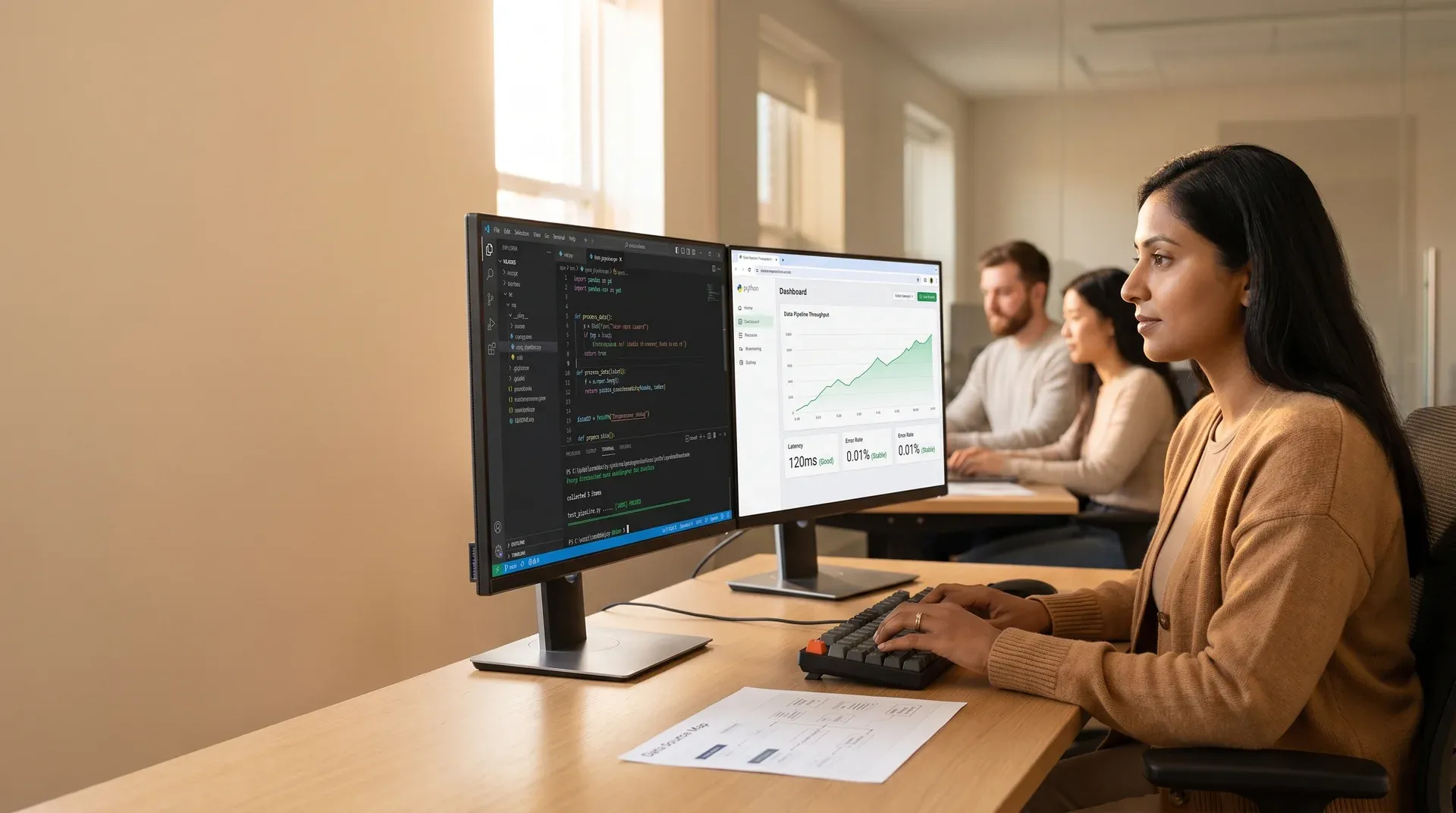
The spreadsheet was quick to build. Your team is still paying for it.
Five operations your team runs by hand today. Five operations that stop running by hand after we build your Python stack.
Manual data exports every Monday morning
3 people, 4 hours each, to produce the same report that was "finished" six months ago.
API integrations built in Excel formulas
Breaks silently on rate limit changes. Nobody knows until a client calls.
Data lives in 6 systems nobody can join
Your CRM has the customer. Your ERP has the order. Your warehouse has the stock level. No one has the full picture — so decisions get made on guesses.
Machine learning model runs on someone's laptop
Works when they are in the office. Disappears when they are not. No monitoring, no retraining schedule.
The backend script is 6,000 lines in one file
Only the original developer understands it. Two people have already tried to refactor it and stopped.
Airflow DAG generates Monday report at 6am
Scheduled, monitored, and alerted if it fails. Nobody needs to touch a laptop.
FastAPI handles all third-party integrations
Retry logic, rate limit handling, error boundaries, and structured logging. Documented with OpenAPI.
One live view of all 6 systems
A single ETL pipeline pulls your CRM, ERP, and warehouse into one data warehouse. Your dashboards show real numbers. Your team stops guessing.
Machine learning model deployed to a managed endpoint
MLflow tracking, scheduled retraining, drift detection, and a Grafana dashboard your team can read.
Clean modules, type hints, 90%+ test coverage
Any Python developer you hire can read and extend the codebase on their first sprint.

"We spent six months adding a column to a report that should have been a three-line Python function. Every Monday was the same thing." — Head of Data, logistics company
Name the number. Then decide if you can keep ignoring it.
Enter your team size, weekly hours on manual data work, and hourly cost. The number you see is what you recover every year with Python automation. Most companies find it pays for the project in under six months.
What Your Team Spends Today
Python automates 80 to 95% of repetitive data work. This calculator uses 70% — the conservative end — so the number you see is a floor, not a ceiling.
Recoverable Value: By Automating With Python
Six problems your team has right now. Six things Python solves.
data sources unified into a single pipeline on average
Data engineering and ETL pipelines
pandas, Polars, PySpark, and Airflow orchestration. Extract from any source, transform with type-safe schemas, load to your warehouse. Automated, monitored, and alertable. Your team sees one source of truth instead of six conflicting exports.
median API response time on FastAPI production endpoints
REST APIs with FastAPI and Django
OpenAPI docs auto-generated, Pydantic validation on every request, async endpoints for high throughput. Versioned routes, structured error responses, and rate limiting from day one. Your mobile app, web dashboard, and third-party tools connect to one reliable backend.
model deployed and running in production — not stuck on a laptop
Machine learning and AI in production
scikit-learn, PyTorch, and XGBoost pipelines with MLflow experiment tracking. Model serving via FastAPI or Vertex AI. Drift detection, scheduled retraining, and performance dashboards. Your model keeps working, even when the person who built it is on vacation.
of manual data operations recoverable through Python automation
Automation that runs without anyone touching it
Scheduled jobs via Airflow or AWS Lambda. Web scraping, file processing, report generation, notification workflows, and system integration scripts that run without human intervention. Your team recovers the hours they spent babysitting manual tasks.
reporting hours per month eliminated for a 5-person data team
Data analysis and automated reporting
pandas, NumPy, and Plotly for analysis pipelines. Automated report generation in PDF, Excel, or web dashboard format. Reports land in your stakeholders' inboxes on schedule — no analyst required.
infrastructure cost when pipelines are idle — scales to zero
Cloud functions and serverless pipelines
AWS Lambda, GCP Cloud Functions, and Google Dataflow pipelines. Event-driven architectures that scale to zero when not in use. You pay for compute when it runs, not when it waits.
Related frameworks and stacks:
A live streaming platform migrated its full data layer. Zero users noticed.
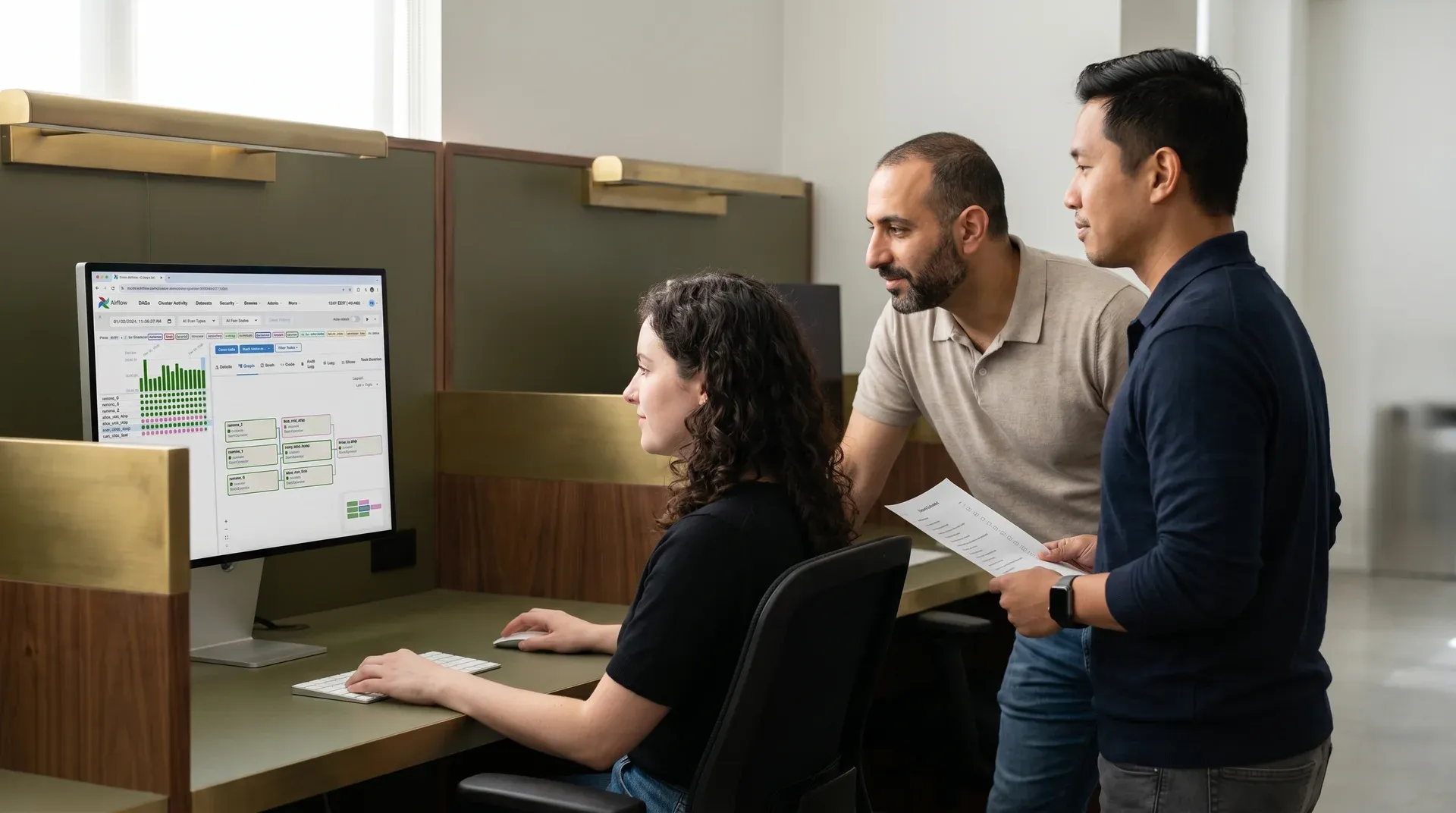
OTT Media Platform
Enterprise Cloud Data Migration
minutes of service interruption for a live streaming platform with active subscribers during a full production data migration
Python extract, transform, and load pipeline commits
Real-time change data capture from MongoDB and DocumentDB. Zero-downtime replication architecture.
pandas and Dataflow workers. Schema mismatch detection with automatic backfill on deviation.
High-write-volume optimized models. Production system runs in parallel during verification window.
Row count, hash comparison, and index validation before cutover. Automated rollback if threshold missed.
Firestore architecture live. Scalability improved. Infrastructure overhead reduced. Growth ready.
What we delivered: Cloud migration architecture plan. NoSQL data model design. Real-time data replication pipeline. Serverless ETL with Python and Dataflow. Full Google Cloud Platform integration.
We write Python your team can own, run, and extend without us.
Click any claim. See the code behind it. These are not promises. Every standard below runs from sprint one — on every project we deliver.
Type hints catch bugs before tests run. Dataclasses lock your schema at the data layer. pytest runs at 90%+ coverage before anything merges. The next Python developer you hire opens this repo and knows exactly what every function does.
structlog for structured JSON logs. Prometheus metrics exposed on every service. Sentry for exception tracking. Airflow alerts on service level agreement miss. Your on-call engineer gets a Slack message before a user files a ticket.
pyproject.toml with pinned dependencies, pre-commit hooks, and automated formatting. A new Python developer on your team runs the first pipeline on day one — without calling us. We document every decision so you never need to ask us why something works the way it does.
What Typical Python Agencies Miss
Scripts without type hints: breaks on Python version change
No structured logging: debugging in production means guessing
requirements.txt with unpinned versions: a 3am production failure waiting to happen
Monolithic pipeline files: 8,000 lines, untestable, untouchable
Redefine: typed, tested, documented, monitored from sprint one
Volume proof
What technical buyers ask us before signing.
Framework choice, pipeline architecture, and automation scope shape cost and timeline. These are the specific answers — not the marketing version.
We scope every project before work begins. You see itemized pricing, a full architecture document, a data model, and a pipeline design before signing anything.
No commitment to receive a proposal.
FastAPI when: you are building a pure API backend, performance is critical, or you need async endpoints for high-throughput workloads. Django when: you need an admin interface, object-relational mapping-heavy create-read-update-delete operations, or a monolithic application with built-in authentication. The architecture sprint produces this recommendation in writing based on your specific requirements before we touch a line of code. See Technology Stack for more context.
Every pipeline ships with structured logging via structlog, Airflow service level agreement monitoring, and Sentry exception tracking. Alert thresholds are agreed before the pipeline goes live. Failed runs trigger a Slack notification with the error context, not a silent failure you discover two days later in a downstream report. Retry policies and dead-letter queues are configured per task based on idempotency requirements.
Architecture sprint: 2 weeks. Simple automation script with scheduling and monitoring: 3 to 5 weeks. Multi-source extract, transform, and load pipeline with warehouse output: 8 to 14 weeks. Full data platform with API layer, machine learning model serving, and dashboards: 14 to 22 weeks. Cloud data migration like the streaming platform case above: 6 to 12 weeks depending on data volume and consistency requirements. Every project begins with a sprint plan showing week-by-week deliverables.
Both. For existing codebases, we start with a Python code audit that maps architecture debt, missing type hints, test coverage gaps, dependency risks, and performance bottlenecks. The audit produces a refactor priority matrix. You stay in production throughout, no big-bang rewrites. Incremental modernization with measurable improvements per sprint.
Everything. Code committed to your repository throughout. Architecture Decision Records, runbooks, and contribution guides in your wiki. pyproject.toml, pre-commit hooks, and continuous integration configuration all yours. A new Python developer on your team can extend or debug the pipelines without us present. No ongoing Redefine dependency is a delivery requirement, not an optional extra.
Check which of these fits your situation.
We turn away projects Python cannot solve well. Check the items below. If most apply, we are likely a strong fit.
Not sure? Describe your situation and we will tell you directly whether Python fits — and what the realistic scope looks like.
Team doing manual data exports, reports, or reconciliations
Scheduled Python pipelines can automate 70 to 95% of repetitive data operations.
Building an API so your app, dashboard, or partners can access your data
FastAPI or Django with structured validation, OpenAPI docs, and async support.
Data from multiple systems that needs to be unified or analyzed
Extract, transform, and load pipeline, data warehouse, and dashboard. Data lives in one place your team can trust.
Machine learning model or prediction system that needs to run reliably in production
MLOps pipeline: training, serving, monitoring, and retraining on a schedule.
Not a Strong Match If:
You need a consumer-facing mobile app with native device features
Python is the backend choice. We will recommend the right frontend for your mobile requirement.
Total project budget under $8,000
A production-ready Python architecture takes real engineering time. Below $8,000, the output cuts corners we are not willing to cut.
Tell us what your team does manually. You get a scoped plan in 3 days.
No commitment. No sales pitch. You see itemized pricing, a pipeline design, and a full architecture plan before you sign anything.
Submit your brief
Describe the manual process, where your data lives, and what you want to stop doing by hand. Takes 3 minutes.
Technical call within 48 hours
With a Python architect. We ask about your data sources, volumes, and how often the pipeline needs to run.
Scoped proposal in 3 days
Architecture plan, pipeline design, sprint schedule, and line-item pricing.
Sprint 1 within 1 week of sign-off
Architecture sprint delivers the data model and pipeline diagram before a line of code is written.
No commitment. Call within 48 hours. Itemized proposal in 3 days.
Brief received.
A Python architect reviews your situation within one business day and sends a scoped proposal within 3 business days.