One Customer Record. Every System. Always Current.
Your CRM says one thing. Your ecommerce platform says another. We build sync logic that ends the disagreement. Every system reads from one customer record.
Send your brief → Call in 48 hours → Proposal in 3 days → Work starts in 1 week
Hero · Data analyst reviewing unified customer profiles

Every System Shows a Different Customer Record
When customer data lives in multiple systems with no connection between them, every platform builds its own version of the truth. The result is not just wasted time. It is wrong decisions made confidently on stale data.
Before Customer Data Synchronization
- A customer updates their email at checkout, but your CRM still sends to the old address
- Support agents give customers outdated information because the helpdesk does not show the latest purchase history
- Duplicate records pile up because two systems create new entries instead of matching to an existing profile
- Marketing segments run on customer attributes that are weeks behind because the sync only fires on weekends
After Custom Customer Data Synchronization
- A customer email update in any system reaches every connected platform in real time. No manual follow-up.
- Support agents and marketing teams read from the same customer profile. Always current. Always consistent.
- Duplicate records stop forming. Existing duplicates merge on a schedule your team approves.
Pain · Operations team viewing unified customer record

See how this fits within integration services as a whole.
Out-of-Sync Customer Data Breaks Every Team That Touches It
The pain shows up differently depending on where you sit. But the root cause is always the same: customer data that does not update consistently across the systems your teams rely on.
The Problem
"My segments are wrong and I cannot trust the data they are built on."
- Customers who upgraded three weeks ago still get starter-tier emails because the email platform never got the update
- Win-back campaigns target active buyers because segments only read one system, not all of them
- Weekly list exports are the only way to refresh audiences, and they are always a week behind
After Synchronization
"Every segment reflects who the customer is today, not who they were last week."
- Customer attribute updates in the customer relationship management propagate to the email platform and ad audiences in real time
- Segments are always built on complete, current data from every system your customers interact with
- No manual list exports, no stale audiences, no campaigns sent to the wrong tier
The Problem
"Our agents are apologizing for wrong information because every system shows something different."
- The helpdesk shows a six-month-old shipping address while fulfillment shipped to the updated one. Nobody knows which is right.
- Purchase history in the support tool does not match order history in the store because each system counts orders differently
- Every support call starts with the agent switching between three tools to find the record that looks correct
After Synchronization
"Agents see the same customer record whether they are in the helpdesk, the customer relationship management, or the order system."
- Customer contact details, order history, and account status are consistent across every tool your support team uses
- A contact update in any system reflects in all others before the next interaction, so agents always see current information
- Support resolution time drops because agents spend time resolving issues rather than reconciling which record is accurate
The Problem
"Every exception report has two conflicting data points and I cannot tell which is right."
- Orders ship to the address in the fulfillment system, which is not the one the customer updated in the store two days ago
- Billing runs on customer account data from the enterprise resource planning system, but the enterprise resource planning system receives updates two days after the store
- Your team manually reconciles customer records across systems each month before any financial or operational report can be trusted
After Synchronization
"Customer data is accurate the moment it is updated and stays accurate through fulfillment, billing, and operations."
- Customer-facing data changes in any system propagate to fulfillment, billing, and reporting systems in real time
- Exception reports get shorter each month because the sync layer prevents data from diverging in the first place
- Monthly reconciliation drops from a multi-day process to a quick audit because systems are already in agreement
Six Things Your Customer Sync Handles From Day One
Every sync we build is scoped to your platforms, your data models, and your conflict resolution rules. Owned code. No subscription. No marketplace connector you will outgrow.
For related workflows, explore our customer relationship management and enterprise resource planning integration use case or our broader data integration services.
Single Source of Truth
We define which system owns each customer field before writing any code. Every platform reads from and writes to the same master record. No ambiguity about which value is correct.
Bidirectional Real-Time Sync
Changes in any connected platform reach all others right away, not on a scheduled batch. A customer email update in your store reaches your CRM and email platform in seconds.
Conflict Resolution Logic
When two systems hold different values for the same field, a defined rule set resolves the conflict automatically. Every resolution is logged. Your team gets alerted when the same conflict keeps appearing.
Deduplication and Merge Rules
We detect duplicate customer records based on matching criteria you define, merge them according to your business rules, and block them from re-forming. The logic is built around how your systems create records, not a generic algorithm.
Field-Level Mapping and Transformation
Different systems store the same customer information in different field names, data types, and formats. We build the translation logic that maps between them correctly, including multi-field to single-field conversions.
Sync Health Monitoring
After go-live, we monitor every sync event, alert your team when records fail to update, and provide a data quality report showing how many records are in perfect sync right now. The sync does not end at deployment.
Five Steps From Audit to Live Sync
Our process defines data ownership and conflict rules before we build anything. You review and approve every decision before we write a line of code.
Step 1 Output · Customer Data Audit
| System | Customer Fields | Update Method |
|---|---|---|
| Dynamics 365 | Name, address, account tier | Manual |
| Shopify | Email, phone, shipping address | Real-Time |
| Klaviyo | Email, preferences, events | Batch |
| Helpdesk | Contact, order history | Weekly |
Step 2 Output · Source of Truth Map
Step 3 Output · Field Mapping Schema
"source_field": "ShopifyCustomer.email",
"target_field": "Dynamics365Contact.emailaddress1",
"transform": "lowercase_trim",
"conflict_rule": "source_wins",
"sync_mode": "real_time"
}
Step 4 Output · Sync Test Results
Step 5 Output · Data Quality Monitor
Customer Record Health
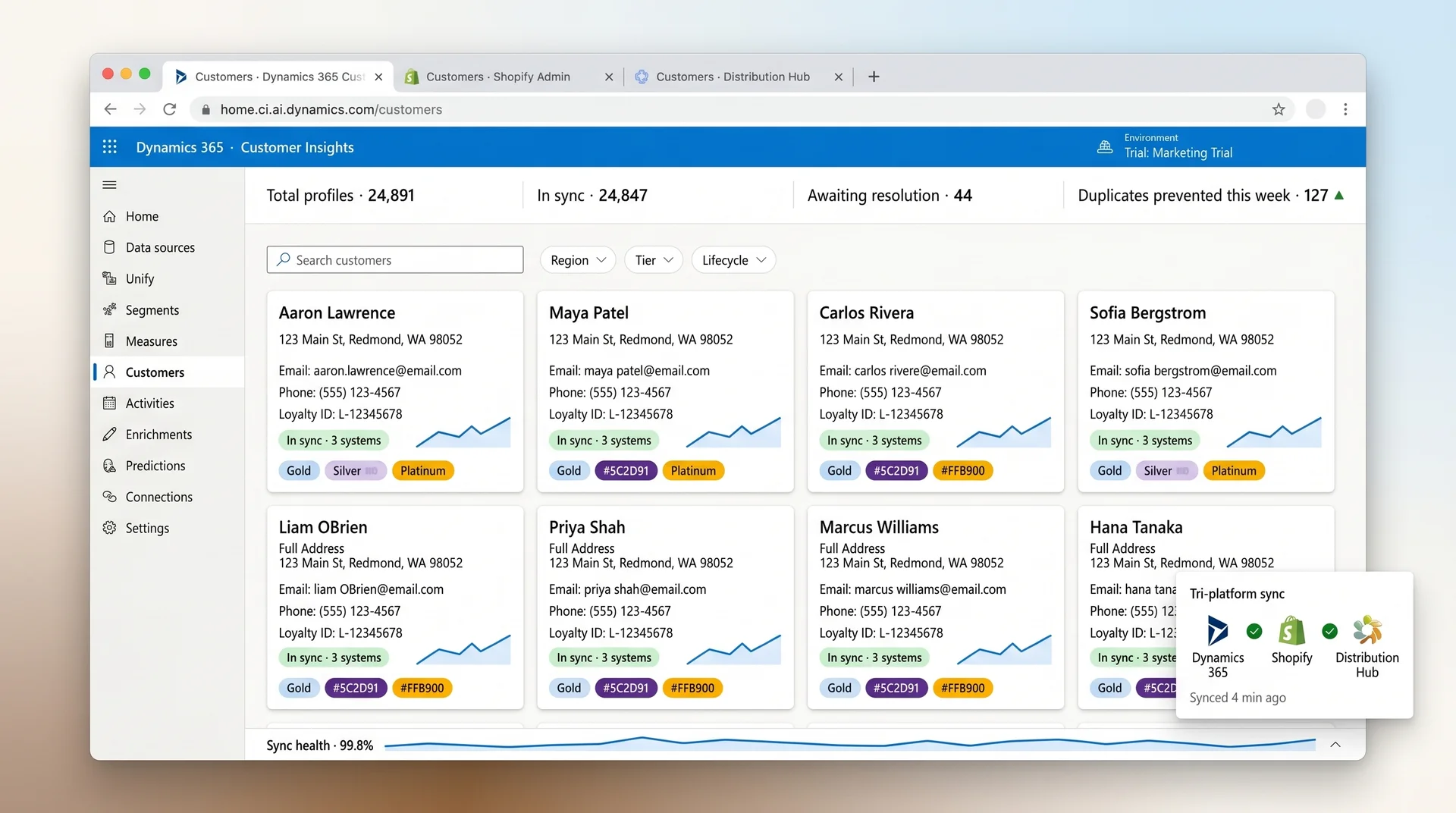
Updated 4 minutes agoHow a Distributor Connected Every Customer System and Stopped the Data Conflicts
A distribution operation managing customer data, inventory, and order records across disconnected platforms with no shared synchronization layer.
The Challenge
Customer data, inventory records, and orders lived in multiple systems with no sync between them. Every team worked from a different version of the customer record. That meant wrong shipments, billing mistakes, and support calls that started with "let me check another system."
The Solution
We built bidirectional integrations with Shopify and a second distribution platform to sync customer information, orders, and inventory in real time. We added a third-party logistics warehouse integration to close the gap in fulfillment data. We deployed automation tools to keep customer data consistent across every connected platform. For the underlying platform work, see our customer relationship management integration services.
0+
platforms synced in one deployment with real-time customer data across every system
Integrated systems now deliver consistent, reliable customer data across all connected platforms, reducing manual reconciliation and improving accuracy across fulfillment, billing, and customer service.
Proof · Unified customer data dashboard
A Custom Sync Partner. Not a Connector Marketplace.
Off-the-shelf tools synchronize systems that already follow common patterns. We synchronize the systems you actually have, including the ones with non-standard field structures, proprietary data models, and conflict behavior that generic tools cannot handle.
We Define Ownership Before Building Anything
Every sync provider should define source of truth before writing code. We do. The ownership map and conflict rules are documented, reviewed, and approved by your team before Sprint 1 starts.
The Code Is Yours, Not a Subscription
Every sync adapter we build is delivered as owned source code. There is no platform to cancel, no per-record pricing that grows with your customer base, and no vendor that can change the terms after you are dependent on the system.
We Monitor the Quality, Not Just the Connection
Most integration providers declare success when the connection is live. We track data quality after go-live, measuring how many customer records are in agreement across all systems and alerting your team when that number drops.
Looking for order synchronization integration services or real-time data integration services alongside customer data sync? All three can be scoped together.
Questions About Customer Data Sync
Customer data synchronization is the process of keeping customer records (names, contact details, purchase history, preferences, account status) consistent and current across every platform that holds them. Typical systems include CRM platforms, ERP systems, ecommerce storefronts, helpdesk tools, email marketing platforms, and marketing automation systems. The goal: a customer record updated in any one system reflects accurately in every other system without manual re-entry.
Conflict resolution is defined before any code is written. For each field, a source-of-truth rule is established that determines which system wins when two platforms hold different values for the same customer. For example, the customer relationship management system might own the email address field while the ecommerce platform owns the shipping address. When a conflict occurs, the defined rule resolves it automatically, logs the change, and alerts your team if the conflict pattern suggests a data quality issue.
Yes. Field-level mapping and transformation are built into every customer data synchronization solution we deliver. We map each field from the source system to the corresponding field in the target system, handle data type conversions, and write transformation logic for cases where the same information is stored differently. For example, a single name field in one system may map to separate first-name and last-name fields in another. These mappings are designed and approved before any sync is deployed.
A scoped customer data sync project typically takes six to fourteen weeks. The range depends on the number of systems, the complexity of the data model mapping, and the condition of existing customer records. Audit and architecture: two to three weeks. Build and testing: four to nine weeks. Monitoring begins at go-live. Every project is fully scoped before work starts, so you have an exact timeline and cost before Sprint 1 begins. See our integration assessment audit as a starting point.
Standard tools connect systems that already follow common data patterns. A custom customer data synchronization company builds the sync logic your actual systems require, including conflict resolution rules, deduplication strategies, field-level transformations, and handling for your specific data anomalies. The code is owned by you, not licensed. The sync is built around your business rules, not a generic template. And the engagement continues after go-live with monitoring and maintenance as your customer data and systems evolve. Explore our broader integration services for related use cases.
Describe Your Sync Challenge. Get a Scoped Proposal in 3 Days.
Describe your sync challenge and we will scope the work before asking for any commitment. Scoped before work starts. Line-by-line pricing. No commitment to get a proposal.
Response in 48 Hours
We review and reply fast
Proposal in 3 Days
Scoped and line-by-line
100 Plus Projects Delivered
Across platforms and industries
All Code Fully Owned by You
No license or subscription
Brief Received
We will review your customer data setup and send a scoped proposal within 3 business days.
Pre-footer · Integration consultants reviewing customer data architecture

Your Customer Records Are Ready for One Source of Truth
Custom customer data sync built for the platforms you actually run. One source of truth. Real-time updates. Owned code that stays current as your systems grow.
Scoped before work starts · line-by-line pricing · no commitment to receive a proposal
Submit your brief → Call within 48 hours → Scoped proposal in 3 days → Sprint 1 within 1 week of sign-off