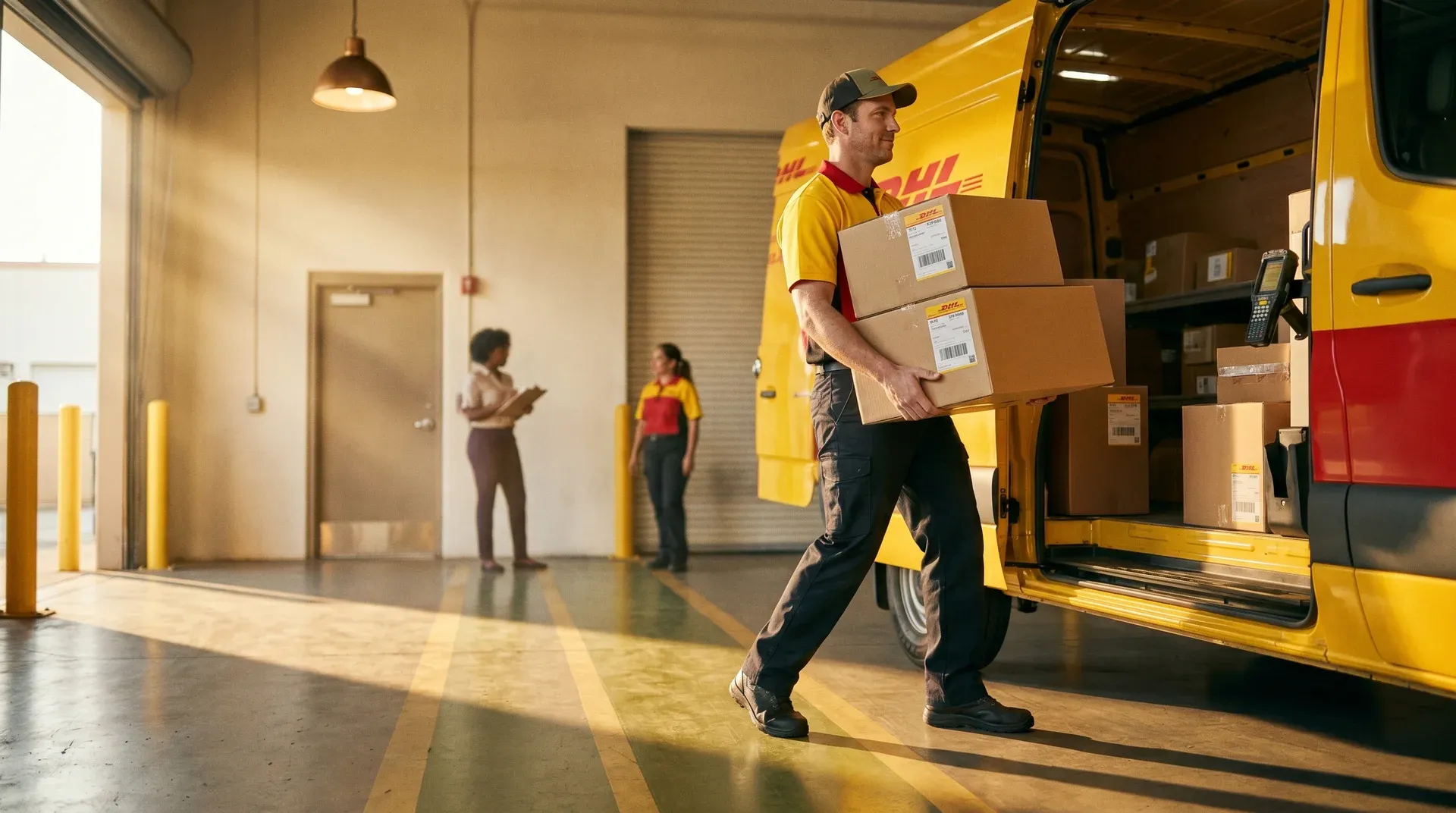
DHL shipping integration that prints the label before your picker reaches the shelf.
One API connection covers every DHL service. Rate-shop, label, manifest, and track. Your store, your ERP, and your customer all get the same data at the same second. No copy-paste. No logins. No reconciliation spreadsheets.

The throughput behind 120+ brands shipping on this exact bridge.
Two lanes. One ships the order before your second coffee.
Manual carrier work is the silent tax on every growing store. Copy a tracking number here. Paste a customs line there. Refresh DHL MyBill at month end. A clean DHL integration runs that whole lane in under 40 seconds.
- Login to DHL MyDHL+, paste address by hand, pick service from a long list.
- Re-type HS codes and customs values on every international parcel.
- Copy the tracking identifier back to Shopify, then to NetSuite, then to the customer.
- Reconcile MyBill at month end. Spreadsheet, coffee, regret.
- Order paid in Shopify → label printed at the bench before the picker arrives.
- HS codes, declared values, and incoterms pulled straight from your PIM. No re-typing.
- Tracking identifier and status events flow back to store, ERP and customer email.
- DHL invoices reconciled line by line against fulfilled orders. Done.
One DHL ecommerce integration. Every service. Every lane.

SCAN · ANT-WH-04 · 14:22:08
A picker scans the box. The label is already printed. The customer already has the tracking link.
Six steps. One integration.
Click any step to see what happens at each stage. The diagram auto-advances every four seconds, or you can explore at your own speed.
Order paid
The second a buyer pays in Shopify, BigCommerce, or your custom store, our integration grabs the order. It collects the address, line items, weights, customs values, and incoterms. Then it shapes everything into a format DHL accepts. No human touches it.
Validate and rate-shop
The integration validates addresses against DHL's directory and checks weights against your PIM. It returns live rates from every DHL service that meets the speed your customer chose.
Generate label
ZPL for thermal, PDF for laser. Commercial invoices and customs documents render from your product information management system in the same call. The picker prints from the same screen they pack on.
Manifest
All labels created in the cutoff window roll up into a single end-of-day manifest, signed and sent to DHL before the driver arrives. No more printer roulette at 5pm.
Track and notify
Status events stream back as webhooks. Your store, ERP, customer email and support tool all hear the same truth at the same moment.
Reconcile
Match every DHL invoice line against a fulfilled order. Flag surcharges, dimensional weight adjustments and corrections. Post the result to your general ledger.
What your operations console looks like on a live account.
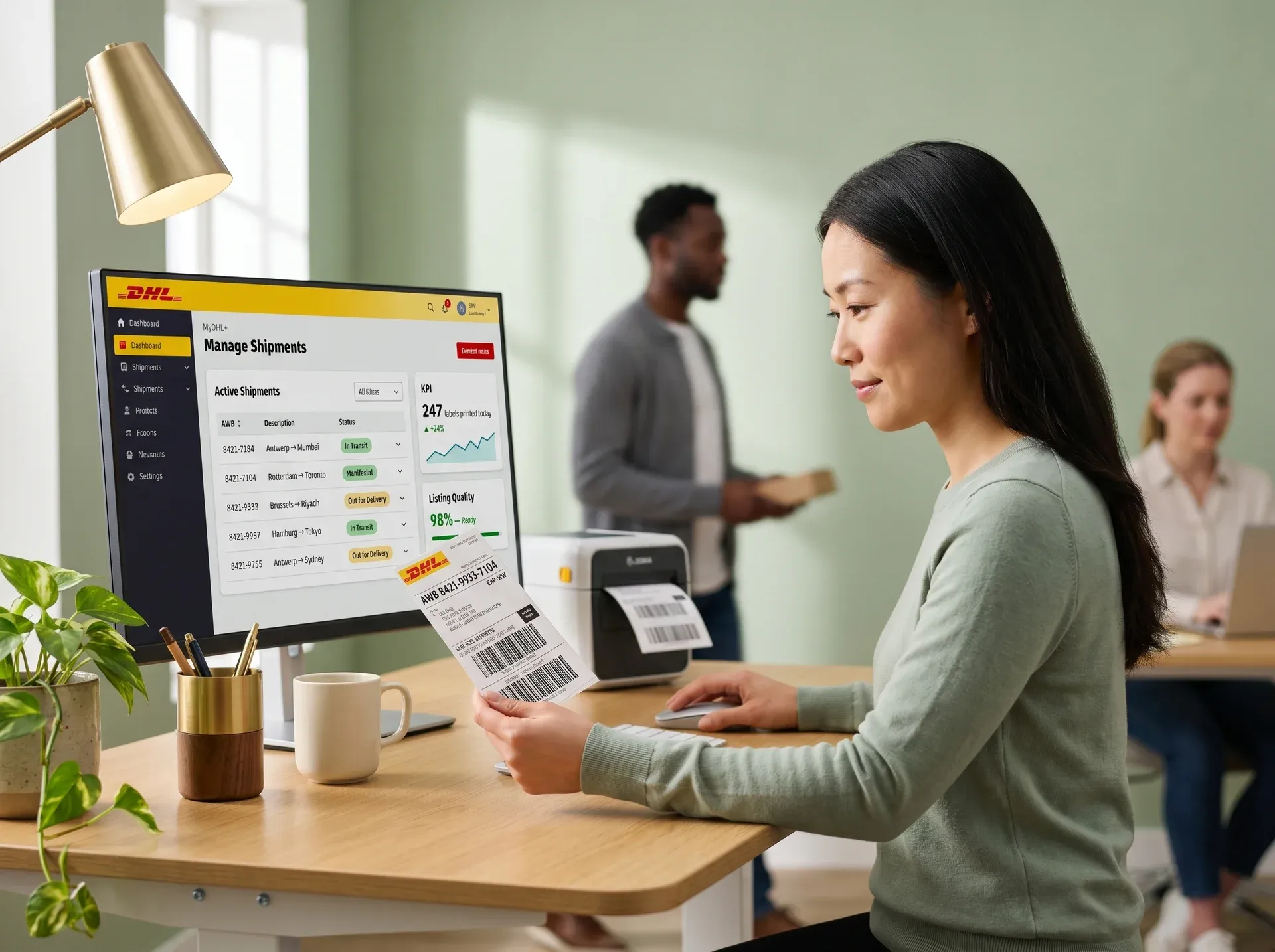
This is a working preview of the dashboard and the event stream behind it. Live rows pulse. The webhook feed advances. The SDK code below is identical to what runs on production accounts right now.
import { dhl } from '@redefine/integrations'const label = await dhl.createShipment({
  order: order.id,
  service: 'EXPRESS_WORLDWIDE',
  declared: order.subtotal,
  pickup: 'auto',
})

// → AWB, PDF label, manifest entry
DHL integration services: six capabilities ready the day your bridge goes live.
One connector. Every DHL service covered.
Express, Parcel, eCommerce, Freight, Supply Chain — and Same Day where the lane exists. We pick the rate the customer paid for. You ship.
Live rates at checkout
Tracking back to every system
- → Shopify order.fulfilled
- → NetSuite shipment.created
- → Klaviyo customer.notified
- → Gorgias ticket.linked

Print at the bench
Thermal-printer ready labels (4×6 ZPL or PDF). The picker prints from the same screen they pack on.
Exceptions you can act on
Customs holds, address fails and weight mismatches surface as tasks, not buried errors.
MyBill, line by line
Match every DHL invoice line against a fulfilled order, flag surcharges, and post the result to your ERP. Month-end is one screen.
Pick the delivery promise. We map it to the right DHL service code.
DHL has a code for every promise — and we keep them straight so your team doesn't have to. The row highlights the one your customers buy most often.
| Code | Service | Use case | Transit | Coverage | Live API |
|---|---|---|---|---|---|
| EXP-WW | Express Worldwide | High-value direct-to-consumer, B2B samples | 1 to 3 days | 220+ countries | v2 |
| PCL-INT | Parcel International | Standard cross-border direct-to-consumer | 3 to 6 days | 70+ countries | v2 |
| ECM-PKT | eCommerce Packet | Low-weight, price-sensitive | 5 to 9 days | 200+ countries | v2 |
| FRT-LTL | Freight LTL | Pallets, B2B replenishment | 2 to 7 days | EU, NA, APAC | v1 |
| SDX-DOM | Same Day Domestic | Time-critical urban | Same day | Major metros | v2 |
| SCN-MGT | Supply Chain Management | Third-party logistics warehouse and fulfilment | Programmatic | Global | v2 |
A home-goods brand hit $70M in annual revenue with one integration handling every channel.

A US home-goods brand selling drapery and window treatments online and through wholesale, with orders flowing across multiple sales channels into a single ERP.

Inventory, orders, and fulfillment lived in different systems. The team handled carrier work by hand, multi-channel data never matched, and month-end reconciliation ate days. Decisions waited on spreadsheets that were already stale.
Redefine built a custom commerce front end and connected it to Dynamics 365 with Power BI dashboards. Carrier and fulfillment integrations ran through one bridge. Orders, inventory, and shipments stayed in sync without anyone copying a tracking number.
The operations team cut reconciliation from days to minutes. Inventory accuracy and customer satisfaction improved across every sales channel. The integration that handles their carriers is the same one this page describes.
Move three sliders. See the bleed.
Plug in your numbers. The counter shows what manual shipping costs you this month, this quarter, and this year. The integration pays for itself in the first two weeks.
Three things the aggregators won't do.
Most aggregators treat DHL like one more rate in a dropdown. We treat it like a carrier relationship with rules, lanes, and surcharges that affect every shipment you book.
The five things teams always ask.
You ship on your own DHL account. We connect to it. Your rates, your contract, your customer relationship — we just remove the manual work between the order and the label.
Shopify, BigCommerce, Adobe Commerce, custom Next.js or headless stacks, plus ERPs like NetSuite, Microsoft Dynamics 365 Business Central, Odoo, and SAP B1. If you can call a webhook, we can wire it.
A clean shop with documented order data: first labels print within two weeks. A multi-channel ERP integration with customs, returns, and reconciliation: typically 6 to 10 weeks.
Returns labels are generated on the same bridge. Commercial invoices, proforma invoices and electronic trade docs are produced from your product information management system. DDP and DDU are toggles per service code, not separate integrations.
You do. The bridge ships into your repo, your CI/CD and your secrets store. We document it, hand it over, and stay on retainer only if you want us to. No lock-in.
Describe your DHL shipping situation. We will come back with a plan.
We read every brief and reply within two business days. We will not call until we have studied your situation and have something useful to say.
Call within 48 hours · proposal in 3 days · first labels printing in week 2 of sign-off.
Brief received.
We'll review your situation and send a scoped proposal within 3 business days. If something is unclear we'll write first, not call.
One integration. Every DHL service. Yours to own.
Submit your brief. See a scoped proposal in three days. Have your first DHL labels printing through your own DHL shipping integration within two weeks. No commitment. No pitch.