USPS shipping integration for live rates, labels, and tracking
Your checkout quotes flat estimates. Your team types labels by hand. Tracking never reaches customers. A USPS shipping integration fixes all three: live rates at checkout, automated label printing, address verification, and tracking webhooks that update orders and emails without manual work.
Hero: fulfillment operations team at dual-monitor workstation

What a USPS integration fixes in your shipping process
Every broken step in your shipping flow has a direct cost: overcharged customers abandon at checkout, returned shipments waste your team's time, and missing tracking creates support volume you never needed.
Live rates calculated per package
Weight, dimensions, origin postal code, destination postal code. Exact USPS pricing at checkout, every time
Labels generated the instant an order is placed
Print-ready ZPL or PDF to your thermal station. Zero manual entry
USPS address correction before every label
AddressValidateV4 corrects and Delivery Point Validation confirms delivery addresses automatically
Tracking events push to your store and customer
Webhook delivery updates order status and post-purchase email sequences without polling
Returns portal generates labels on demand
Customers self-serve from any device. No email, no wait, no team intervention
Carrier logic routes cheapest eligible service
Ground Advantage automatically selected when delivery window and weight allow
Flat-rate estimates at checkout
Customers are overcharged on light parcels and undercharged on heavy ones
Labels entered manually
Copy-paste from one screen to another for every shipment that leaves your dock
No address validation
Returned shipments land back in your warehouse with full carrier fees attached
Tracking never reaches customers
Support inboxes fill with "where is my order" tickets your team handles manually
Returns labels emailed on request
Each return starts with a customer email and a manual response from your team
Paying Priority Mail rates for everything
No carrier logic to route cheaper-eligible shipments to Ground Advantage
Pain: merchant manually entering packing slips into a spreadsheet

How your store talks to USPS
Five layers work together every time an order is placed or a rate is requested. The workflow auto-advances every 4 seconds. Click any node to take control and stop the rotation for this section.
Node 1: Your Store Platform
Orders, products, customers, and addresses
Your Shopify, BigCommerce, WooCommerce, or custom headless store holds order data, product weights and dimensions, customer delivery addresses, and payment status. When an order is placed or a shipping rate is requested at checkout, this layer triggers the integration flow. We configure the specific webhook triggers or API calls your platform uses to initiate each action.
Node 2: Redefine Connector
The USPS connector: normalization, retries, and error handling
Our middleware layer normalizes your platform's data format into the structure USPS Web Tools expects. It manages API versioning, enforces request rate limits, handles retry logic when USPS returns a temporary error, and routes requests to the correct endpoint based on action type. Your checkout never returns a blank shipping section because of an upstream timeout.
Node 3: USPS Web Tools API
The official USPS API gateway
The USPS Web Tools API handles four core functions: rate calculation (RateV4), address validation and correction (AddressValidateV4), shipping label generation (eVSLabel for Priority Mail and Ground Advantage; eVSPriorityLabel for Priority Mail Express), and shipment tracking event delivery (TrackV2). All calls go to USPS production endpoints using your registered Web Tools credentials.
Node 4: Label Print Service
Print-ready output to your shipping station
When the USPS API returns label data, this layer formats the output as a ZPL file for Zebra or Dymo thermal printers, or as a print-ready PDF for standard laser printers. Labels include barcode, tracking number, service class, postage amount, and required USPS intelligent mail package barcode indicia. Output is stored in your order record and available for reprint without a new API call.
Node 5: Tracking Dispatcher
Status events back to your store and customers
Tracking events from USPS push to your order management system and trigger your post-purchase email flows. Your customer sees "In Transit," "Out for Delivery," and "Delivered" without any manual update. The dispatcher also handles exception events: address correction, attempted delivery, held at post office, so your support team sees the same data your customer does.
This integration pairs well with shipping automation workflows for multi-carrier operations.
Every USPS ecommerce integration capability, built as one system
The integration is scoped to your platform and shipping volume. You get the capabilities below connected as a coherent layer, not individual plugins patched together.
Real-Time Rate Calculation
Your store sends package weight, dimensions, origin postal code, and destination postal code to the USPS RateV4 endpoint at checkout. The API returns exact prices for every eligible service class: Priority Mail, Priority Mail Express, USPS Ground Advantage, First-Class Package Service, and Media Mail where applicable. Your customer sees real carrier pricing, not a markup or a flat estimate.
Automated Label Generation
Label created and queued the moment an order ships. ZPL for thermal printers. PDF for laser. No manual entry. Responds in under 400ms.
Address Verification
AddressValidateV4 corrects and Delivery Point Validation confirms every delivery address before a label is generated. Reduces returned shipments and carrier exception fees.
Tracking Webhooks
TrackV2 events push to your order management system. No polling. Statuses update automatically: In Transit, Out for Delivery, Delivered, and exception events.
Scheduled Pickup
Request USPS pickups from your warehouse or retail location. Cutoff windows and confirmation status sync back to your order management system so dispatch matches what actually went out the door.
Returns Label Automation
Pre-built returns portal lets customers generate a USPS return label from any browser. Labels arrive in seconds. No email thread, no team intervention needed.
Carrier Fallback Rules
If a rate call errors or times out, pre-configured fallback rules apply: flat rate, secondary carrier, or hidden shipping so checkout never breaks under API pressure.
Dimensional Weight Logic
Packages rated on actual weight or dimensional weight, whichever USPS bills for. The integration calculates both and sends the correct value before label generation.
Scoping and pricing
Most USPS integration projects cost between $3,500 and $8,500. Final price depends on your platform, the services you need, and any custom shipping rules for your checkout. Here is the math: a 2% overcharge rate on $150,000/month in orders costs you $3,000 every month. Most stores recover the full integration cost within 6 to 8 weeks.
Scoped before work starts · line-by-line pricing · no commitment to receive a proposal
The USPS API endpoints we build your integration on
Every integration is built against official USPS Web Tools production endpoints. The cards auto-advance every 4 seconds. Click any card to take control and stop the rotation for this section.
Priority Mail
Ground Advantage
Priority Mail Express
First-Class Package
Media Mail
Parcel Select
Integration results from a live ecommerce engagement
The case study below comes from our integration services portfolio. All outcomes are attributable to the specific engagement described.
Proof: operations team confirming integration go-live on screen

Forloh makes USA-manufactured outdoor clothing and hunting gear, sold direct through Shopify.
The problem
Shopify, Amazon, and third-party fulfillment apps were not synchronized. Inventory levels drifted between platforms. Customer data required manual reconciliation after every fulfillment cycle. Technical failures during high-volume periods caused order errors that needed manual correction.
The solution
A secure integration framework was built to connect Shopify with Amazon and supporting third-party applications. Core ecommerce processes were automated across the connected stack. Data synchronization was configured to run continuously: inventory, customer records, and order status kept consistent across all platforms without manual intervention.
The result
Shopify, Amazon, and a third-party fulfillment app unified in a single integration layer. Zero manual data reconciliation. Inventory and customer data accuracy improved across all connected systems. System reliability held through peak-season order volume.
What makes our USPS integration services different
Other integration partners use the same USPS endpoints. The difference is in the connector layer: how errors are handled, how the API is versioned, and what happens when your store is under peak load.
Checkout never breaks on a USPS error
Every integration we build includes configured fallback rules. If USPS returns a 5xx error or times out, your checkout shows a fallback rate and continues to accept payment. No blank shipping section. No cart abandonment from a carrier outage you cannot control.
A full handoff document, not just deployed code
Every project closes with documentation that covers your API credentials location, the specific endpoints in use, fallback rule configuration, and how to add a new USPS service class later without rebuilding. Your team owns the integration from day one.
Platform-native, not a generic middleware layer
We build against your specific platform's native shipping API hooks: Shopify's Carrier Service API, BigCommerce's Real-Time Shipping Quotes, or direct webhook configuration for headless stacks. The result is tighter performance and cleaner error handling than a generic third-party middleware.
Scoped against your actual shipment data
Before writing a single line of code, we review your average package weight and dimensions, top destination postal codes, and current carrier spend. The integration is scoped to what your store actually ships, not a template wired for a hypothetical average merchant.
USPS shipping integration: common questions
The integration supports Priority Mail, Priority Mail Express, USPS Ground Advantage, First-Class Package Service, Media Mail, and Parcel Select. Which services appear at checkout is configurable. You can restrict by shipment weight range, destination type, or business rule. For example, showing Ground Advantage only when your carrier logic confirms it meets the buyer's expected delivery window.
Most USPS integration projects go live within 5 to 10 business days from signed scope. The timeline depends on your platform, how many services you are enabling, and whether your checkout requires custom carrier logic. For example, rate capping, dimensional weight overrides, or service-specific product restrictions. A scoped proposal will include a specific go-live date based on your setup.
Yes. The USPS AddressValidateV4 API checks every delivery address before a label is generated. Addresses are corrected against the official USPS postal database and confirmed with a Delivery Point Validation code. If an address cannot be confirmed, the system flags the order before a label is attempted, so you never pay postage on a label that USPS cannot deliver.
Your store sends package weight, dimensions, origin postal code, and destination postal code to the USPS RateV4 endpoint the moment a buyer reaches checkout. The API returns exact rates by service class. Customers see actual USPS pricing, not a markup and not a rounded estimate. You can optionally apply a handling markup as a configured percentage on top of the live rate if your pricing model requires it.
Fallback rules are configured during the integration setup. If a rate call times out or returns a server error, your store displays a pre-configured fallback: a flat rate, a secondary carrier option, or a hidden shipping method so checkout continues to accept payment. Every API error is logged with request and response data so your team can review patterns and flag recurring issues with USPS credentials or endpoint access.
Start your USPS integration scope
Tell us what your store ships, which platform you are on, and what is currently broken in your shipping flow. We will review your setup and send a scoped proposal within 3 business days.
We review your platform, shipping volume, and current setup
Call within 48 hours to confirm scope and ask any follow-up questions
Line-by-line scoped proposal delivered within 3 business days. No commitment to receive it
Sprint 1 begins within 1 week of sign-off. Integration live 5 to 10 days after kickoff
Also explore
ShipStation connectorCall within 48 hours · proposal in 3 days · Sprint 1 within 1 week of sign-off
Brief received
We will review your store setup and send a scoped proposal within 3 business days. If we need to clarify anything, we will call within 48 hours.
Stop quoting estimates. Start shipping on exact USPS rates
Your USPS shipping integration scope is built around your actual package data, your platform, and your shipping rules. No template. No guesswork. Live USPS rates at checkout, automated label printing, and tracking that reaches your customers without your team touching it.
No commitment. No pitch. Submit your brief. Call in 48 hours. Proposal in 3 days.
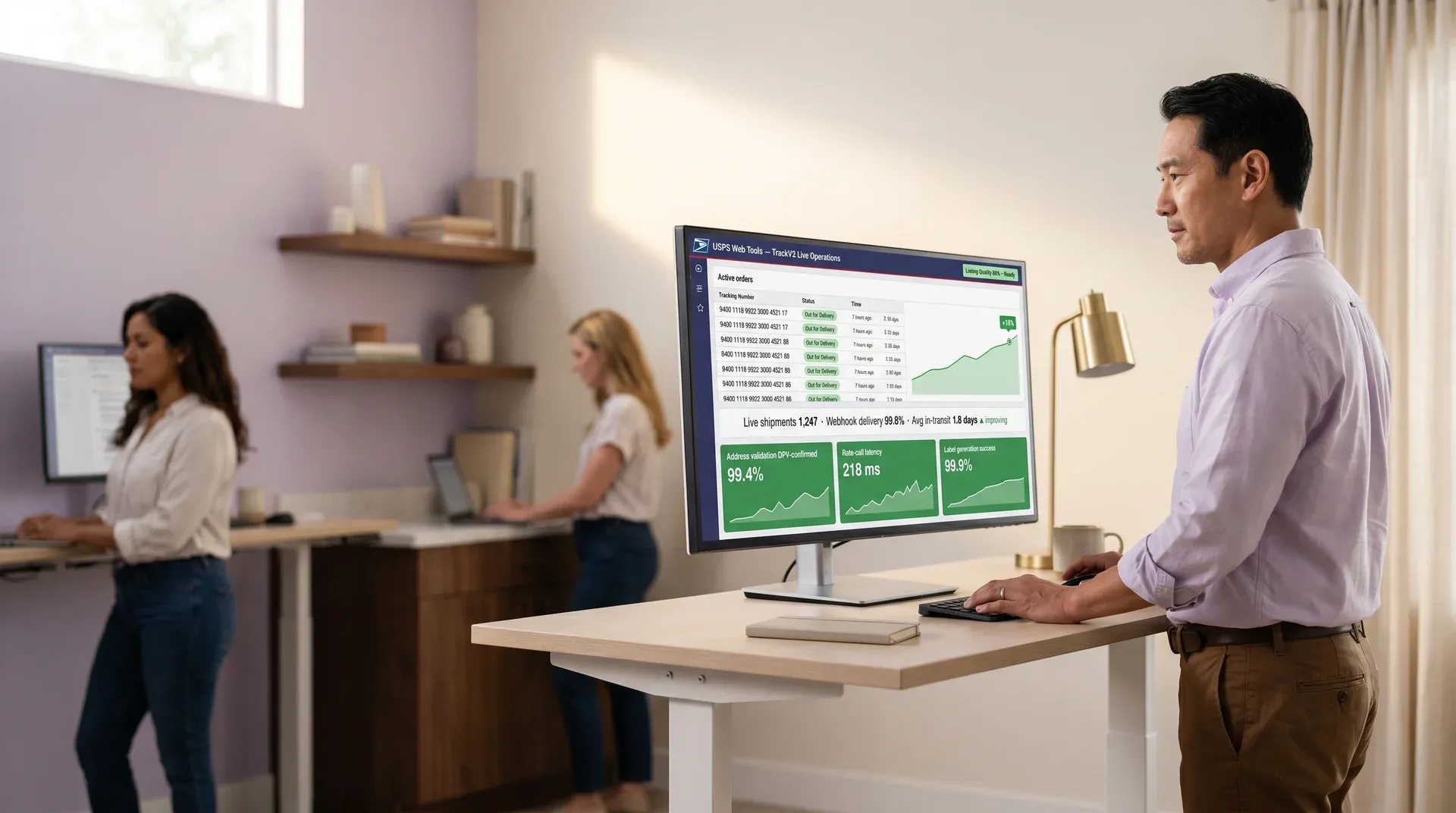
Pre-footer: operations lead monitoring order tracking dashboard at standing desk