Your ecommerce and ERP systems should talk to each other. We make that happen.
Every order should land in your ERP within seconds. Not hours. Not after someone re-enters it by hand. We connect your storefront to your ERP so orders, inventory, and financials move without your team touching them.
Projects completed
120+
Ecommerce brands served
85+
Average time to live
3 weeks
Tell us your setup → Call within 48 hours → Scoped proposal in 3 days → Sprint 1 within 1 week of sign-off
Hero: operations lead reviewing integration dashboard

Systems we connect
Your team is the integration
When your ecommerce platform and ERP are not connected, your operations team becomes the bridge. Someone exports a file. Someone re-enters the order. Someone checks inventory in both systems and picks the count they trust more. Every manual step is a chance for error and a delay your customer notices.
The Old Way
Orders exported from Shopify as a file every morning, manually re-entered into the enterprise resource planning system by 9 AM
Inventory updated in the enterprise resource planning system overnight: storefront shows counts that are already wrong by 8 AM
Fulfillment team cannot confirm stock without checking both systems and doing the math themselves
Finance closes month-end 3 to 5 days late reconciling order revenue between systems
After Integration
Orders appear in the enterprise resource planning system within seconds of placement: no exports, no re-entry, no morning delay
Every pick, pack, or adjustment in the enterprise resource planning system pushes inventory counts back to the storefront in real time
Fulfillment team sees a single authoritative stock number: the same one the customer saw when they ordered
Finance closes month-end on day 1 because the data was always reconciled
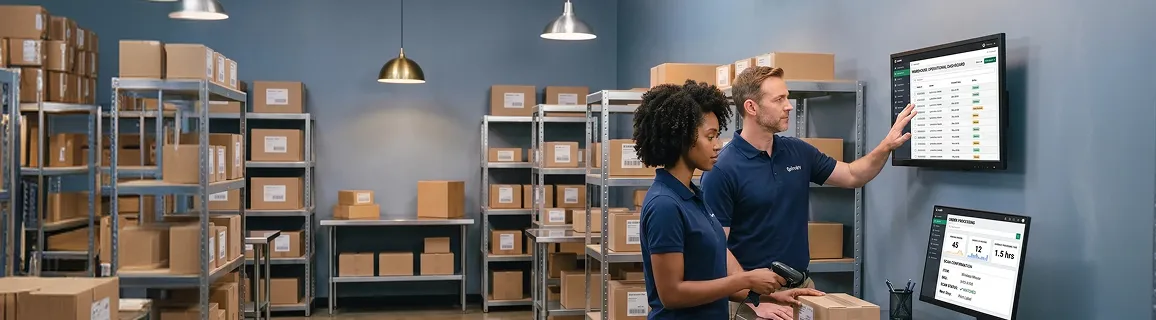
Pain: warehouse team fulfilling orders manually
Every day without integration is a real number
Manual order entry, inventory errors, and delayed fulfillment cost real money every month. Move the sliders below to see what disconnected systems cost your operation today.
Your operation
Cost accumulating right now
Labor cost of manual processing (monthly)
$—
Revenue lost to fulfillment errors (monthly)
$—
Total cost of inaction (per year)
$—
Refreshes as you adjust the sliders above
No commitment. No pitch. A scoped proposal in 3 days.
Your integration architecture, mapped before we write a single line of code
Live data flow: click a node to see what it handles
Select a node above
Click any node to see what happens at that layer of the integration.
Storefront → Enterprise Resource Planning
- Order headers and line items
- Customer data and shipping address
- Payment confirmation and gateway reference
- Discount codes and promotion data
- Return and refund requests
Enterprise Resource Planning → Storefront
- Real-time inventory levels per stock keeping unit and location
- Fulfillment status and tracking numbers
- Product catalog updates and price changes
- Customer account credit and business-to-business pricing tiers
- Back-in-stock flags and availability windows
What your ecommerce ERP integration covers, end to end
Real-time order sync
Orders placed on your storefront create sales orders in your ERP within seconds. Line items, quantities, shipping, discounts, and customer data map to the right fields. No re-entry. No delay. Works for B2C single-item orders and B2B bulk orders equally.
Inventory sync
Every pick, receipt, or adjustment in your ERP pushes updated counts to your storefront. Oversells disappear. Safety stock rules enforce themselves.
Fulfillment status loop
Tracking numbers, ship dates, and fulfillment confirmations from your ERP push to the storefront order record automatically. Your customers get accurate shipping emails. Your team touches nothing.
Automatic financial posting
Sales orders become invoices. Revenue posts to the right general ledger accounts. Your finance team closes month-end without a reconciliation sprint.
Error handling and alerting
The system catches, logs, and retries failed events automatically. Your team gets a Slack or email alert for anything that needs human attention. No silent failures discovered three days later.
Multi-location and multi-currency
Route orders to the right warehouse. Apply location-specific tax rules. Convert currencies at the point of sync. Your ERP always gets a clean, compliant record, no matter where the order came from.
Returns and refund sync
Refunds and returns from the storefront create credit memos in your ERP automatically. Stock goes back on the shelf. The general ledger updates itself. Your operations team never opens a spreadsheet to reconcile returns.
From signed scope to live data sync in 3 weeks
Most integrations stall in discovery. We start with a field-mapping audit in week one. We build the connection in week two. We go live in week three with a UAT gate before anything touches production.
Signed by your team before any build begins: no surprises in production.
Proof it works
Case study: business-to-business ecommerce team at workstations post-integration

Business-to-Business Promotional Products Platform
Business-to-Business EcommerceA business-to-business promotional products company serving corporate clients through a headless ecommerce platform, with enterprise resource planning and customer relationship management as the operational backbone.
0
faster order processing, with catalog load times cut by more than half
What most ecommerce ERP integration firms get wrong
Most integration work stops at "it connects." We build integrations that handle edge cases, fail gracefully, and can be maintained by your team without calling us. That distinction compounds over time.
Edge cases are designed in, not discovered later
Most integrations break on cancelled orders, partial refunds, address validation failures, and duplicate webhooks. We test all of these before go-live and build handlers for each.
Monitoring that alerts you before your customers notice
We instrument every integration event. When a sync fails, you get an alert within 60 seconds with the exact payload that caused it: not a customer complaint two hours later.
Documentation your team can actually use
Every integration ships with a runbook: field mappings, retry logic, alert thresholds, and how to add a new data object without calling us. Your operations team can self-serve within 90 days of go-live.
Scoped pricing from day one, not a discovery black hole
You get a line-by-line proposal with a fixed scope before we start. If requirements grow in Sprint 2, we scope the delta and you approve it: no invoices that surprise you at month-end.
Platform-native builds, not middleware wrappers
We build on the native APIs and event architecture of your specific ERP. Not a generic iPaaS connector that adds latency and another vendor you manage forever.
You own the code
Every custom integration we build is delivered to your repository on day one. No lock-in. No runtime fees. No vendor risk if you scale into an in-house engineering team.
Also evaluating these use cases?
Questions we hear on every discovery call
For a standard Shopify-to-Dynamics-365 or BigCommerce-to-NetSuite integration covering order sync, inventory sync, and fulfillment status, we typically go live in 3 weeks from signed scope. More complex integrations involving custom approval workflows, multi-currency, or multi-warehouse logic take 4 to 6 weeks. We scope the exact timeline in week one after the field-mapping audit.
We work with Microsoft Dynamics 365 (Business Central and Finance and Operations), NetSuite, SAP Business One, SAP S/4HANA, and legacy NAV deployments. For older on-premise enterprise resource planning instances without a REST API, we use OData or web services endpoints. We review your enterprise resource planning's API surface during the discovery call before quoting.
Failed events are caught, logged with the full payload, and retried automatically up to three times with exponential backoff. If all retries fail, your team gets an alert within 60 seconds with the exact error and the order ID. We also build a manual retry interface so your operations team can push the event again without calling us.
Yes. Business-to-business complexity is where off-the-shelf connectors break down. We build custom logic to sync customer-specific price lists from the enterprise resource planning system to the storefront, handle approval-gated ordering, and pass business-to-business account references through every order event. This is scoped explicitly in week one.
Integration platform as a service tools add latency, licensing costs, and a third vendor to manage. We build integrations using native APIs directly between your systems. You own the code, there are no per-transaction fees, and when your enterprise resource planning system gets upgraded you update a configuration file rather than rebuilding a connector flow.
Get your scoped integration proposal
Tell us what your ecommerce stack looks like today and which ERP you run. We will review your situation and come back with a scoped proposal: line by line, no ambiguity.
Call within 48 hours to discuss your current setup
Scoped proposal in 3 business days: line by line
Sprint 1 begins within 1 week of sign-off
Submit your brief
Call within 48 hours · Proposal in 3 days · Sprint 1 in 1 week of sign-off
Got it. We will review your ecommerce and ERP setup and send a scoped proposal within 3 business days.
Reply within 48 hours
Proposal in 3 days
120+ projects delivered
You own the code
Ready to stop reconciling?
Your next order should write itself into your ERP
No commitment. No pitch. A scoped proposal in 3 days showing exactly what your ecommerce ERP integration covers and what it costs.
Get My Workflow Solution ReviewSubmit brief → call in 48 hours → proposal in 3 days → Sprint 1 within 1 week of sign-off
3 weeks
Average time to production go-live
99.9%
Integration uptime service level agreement
<10s
Order sync latency
120+
Integration projects delivered