Stop reconciling data by hand. One integration layer runs it all.
Your ERP, CRM, warehouse, and ecommerce systems push data to one shared layer. Every team sees the same numbers. No exports. No reconciliation meetings. No Monday-morning fire drills.
integration projects delivered across enterprise resource planning, ecommerce, and operations platforms
Hero · Enterprise integration operations center

Disconnected systems cost more than the license fees to run them
Your ERP, CRM, warehouse, and ecommerce systems cannot talk to each other. So your teams fill the gap with CSV exports, reconciliation meetings, and spreadsheets. That is the silo tax.
How your team fills the gaps now
Finance exports data from the ERP every Monday morning
Numbers are already outdated before anyone opens them.
One analyst owns every cross-system reconciliation
A single-person dependency with no backup and no audit trail.
Customer records exist in four places with four different values
Sales, operations, and support all work from different versions of the truth.
Every new system means rebuilding every existing connection
Point-to-point integrations multiply with every new application.
Manual sync · 4 systems, 0 connections
Manual CSV export every Monday, Tuesday for the previous week
Sales team updates manually; finance never sees it in real time
Stock count emailed Friday; procurement orders Monday on stale data
Order data rekeyed into enterprise resource planning daily at 6 a.m.
Estimated weekly hours lost to manual reconciliation: 18
After enterprise application integration
All systems share data the moment an event fires
A purchase order in the enterprise resource planning system triggers inventory updates and fulfillment automatically.
One source of truth for every customer, order, and inventory record
Finance, sales, and operations all read from the same synchronized data layer.
New systems connect to the hub once, not to every existing platform
The hub-and-spoke architecture absorbs new applications without rebuilding existing flows.
Errors surface with context, not silence
Every failed record is logged with the reason and route for resolution before it cascades.
Financials, purchase orders, and item ledger syncing in real time
Pipeline and customer data bidirectional with enterprise resource planning
Stock levels update every 5 minutes, fulfillment triggers on order confirmation
Orders flow to enterprise resource planning in under 90 seconds, no human touch
Weekly hours recovered from manual reconciliation: 18
Is your enterprise ready for application integration?
Work through the checklist below. Each item your team confirms is a signal that integration will pay for itself. The more you check, the stronger the case.
You run two or more enterprise platforms that hold the same data
Finance, sales, operations, or fulfillment systems that are not automatically synchronized.
Staff spend meaningful hours each week on manual data transfers
Exports, imports, copy-paste reconciliation, or email-based data handoffs.
Reporting across departments shows different numbers for the same metrics
Finance and operations disagree on revenue, inventory, or order counts each quarter.
Adding a new system would require rebuilding existing connections
Point-to-point integrations that multiply with each new platform added to the stack.
Your platforms have an API or support file-based data exchange
The technical prerequisite for building an enterprise application integration layer.
Leadership has approved budget for a systems integration project this year
Internal alignment and budget authorization that makes the engagement actionable.
0/6
Work through the checklist to see your score
Strong fit for enterprise application integration. Get your architecture scoped.
Get My Integration Architecture ScopedOutcomes every department feels by the end of the first month
This is not a technology project. It is how your organization makes decisions from clean data. It is how you scale operations without adding headcount. And it is how you onboard new systems without rebuilding everything around them.
One shared data source for every department
Every department reads from a synchronized data layer. No duplicate records. No reconciliation meetings. No Monday-morning exports.
An integration hub that grows with every new system
New platforms connect to the integration hub once. No rebuilding of existing flows. No cascading changes to adjacent systems.
Error handling that catches failures before they cascade
Failed records surface with context and a fix path before they hit customer-facing systems or slow your operations.
Custom transformation logic built around your business rules
Field-level mapping, conditional routing, and validation logic designed to match your workflows exactly, not a generic off-the-shelf template.
Runbooks and documentation your team owns from day one
Every integration we deliver ships with structured runbooks, flow documentation, and monitoring setup so your operations team owns it without depending on us.
Full code ownership with no platform lock-in
Everything built is yours. You own the connectors, the transformation logic, and the architecture. No vendor holds your integration behind a subscription tier.
From 19 disconnected legal entities to one integrated enterprise platform
A New York-based renewable energy provider ran 19 global legal entities on separate platforms. Reports showed different numbers across business units. Budget control was manual. Field operations had no central system for power plants, assets, or work orders.
Operational friction before integration
- 19 legal entities running separate, disconnected enterprise platforms
- Reporting tools lacked alignment with long-term business strategy
- No centralized system for field service, assets, or power plant management
Legal entities unified on one platform
Data silos eliminated across all entities
Enterprise modules integrated including field service and analytics
Case Study · Unified enterprise integration dashboard
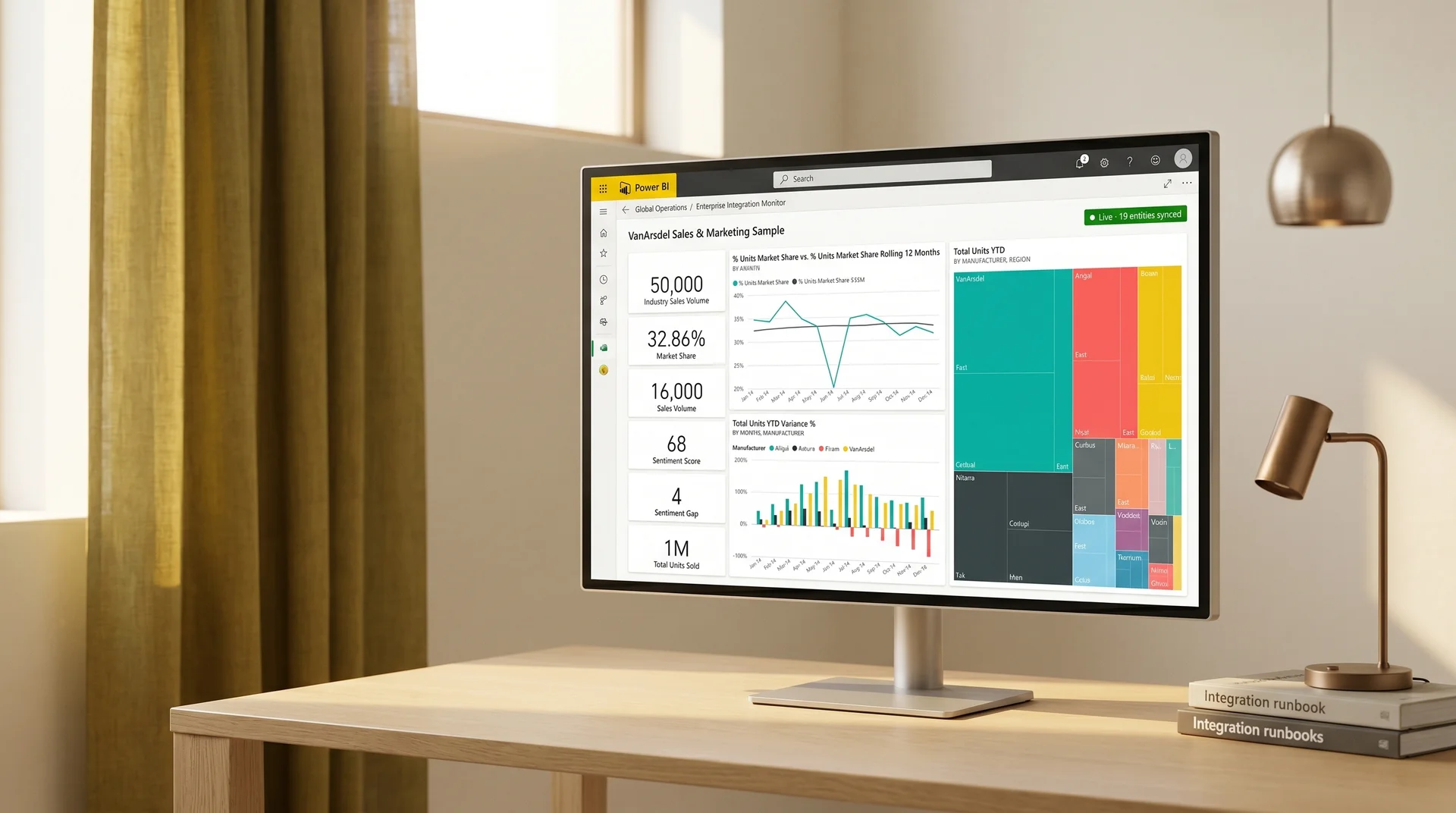
Redefine unified all 19 legal entities on a single enterprise platform. Workflow automation cut document approval times across multiple management levels. Budget controls now run with minimal manual input. Field service teams manage power plants and assets from one central system. Analytics dashboards give leadership a full operational picture across every data source.
Most enterprise integration projects fail at the handoff, not the build
Other integration partners configure connectors, show you a diagram, and leave. We design the architecture. We build transformation logic. We document every flow. And we hand over a system your team can run without us.
Differentiation · Enterprise integration architects collaborating

What other integration consultants deliver
- Point-to-point connections that compound in complexity with every new system
- Custom logic only the original developer can maintain or extend
- Error handling treated as a phase-two backlog item
- No documentation delivered after go-live
- Integration licenses tied to a platform your team cannot exit
What Redefine delivers
- Hub-and-spoke architecture built to absorb new systems without rebuilding flows
- Full code ownership transferred to your team at handoff
- Error handling, alerting, and retry logic built into every connector
- Structured runbooks and flow documentation delivered at handoff
- Integration architecture that scales without a subscription holding it hostage
Questions enterprise teams ask before starting an integration project
Enterprise application integration connects your business-critical systems so they share data automatically. For large organizations, running separate platforms for finance, operations, sales, and fulfillment without integration creates real problems. Data lives in silos. Reconciliation eats hours every week. Reports are outdated before anyone opens them. A well-designed enterprise application integration layer fixes this by moving data between systems in real time, based on your business rules.
We connect ERP systems, CRM platforms, warehouse management systems, ecommerce storefronts, marketplaces, BI tools, field service apps, and custom internal databases. If a system has an API, supports file-based exchange, or uses standard messaging protocols, we can bring it into your integration architecture.
Point-to-point integrations connect two systems directly. They become unmanageable as your system count grows. Enterprise application integration routes data through a centralized hub instead. This is often a hub-and-spoke or event-driven message bus model. Adding a new system means connecting it to the hub once. You do not rebuild a direct connection to every existing system. The result is an architecture you can maintain, audit, and scale as your business grows.
We use both, and the choice depends on your systems, data complexity, and long-term ownership requirements. Pre-built middleware connectors accelerate standard system pairs. For organizations with custom data models, proprietary systems, or business logic that generic connectors cannot handle, we design and build custom enterprise application integration logic, including transformation rules, validation layers, and error-handling workflows, so you are not constrained by what a platform supports out of the box.
Every enterprise application integration engagement includes a system discovery and architecture review, field-level data mapping specifications, connector build or configuration, end-to-end testing with reconciliation validation, error-handling and alerting setup, and a structured handoff with documented runbooks. For organizations requiring ongoing support, we offer monitoring retainers that cover incident response, endpoint additions, and platform-version management as your stack evolves.
Tell us which systems need to talk. We will map the integration architecture.
Scoped before work starts. Line-by-line pricing. No obligation to move forward.
Response in 48 hours
A senior integration architect reviews every brief
Proposal in 3 days
Line-by-line scope with architecture and timeline
200+ integrations delivered
Across enterprise resource planning, ecommerce, and logistics
Full code ownership
No platform lock-in, no subscription dependency
Brief received
We'll review your enterprise setup and send a scoped integration proposal within 3 business days.