WooCommerce integration services
Your WooCommerce store integrated with every system it depends on.
Orders, products, inventory, and customers sync between WooCommerce and your enterprise resource planning or accounting system automatically. No plugin subscriptions. No recurring middleware fees.
0+
WooCommerce integrations
14d
First live sync
Zero
Plugin fees
Submit brief → call in 48 hours → proposal in 3 days → first sync live in 14 days
Your team's time is typically 1 to 2 hours per week, one field mapping review and a quality assurance sign-off. We build the connectors and handle every edge case.
WooCommerce REST API
WordPress hooks
WordPress Multisite

The manual WooCommerce operations problem
Here is where 3 hours of your team's day goes when WooCommerce and your enterprise resource planning do not talk.
This is not an edge case. It is the daily reality for every WooCommerce store running on a separate enterprise resource planning, accounting platform, or fulfillment system.
Without WooCommerce integration
9:00 am
Export yesterday's orders from WooCommerce to CSV
30 min
9:30 am
Import CSV to enterprise resource planning, fix duplicate customer records
45 min
10:30 am
Check enterprise resource planning stock levels, manually update WooCommerce
40 min
11:15 am
Fix pricing conflict: enterprise resource planning and WooCommerce disagree
20 min
2:00 pm
New product added to enterprise resource planning: publish manually to WooCommerce
45 min
4:30 pm
End of day: find 3 sync errors, troubleshoot manually
35 min
Daily total: 3 hours 35 min of manual integration work
With WooCommerce integration
9:00 am
All overnight orders auto-created in enterprise resource planning via webhook
Automated
9:30 am
Customers matched or created in enterprise resource planning automatically
Automated
10:30 am
WooCommerce inventory updated from enterprise resource planning in real time
Automated
11:15 am
Prices in sync: enterprise resource planning is the source of truth for both
Automated
2:00 pm
New enterprise resource planning product auto-published to WooCommerce store
Automated
4:30 pm
Integration dashboard green. Zero errors. Zero backlog.
In sync
Daily total: 0 hours manual integration work3h 35min returned to your team

WooCommerce integration approach comparison
How WooCommerce integrations compare across three approaches.
Plugin-based connectors break on WordPress updates. iPaaS middleware adds recurring costs and API limits. Custom integration gives you full WooCommerce API coverage with code you own.
| Integration criteria | Plugin or iPaaS approach | Redefine custom integration |
|---|---|---|
WooCommerce API coverage | Core endpoints only Custom product attributes, subscription products, and third-party plugin data not covered | Full REST API + WordPress hooks Every endpoint available. Plugin-modified data fields mapped before build starts |
Sync method | Polling every 5 to 15 minutes Orders sit in queue for up to 15 minutes before appearing in enterprise resource planning | Real-time webhooks + batch fallback WooCommerce webhook fires instantly. Batch catchup runs every 5 minutes as safety net |
WordPress plugin conflicts | Breaks on plugin updates Third-party plugins that modify orders, products, or customers break generic connectors silently | Plugin stack audited before build Installed plugins reviewed. Integration built to handle their specific modifications to WooCommerce data |
Code ownership | No, vendor dependent Cancel the plugin or iPaaS, lose the integration. No access to sync logic running your business | Full source code on go-live day Complete source code, field maps, and documentation delivered. No ongoing licence required |
Error handling | Silent failure Sync errors accumulate in a log no one reads. Problem discovered when customer complains about missing order | 4h service level agreement with classified alerts Every failed sync event classified by type and routed to the right team with resolution path |
Pricing model | Monthly subscription WooCommerce plugin: $99 to $299 per month. iPaaS middleware: $299 to $1,500 or more per month. Costs scale with order volume | Fixed scope, fixed fee One project, one invoice. No monthly subscription. No per-transaction charges. No volume caps |
WordPress Multisite | Not supported Generic plugins and connectors are built for single-site WordPress with one WooCommerce store | Per-site sync rules supported Each site in a WordPress Multisite network can have independent sync rules and enterprise resource planning routing |
What gets integrated
Every WooCommerce object your operations depend on, synced to your enterprise resource planning.
100%
WooCommerce orders auto-created in enterprise resource planning
Every order placed in WooCommerce creates a corresponding enterprise resource planning sales order with correct customer attribution, line items, discounts, and shipping cost. Order status flows back to WooCommerce automatically.
Webhook-drivenRefunds and cancellationsGuest and registered
<30s
Inventory and pricing sync from enterprise resource planning
Stock levels update in WooCommerce within 30 seconds of an enterprise resource planning warehouse transaction. Pricing changes made in enterprise resource planning, including customer tier prices and sale prices, push to the correct WooCommerce product fields automatically.
Stock levelsCustomer group pricingVariable product stock
Zero
Manual product and customer maintenance
Products created or updated in enterprise resource planning publish to WooCommerce automatically with correct categories, attributes, and descriptions. New WooCommerce customers create enterprise resource planning accounts immediately. Existing enterprise resource planning customers are matched by email to prevent duplicates.
Product auto-publishCustomer dedup logicCustom fields
Pricing transparency
Scoped per object, per plugin, per enterprise resource planning version. No commitment to receive a proposal.
Factor 1
WordPress and WooCommerce version
WooCommerce REST API capabilities differ between WooCommerce 5.x and WooCommerce 8.x. WordPress Multisite with WooCommerce on multiple sites is more complex than a single-site install. We confirm your setup before writing scope.
Factor 2
Plugin stack and custom field depth
Stores with WooCommerce Subscriptions, WooCommerce Memberships, or custom plugins that modify order or product schema require a plugin audit before build starts. Each custom field adds scope to the field mapping work.
Factor 3
Enterprise resource planning or accounting platform connected
WooCommerce connected to Dynamics 365, NetSuite, or SAP is more complex than WooCommerce connected to QuickBooks or Xero. Each enterprise resource planning connector is scoped and priced separately from the WooCommerce connector.
Client proof
WooCommerce integration built. Manual operations eliminated. Enterprise resource planning in sync.
WooCommerce integration results
0%
Orders routing to enterprise resource planning automatically
Zero
Manual data entry per day after go-live
14d
First live order sync from signed scope
Equipment dealer, business-to-business and direct-to-consumer
Challenge
WooCommerce store running with 400 or more product stock-keeping units required manual enterprise resource planning sync every day. Pricing discrepancies between WooCommerce and enterprise resource planning caused incorrect invoices. Inventory updates took 24 or more hours to reflect in the store, causing overselling.
Integration approach
Custom WooCommerce REST API integration with enterprise resource planning. WooCommerce webhook triggers enterprise resource planning order creation on every purchase. Enterprise resource planning stock and pricing push to WooCommerce in real time on every warehouse transaction. Customer matching by email with deduplication logic.
WooCommerce RESTWordPress webhooksEnterprise resource planning order routingReal-time inventory
Result
Pricing errors eliminated. Order routing fully automated. Inventory accurate within 30 seconds of any enterprise resource planning warehouse movement. Manual integration work removed from daily operations.
Sync method
Real-time webhooks
Error handling
4h alert service level agreement
Why choose Redefine
What separates a WooCommerce integration that lasts from one that breaks.
What matters
Typical approach
Redefine approach
Architecture sign-off before build
Build first, discover problems during quality assurance
Field map approved before any code written
WooCommerce plugin audit
Skipped, discovered as a problem post-launch
Required first step. Plugin conflicts resolved before build
Implementation timeline
6 to 16 weeks with vague milestone dates
First order in enterprise resource planning in 14 days. Go-live in 21 days.
WordPress major version updates
May break connector with no warning
Custom code targets stable WooCommerce REST API endpoints that persist across WordPress versions
Common questions
What buyers ask before starting a WooCommerce integration project.
WooCommerce exposes two API layers: the WooCommerce-specific REST API (at /wp-json/wc/v3/) for orders, products, customers, and reports, and the WordPress REST API (at /wp-json/wp/v2/) for posts, pages, and media. A complete integration uses both. We also leverage WooCommerce's webhook system for real-time event notifications, woocommerce_checkout_order_processed, woocommerce_order_status_changed, and woocommerce_product_updated are used for instant sync rather than polling.
We support any WordPress/WooCommerce setup that exposes its data through the REST API or WordPress action hooks. Commonly integrated extensions include WooCommerce Subscriptions (recurring billing and subscriber data), WooCommerce Memberships (membership tiers and access rules), Advanced Custom Fields (custom product and order fields), and WPML (multilingual stores). We audit your installed plugin stack before writing scope, any plugin that modifies order, product, or customer data is reviewed and the integration accounts for its changes.
Yes. WooCommerce variable products (parent and variation structure) are mapped to their enterprise resource planning item equivalents during the field mapping step. Each variation's stock-keeping unit, stock level, and pricing syncs independently. The parent product attributes (color, size, and so on) map to enterprise resource planning attribute values. For high-variation catalogs (100 or more variations per product), we use batch sync strategies to avoid hitting WooCommerce's per-request limits.
The integration targets stable WooCommerce REST API endpoints that WooCommerce has maintained across major versions. We avoid relying on WordPress internals or undocumented hooks that change without warning. In practice, major WordPress or WooCommerce version upgrades require a compatibility review (which we can scope and price as a maintenance retainer or fixed engagement), but routine minor updates generally do not affect the integration.
Fixed-scope, fixed-fee pricing based on your WooCommerce version, plugin stack complexity, connected enterprise resource planning or accounting platform, and sync objects required. Each object type, orders, products, inventory, customers, is scoped and priced individually. You receive a line-by-line proposal before committing. No monthly platform subscription, no per-transaction fees, no plugin licences. Source code and documentation delivered at go-live.
Start your WooCommerce integration project
Get a scoped proposal in 3 days.
No commitment. No pitch. Tell us your WooCommerce setup, installed plugins, and connected systems and we will send a line-by-line proposal with field map, timeline, and cost.
Brief received
We will review your WooCommerce setup and send a scoped proposal within 3 business days. Expect a call within 48 hours.
Call within 48 hours → scoped proposal in 3 days → no commitment required
Call in 48 hours
Proposal in 3 days
160+ projects
Code ownership
Start your WooCommerce integration project
Connect WooCommerce to every system your store depends on. No plugins. No iPaaS. Code you own.
No commitment. No pitch. Tell us your WooCommerce version, plugin profile, and enterprise resource planning platform. We will send a scoped proposal with exact field map, timeline, and cost in 3 days.
No commitment. No pitch. Call within 48 hours.
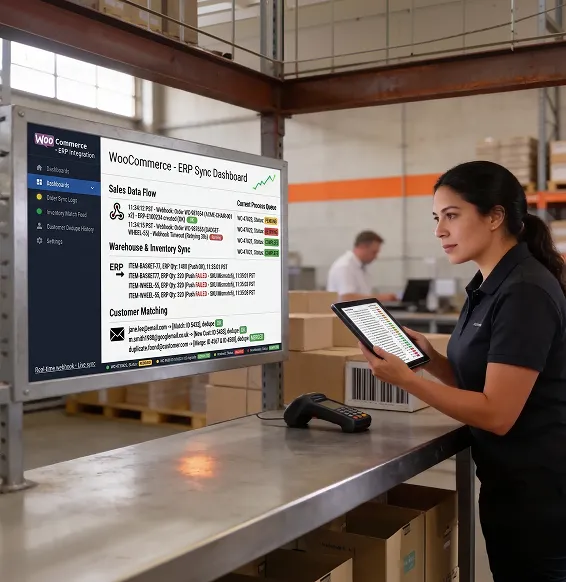
Order #WC-47821 webhookEnterprise resource planning sales orderCreated
Stock-keeping unit 4421 stock: 47 unitsEnterprise resource planning stock syncUpdated
New customer: Apex CorpEnterprise resource planning accountMatched
Price list: tier B customersWooCommerceSynced
Zero manual actions required.Day 14 of 14
