Zapier integration that stays reliable when your business hits scale.
We audit your Zaps, build custom middleware around them, or replace them with owned integration code. Fixed pricing. One team. All three paths.
Pricing signal
Submit brief → call within 48 hours → Zapier audit brief in 3 days → build starts within 1 week of sign-off
Your team's involvement across a Zapier audit or migration build is typically 2 to 3 hours per week: one workflow review session, async feedback on the migration plan, and a sign-off on the first live replacement. We handle everything else.
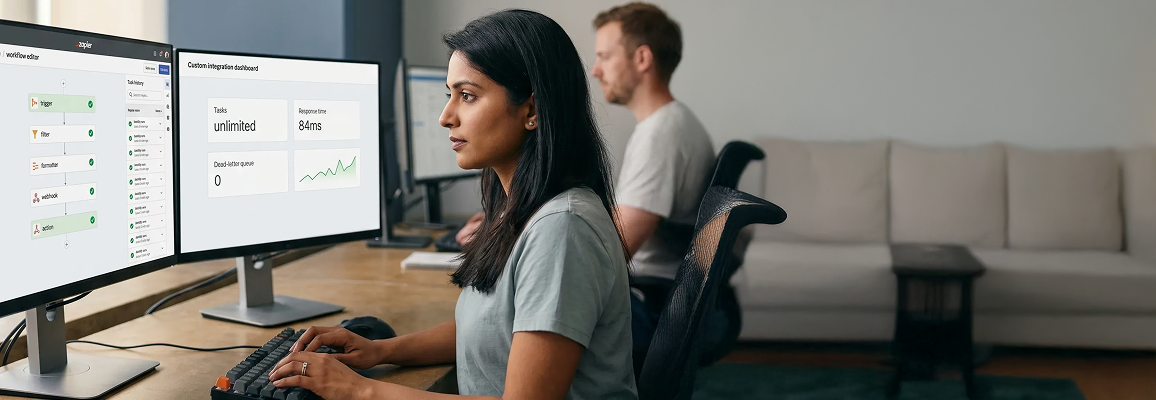
Real Zapier errors that cost businesses revenue every month
Your team has already hit these failure modes. Or you will, as volume grows. Zapier handles simple automation well. It does not handle business-critical reliability.
Every failed record enters a dead-letter queue. Error alerts fire before data loss compounds. Nothing gets silently skipped.
Custom integration runs on your infrastructure. No per-task billing limits. No paused automations during month-end peaks.
Data contracts lock down field types before the build starts. Null values, mismatches, and format errors get caught and handled. Nothing gets skipped.

Is Zapier still the right tool for your automation stack?
Check every item that matches your current setup. Your score shows which path fits your operation.
Three Zapier integration paths. One team delivers all three.
Zapier triggers. Redefine middleware.
Keep your Zapier webhooks and triggers. Replace the limited code steps with a middleware layer that handles transforms, validation, and error recovery. You get Zapier's speed with production-grade reliability.
Full custom integration replacing your Zaps
Real-time sub-second responses. Zero task limits. Full audit trails. Dead-letter queues. No monthly platform fee. Zapier is migrated out entirely.
Zapier workflow audit and optimization
Before building anything, we audit your existing Zaps. The report identifies failure-prone steps, recommends reliability fixes, adds error notifications, and documents every workflow for your team.
Off Grid Knives: BigCommerce, Klaviyo, and Amazon connected. Revenue from $1M to $3.8M in 3 years.

Off Grid Knives grew from $1M to $3.8M in three years through integrated multi-channel automation. The same automation patterns underpin our Zapier integration consulting work.
Off Grid Knives faced strict advertising restrictions on knife sales. Growth had to come from owned channels, SEO, and automation. The existing ecommerce setup required manual order processing with no unified channel view.
A custom BigCommerce store with API-driven order processing. Klaviyo integrated for server-side event tracking and lifecycle automation. Amazon Store and A+ connected as additional channels with unified inventory.
Annual revenue grew from $1M to $3.8M in three years. Klaviyo became a major revenue channel. Multi-channel integration drove growth without paid advertising.
How Zapier integration and custom middleware work together
The hybrid architecture uses Zapier for no-code triggers and API connectors. Custom middleware replaces Zapier where it fails. Transforms, error recovery, and reliability run on your own infrastructure.
When Zapier handles it natively versus when you need Redefine
This is the honest comparison most Zapier integration companies avoid publishing.
Zapier integration consulting: what you need to know
Zapier integration services cover three areas. First, building new Zapier workflows and Zaps for your business. Second, extending Zapier with custom middleware when native Zaps hit their limits. Third, migrating off Zapier to custom integration when reliability and scale demand it. See the custom integration versus Zapier comparison for the full breakdown.
Replace Zapier when you hit monthly task limits regularly, when Zaps fail silently without recovery, when you need sub-second real-time responses, when multi-step data transforms exceed Zapier filter logic, or when your Zapier subscription cost grows faster than the value it delivers. The readiness checklist above gives you a scored assessment.
Yes. The hybrid approach is the most common engagement. Zapier handles event triggers and routing (what it does well), while a Redefine custom middleware layer handles transforms, error recovery, and data validation (what Zapier does poorly). This extends Zapier's reach without a full migration. See our API integration services page for the middleware layer detail.
A Zapier audit takes 5 to 10 days and delivers a full risk assessment with a fix versus migrate recommendation. A hybrid build adding custom middleware to your existing Zapier setup runs 12 to 18 days. A full migration from Zapier to custom integration runs 3 to 6 weeks depending on the number of Zaps being replaced.
Zapier audits start from $800 fixed-price. Hybrid builds combining Zapier triggers with Redefine custom middleware start from $3,200. Full custom integration builds replacing Zapier entirely start from $6,400. All builds include a confirmed go-live date and 30 days of post-launch support. There are no ongoing subscription fees for the custom integration code.
Get Your Zapier Integration Audit Plan
Tell us about your Zapier setup and what is failing. We respond within 48 hours with a call and a clear path forward.
Call within 48 hours → audit brief in 3 days → build starts within 1 week of sign-off
Brief received
We will review your Zapier setup and send an audit plan within 3 business days.

Start with the audit. Know exactly what is at risk. Get your plan in 5 days.
96 Zapier builds delivered. Fixed pricing from $800. Your team commits 2 to 3 hours per week. We handle the rest.
No commitment. No pitch.