You've outgrown Zapier. Now get custom integration with no task limits and no vendor lock-in.
Zapier to custom integration services that replace brittle Zaps with automation code your team owns. No task limits. Real-time event triggers. Business logic as complex as you need it. Zero per-task billing.
integration projects delivered · ecommerce, SaaS, and enterprise teams across the US
Hero · Custom integration replacing third-party Zap automations

(No change recommended)
Task limits. Polling delays. Missing connectors. Fragile multi-step Zaps that break on every schema change. When Zapier costs more than it saves, a custom integration migration is overdue.
Signs you have hit the Zapier wall
Monthly task counts are driving your Zapier bill, not your feature needs
You pay more each month simply because your business grew, not because the tool got better.
Zaps poll on 15-minute or longer intervals so your data is always slightly stale
Real-time events are not possible on Zapier. Your business runs on delayed information.
The system you need to connect has no Zapier connector
Your custom or legacy system is invisible to Zapier's connector library and always will be.
Multi-step Zaps with conditional logic are fragile and break on any schema change
Complex logic built in Zapier's step editor becomes unmaintainable and fails silently.
Task limit reached · automations paused
You have used 49,847 of 50,000 tasks this month. Zaps will stop running until your billing cycle resets on the 1st.
Current plan · Professional · 50,000 tasks/month
Upgrade to Business plan for 100,000 tasks · $599/month · or migrate to custom integration
See what your Zaps look like after a custom integration migration
Same workflows. Two different outcomes. Compare how they run on Zapier versus a custom integration your team owns outright.
(No change recommended)
Last 24 hours · All Zaps
312 orders missed fulfillment window · manual recovery required
(No change recommended)
Last 24 hours · All integration flows
0 missed fulfillment windows · 0 manual recovery required today
What custom integration gives you that Zapier never will
This migration is not just about removing task limits. It gives your automation a real architecture so your business runs without caps, delays, or vendor dependencies.
No task limits, no billing per event, no ceiling on your automation
Custom integration runs as many events as your business generates. Your automation bill does not grow when your transaction volume grows.
Real-time event triggers instead of 15-minute polling
Custom integration fires the moment an event occurs. No polling window. Your downstream systems reflect the current state of your data within seconds.
Unlimited conditional logic and data transformation in code
Any business rule, any transformation, any conditional branch. Custom integration code expresses logic that a Zap step editor simply cannot represent.
Connect any system with an API, including your custom tools
No connector library needed. If a system has an API, custom integration code can reach it, no matter how niche or proprietary.
Structured error handling that surfaces failures before they cascade
Every failed event is logged with context, retried with backoff, and surfaced to your team through the alerting channel you already use. Nothing disappears silently.
Full code ownership with runbooks your team inherits at handoff
The code, the docs, and the monitoring setup are yours at handoff. No vendor can change pricing, deprecate a connector, or hold your automation hostage.
How one ecommerce brand replaced Zapier with a custom integration across Shopify and Amazon
A US-based consumer brand on Shopify was syncing inventory, customer data, and orders across Shopify and Amazon using Zapier and manual processes. Orders got delayed. Inventory counts drifted between platforms. Every fix required someone to manually reconcile the data.
Pain before custom integration
- Manual processes with limited efficiency across Shopify, Amazon, and supporting tools
- Inventory and customer data inconsistencies across every platform requiring manual reconciliation
- Ongoing technical instability and integration breakages requiring constant monitoring and repair
Manual data entry removed across Shopify and Amazon
Platforms connected through one integration layer
Manual recovery tasks after go-live
Case Study · Custom integration monitor replacing third-party connectors
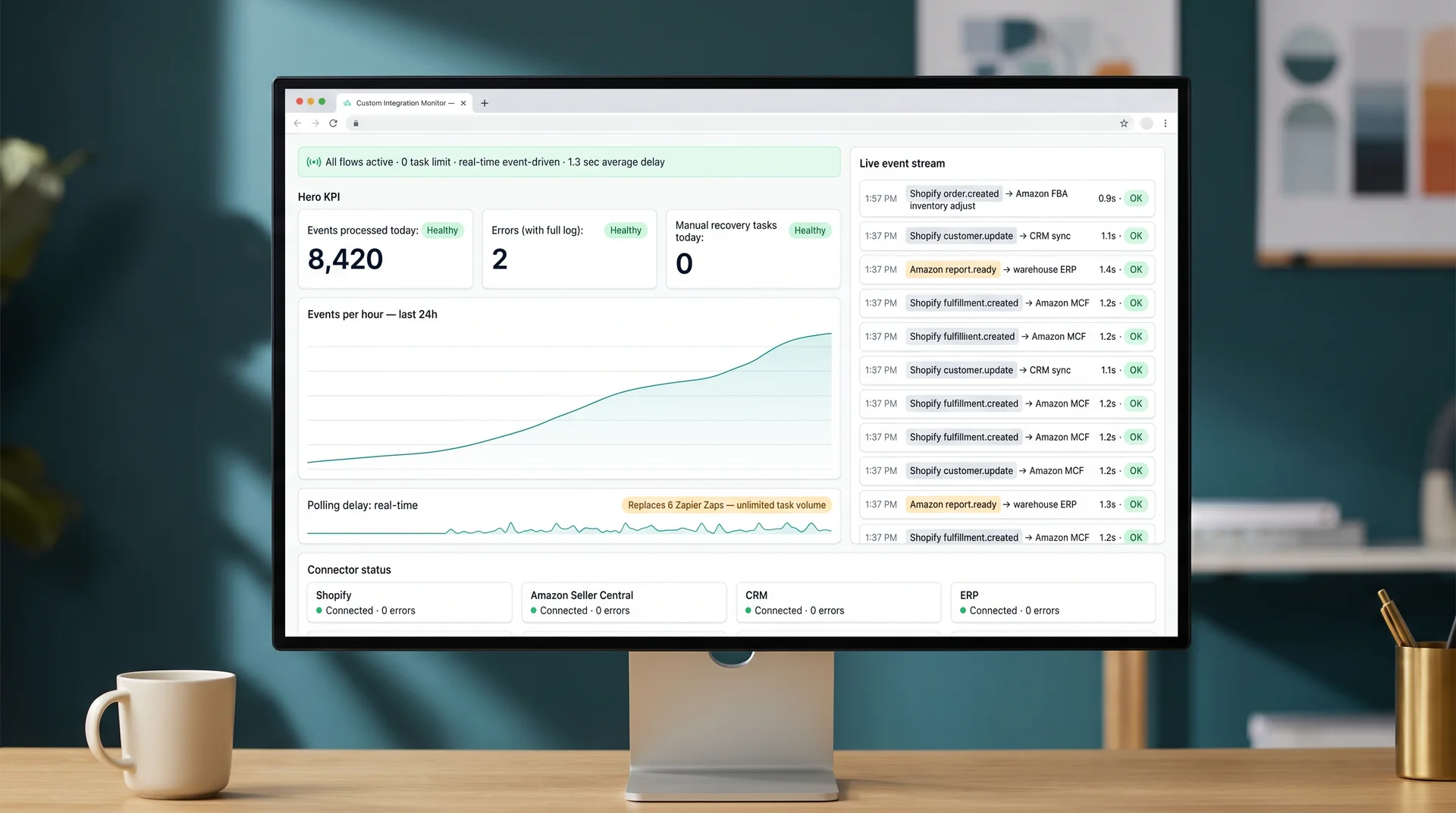
We built a custom integration layer connecting Shopify with Amazon and their supporting tools. Order sync, inventory updates, and customer record matching now run automatically with zero manual steps. After go-live, the team reported zero manual recovery tasks and consistent inventory accuracy across both platforms.
Migrating from Zapier is not just swapping one tool for another. It is rebuilding how your systems talk to each other.
Every Zapier to custom integration migration starts with a full audit. We map each Zap, document the logic, and flag the edge cases. Then we build replacement automation that handles what your Zaps were getting close to, plus the failures they were hiding.
Differentiation · Migration audit review, custom integration planning session

What most migration projects overlook
- Replacing the happy-path flow but missing the edge cases the old Zap was quietly handling wrong
- Cutting over too fast and leaving your business exposed during a half-complete migration
- Rebuilding the Zap as a script with the same brittleness instead of a real integration architecture
- No documentation, no monitoring, and no runbooks after go-live so the team is back to square one
What every Redefine migration includes
- Full Zapier to custom integration audit mapping every Zap, its logic, and its known failure modes
- Parallel-run migration with both systems running until the custom integration passes parity validation
- Error handling, retry logic, and alerting built into every replacement flow from the first sprint
- Runbooks, flow diagrams, and monitoring thresholds delivered with the code at handoff
Related integration services
Common questions about Zapier to custom integration migration
The clearest signals: you keep hitting Zapier task limits and upgrading plans just to keep running. Your conditional logic needs more steps than Zapier can handle. You need to connect a system with no Zapier connector. Or Zap failures cause downstream problems your team has to fix by hand. If any of these sound familiar, a Zapier to custom integration migration is worth scoping.
A properly managed Zapier to custom integration migration runs both systems in parallel during a cutover period. We build and test the custom integration, validate that every workflow produces the same output as your existing Zaps, then switch traffic to the new system and disable the Zaps only after confirming parity. Existing automation continues running throughout the migration so your business is never dependent on a half-complete transition.
Custom integration code handles unlimited task volume with no per-task billing. It supports complex conditional logic across multiple systems at the same time. You get real-time event streaming instead of polling intervals, custom data transformation rules, and connections to systems that have no Zapier connector. Every failed event gets structured error handling with automatic retry and alerting. Zapier works well for simple flows between supported apps. Custom integration handles everything beyond that.
Most Zapier to custom integration migrations covering five to fifteen workflows go live in four to eight weeks. The timeline depends on the complexity of the logic in your existing Zaps, the number of systems involved, and how much custom transformation or error handling the replacement needs to support. We publish a line-by-line delivery timeline before work begins so your team can plan around each milestone.
Yes. Every custom integration we build transfers to you at handoff with documented runbooks, flow diagrams, and monitoring configuration. You own the code completely with no ongoing per-task billing and no dependency on a platform that can change its pricing or connector support at any time. Your team or any developer can maintain and extend the integration without returning to us.
(No change recommended)
Scoped before work starts. Line-by-line pricing. No commitment required to get a proposal.
Response in 48 hours
A migration specialist reviews every brief
Proposal in 3 days
Line-by-line scope with migration plan
200+ integrations delivered
Across ecommerce, enterprise resource planning, and cloud platforms
Full code ownership
Your code, your runbooks, no task billing
Brief received
We'll review your Zapier setup and send a scoped custom integration proposal within 3 business days.
We can scope your Zapier to custom integration migration and have it live in weeks
No commitment. No pitch. You get a line-by-line proposal built around your existing Zaps and the custom integration that replaces them. The migration plan runs both systems in parallel so your business never stops.
Submit your brief · call within 48 hours · scoped proposal in 3 days · Sprint 1 within 1 week of sign-off