Permissions Management Software That Spans Every Module
Our permissions management software governs who sees what across product information management, storefront, order management, marketplace, forms, and program stores. No separate admin consoles. No permission drift between tools.

When permissions live in six different tools, every hire is a security gap
Most platforms bolt on a basic admin panel per product instead of unified permissions management software. Your team ends up with overlapping accounts, mismatched roles, and no single place to audit who has access to what.
Each tool has its own admin panel. Onboarding a new hire means six separate role assignments across six systems.
When a data change happens, there is no single trail. You cannot tell which user edited which field in which system.
Offboarding leaves orphaned accounts because IT has no visibility into every tool the employee touched.
Editors can accidentally overwrite pricing or publish unapproved content because field-level restrictions do not exist.
Auditors ask for an access report. You spend two days pulling exports from every system and reconciling them manually.
Automation agents can run bulk operations across your catalog with no role-based scope. Any model sees everything.
Assign a role once in the access control software. Access propagates across product information management, order management, storefront, marketplace, forms, and program stores automatically.
Every field edit, login, export, and approval is captured in one tamper-evident log. Instant access on any device.
Deactivate a user in one place. Access is revoked across every module immediately. No orphaned accounts.
Lock pricing fields to finance roles. Lock publish actions to senior editors. Granular control per field, per module.
Export a full access matrix in seconds. Show auditors who has access to what, with timestamps and approval chains.
Automation agents inherit the same rules as human users. Artificial intelligence can only touch what its assigned role permits.
Every team sees exactly what they need. Nothing more.
Redefine's role-based access control, or RBAC software, adapts to your organizational structure. Choose a role to see the experience your team gets.
Full system control with complete audit visibility
- Manage all users, roles, and permission templatesCreate roles once and apply them as templates. Duplicate for new team members in under 60 seconds.
- Single sign-on and multi-factor authentication enforcement across all modulesEnforce single sign-on and multi-factor authentication from one identity governance software panel. No per-tool configuration.
- Full audit log export for compliance and security reviewsPull timestamped logs per user, per module, per action. Export as comma-separated values or feed directly into your security information and event management system.
- Artificial intelligence governance: scope automation agents by roleAutomation agents run under assigned roles. Bulk enrichment only touches what the role allows.
Edit products without touching pricing, orders, or publishing controls
- Field-level restrictions by attribute groupManagers can update descriptions, images, and specifications. Pricing, cost, and margin fields are read-only to their role.
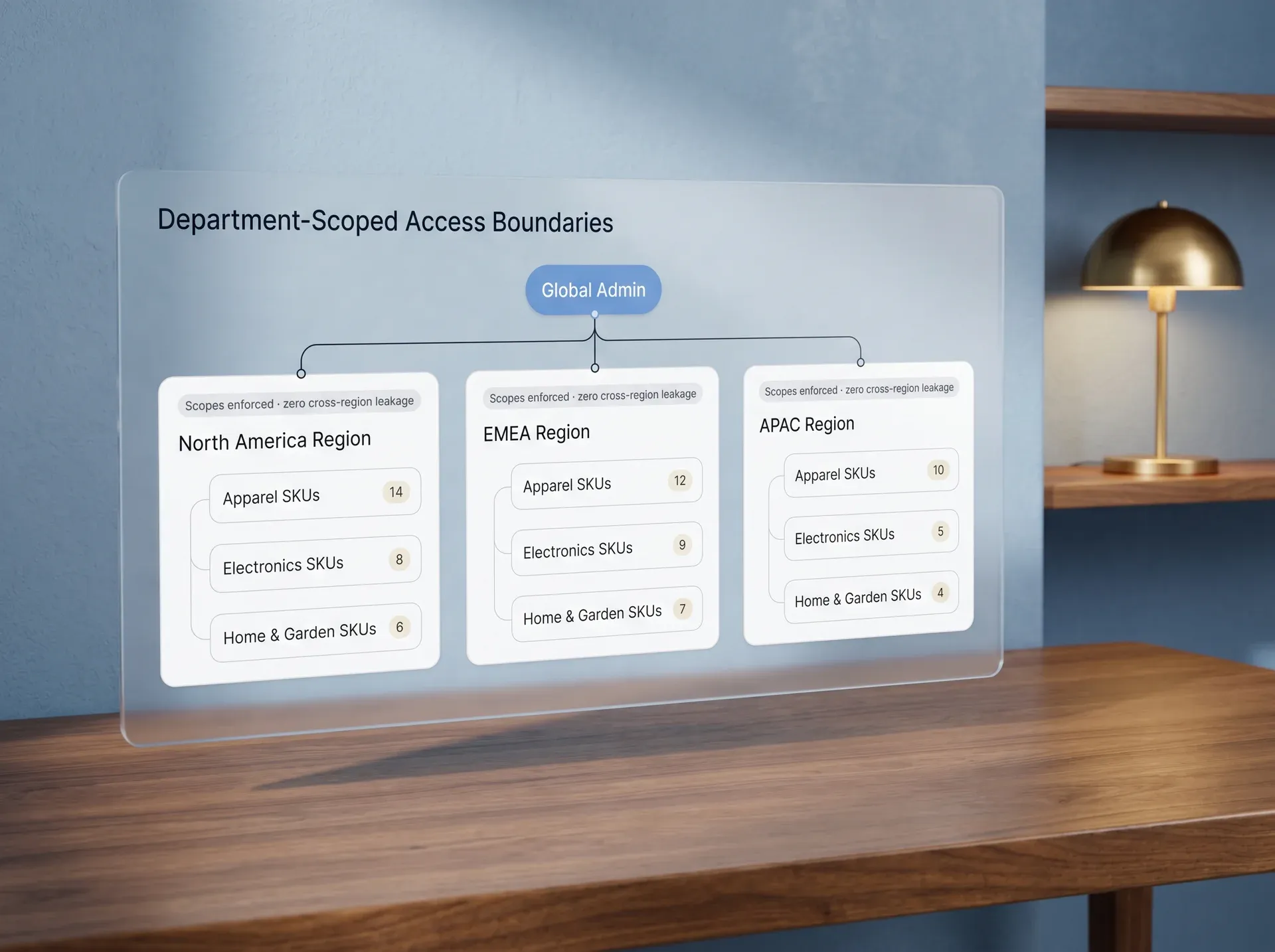
- Department-scoped product catalog accessApparel team only sees apparel stock-keeping units. Electronics team only sees electronics. No cross-department data exposure.
- Approval workflow before any publish actionCatalog updates go through a review queue before going live. Senior editors approve or reject with one click.
- Bulk operations scoped to your role boundaryRun bulk enrichment across your department. System enforces your role boundary automatically on every operation.
Application programming interface keys scoped to roles. Integrations inherit the same permission model.
- Application programming interface tokens bound to role permissionsGenerate application programming interface keys that inherit a specific role's access scope. Integration cannot exceed what the role allows.
- Webhook and event scopingSubscribe to only the events your integration is permitted to receive. No cross-module event leakage.
- Single sign-on integration with your identity providerConnect SAML 2.0 or OpenID Connect. User roles map from your identity provider groups automatically on first login.
- Audit log application programming interface for security information and event management integrationStream tamper-evident logs to Splunk, Datadog, or any security information and event management system via representational state transfer application programming interface. Real-time or batch export.
Every access control software capability your enterprise requires
From role templates to attribute-level locking, Redefine ships every permission primitive in one permissions management software platform, not scattered across product add-ons.
Role-based access control across product information management, order management, storefront, marketplace, forms, and program stores
A user's role in the user access management software governs their access across every module from day one. No duplicate role configurations. No permission drift when a new module is added to your stack.
- Assign once, propagate everywhere
- Role duplication for fast team onboarding
- Custom roles per department or project team

Lock individual product fields per role, not just entire modules
Go beyond module-level access. Restrict which fields within a product record a role can view, edit, or cannot see at all. Pricing stays with finance. Content stays with editors.
- Per-attribute read, write, and hidden states
- Attribute group locking for related field sets
- All field-permission changes logged to audit trail
Scope data access by team, department, or brand region
Multi-brand or multi-region operations need data walls between teams. Redefine lets you scope users to specific product categories, storefronts, regions, or program stores without creating separate environments.
- Category-scoped catalog access per team
- Region-scoped storefront administration
- Brand-specific program store admin roles
Permission Templates
Build role templates once. Apply to new users instantly. Duplicate and modify for new team structures without starting from scratch.
Single Sign-On and Multi-Factor Authentication
SAML 2.0 and OpenID Connect support. Enforce multi-factor authentication across all modules from a single security policy. No per-tool configuration.
Audit Log Export
Full tamper-evident log of every user action across every module. Export as comma-separated values or stream to your security information and event management system for compliance and forensics.
Session Controls
Set session timeout policies per role. Force re-authentication for sensitive operations like bulk exports or permission changes.
From first role assignment to full compliance posture in under 10 days
Redefine's permissions management software follows a structured onboarding sequence. Your team reviews; we configure your user access management software. Most organizations achieve full role coverage by the end of week two.
We map your departments, teams, and decision-makers to define the role structure before writing a single permission.
We build your RBAC software role library with attribute-level rules. You review and approve before any permissions are applied to live users.
Connect your identity provider. We configure SAML 2.0 or OpenID Connect and test multi-factor authentication enforcement across all modules before go-live.
Users are assigned to roles. Your team runs user acceptance testing. We adjust any edge cases in role boundaries before sign-off.
We run a final access audit, verify log completeness, and hand over the compliance documentation package your security team needs.
From manual approvals to unified RBAC software

Built on enterprise-grade identity governance software
Redefine's access control software runs at the data layer, not the user interface layer. Access enforcement happens before any data reaches the application, regardless of how the request arrives.
Data-layer enforcement
Permission checks run at the application programming interface and database layer. Bypassing the user interface does not bypass access control. Applies equally to human users and artificial intelligence agents.
SAML 2.0 and OpenID Connect
Connect any SAML 2.0 or OpenID Connect identity provider. Role mapping from your identity provider groups happens automatically on each user's first login. No manual sync.
Tamper-evident audit logs
Every action is written to an immutable append-only log. Logs cannot be edited or deleted. Export via representational state transfer application programming interface or stream to your security information and event management system in real time.
Artificial intelligence agent role boundaries
Automation agents are assigned roles like human users. No artificial intelligence model can read or write outside its assigned permission scope. Bulk enrichment runs stay sandboxed.
Access anomaly detection
Artificial intelligence monitors for unusual behaviour patterns: off-hours access, bulk exports, permission escalation attempts. Alerts fire before a breach becomes a breach.
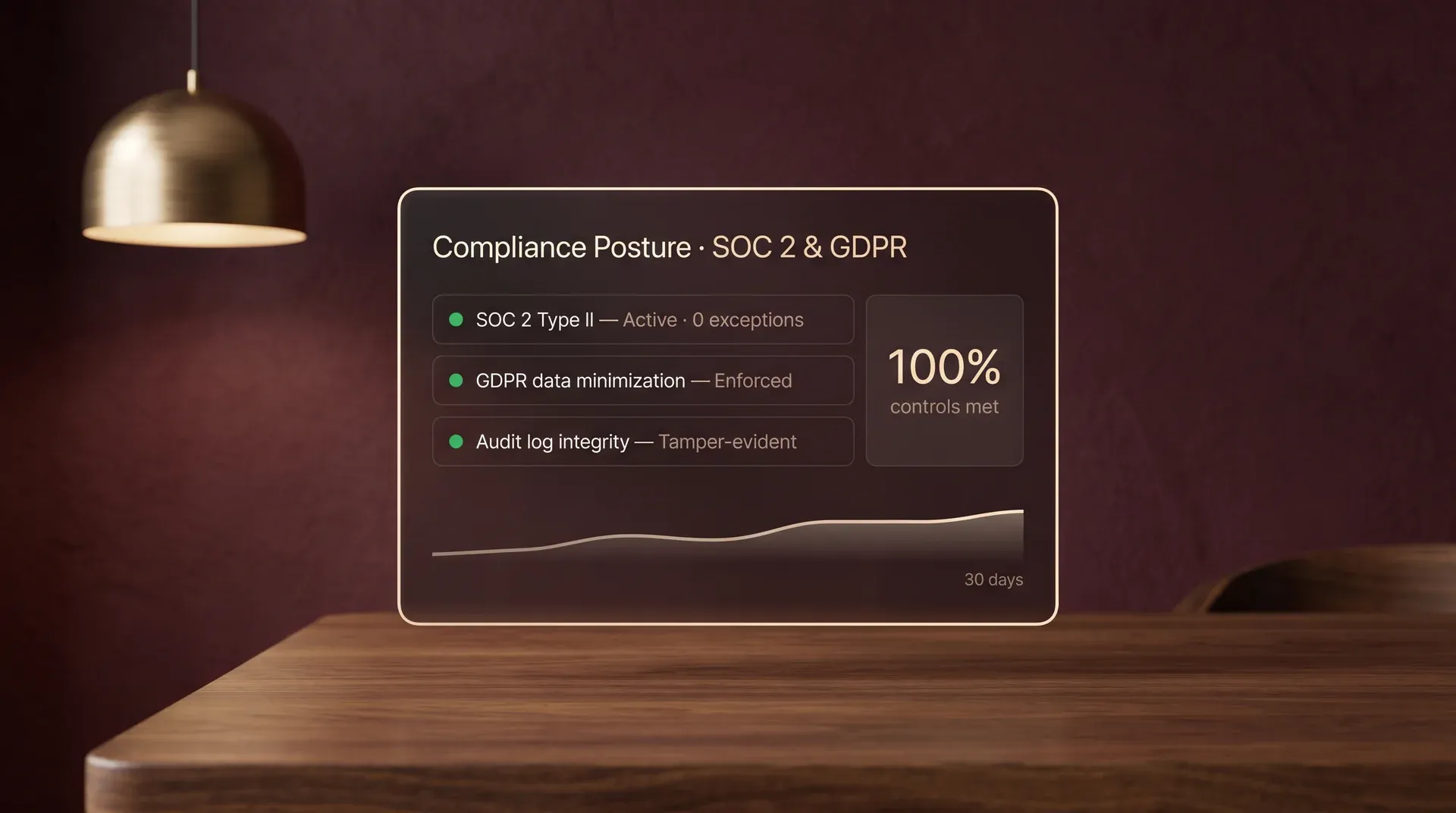
SOC 2 and GDPR ready
Access controls map to SOC 2 Type II and GDPR data minimization requirements out of the box. Compliance documentation included.
Other platforms split governance across products. Redefine unifies it.
When you run product information management, order management, storefront, and program stores in separate tools, you end up with separate identity governance software for each. Redefine's permissions management software eliminates that fragmentation with one engine for the entire stack.
| Capability | Typical partner | Redefine |
|---|---|---|
| Unified role-based access control across all commerce modules | Not available | Available |
| Attribute-level field permissions per role | Not available | Available |
| Single audit log across every module | Not available | Available |
| Artificial intelligence agent role-boundary enforcement | Not available | Available |
| Permission templates and role duplication | Partial | Available |
| Single sign-on with automatic identity provider group-to-role mapping | Add-on cost | Included |
Who benefits most from user access management software
- Teams running 3 or more Redefine modulesThe value of unified RBAC software multiplies with every additional module under one roof.
- Enterprise business-to-business operations with department-scoped catalogsYou need team-level data walls without creating separate environments for each department.
- Organizations preparing for SOC 2, GDPR, or ISO 27001 auditsIdentity governance software evidence is a primary audit requirement. Redefine generates it automatically.
- Operations using artificial intelligence automation that needs guardrailsArtificial intelligence agents running bulk enrichment or catalog updates need the same boundaries as human editors.
- Single-user operations with no team access requirementsIf one person administers everything, a simple admin login is sufficient for your needs right now.
- Direct-to-consumer brands with 2 or fewer staff using the platformSmall teams with shared access do not need formal role-based access control until they start scaling.
- Projects using only one Redefine module in isolationModule-level access is sufficient if you are not yet running a multi-module stack.
Not sure? Tell us your situation and we will be straight with you about whether this fits your operation right now.
Questions buyers ask before committing to unified role-based access control
Redefine role-based access control works alongside your identity provider, not in competition with it. You connect your existing identity provider via SAML 2.0 or OpenID Connect. Users authenticate through your identity provider, and their group memberships map to Redefine roles on first login. You keep your existing single sign-on infrastructure while gaining granular attribute-level control inside Redefine's modules.
You can assign any user a role with a defined expiry date. When the expiry passes, their access is automatically revoked across all modules. All actions taken during the access period remain in the audit log with their user identifier. Contractors never require a separate offboarding process through IT.
Enforcement runs at the data layer, not the user interface layer. Every application programming interface token is bound to a role and that role's permissions apply to all requests made with that token. An application programming interface key configured for catalog read access cannot write pricing data or access order history, regardless of the endpoint called. All application programming interface actions appear in the same audit log as user interface actions.
Most organizations complete role mapping, single sign-on configuration, user assignment, and user acceptance testing within 10 business days. We start with a role inventory session on day one, build and review the role library by day three, connect your identity provider by day five, and complete user acceptance testing by day eight. The final compliance documentation is ready by day ten. Your team's time investment is approximately 3 to 4 hours across the full 10-day window.
Yes. The admin console provides a one-click access matrix export that shows every user, their assigned role, the modules they can access, and the attribute-level permissions for each. The export includes timestamps for every role change and permission modification. Audit logs can be exported as comma-separated values or streamed to your security information and event management system in real time. Both exports satisfy the access evidence requirements for SOC 2 Type II, ISO 27001, and GDPR data minimization reviews.
Stop managing permissions across six different tools
Tell us about your current access setup and we will show you exactly how our permissions management software consolidates it. No commitment. No pitch.

- Call within 48 hours of receiving your brief
- Scoped access policy proposal in 3 business days
- Sprint 1 begins within 1 week of sign-off
- Full access policy live across all modules in 10 days
Brief received
We will review your access setup and send a scoped proposal within 3 business days.
Tell us what your team manages manually that a permission system should handle.
Call within 48 hours • proposal in 3 days • Sprint 1 within 1 week of sign-off
One role system for every module your team runs
Review your security and governance posture, plus your permissions management software setup, with our team. No commitment. No pitch.