Automated reporting software that already knows what's wrong. Now it tells you.
Automated reporting software watches every metric on your ecommerce platform. But right now, spotting an anomaly means staring at dashboards. Redefine's artificial intelligence reads every signal, flags every deviation, and forecasts every trend before your team has had coffee.

Data without intelligence is just noise.
- Revenue dips go unnoticed for days because nobody monitors every metric manually
- Forecasting means exporting comma-separated value files and running pivot tables in spreadsheets
- High-value customer cohorts stay buried in raw data no one has time to segment
- Every insight lives in a separate business intelligence tool that needs weekly maintenance
- Your team reacts to problems that happened three days ago
- Artificial intelligence monitors every metric continuously and alerts you the moment a pattern breaks
- Every dashboard shows a 30/60/90-day AI-predicted trajectory alongside live numbers
- Artificial intelligence cohort discovery names and ranks your best customer segments automatically
- All reporting is native to the platform, fed by the same live data as your operations
- Your team acts on what is happening right now, not what happened last week

This is what your ecommerce reporting software looks like with artificial intelligence built in.
This ai dashboard software counts numbers up on entry. Anomaly alerts pulse in real time. Forecasts update as new orders flow in. Every metric is live.
Revenue Today
$0
Orders
0
Cart Abandonment
AI Alert0%
Average Order Value
$0
Revenue Forecast: 90 Days
Artificial Intelligence Anomaly Alerts
3 activeCart abandonment spiked +18 percentage points in last 2 hours
Checkout page, mobile segment
Product information management completeness dropped below 82%
Category: Electronics, 214 SKUs affected
Marketplace listing errors up 34%
Amazon channel, last 6 hours
Revenue per visitor +9.3%, no action needed
All channels, trending up 5 days
Artificial Intelligence Cohort Discovery
Auto-segmentedRevenue by Channel: Today
versus 30-day averageThree artificial intelligence capabilities no other ecommerce reporting software ships natively.

Artificial Intelligence Anomaly Detection
This automated reporting software monitors every metric on every channel continuously. When any signal deviates from expected range, it fires an alert with an explanation, not just a number. You know what happened and why.
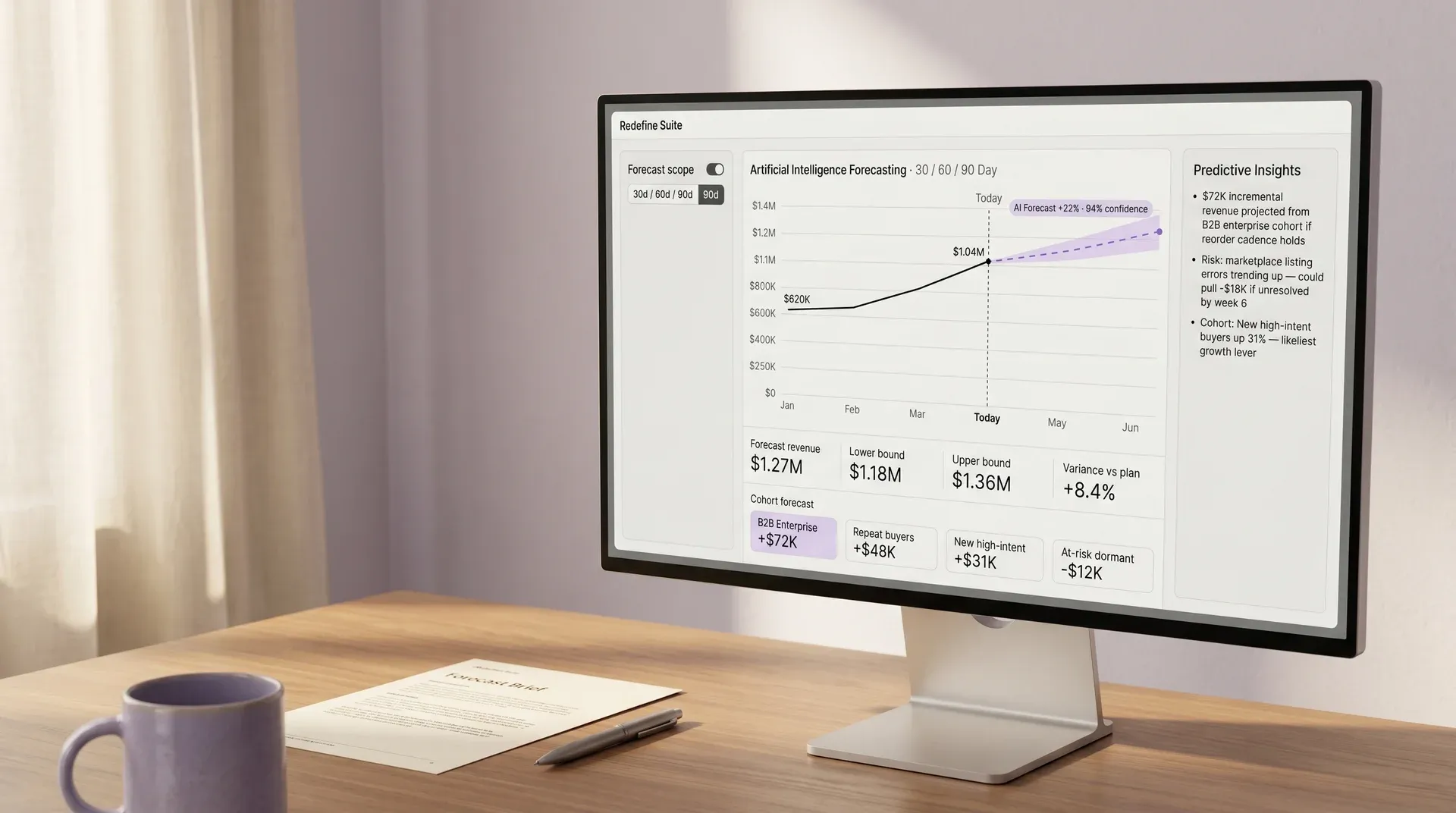
Artificial Intelligence Forecasting in Dashboards
Every key metric shows a 30, 60, and 90-day AI-predicted trajectory alongside actuals. Revenue, orders, product information management completeness, marketplace listings, all get a confidence-banded forecast. No separate forecasting tool. No manual model.
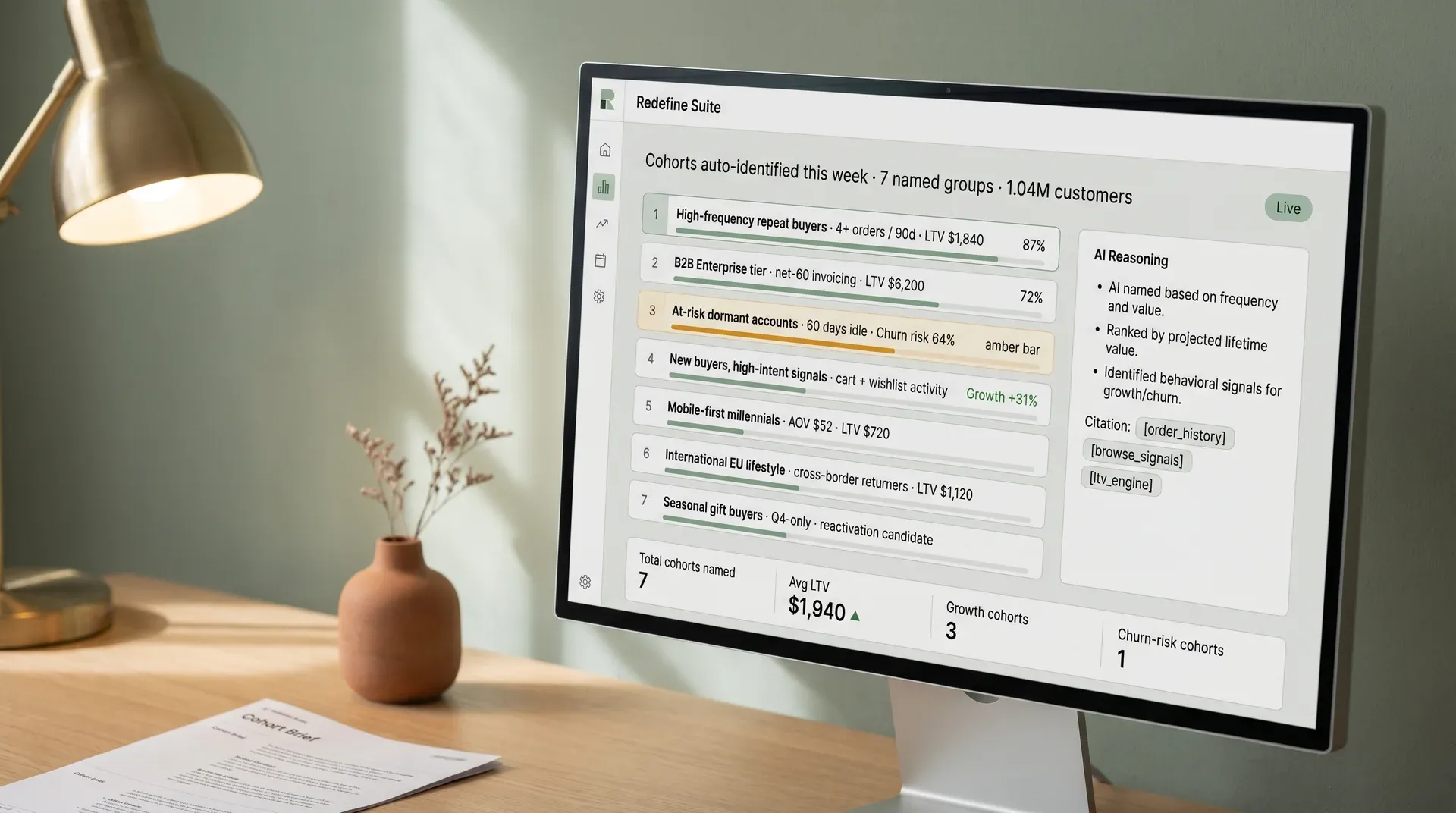
Artificial Intelligence Cohort Discovery
Artificial intelligence identifies high-value customer and account segments automatically, names them based on behavioral patterns, and surfaces the actions most likely to grow each cohort. No manual segmentation. No analyst required.
Cross-Platform Unified View
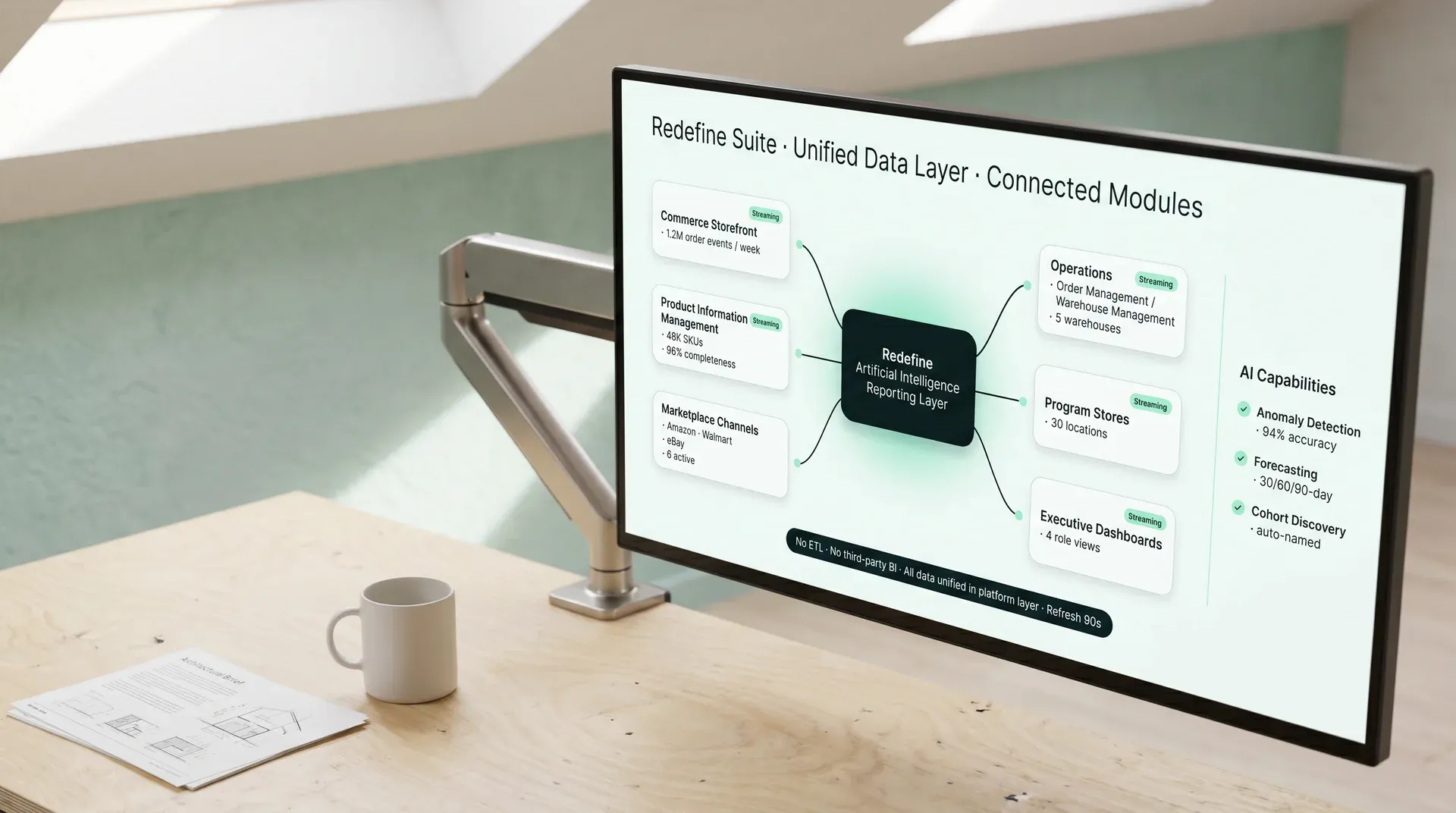
Commerce, product information management, marketplace, operations, and program store data feed a single automated reporting software layer. No fragmented dashboards. One view of the whole platform.
Role-Specific AI Dashboard Software
Executive, operations, and channel views in the ai dashboard software each surface the metrics that matter for that role. No noise. No irrelevant rows. Every stakeholder sees their signal, not the whole firehose.
Smart Alerts and Scheduled Reports
Set thresholds and schedules, or let the ai reporting software decide when something is worth interrupting you for. Alerts fire over Slack, email, or in-app. Reports land in inboxes before standup.
From raw commerce data to artificial intelligence insight in four steps.
Every feature of this automated reporting software runs on the same unified data layer that powers your operations. No extract, transform, load pipeline. No manual exports. No third-party business intelligence contract.
Day 1
Unified data ingestion
Commerce, product information management, marketplace, operations, and program store data all stream into a single reporting layer automatically.
Day 2
Baseline modeling
Artificial intelligence builds seasonal baselines and expected ranges for every metric using your historical commerce data, not a generic template.
Day 3
Forecast and cohort activation
Forecasting tracks go live on every dashboard. Cohort discovery runs its first segmentation pass and names identified groups.
Ongoing
Continuous artificial intelligence refinement
The artificial intelligence model improves with every week of new data. Alert thresholds tighten, forecasts sharpen, and cohort definitions self-correct.
Step 1: Data Ingestion
No extract, transform, load pipeline required. All data is already unified in the platform layer.
Data-driven decisions scaled revenue to $15 million.

Client
CCTV Security Pros
Security / RetailGlobal provider of security camera systems for residential and commercial customers. Operates on BigCommerce with multi-channel digital marketing and analytics at scale.
Problem
Marketing performance was difficult to track across channels. Budget allocation was based on instinct rather than attribution data. Revenue growth was inconsistent and hard to attribute to specific campaigns.
Solution
Unified Google Analytics 4 analytics and attribution setup across paid search, social, email, and marketplace channels. Continuous performance-driven optimization enabled by accurate cross-channel reporting and return on investment tracking.
Result
Revenue scaled through data-driven campaign execution. Enhanced attribution and reporting enabled more efficient budget allocation, improved return on investment, and sustainable global growth across digital channels.
The typical AI analytics platform reports on data it doesn't own.
A point-solution ai analytics platform sits outside your commerce platform. It can only report what you export to it. Redefine artificial intelligence is native to the same layer that processes every order, every listing, every product information management change. That is a different class of reporting.
| Capability | Typical AI analytics platform | Redefine Artificial Intelligence Reporting |
|---|---|---|
| Native to the commerce platform | ||
| Anomaly detection with explanation | Flags only, no context | |
| 30/60/90-day forecast on every metric | Revenue only, manual setup | |
| Automatic cohort discovery and naming | ||
| Cross-module data (product information management, order management, marketplace) | ||
| No separate business intelligence tool required | Requires export and business intelligence licence |
Who gets the most from automated ecommerce reporting.
Multi-channel retailers
Managing revenue across storefront, marketplace, and business-to-business portal means dozens of dashboards. A native ai analytics platform unifies every signal and flags the anomalies that matter, so your team stops tab-switching.
Business-to-business commerce operators
Account-level cohort discovery and pipeline forecasting in automated ecommerce reporting help business-to-business teams identify which accounts are growing, which are at churn risk, and where to focus next quarter's energy.
Catalog-heavy brands
Large catalogs mean product information management completeness, listing health, and content scoring all drift over time. The ai reporting software tracks all those dimensions and catches gaps before they affect search ranking or conversion.
Growth-stage ecommerce teams
When you don't have a full analytics team, automated ecommerce reporting does the monitoring work for you. It watches everything, surfaces what matters, and gives your small team the leverage of a much larger one.
International commerce operations
Cross-border operations generate signals in every region simultaneously. Automated ecommerce reporting tracks regional revenue anomalies, channel discrepancies, and conversion shifts across all geographies in one view.
Executive reporting stakeholders
Leadership needs clean, role-specific views of the numbers that drive decisions. This ai dashboard software generates executive-ready dashboards automatically, with forecasts attached to every metric they care about.
This is not the right fit if you:
Not sure if this fits your situation? Tell us your situation and we'll be straight with you.
AI reporting software works because everything feeds the same data layer.
Other analytics tools bolt on to your platform and pull data via application programming interface. Redefine ai reporting software is the platform's own reporting layer, fed by every module in real time. That means richer signals, faster anomaly detection, and forecasts that factor in every dimension, not just revenue.
Analytics and Reporting Hub
Full analytics module overview, executive dashboards, and cross-platform reporting.
Commerce Reporting
Order-level, stock-keeping-unit-level, and channel-level commerce data feeding the artificial intelligence layer.
Executive Dashboards
Role-specific dashboards with artificial intelligence forecasts attached to every headline metric.
Operations Reporting
Warehouse, fulfillment, and service-level agreement data contributing to anomaly detection baselines.
Marketplace Reporting
Amazon, eBay, and other channel data tracked in real time by artificial intelligence alert monitoring.
Workflow Reporting
Approval times, service-level agreement compliance, and form completion rates visible in artificial intelligence dashboards.
Frequently asked questions.
No. Artificial intelligence reporting in Redefine is native to the same platform that processes your orders, product information management updates, marketplace listings, and operations data. There is no extract, transform, load pipeline and no separate business intelligence tool. Everything runs on the data that already exists in the platform layer, which means anomaly detection and forecasting update in real time as your commerce operations run.
The artificial intelligence baseline models start producing meaningful thresholds within 30 to 90 days of data, depending on your transaction volume. Lower-volume operations may take longer to establish statistically reliable thresholds, but the system will still surface hard deviations from the moment it activates. Forecasting accuracy improves with each additional month of data and self-corrects with seasonal patterns as they recur.
Artificial intelligence monitoring covers every metric in the platform, including revenue, order volume, cart abandonment, average order value, product information management completeness scores, marketplace listing health, fulfillment service-level agreements, approval times, and more. Because the artificial intelligence layer reads from the unified platform data, it tracks every dimension that any module produces, not just the front-end sales numbers. This is what makes it fundamentally different from a point-solution analytics tool that can only see what you export to it.
Customer relationship management and email tool segments are typically rule-based, defined manually using filters you set. Artificial intelligence cohort discovery identifies patterns in behavioral data that no rule would have found, then names the cohorts and tracks their performance over time. You don't define the segments in advance. The artificial intelligence finds them, labels them, and tells you which cohorts are growing, shrinking, or showing churn signals. This is especially powerful for business-to-business account-level analysis where purchase behavior is complex and account health signals are scattered across multiple data points.
Alert volume is configurable at both the threshold level and the delivery channel level. You can set minimum deviation thresholds before an alert fires, choose which metrics get artificial intelligence monitoring, and decide whether alerts go to Slack, email, in-app, or a combination. The artificial intelligence model also reduces false positive rates over time as it learns your normal variance patterns. Most teams configure alerts so that only genuine anomalies worth acting on interrupt them, with a daily digest covering minor deviations.
See artificial intelligence reporting on your data.
Submit your brief and we will show you what automated reporting software does with anomaly detection, forecasting, and cohort discovery running on your own commerce platform. No commitment. No pitch.
- Artificial intelligence anomaly detection across all your active metrics
- 30/60/90-day revenue and operations forecasts in every dashboard
- Automatic cohort discovery with named segments and lifetime value scoring
- Role-specific dashboards for executive, operations, and channel stakeholders
- No separate business intelligence tool, no extract, transform, load pipeline, no weekly export ritual
Explore related modules:

Tell us what your team is doing manually that artificial intelligence should handle.
Brief received.
We'll review your platform setup and send a scoped proposal within 3 business days. You'll hear from us within 48 hours to confirm we've reviewed your brief.
Your ecommerce reporting software should work as hard as you do.
Stop checking dashboards manually. Stop waiting for analysts. Let automated reporting software handle anomaly detection, forecasting, and cohort discovery so your team can focus on decisions, not data gathering.
No commitment. No pitch. Just your data, with artificial intelligence on it.