Your data already knows why revenue dropped. Your AI ecommerce analytics should too.
Ask a question in plain English. Redefine's AI ecommerce analytics surfaces the root cause across every module: catalog, listings, inventory, pricing, and orders, then hands you a ranked action list with one-click execution.

You can see the number is down. You can't see why.
- Revenue drops on Tuesday. You open four tabs in three tools to start piecing together what happened.
- Your ecommerce business intelligence dashboards show what happened. They never explain why it happened or what to do next.
- Identifying a root cause takes a data analyst, a query, and a 48-hour wait. The window to act has already closed.
- Each module: catalog, listings, inventory, pricing, reports in isolation. Cross-module causes stay invisible.
- Type "why did business-to-business revenue drop last week?" and AI ecommerce analytics traces the root cause across catalog, listing, and inventory simultaneously.
- Every Monday, an AI-written business narrative arrives: what changed, why it changed, and what three actions to take this week.
- AI attribution traces a lost sale back through catalog gap, listing suppression, stockout, and pricing misalignment, one linked chain.
- Ranked prescriptive actions appear directly below the insight. Click once to execute in the same platform, no copy-paste into a separate tool.

Ask the question your dashboard never answers.
Select a real commerce question below. Watch AI ecommerce analytics scan every module, surface the root cause chain, and generate ranked actions, ready to execute in one click.
Click any query to explore it. The engine cycles automatically when this section is in view.
Commerce analytics software with every insight, zero extra tools.
Natural Language Queries
Ask any commerce question in plain English. This commerce analytics software scans Product Information Management, Order Management System, marketplace, catalog, and pricing data simultaneously and returns a plain-English answer with source attribution.
AI Weekly Business Narrative
Every Monday your team receives an auto-written summary: what changed across all modules, why it changed, and a ranked list of recommended actions for the week ahead.
AI Attribution Modelling
A lost sale is traced back through every contributing factor: catalog gap, listing suppression, stockout signal, pricing misalignment. You see the full causal chain, not just the outcome number.
Prescriptive AI Actions With One-Click Execution
After identifying a problem, the AI generates a ranked action list: reprice, restock, re-sync listing, update catalog attribute. Each action is executable in the same commerce analytics platform. No switching to a separate tool. No copy-paste. The insight and the fix live in the same workflow.
Anomaly Detection and Alerts
The commerce analytics software continuously monitors for statistical anomalies across revenue, margin, order volume, and listing health. When a signal emerges, it alerts you with context, not just a red number.
Role-Specific Dashboards
Executive summary, operations drill-down, marketplace health, and marketing attribution. Each role sees the key performance indicators most relevant to their decisions, pre-configured and updated in real time.
Scheduled Reports
Set weekly or monthly delivery for any report. Receive it by email, Slack, or in-platform, in the format your team actually uses.
Threshold Alerts
Define the key performance indicator thresholds that matter to your operation. When a metric crosses a boundary, the alert arrives with root cause context attached, not just a number out of range.
Data Exports
Export any dataset as comma-separated values, JSON, or direct to BigQuery. All exports include dimension metadata so downstream tools receive clean, normalized data, not raw rows.
Retail analytics software built for the people who act on it.
Wakes up to a Monday narrative that summarizes every material change from the prior week. Makes decisions before the first team standup, without opening an ecommerce business intelligence tool.
Monitors order service-level agreement adherence, return exception rates, and fulfillment anomalies. When a deviation appears, the AI has already traced it to a supplier delay or warehouse routing rule before the operations team opens a ticket.
Sees campaign attribution tied to actual order conversion, not just ad click-throughs. Identifies which campaigns created product demand versus which simply harvested it from organic search.
Reviews a single consolidated executive dashboard: revenue, margin, Net Promoter Score proxy, and fulfillment velocity, across every business unit, brand, and region without toggling between tools.
Tracks listing health, buy-box win rate, and channel-specific conversion across all active marketplaces in one view. Receives daily alerts when suppression risk or pricing drift is detected before it compounds.

Sample output from Redefine AI analytics: role-filtered executive view.
Analytics that close the loop on revenue.
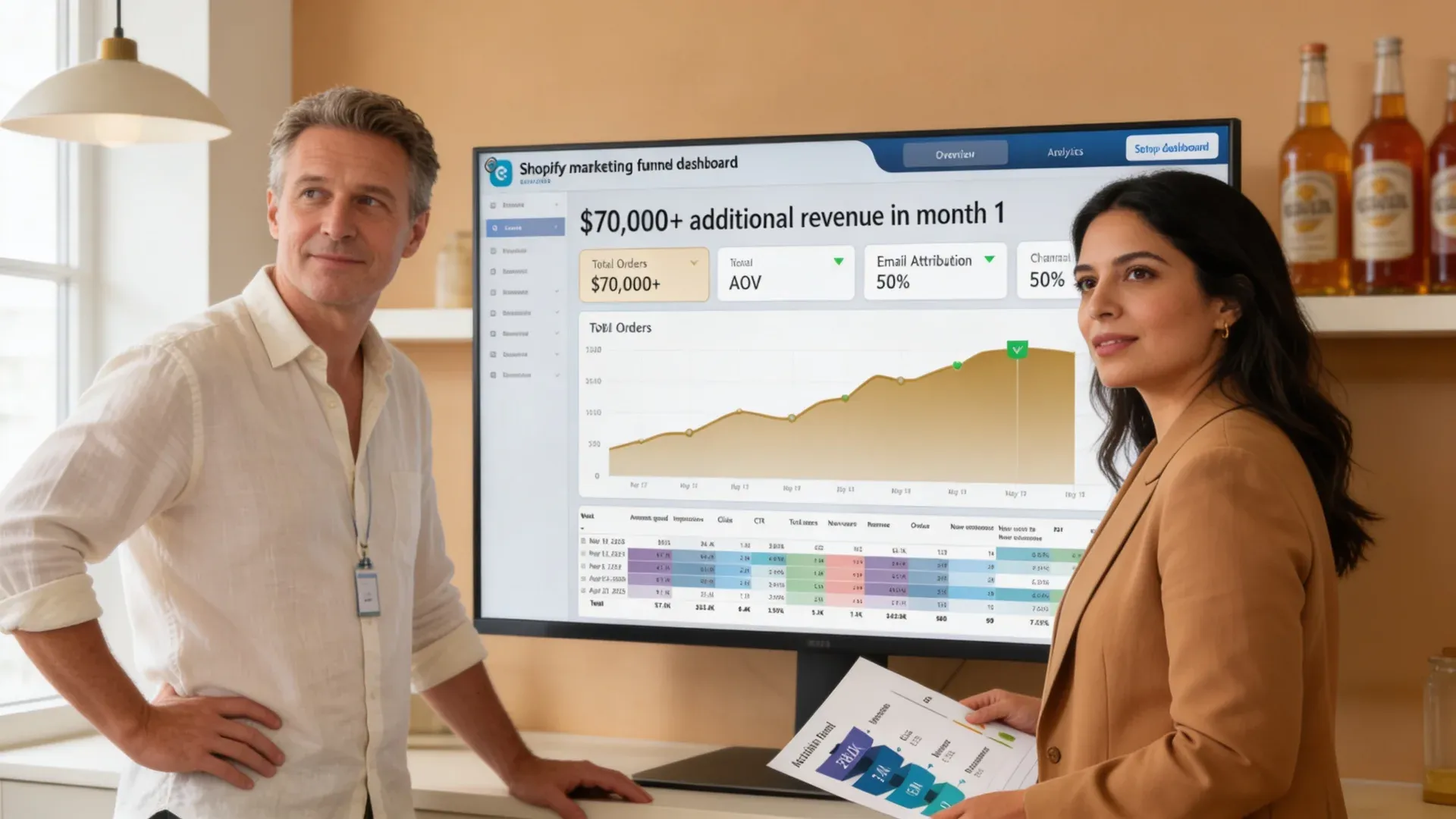
- 50% of monthly revenue attributed to email via unified analytics
- Real-time cross-platform reporting: Toast, Shopify, and customer relationship management unified
- Predictive trend forecasting enabled proactive campaign planning
One commerce analytics platform. Ten modules. Zero data gaps.
AI ecommerce analytics on a unified platform has an unfair advantage: the data model is already consistent. No extract-transform-load pipeline, no normalization lag, no conflicting metric definitions across tools. AI reasons over a single truth.
Ecommerce business intelligence tools built on top of separate platforms must constantly reconcile mismatched data models. Every pipeline introduces lag. Every join introduces ambiguity. The AI never has a complete picture, it always has a partial one.
Every module writes to the same data layer with the same taxonomy. An order references the exact product record in Product Information Management, the exact listing in the marketplace module, and the exact inventory node in the Order Management System. Attribution is structural, not inferred.
AI identifies the insight. AI generates the action. You click approve. The action executes in the same commerce analytics platform, updates the same data layer, and the AI monitors the outcome. The loop is closed before you open a second tab.
Other tools show you the dashboard. Redefine shows you the answer.
Cross-module, not module-isolated
Standard commerce analytics software reports on one data source per vendor. Redefine's AI reasons across Product Information Management, Order Management System, content management system, marketplace, and commerce simultaneously. A dropped revenue metric can be traced to a catalog gap, a listing suppression, and a pricing rule, all in one response.
Prescriptive, not descriptive
Most business intelligence tools stop at the number. Redefine's AI ecommerce analytics continues: it generates a ranked list of actions, estimates the impact of each, and lets you execute the top action in a single click, without leaving the commerce analytics platform to open a separate workflow tool.
Governed, not ungoverned AI
Every AI query, every recommendation, and every one-click action is logged with an audit trail. Role-based access controls ensure the right people see the right data. AI governance is native, not bolted on after the fact.
Your ecommerce business intelligence questions, answered.
No. Natural language queries are designed for operators, marketers, and executives, not analysts. You type a question the way you would ask a colleague. The AI interprets the intent, runs the analysis across the relevant modules, and returns a plain-English answer with the supporting data. No query language, no data preparation, no analyst dependency.
Business intelligence tools visualize data you already know how to interpret. They require someone to build and maintain the dashboards, and when something changes, they show you the change but not the cause. Redefine's analytics are native to the platform. The AI understands the data model structurally, not as a report layer. It explains root causes, generates ranked actions, and executes them. No dashboard builder required. No separate execution tool needed after the insight.
The AI analytics layer reads from all native Redefine modules in real time: Product Information Management product data, Order Management System order and fulfillment data, marketplace listing health and channel performance, content management system content performance, commerce conversion and pricing data, and inventory stock levels. All data is normalized on a single schema, there are no cross-tool reconciliation delays. For brands with external data sources, BigQuery integration and application programming interface exports are supported.
Each week, the AI generates a written business narrative covering what changed across all modules versus the prior week, the most likely explanations for the changes, and a prioritized list of recommended actions. It is delivered to configured recipients by email and also accessible in-platform. Role-based content filtering means executives receive a summary view while operations leads receive a detailed breakdown, the same narrative, calibrated for the audience.
By default, every prescriptive action requires human approval before execution, a single click in the platform. For lower-risk, high-frequency actions (for example, re-syncing a listing attribute or restocking a reorder point), you can configure auto-execution rules within defined thresholds. All actions, manual or automated, are logged in the audit trail with the AI's reasoning attached. Governance controls are set per role, per action type, and per business unit.
No replacement is required. Redefine exports normalized data to BigQuery, comma-separated values, and application programming interface endpoints compatible with most business intelligence platforms. Teams that want to keep their existing dashboards for specific reporting needs can continue to use them; they simply receive cleaner, more reliable data from a single normalized source. Most teams find that as native retail analytics software answers more of their daily questions, dependency on separate business intelligence tools reduces naturally over the first two to three quarters.
A straight answer on who this fits.
- Your team spends more than 4 hours per week reconciling metrics from multiple tools
- You operate across multiple channels (direct-to-consumer, business-to-business, marketplace) and need cross-channel attribution
- Revenue anomalies take more than 24 hours to diagnose because data lives in separate systems
- Leadership wants a weekly business summary without involving a data team to produce it
- You operate a single channel with no plans to expand: existing retail analytics software is sufficient at this scale
- Your data lives entirely in a custom-built system with no external integrations: a scoping call is needed first
- You need a standalone business intelligence visualization tool for custom report design: we do not replace Tableau or Looker Studio for advanced data exploration
Not sure? Tell us your situation and we will be straight with you.
Talk to our team →Stop reporting on what happened. Start knowing why.
Tell us what your team is doing manually that retail analytics software should handle. We will review your situation and send a scoped proposal within 3 business days.

Brief received.
We will review your situation and send a scoped proposal within 3 business days. No commitment required to receive it.
Tell us about your analytics workflow
Your next insight is one question away.
No commitment. No pitch. Submit your brief and we will show you exactly what AI ecommerce analytics would surface in your operation, scoped, specific, and ready to act on.