Every brand. One multisite cms.
One admin.
Run every site from one multisite cms instead of juggling separate content management system logins for every site your team manages. Redefine gives your content teams a single, governed workspace where each site inherits your shared templates, assets, and approval rules.


Five sites. Five logins. Zero control.
Without a multi website cms, every brand or regional site lives in its own content management system silo, and your team spends more time context-switching than creating. Templates drift. Assets get duplicated. A single approval change means updating every instance by hand.
- Log into 5 different content management system instances to publish a campaign
- Asset libraries out of sync, brand photos vary site-to-site
- Template updates require manual edits across every site
- Approval workflows differ by site, governance breaks down
From scattered sites to unified control in 14 days
Your content team gets a single multi brand cms admin before the end of your second week. Sites inherit your existing templates and assets from day one.
Different roles. One multi tenant cms.
Your marketing team, digital directors, and information technology leads each have different jobs to do. Redefine's multisite cms serves all three without compromise.
Publish once. Land everywhere.
Create a campaign in the parent workspace and push it to every relevant site in one action. Override the hero image or headline per-site without touching the shared template.
- Shared content blocks reuse across all sites automatically
- Site-specific overrides for headlines, images, and locale copy
- Scheduled publishing across sites from one calendar view
- Live preview per site before any approval is triggered
Brand consistency at scale.
Every site your team manages inherits your design system. You set the boundaries once and marketers work freely within them. Governance audits run across the multi tenant cms in seconds.
- Template inheritance prevents brand drift site-by-site
- Role-based permissions scoped per site, not just per user
- Content governance audit across all sites in one report
- Single approval engine, no site-specific workarounds
Application Programming Interface-first. Zero operations overhead.
Every site in your multi tenant cms is independently addressable via REST or GraphQL. Domain and subdomain routing is managed in the admin, no infrastructure changes required for new sites.
- Domain and subdomain management per site, no DNS tickets
- REST and GraphQL Application Programming Interfaces with site-scoped content delivery
- Content Delivery Network-backed delivery, global performance out of the box
- Multi-environment (staging and production) per site in one workspace
GET /v1/content?site=brand-eu
  &locale=de-DE
  &type=hero-banner

HTTP/1.1 200 OK
{
  "site": "brand-eu.acme.com",
  "locale": "de-DE",
  "inherited_from": "parent-workspace",
  "overrides": ["hero-image", "h1"],
  "content": { ... },
  "cache_ttl": 300
}Everything multi website cms teams actually need
One multi website cms. A single admin. Shared governance. Per-site flexibility. No tradeoffs.
One workspace for every site your team manages
Switch between sites in the multi brand cms from a top-level dropdown, no re-login, no separate credentials. Your content teams see only the sites they are permitted to edit.
- Single sign-on login spanning all sites
- Site-scoped permission roles, regional editors see only their site
- Parent-level admins see and govern the full site estate
Site-specific content with shared template structure
Every child site inherits your master content types, layouts, and design tokens. Regional editors can override exactly what they need to, nothing more.
- Reusable content components and blocks propagate site-wide
- Site-level overrides tracked and auditable
- Nested and relational content references work across sites
Shared and site-specific asset libraries
Brand assets live in the shared global library. Regional teams maintain their own site-specific folders. Automatic image optimization and WebP conversion apply to all.
- Digital asset management with tags and metadata
- Automatic WebP and AVIF conversion and format optimization
- Site-scoped asset access, regional teams only see relevant media
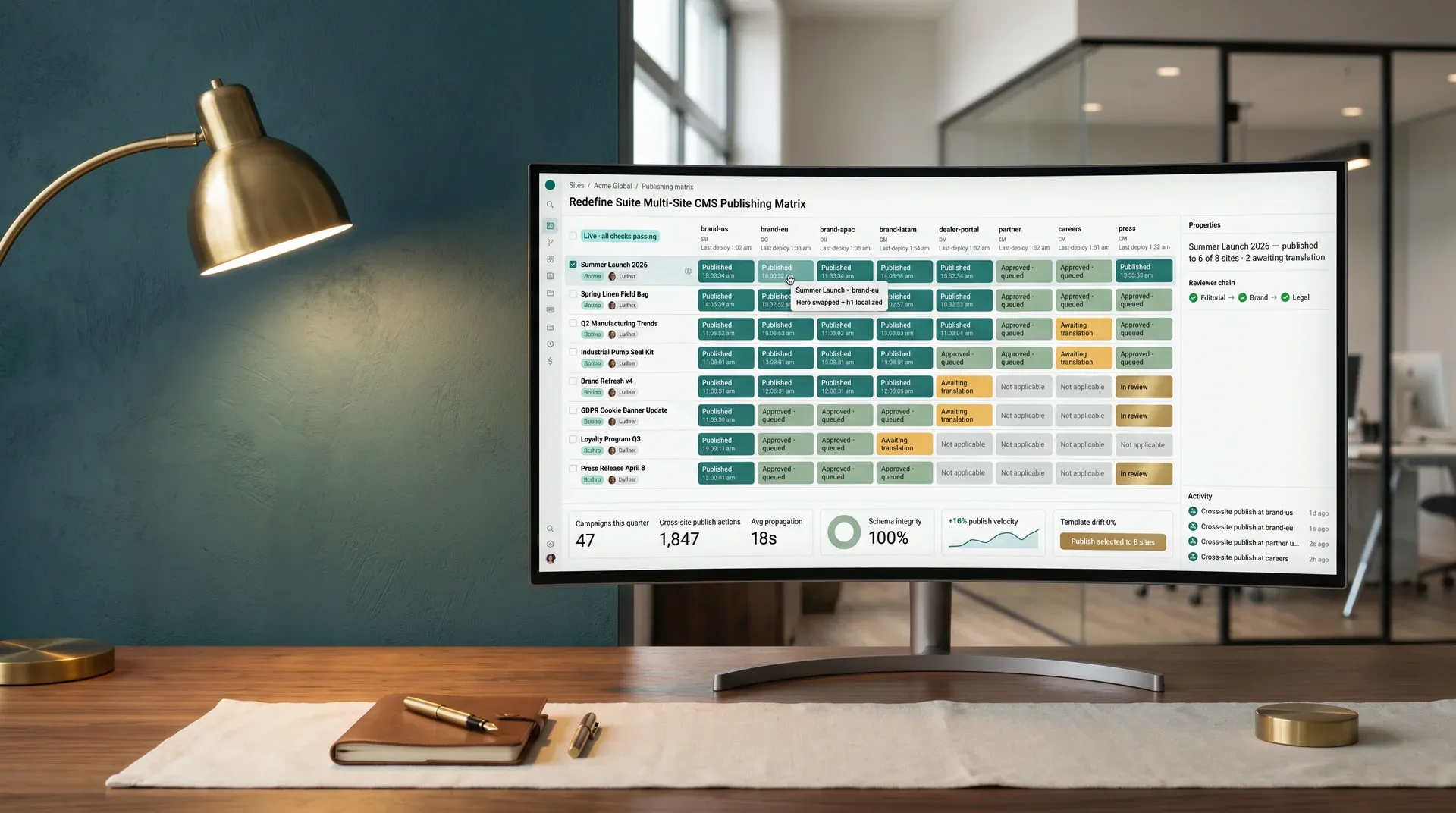
Every campaign. Every site. One matrix.
See the live status of every piece of content across every site you manage. Published, in review, awaiting translation, or scheduled, all in a single grid.
From 30+ stores to $120M in revenue
A national promotional products company managing branded apparel and merchandise across 30+ multi-brand storefronts with a complex enterprise resource planning and content management system integration stack.
Managing content and product data across more than 30+ branded storefronts with no unified content management system, no centralized asset library, and limited visibility into which stores were operating out-of-date templates. Content updates required manual replication across every brand instance.
Up from under $14M when the transformation began. A centralized multisite cms, unified multi-store architecture, and real-time enterprise resource planning integration unlocked the operational scale needed to grow from regional provider to national platform.
Multi brand cms that knows your commerce context
Other content management system platforms treat a multisite cms as a publishing tool. Redefine goes further: each site's content is scoped to its business-to-business account group, dealer tier, or brand, directly connected to the commerce engine, not bolted on separately.
- Multi-site treated as separate workspaces, no shared governance
- No native connection to business-to-business account tiers or dealer groups
- Content approval lives in a different tool from order approvals
- Asset libraries siloed by site instance
- Site content scoped to business-to-business account group, dealer tier, or brand
- Content approval using the same workflow engine as order approvals
- Marketer can publish a product-aware landing page from live product information management data, no Application Programming Interface work needed
- Digital asset management assets linked directly to product information management products and pushed to storefronts automatically
- Single admin managing multiple brand or regional sites
- Site-specific content and template inheritance
- Domain and subdomain management per site
- Draft, review, and approval workflow states
Headless delivery. Site-scoped Application Programming Interfaces.
Every site in your enterprise multisite cms is independently addressable. One Application Programming Interface key, scoped by site, no shared namespace collisions, no cross-site content bleed.
Explore the full enterprise multisite cms platform
Common questions about our enterprise multisite cms
There is no hard limit on the number of sites. Enterprise teams managing 50-plus brand, regional, and partner sites operate from the same admin workspace. Performance and governance scale with your site count, no degradation as the estate grows.
Yes, this is a core differentiator. You can scope a site to a specific business-to-business account group, dealer tier, or brand segment. Content in that site is only accessible to users who belong to that segment's account scope. This means a dealer portal site shows only the content relevant to dealers, not public visitors.
Updates to shared parent templates propagate to all inheriting sites on the next publish. If a site has a local override on a specific component, that override is preserved. The parent update applies to every other part of the template. You can preview the inherited update per site before publishing to confirm nothing breaks locally.
Every site has its own staging and production environments, managed from the parent workspace. You can promote staging to production per-site with a single action. Staging environments are separately addressable via the Application Programming Interface, so your frontend teams can preview changes before release without touching live traffic.
Multi-site content management is natively connected to the Redefine product information management, order management, and commerce engine. A marketer can publish a product-aware landing page that pulls live inventory and pricing from native product information management data, no Application Programming Interface integration required. Asset libraries in the content management system are the same assets that populate product listings in the business-to-business portal and marketplace feeds.
See every site in one workspace today
Book a 30-minute walkthrough with a multisite cms specialist. We will map your existing site estate and show you exactly how template inheritance and site scoping would work for your brand.
No commitment. No pitch.
Submit your brief, call within 48 hours, scoped proposal in 3 days, Sprint 1 begins within 1 week of sign-off