The CMS Platform wheremarketers take over.
Our cms platform lets developers define the content model once. Marketing teams own content forever. Publishing approvals, multi-site, localization, and content governance included.
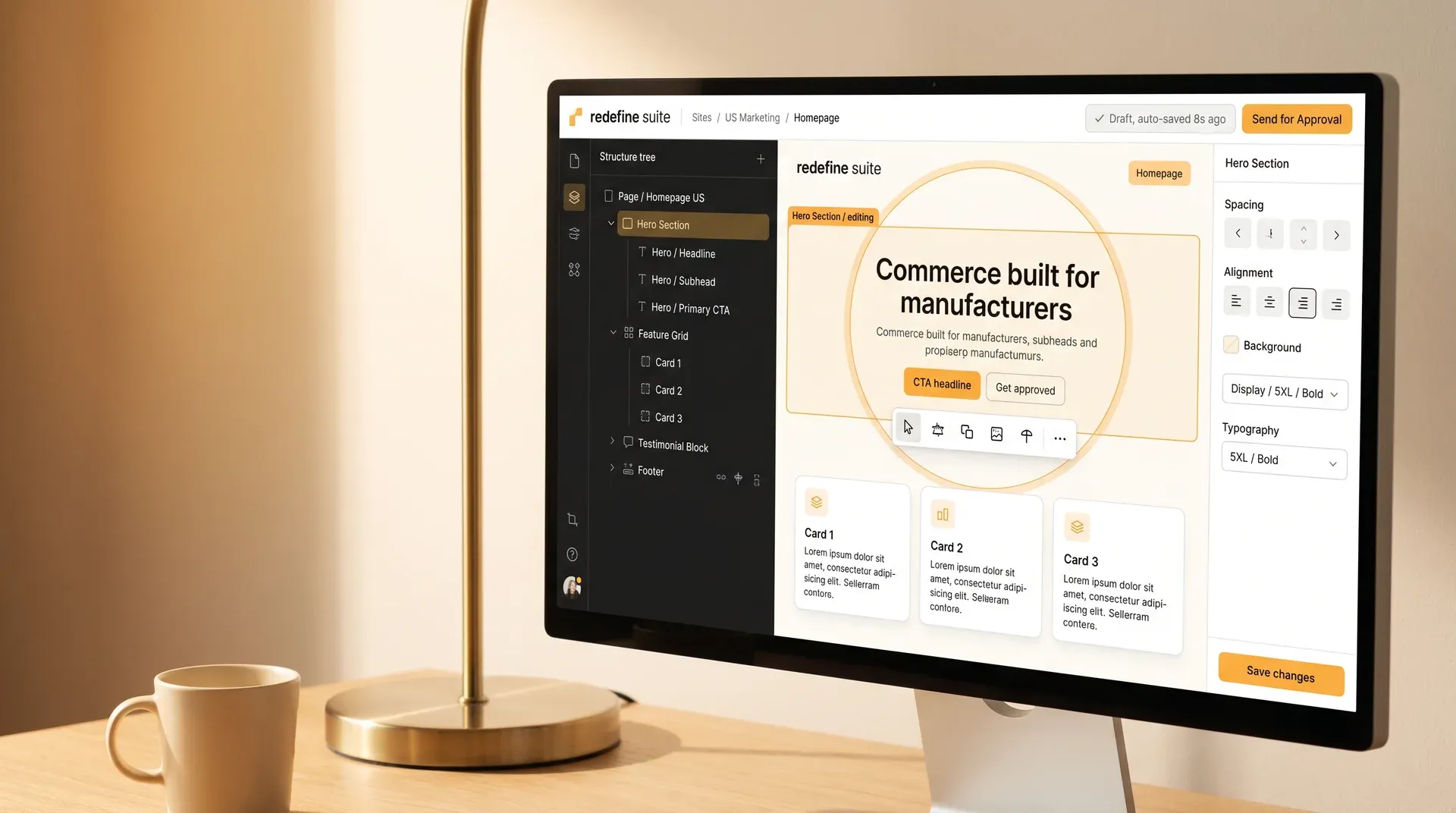
Drag to see what changes when a marketer needs to edit one headline.
Same task. Same content. Completely different experience. Drag the handle left and right.
The visual editor your marketing team will actually use.
Click the blocks in the left panel to add them to the page. Click any element on the page to edit its properties. No code. No developer ticket.
The content lead and designer review the page itself, not a Jira ticket.
Two people, one canvas, one click to send for approval. No staging branch, no developer in the room.

How much is your current content management system really costing you?
Adjust the four inputs to match your team. The calculator updates in real time.
Your team today
Everything in one headless cms platform. Nothing bolted on.
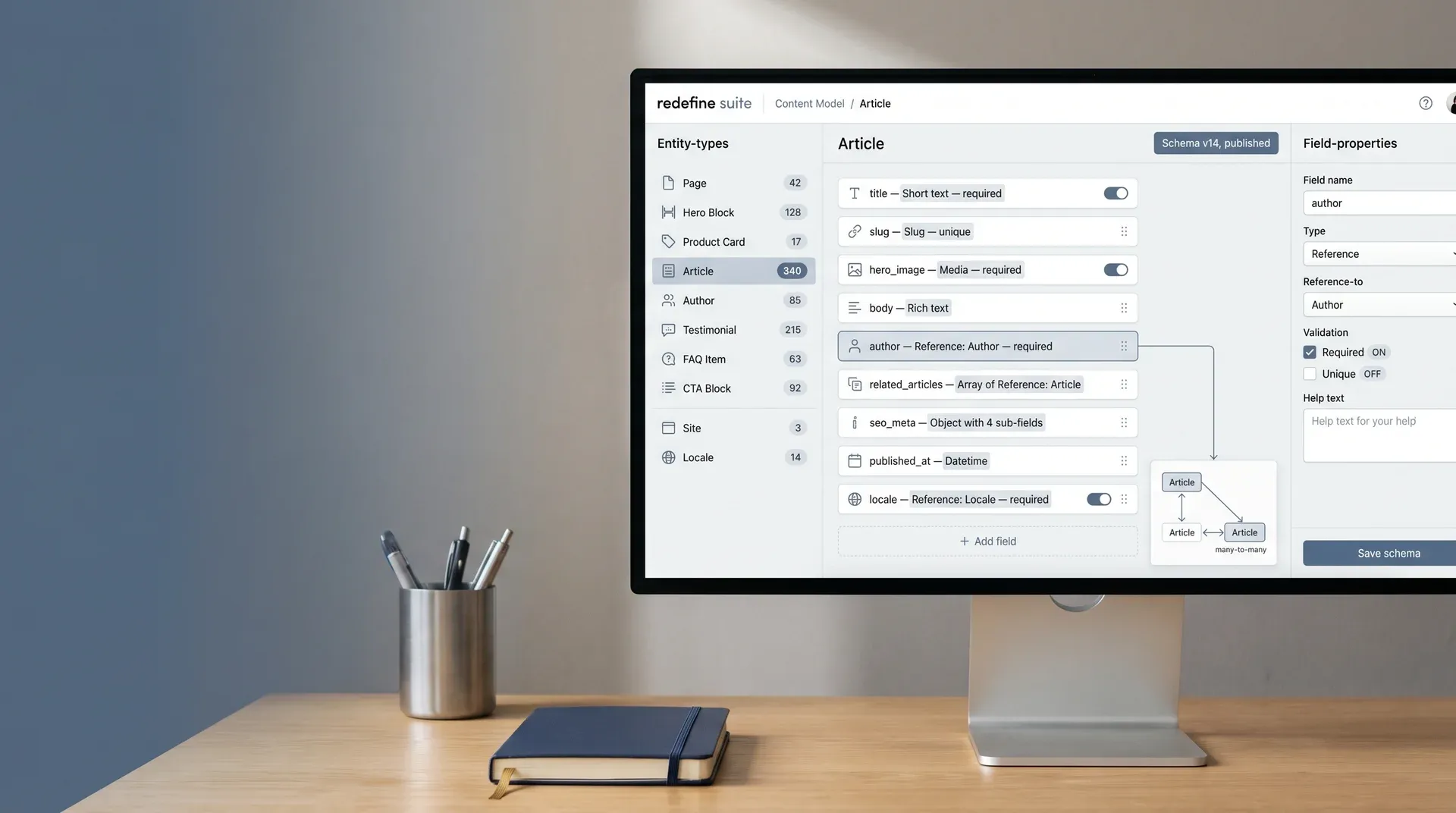
Entity types, fields, and relationships in one schema.
Developers define the shape once in our enterprise content management platform. Marketing teams create, edit, and publish forever.
The enterprise cms capability every team needs. Does your current system have it?
✓ = Included natively ✕ = Not available ~ = Requires a custom build or paid add-on
| Capability | Redefine |
|---|---|
| Visual editor for non-developers | ✓ |
| Multi-step publishing approvals | ✓ |
| Multi-site from one instance | ✓ |
| Native localization workflows | ✓ |
| Content governance and full audit trail | ✓ |
| Connected to commerce platform natively | ✓ |
| Fully managed hosting and service agreement | ✓ |
| Marketing team independence day-to-day | ✓ |
One content record. One publish. Three brand sites update.
Click between brands. The same product content renders in each site's visual identity without duplication or separate instances.
Dark theme · Spec-first · Quote-focused calls to action
Light theme · Price-first · Add-to-cart experience
Indigo theme · Account pricing · Net terms · Partner-specific layout

Multi-step approvals with a full audit trail.
Configurable per content type, site, and locale. Every action logged with user identity, timestamp, and change detail.
"How long will it take to switch?" 12 weeks. Live at the end.
Your existing content management system stays live throughout. Cutover happens at the end, with a tested rollback path.
"The developer team stopped receiving content tickets on day one of go-live. Our marketing team can now run an entire campaign, pages, banners, product copy, regional variants, without involving engineering once."
What buyers ask before they decide.
Yes. Developers define the content model once. After that, all content creation, editing, previewing, and publishing is handled by the marketing team in the visual editor with no code involved. The only time a developer is needed is when the content model structure itself needs to change, which happens far less frequently than content updates.
The headless cms platform is front-end agnostic. Content is delivered via REST and GraphQL application programming interfaces to any framework: Next.js, Nuxt, Astro, React, Vue, mobile, or any custom stack. When content is published, webhook events fire and each connected front end revalidates automatically.
Yes. Multi-site and localization are native modules. Each site has its own content space, publishing rules, and team permissions within one instance. Shared content can be authored once and localised into multiple language variants. Regional editors only access the sites assigned to them. Publishing to one locale does not affect others unless you explicitly push it across.
Content in the content management system links natively to product records in the Omnichannel Commerce Platform. A product page updated in the cms platform publishes across business-to-business portals, direct-to-consumer storefronts, and marketplace listings simultaneously. These are the same platform, not separate tools connected by integrations.
Yes. Multi-step approval chains are configurable per content type, site, or locale. Legal review, brand review, and editorial sign-off can all be required in sequence. Every content action is logged with user identity, timestamp, and change detail. Role-based access determines who can create, approve, or publish at each level.
One session. Your content team. Independent.
A cms platform specialist builds a live walkthrough using your content structure, your brand sites, and your team setup. No demo account. Your actual architecture.
Scoped before work starts · line-by-line pricing · no commitment to receive a proposal
Submit your brief → call within 48 hours → scoped proposal in 3 days → Sprint 1 begins within 1 week of sign-off
Your team's time across an enterprise cms build is typically 2 to 3 hours per week: content model review, team access sign-off, and staging validation. We handle architecture, migration, and training.
The more specific you are, the more relevant the session will be.
Submit your brief → call within 48 hours → proposal in 3 days → Sprint 1 within 1 week of sign-off
One session. Your content team. Independent.
A content management system specialist builds a live walkthrough using your content structure, your brand sites, and your team setup. No demo account. Your actual architecture.
Submit your brief → call within 48 hours → scoped proposal in 3 days → Sprint 1 begins within 1 week of sign-off