Your supplier catalog software,
curated per store
Redefine supplier catalog software stops you copying product data between spreadsheets and supplier portals. It pulls vendor catalogs into a master Product Information Management system, then lets you build store-specific assortments with size matrices, minimum order quantity rules, and an approval workflow before anything goes live.

Catalog chaos versus one supplier catalog system
- Export supplier price list, re-format in spreadsheet, manually upload to each store
- Store-specific variant rules tracked in a separate document nobody updates
- Discontinued items appear on live stores for days before anyone notices
- No audit trail for who approved what. Every product dispute becomes a conversation.
- A connected supplier catalog system pipes feeds into the master Product Information Management catalog automatically on every update
- Assortment builder scopes which stock-keeping units, sizes, and colors appear per store with one click
- Discontinued items are removed across all stores the moment the supplier updates the feed
- Every product approval is logged with a timestamp, user, and the exact catalog state at approval

From supplier feed to live store assortment in four steps
Your catalog operations team connects supplier feeds once. From there, the supplier catalog software handles sync, approval, and per-store publishing without manual re-imports.
Connect supplier feed
Application programming interface, Electronic Data Interchange, or CSV import
Review in Product Information Management
Enrich and approve before publish
Build store assortment
Scope stock-keeping units, variants, minimum order quantities per store
Publish and keep in sync
Updates flow automatically on supplier change
Active supplier connections
Last sync: 3 min ago | Next: 57 min
Awaiting review: 14 products
Embroidered Polo, Navy / M-3XL
Supplier Alpha · SKU-4421
Quarter-Zip Pullover, Black / S-XXL
Supplier Beta · SKU-7783
Tote Bag, Natural / One Size
Supplier Alpha · SKU-9902
Store: Apex Corp Employee Store
Embroidered Polo
Sizes: S M L XL 2XL | Min order: 12
Quarter-Zip Pullover
Sizes: S M L XL | Min order: 6
Tote Bag
One Size | Min order: 24 | Exclusive: Yes
Soft-Shell Jacket
Not assigned to this store
Live stores: catalog sync log
Discontinued SKU-3310 removed from 4 stores automatically
Every vendor catalog management capability your team needs

Product catalog management starts here: assign specific stock-keeping units from the master Product Information Management catalog to individual stores. Each store gets its own curated product selection without duplicating data.
Connect supplier feeds via application programming interface, Electronic Data Interchange, or CSV. Vendor catalog management runs from one master Product Information Management catalog, so product data flows in automatically on every supplier update.
Manage full size-color grids per product. Control which variant combinations are visible per store and enforce rules at the variant level.
Set minimum order quantity rules per stock-keeping unit or per store at checkout. Buyers are blocked from ordering below threshold and shown a clear explanation.
Mark products exclusive to a single store. Buyers in other stores cannot see or order that stock-keeping unit, keeping program separation clean.
The assortment builder pulls directly from the master Product Information Management catalog. Before any item goes live in a program store, this supplier catalog system runs it through an approval workflow that logs the reviewer, timestamp, and product state. No other program-store platform does this natively.
When a supplier removes a product, it is unpublished from all stores in the next sync cycle. No manual review required.
What product catalog management delivers in practice

Company
Eyeglasses123
Multi-channel RetailOnline retailer of branded sunglasses and eyeglasses operating across multiple sales channels with a complex supplier and drop-shipping model.
Problem
Existing systems lacked supplier catalog automation. Inventory synchronization across channels was manual, creating overhead costs and degrading supplier reliability as the business scaled.
Solution
A custom order management system was implemented with real-time supplier sync, automated restocking alerts, consolidated sales tracking, and improved visibility into supplier performance across all channels.
Result
Annual revenue reached $6 million after supplier catalog automation reduced overhead and improved inventory accuracy across all channels.
What typical program-store platforms leave out
Other platforms are often strong on storefront design but thin on the vendor catalog management infrastructure that keeps supplier catalogs accurate across multiple program stores. Here is where that matters.
| Capability | Typical partner | Redefine |
|---|---|---|
| Native Product Information Management-linked assortment builder | ||
| Approval workflow before items go live | ||
| Automatic discontinued-item removal across all stores | ||
| Per-store minimum order quantity rules at variant level | ||
| Exclusive product visibility per store | ||
| Budget controls and spend governance | ||
| Cross-platform operations integration (order management system, Product Information Management, analytics) |
Who gets the most from supplier catalog management
Promotional products distributors
You manage dozens of supplier relationships and need decorated stock-keeping units to flow into specific company or team stores without manual catalog re-entry.
Corporate merchandise program operators
Your clients expect exclusive branded items per company store. You need to control exactly which stock-keeping units each corporate buyer sees, with minimum order quantity rules enforced automatically.
Sports league and team store operators
Different teams need different uniform stock-keeping units, different size ranges, and different minimum order quantities. The assortment builder scopes those rules per store without duplicating product records.
Multi-brand wholesale distributors
You represent multiple supplier brands and need vendor catalog software that keeps their catalogs separate but manageable inside a single platform that feeds into multiple buyer portals.
Redemption store program managers
Redemption stores need curated assortments tied to point budgets. The product assortment builder gives you control over which items appear in reward catalogs.
Catalog operations and merchandise teams
You own product catalog management and product data accuracy across every store and every supplier. The approval workflow and sync log give you a full audit trail without chasing supplier emails.
Vendor catalog software connected to your commerce stack
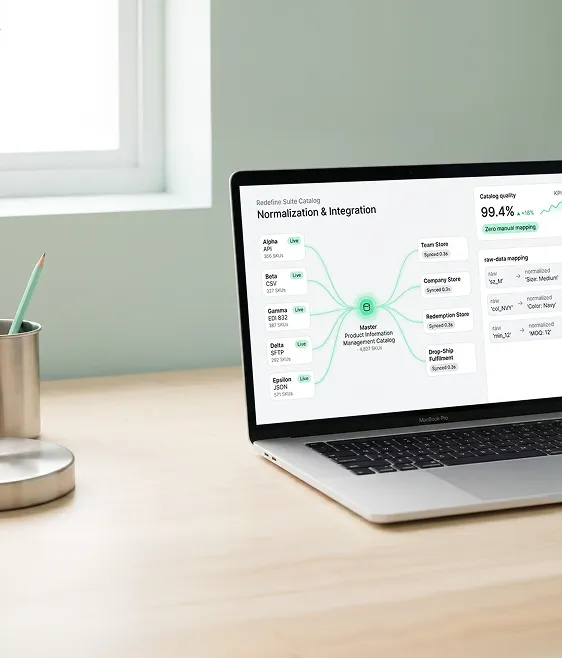
Master Product Information Management catalog
All supplier stock-keeping units live in the master Product Information Management system first. The assortment builder pulls approved products from there. No shadow catalogs, no duplicate data entry.
Explore Program Store SoftwareTeam store and company store storefronts
Assortments built in this module publish directly to team or company stores. One assortment change reflects on every live storefront that references it.
Supplier operations and drop-ship feeds
The vendor catalog software draws from the same feed used for drop-ship order routing. A product approved in the catalog module is already ready for fulfillment.
Program store reporting and analytics
Catalog analytics track which products are selling across stores, which stock-keeping units have low velocity, and which suppliers need performance conversations.
Honest fit check before you book a call
- Operate two or more program stores that share some suppliers but need different product assortments
- Spend more than a few hours per week manually updating product data after supplier catalog changes
- Need an approval step before new supplier products go live in any store
- Sell decorated or customized products with complex size-color matrix variants and minimum order quantity rules
- Run a single store with one supplier and fewer than 200 stock-keeping units that change rarely
- Need only a storefront builder without any catalog data management layer
- All product data is manually curated by your team with no supplier feed source
Not sure? Tell us your situation and we will be straight with you.
Questions buyers ask before booking
Supplier catalog management lets you pull supplier and vendor product feeds directly into your program store assortments. You control which stock-keeping units are visible per store, enforce minimum order quantities, and keep product data in sync without manual imports.
Yes. The assortment builder lets you assign specific products from your master catalog to individual stores. Each store only shows the stock-keeping units, sizes, and colors you approve for that audience.
When a supplier submits or updates a product, it enters an approval queue. Your team reviews product data, images, and attributes inside the Product Information Management system before publishing to any store. Items go live only after explicit approval.
Yes. Size and color matrix management is built in. You can control which variants are visible per store and enforce minimum order quantity rules at the variant level.
Redefine connects the assortment builder directly to a master Product Information Management catalog. Product updates flow from the supplier through an approval workflow into every store simultaneously. Other platforms require manual re-imports or separate middleware to keep supplier data current.
See the supplier catalog module in your program store
Tell us your store count, supplier mix, and current catalog pain. We will review your situation and show you exactly how our supplier catalog software, the assortment builder, and the approval workflow would fit your setup.
Explore related pages
Submit your brief
Call within 48 hours · proposal in 3 days · Sprint 1 within 1 week of sign-off

Your supplier catalog should run itself
Stop managing product data by hand. See how this supplier catalog software, with its assortment builder and approval workflow, fits your store count and supplier mix in a 30-minute walkthrough.