Employee Store Software that runs your whole program
Employee store software lets you launch branded company stores with budget controls, artwork proofing, and real-time order ops. It runs on the same platform that powers your business-to-business commerce, Product Information Management, and supply chain.

Your store program is only as strong as the ops behind it
Employee allowances tracked in spreadsheets. Overspend detected only after orders ship. Finance reconciles manually every month.
Proofs emailed back and forth. Approvals lost in inboxes. Wrong logo version goes to print and the order reruns.
Your store tool has no idea what your enterprise resource planning system holds. Inventory, fulfillment, and supplier data sync on a delay, or not at all.
No central audit trail. Rogue orders, unapproved products, and unchecked access erode brand standards quietly.
Which department ordered the most? Which products earned margin? Your store tool has no report that answers either question.
Each division or brand has its own store login, its own product list, and its own support overhead. One update means ten logins.
One platform for every online company store you run
Employee store software is Redefine's module for launching and managing branded employee and corporate merchandise stores. This branded merchandise store engine is built as a native module inside the Program Store platform, not bolted on.
That means your online company store shares a product catalog with your business-to-business storefront, your Product Information Management system, your order management layer, and your supplier operations: in the same admin, with the same role-based access model you already use.
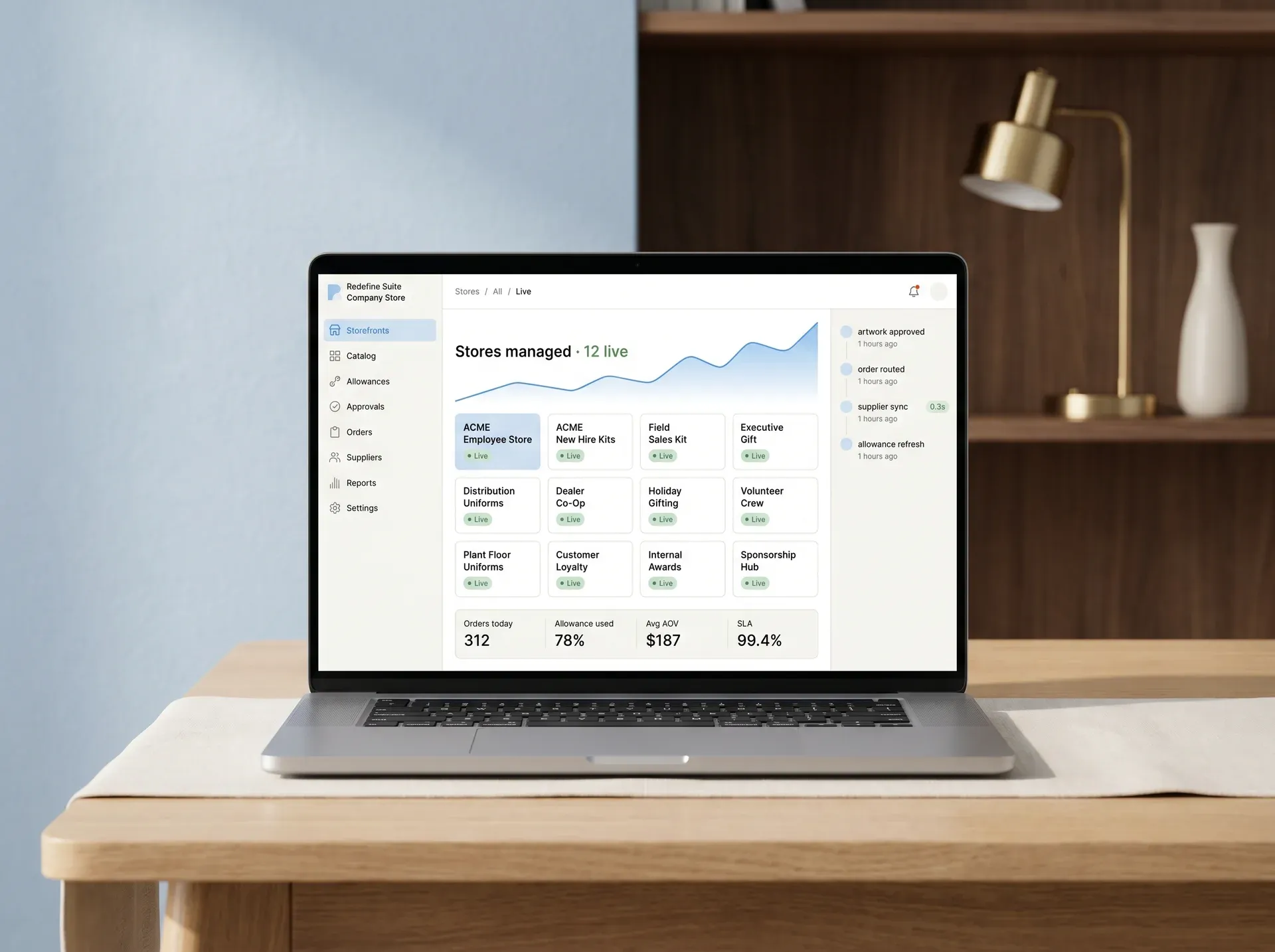
Everything a branded merchandise store program needs: nothing extra required

Branded storefronts for every audience
Launch a separate branded merchandise store for corporate employees, new hire kits, sales teams, uniform programs, or dealer networks. Each store gets its own theme, product assortment, and access rules: managed from one admin.
Dealer-branded storefronts
Give each dealer their own co-branded store drawing from your master product catalog. They sell their assortment: you control brand standards and product content from the top level.
Allowances enforced at checkout
Set per-employee, per-department, or per-role budgets. Allowances apply before the order is placed: no overspend, no manual reconciliation, no finance headaches.
See budget and redemption controls →Structured approval flows
Every artwork request routes through a defined approver chain. Versions are locked. No order moves to production until the right person signs off: tracked in a full audit log.
See proof and approval workflows →Store analytics without a business intelligence tool
Department spend, product velocity, redemption rates, and margin by store: built into the admin. No additional analytics license or data export required.
Program store, business-to-business commerce, and direct-to-consumer: same platform, same admin
Your employee store software runs on the exact same platform as your business-to-business portal and direct-to-consumer storefront. Product data, pricing, inventory, and order ops are shared natively: no sync, no middleware, no double data entry.
Single sign-on-gated employee online store access
Gate any employee online store behind your identity provider. Employees see only the products and prices their role allows. Department budgets apply automatically on login.
Calculate what your program actually costs to run
Enter your program size. The calculator shows you estimated annual spend, admin overhead, and the cost of running the same program on disconnected point solutions.
Your program size
Your program cost estimate
Estimates based on industry averages. Your actual savings will vary.
From signed scope to live company store in 10 days
Redefine runs each employee store software program in a structured sprint. Your team reviews deliverables once per week. We handle configuration, supplier setup, and go-live quality assurance.

Map assortment from your Product Information Management system. Configure store branding, navigation, and product pages. Single sign-on credentials provided.
Per-employee or per-department allowances set. Role-based access model applied. Finance team gets reporting access.
Approver chain defined. Version control enabled. First test artwork submitted and approved through the workflow.
Supplier catalog synced. Order routing rules applied. Enterprise resource planning integration live for financial transaction write-back.
Full quality assurance pass. Store goes live. Your admin team gets a walkthrough. Analytics dashboard populated with first orders.
From $14M to $120M across 30 branded stores

Parsons Kellogg
A major provider of promotional products, corporate apparel, and branded merchandise: operating a large multi-store ecommerce footprint with over 1 million inventory items across 30 branded stores.
No unified visibility across 30 separate stores. Manual processes, fragmented integrations, and limited analytics constrained warehouse operations and slowed decision-making at scale.
Redefine delivered a headless ecommerce architecture with custom Power BI integration, Dynamics enterprise resource planning write-back, RESTful application programming interface layer connecting all 30 stores, and real-time inventory and financial reporting across the entire operation.
Annual revenue scaled from $14M to over $120M. Unified reporting across 30 stores. Operational efficiency improved through automation and real-time analytics. The platform positioned them as an industry leader in promotional apparel.
Where typical corporate store software stops
Most corporate store software does stores well. What it does poorly is everything that keeps the program running: budgets, proofing, ops integration, governance, and analytics.
| Capability | Typical program store tool | Redefine |
|---|---|---|
| Branded company stores | ||
| Per-employee budget and allowance controls | Partial | |
| Structured artwork proofing with audit trail | ||
| Native enterprise resource planning and Product Information Management integration (no middleware) | ||
| Built-in program analytics (no business intelligence tool needed) | ||
| Business-to-business commerce and company store on one admin | ||
| Single sign-on-gated employee portals with role-based access | Partial | |
| Multi-store admin with unlimited stores | Limited |
Who runs company stores on Redefine
HR and People Operations
Run an employee online store for swag, new hire welcome kits, and uniform programs with budget controls enforced at checkout and department-level reporting for finance.
Brand Managers
Control assortments, lock artwork versions, and monitor store performance across every division or client without losing brand consistency in any store.
Promotional Products Distributors
Run company stores for clients without managing separate tools. Supplier catalog, artwork proofing, and order ops all live on the same platform as your own business-to-business business.
Multi-Division Enterprises
Each division, subsidiary, or region gets its own online company store with its own branding, product list, and budget rules. One admin. One audit trail. One data layer shared across all of them.
Dealer and Distributor Networks
Set up co-branded dealer storefronts drawn from your master catalog. Dealers see their assortment and pricing. You control brand standards, product content, and access at the top level.
Sales Enablement Teams
Equip sales reps, partners, and field teams with branded kits and materials through a controlled employee online store. Budgets tied to team or quota level. Orders tracked to individual rep.
Your online company store connects to every system you already use
Financial transaction write-back, inventory visibility, and order sync: live, no batch jobs.
Draw store assortments directly from your master Product Information Management system. Store-specific overrides without touching master product data.
Gate store access behind your identity provider. Role-based access rules tied to directory groups.
Supplier-driven product data feeds into store assortments. Decorated product workflows connected end to end.
Supplier Catalog Management →Every store order routes through the same order ops layer as your business-to-business commerce: one fulfillment pipeline, one status view.
Run team and redemption stores on the same admin alongside your company store: different store types, one platform.

Questions buyers ask before choosing corporate store software
Yes. Redefine lets you manage unlimited branded stores from a single admin. Each store has its own theme, product assortment, access rules, and budget configuration. One admin update applies across every store you control.
Allowances are enforced before the order is placed. You set budgets by employee, department, or role. Employees see their remaining balance in the store. When the allowance is exhausted, the overage goes to their payment method or the order is blocked: your choice. Finance sees real-time spend without any export or reconciliation step.
Yes. The platform has native connectors for Dynamics 365, NetSuite, SAP, and other major enterprise resource planning systems. Supplier catalog data feeds in through the Supplier Catalog Management module. There is no middleware required: all data connections are direct and synchronous.
Company stores are for internal employee and corporate merchandise programs: typically with budget controls, HR integration, and a gated single sign-on login. Team stores serve external groups like sports teams, schools, and organizations: usually with a defined open window and group order collection. Both run on the same platform and can be managed from the same admin. See Company Store versus Team Store for a full comparison.
A standard company store with Product Information Management import, budget controls, artwork proofing, and single sign-on gating goes live in 10 days from signed scope. More complex programs with multiple stores, enterprise resource planning integration, and supplier onboarding typically run 3 to 4 weeks. We scope it precisely before any work starts.
See a program store walkthrough built for your program size
Tell us about your employee store software program. We will review your situation and send a scoped proposal within 3 business days. No commitment. No pitch.
Submit brief → call within 48 hours → proposal in 3 days → Sprint 1 within 1 week of sign-off

Submit your brief
Call within 48 hours · Proposal in 3 days · Sprint 1 within 1 week of sign-off
Brief received
We will review your situation and send a scoped proposal within 3 business days. Expect a call from our team within 48 hours.