Your BigCommerce catalog is ready for Amazon. We run the channel so you do not have to
We manage Amazon PPC, listing optimization, and account health for brands that run BigCommerce as their primary channel. Your direct-to-consumer operations stay the same. Your Amazon revenue grows.

180+ brands served and $42M+ in advertising spend managed are portfolio-wide totals for our Amazon practice. See all Amazon program figures
In-house Amazon management drains your team. BigCommerce brands that self-manage Amazon spend more time on the channel than growing it.
See what your Amazon numbers look like when a specialist runs the channel, not your internal team.
- Your BigCommerce team writes listing copy. That team is already managing product pages, email, and DTC pay-per-click. Amazon gets their leftover attention.
- Amazon PPC campaigns launch and go untouched. Total advertising cost of sales creeps upward as wasted spend builds in stale search term reports.
- Amazon pricing is reactive. You notice the problem after a competitor bot already undercut your BigCommerce price.
- Account health problems arrive as suspension notices, not as early warnings. Nobody is watching the dashboard daily.
- Amazon listing copy is written by specialists. They know Amazon's A9 algorithm ranks differently than BigCommerce SEO, and they write for both.
- Amazon PPC campaigns are reviewed weekly. We pull negative keywords from live search term data and adjust bids by placement performance.
- Amazon pricing is monitored against your BigCommerce price floor. We enforce your minimum advertised price before competitors force a race to the bottom.
- We monitor account health daily. We catch suppression risks before they become listing suspension notices.

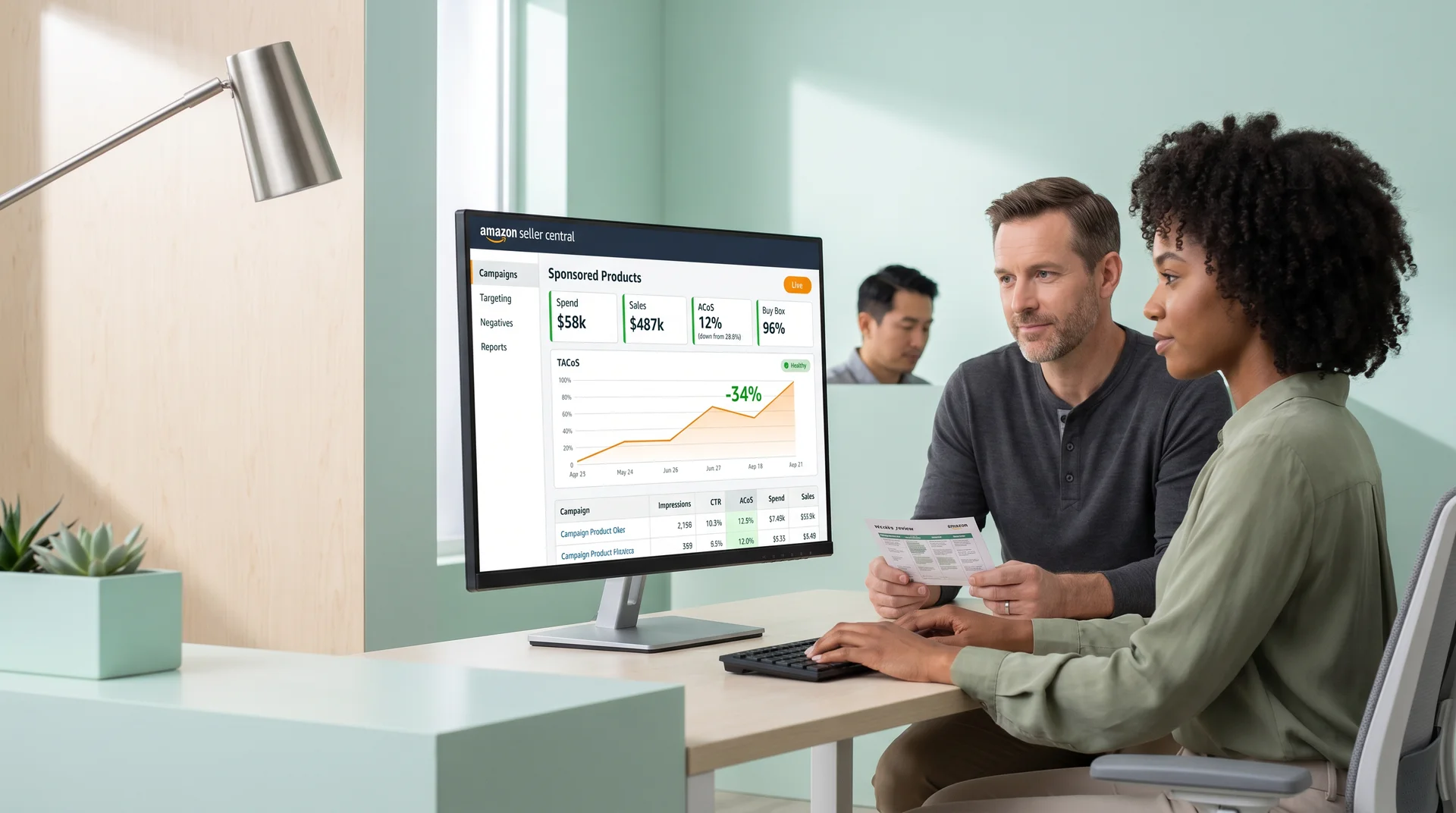
See both channels in one place. No more switching tabs between Seller Central and your BigCommerce dashboard.
Your monthly performance review shows BigCommerce and Amazon side by side, updated in real time. You see which channel drove each sale and where to focus next.
This month: combined revenue
BigCommerce + Amazon · last 30 days
Amazon pay-per-click performance
Account health
Five Amazon channel services built around your BigCommerce catalog, margins, and brand standards
Your BigCommerce catalog structure, pricing discipline, and brand standards are the foundation. We build Amazon on top of what already works.
Amazon catalog setup that starts with your existing BigCommerce product data
Your BigCommerce catalog is the starting point. We map your SKUs, descriptions, and category assignments to Amazon's taxonomy, then add Amazon-specific keyword research before any listing goes live.
- SKU-to-ASIN mapping and new ASIN creation
- Amazon-specific title, bullet point, and backend keyword research
- Category and browse node placement optimization
Amazon PPC management with TACOS targets tied to your actual BigCommerce margins
Your BigCommerce margin data sets your Amazon ad spend target. We build campaigns against what your product line can actually afford, not Amazon's generic industry averages that do not reflect your business.
- Sponsored Products, Sponsored Brands, and Sponsored Display campaigns
- Weekly search term review with negative keyword updates to cut wasted spend
- Monthly TACOS and ROAS reporting against your pre-agreed targets
We know BigCommerce. We know what breaks when you add Amazon on top of it.
Inventory sync, pricing conflicts, order routing, and Brand Registry requirements all create problems specific to BigCommerce and Amazon running together. We have managed this for dozens of brands. We know where the problems are before you hit them.
Inventory sync between BigCommerce and Amazon FBA or Fulfilled by Merchant
Minimum advertised price enforcement across both channels so your BigCommerce listings stay competitive
Brand Registry setup, including A+ content and Brand Store access if not yet enrolled
Order routing recommendations that protect your BigCommerce DTC inventory from Amazon cannibalization
Amazon listing optimization and search ranking that your BigCommerce SEO strategy cannot cover
Amazon's A9 algorithm ranks listings on keyword relevance, conversion rate, and sales velocity. Your BigCommerce SEO does not transfer. Amazon needs its own keyword research, title structure, and backend keyword fields managed separately.
- Amazon keyword research developed separately from your BigCommerce SEO strategy
- A+ content and Brand Store design built from your existing BigCommerce brand assets
- Ongoing listing updates when search term data shows where rank and clicks are being lost
Amazon account management and daily health monitoring to keep your channel open
Your BigCommerce store runs on your servers. Your Amazon account runs on Amazon's rules, and Amazon can suspend it without warning. We monitor health daily, stay ahead of policy changes, and respond fast when alerts appear so your channel stays open.
- Daily account health score monitoring and same-day alert response
- Listing suppression resolved before it costs you Amazon revenue
- Policy compliance check on every new product before it goes live on Amazon
BigCommerce and Amazon integration as part of a channel that compounds over time.
Off Grid Knives
Revenue grew from $1M to $3.8M across DTC and Amazon over three years. BigCommerce-to-Amazon catalog mapping, listing launch, and channel coordination were one workstream inside a coordinated program that also included SEO, A+ content, Brand Store, PPC, and Klaviyo lifecycle flows.
Single-client case study — not a portfolio aggregate.
Read the full Off Grid Knives case studyWhat a BigCommerce-fluent Amazon agency delivers that a generic agency cannot
We start with your BigCommerce product data, not a blank spreadsheet
Generic Amazon agencies ask you to rebuild your product data in their format. We work with your BigCommerce export directly and map it to Amazon's taxonomy. Your team does not have to touch it.
Your BigCommerce margin data sets your Amazon ad spend target, not a generic industry benchmark
A 15% industry average ad spend target is meaningless if your margins are 40%, and it is devastating if they are 8%. Your unit economics determine what is achievable on Amazon. We build every PPC target from your actual margin data.
We use your BigCommerce brand assets in A+ content and Brand Store design, not a blank template
Your brand photography, copy style, and product positioning live inside your BigCommerce theme. We use that as the brief for A+ content and Brand Store design. No intake questionnaire. No rebuilding from scratch.
We report Amazon results alongside your BigCommerce revenue, not as a number without context
For a BigCommerce brand, success means combined channel performance, not Amazon revenue on its own. Your monthly report shows Amazon's contribution to total revenue alongside BigCommerce results so you can make decisions with complete data.
What BigCommerce brands ask before adding Amazon
Not when managed correctly. Brands that run Amazon with disciplined pricing and consistent brand presentation see both channels grow at the same time. Cannibalization happens when Amazon is priced below your minimum advertised price or when Amazon listings break from your BigCommerce brand identity. Both are management failures, not inevitable outcomes. In one client case study, Off Grid Knives grew from $1M to $3.8M across DTC and Amazon over three years while the BigCommerce store continued to grow. Read the full case study.
Your inventory strategy depends on whether you use Amazon FBA, Fulfilled by Merchant, or both. BigCommerce does not automatically sync inventory with Amazon Seller Central. You need either a direct API integration or a third-party feed management tool. We help you pick the right approach for your catalog size and fulfillment setup. We recommend FBA or FBM based on your product type and margins, not based on what is easiest to set up. We recommend what is right for your products.
For a catalog of 10 to 50 SKUs, the timeline from onboarding to first live listings is 3 to 5 weeks. That includes the onboarding call, Brand Registry check, catalog audit, keyword research, copywriting, image review, and listing submission. Amazon's review process adds 1 to 5 business days after submission. Larger catalogs or restricted categories take longer for category approval and compliance documentation. We give you a specific timeline in the proposal after reviewing your catalog.
No, but Brand Registry is strongly recommended for any brand with a trademark. Without it, you cannot access A+ content, Brand Store features, Sponsored Brands campaigns, or counterfeit protection. If you do not yet have Brand Registry, we help you apply during onboarding. Most applications are approved within 2 to 4 weeks of trademark confirmation. We show you exactly what is available without Brand Registry and what opens up once you have it.
The minimum for active PPC management to make sense is $2,000 to $3,000 per month. Below that level, search term data is too thin to optimize meaningfully. For brands launching on Amazon for the first time, we recommend starting with limited PPC while organic rank builds, then scaling spend as conversion data comes in. Your ideal starting budget depends on your category, competition level, and margin structure. We cover this in the proposal.
Share your BigCommerce store details and get a scoped Amazon channel proposal in 3 days
Share your BigCommerce annual revenue, catalog size, and current Amazon situation. We will send a scoped Amazon channel proposal within 3 business days.
Got it. You will hear from us within 48 hours.
We will review your BigCommerce store and Amazon situation, then send a scoped proposal within 3 business days.
Response in 48 hours
Proposal in 3 days
30+ brands launched on Amazon
BigCommerce certified agency
Your BigCommerce store already has what Amazon needs. We run the channel so your team does not have to.
Amazon PPC, listing optimization, account management, and catalog setup built for brands on BigCommerce. No commitment required. No sales pressure. Channel proposal in 3 days.