Dynamics eCommerce integration that puts every order, product, and price into your ERP automatically.
Orders from Shopify, Adobe Commerce, or BigCommerce show up in Dynamics 365 within minutes. Products, inventory, customers, and pricing move both ways. Your team stops touching spreadsheets.
You submit your brief. We call within 48 hours. Scoped proposal arrives in 3 days. Your first order syncs live in 14 days.
Your team spends 2 to 3 hours per week. That covers one field mapping review, confirming data objects over email, and a quality sign-off. We handle the connectors, sync rules, and error handling.

What happens to every order when Dynamics and your store run as separate systems.
Someone on your team fills the gap between your eCommerce platform and Dynamics 365. Every single day.

Your Dynamics 365 and eCommerce store connected and live in 21 days.
Your first order flows between store and ERP on day 14. Every data object syncs both ways by day 21. You approve the architecture before we write a single line of code.
No commitment. We call within 48 hours.
Every order, product, customer, and inventory record connected and live.
Every eCommerce order creates a Dynamics 365 sales order with the correct customer, pricing, and line items. Order status flows back to your store — fulfillment triggers shipping confirmation in the storefront automatically.
Dynamics 365 item cards sync to eCommerce products with correct pricing, units of measure, and product hierarchy. Price list changes in ERP update store prices immediately. Product variants, bundles, and matrices all handled.
Dynamics 365 inventory levels push to your eCommerce store in real time. When a warehouse receives stock, your store's available quantity updates automatically. Multi-location inventory, bin assignments, and reserved quantities all accounted for.
Customer records stay consistent across both systems. Dynamics payment terms, credit limits, and customer price groups apply in your store checkout automatically. B2B accounts see their negotiated pricing without any manual setup.
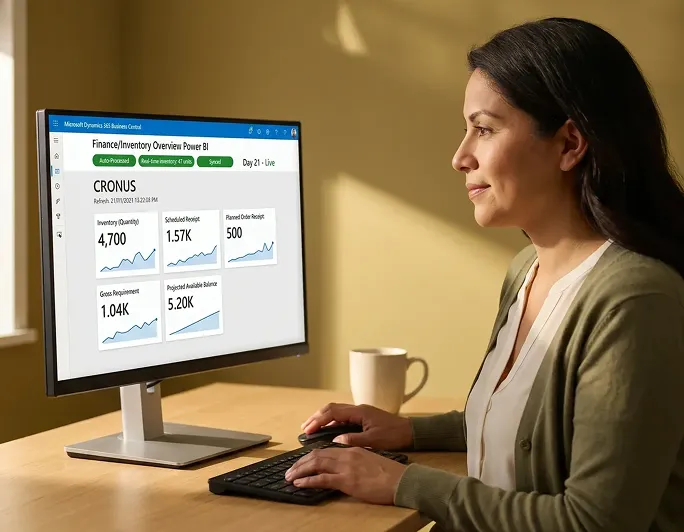
When Dynamics 365 and your eCommerce store share one data source, reporting becomes complete. eCommerce revenue sits alongside ERP financials in Power BI. No more stitching spreadsheet exports from two systems every Monday.
Every line item scoped and priced before work starts. No commitment to get your proposal.
Your Dynamics 365 version and its API capabilities
Business Central 2023 Wave, NAV 2017, and Finance and Operations all have different API structures and OData endpoint behaviors. We scope your specific version before quoting the connector build.
eCommerce platform and customization depth
A standard Shopify store connects differently from a customized headless Adobe Commerce build. We assess your store's customization level and identify custom fields or logic that need specific handling.
Data volume, sync frequency, and business rules
High-volume stores with complex B2B pricing rules, multi-location inventory, and custom order workflows scope differently from a straightforward B2C store. Each business rule is documented and priced separately.
- Integration architecture diagram and field mapping document
- Line-by-line scope with hours per connector and per object type
- 21-day implementation timeline with specific milestone dates
- Risk assessment for your Dynamics version and store setup
Call within 48 hours → scoped proposal in 3 days → no commitment required
B2B eCommerce, ERP, and Salesforce running as one system. Zero manual orders. Live inventory across every channel.
What separates Redefine from other Dynamics eCommerce integration services providers.
Questions teams ask before starting a Dynamics eCommerce integration project.
We build Dynamics eCommerce integrations for Dynamics 365 Business Central (all versions from BC14 onward), Dynamics 365 Finance and Operations, and Dynamics NAV. Each version has different API capabilities — Business Central uses OData and Business Central API v2, while NAV requires web services or REST configuration. We assess your specific version during the scoping call and confirm compatibility before any proposal is issued.
We build Dynamics integrations for Shopify, Shopify Plus, Adobe Commerce (Magento), BigCommerce, WooCommerce, and custom or headless eCommerce platforms that expose a REST API. The integration pattern is the same across platforms: we connect Dynamics 365 via its API layer and your eCommerce platform via its API or webhook system. If your store has an API, we can build the connection.
Dynamics 365 customer price groups, payment terms, and credit limits sync to your eCommerce store and apply automatically during checkout for that customer. When a logged-in B2B account places an order, they see their negotiated pricing from ERP — no manual setup per customer required. We also handle trade discounts, tiered pricing, and contract-specific pricing structures that live in Dynamics.
Every Dynamics eCommerce integration we build includes exponential backoff retry logic and a persistent queue for failed sync events. If the ERP API is temporarily unavailable, transactions queue and retry automatically when connectivity is restored. Critical events like order creation trigger alerts to your team within 4 hours. Nothing is silently dropped — every failure is logged, classified, and resolved.
We price Dynamics eCommerce integrations on a fixed-scope, fixed-fee basis scoped to your specific Dynamics version, eCommerce platform, and required sync objects. Each object type — orders, products, customers, inventory — is scoped and priced individually. You receive a line-by-line proposal before committing. No platform subscription fees, no per-transaction charges, no discovery fees. Source code and documentation delivered at go-live.
Get your scoped proposal in 3 days.
No commitment. No pitch. Share your Dynamics version and eCommerce platform. We send a line-by-line proposal with architecture, timeline, and cost.
We will review your Dynamics and eCommerce setup and send a scoped proposal within 3 business days. Expect a call within 48 hours.
Call within 48 hours → scoped proposal in 3 days → no commitment required
Your Dynamics 365 and eCommerce store, fully connected, in 21 days.
Share your Dynamics version and eCommerce platform. We send a scoped proposal with your exact connector architecture, field maps, and implementation timeline. No commitment. No pitch.
No commitment. No pitch. Call within 48 hours.