Salesforce SAP integration that stops your reps from quoting blind.
Your sales team quotes from memory because SAP pricing never reaches Salesforce. We build custom Salesforce SAP integration services that sync inventory, pricing, and order status in real time, so every rep sees live data without switching systems.
integration projects delivered across CRM, ERP, and ecommerce platforms
Hero · Sales and operations teams working from unified data

Your sales team quotes from memory. Your operations team fulfills on guesses.
Without a live Salesforce SAP integration, the gap between your CRM and your back-office creates errors your customers notice before your team does.
What breaks without Salesforce SAP integration
Reps quote prices that SAP cannot honor
Without live SAP pricing in Salesforce, reps quote from memory or last month's export.
Orders rekeyed from Salesforce into SAP every day
Manual entry that introduces errors, delays, and a daily operations bottleneck.
Customer accounts duplicated across both systems
Finance and sales work from different customer records with different addresses and terms.
Delivery status invisible to the sales team
Reps call operations to ask what's shipped instead of seeing it in the opportunity record.
Manual workarounds filling the gap a Salesforce SAP integration should close
Export opportunity list from Salesforce
CSV, 312 rows, sent to operations inbox at 7:45 a.m.
Re-enter confirmed orders into SAP manually
2.5 hours, 11 data entry errors found in last week's batch.
Pull pricing from SAP, paste into Salesforce quote
Rep used outdated price list for 4 quotes last quarter.
Email delivery status to sales team from SAP
Sent every Friday. Customer calls Tuesday. Rep has no answer.
Estimated weekly hours spent on manual Salesforce to SAP handoffs: 14
One integration. Three teams stop fighting the gap.
A custom Salesforce SAP integration removes the manual handoffs your sales, operations, and finance teams repeat every day. See what that looks like for each role.
Sales reps close faster with live SAP data inside Salesforce
- Live SAP pricing and inventory visible on the Salesforce opportunity record, no manual lookup required
- Won opportunities convert to SAP sales orders automatically without the sales rep ever leaving Salesforce
- Delivery status and shipment tracking from SAP updates the Salesforce record in real time so reps can answer customer questions immediately
- Quote accuracy improves because pricing always comes from the live SAP catalog, not a spreadsheet saved three months ago
SAP Quote Value
$147,200
SAP Stock Available
284 units confirmed
SAP Lead Time
12 business days
SAP Order Status
Ready to submit
SAP price: $88,400 · Stock: 140 units · Lead time: 8 days
Operations teams receive clean orders without manual rekeying
- Won Salesforce opportunities flow into SAP as confirmed sales orders automatically, with all customer and product data mapped correctly
- Validation logic catches mismatched product codes, invalid customer numbers, and missing required fields before the record reaches SAP
- Inventory changes in SAP update Salesforce product availability in real time, so operations and sales always read the same stock count
- Every failed record surfaces with a clear reason and resolution path before it causes a fulfillment delay
Orders auto-created from Salesforce opportunities today
SO-48821 · Acme Corp
147,200 USD · Valve Package · 284 units
SO-48819 · Bravo Industries
88,400 USD · Pump Assembly · 140 units
SO-48817 · Coastal Systems
61,050 USD · Sensor Array · 200 units
0 manual rekeys today · 3 orders auto-created · 0 validation errors
Finance sees one revenue number, not two conflicting ones
- Salesforce pipeline value reconciles with SAP order value automatically, so forecast versus actual gaps disappear at quarter-end
- SAP invoice and payment data flows back into Salesforce account records so account managers see outstanding balances without asking finance
- Pricing consistency across both systems eliminates the revenue recognition discrepancies that appear when sales closes at a different price than SAP invoices
- Audit trails exist in both systems because every order, quote change, and status update is logged with a source system reference
Salesforce pipeline versus SAP confirmed orders
Salesforce Pipeline
$2.84M
Weighted forecast
SAP Confirmed Orders
$2.83M
Live sync, 0 gap
Six outcomes your teams feel from day one of go-live
A Salesforce SAP integration is a structural change to how your sales, operations, and finance teams work together. Every outcome below starts working the day you go live.
Two-way data flow between Salesforce and SAP
Salesforce opportunities push orders to SAP. SAP inventory, pricing, and fulfillment status pull back into Salesforce. Both teams work from the same numbers.
Validation and error handling on every sync
Bad records get caught before they reach SAP. Every failed sync surfaces with the reason, the field, and the fix, so nothing fails silently.
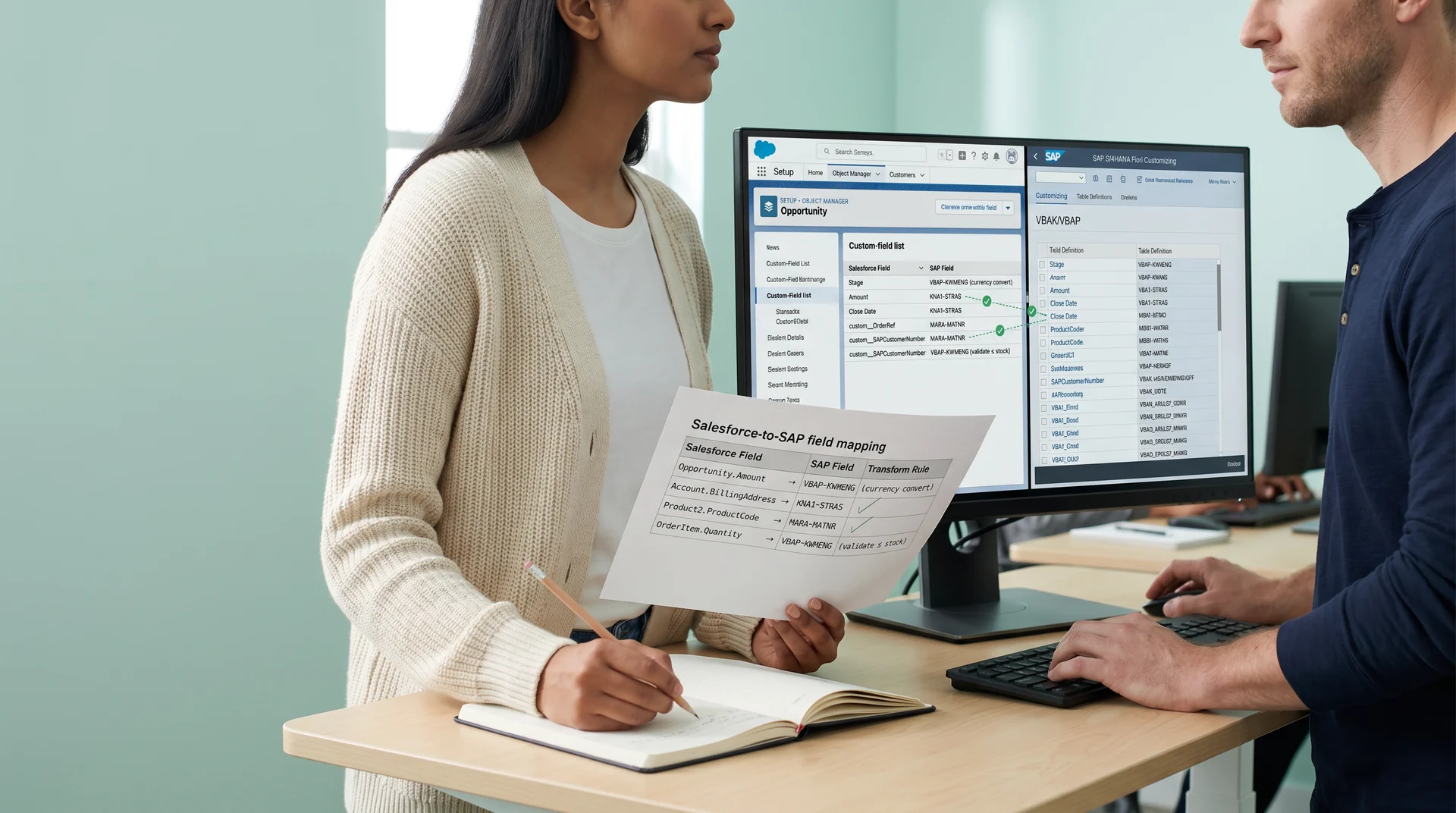
Custom field mapping built around your object model
Your Salesforce custom objects and SAP custom fields are mapped exactly. No forcing your data into a generic template that drops fields your business depends on.
Live monitoring and alerts the moment a sync fails
Your team knows the moment a sync fails, how many records were affected, and what to do next, through the alerting channel you already use.
Documented runbooks your team inherits at handoff
Every flow, every mapping, every alert threshold is documented so your operations team owns the integration and does not need to call us every week.
Full code ownership with no middleware subscription
Everything we build is yours. No vendor holds your Salesforce SAP integration behind a per-connection license that doubles in price each renewal.
From disconnected sales pipeline and back-office to one source of truth
A US-based promotional products company managed leads and pipeline in a CRM platform while the back office ran ERP. The two systems never shared data. Sales reps rekeyed orders by hand. Operations caught errors after the fact. Month-end reconciliation took days.
Operational pain before integration
- No system to manage incoming leads and prospect activity from the ERP environment
- Manual data entry between the CRM platform and ERP introduced recurring errors
- No unified analytics across sales pipeline and order fulfillment data
$0
Manual rekey errors in first 90 days after go-live
Systems connected, including CRM, ERP, and analytics
Pipeline-to-order reconciliation, fully automated
Case Study · Unified CRM and ERP analytics dashboard
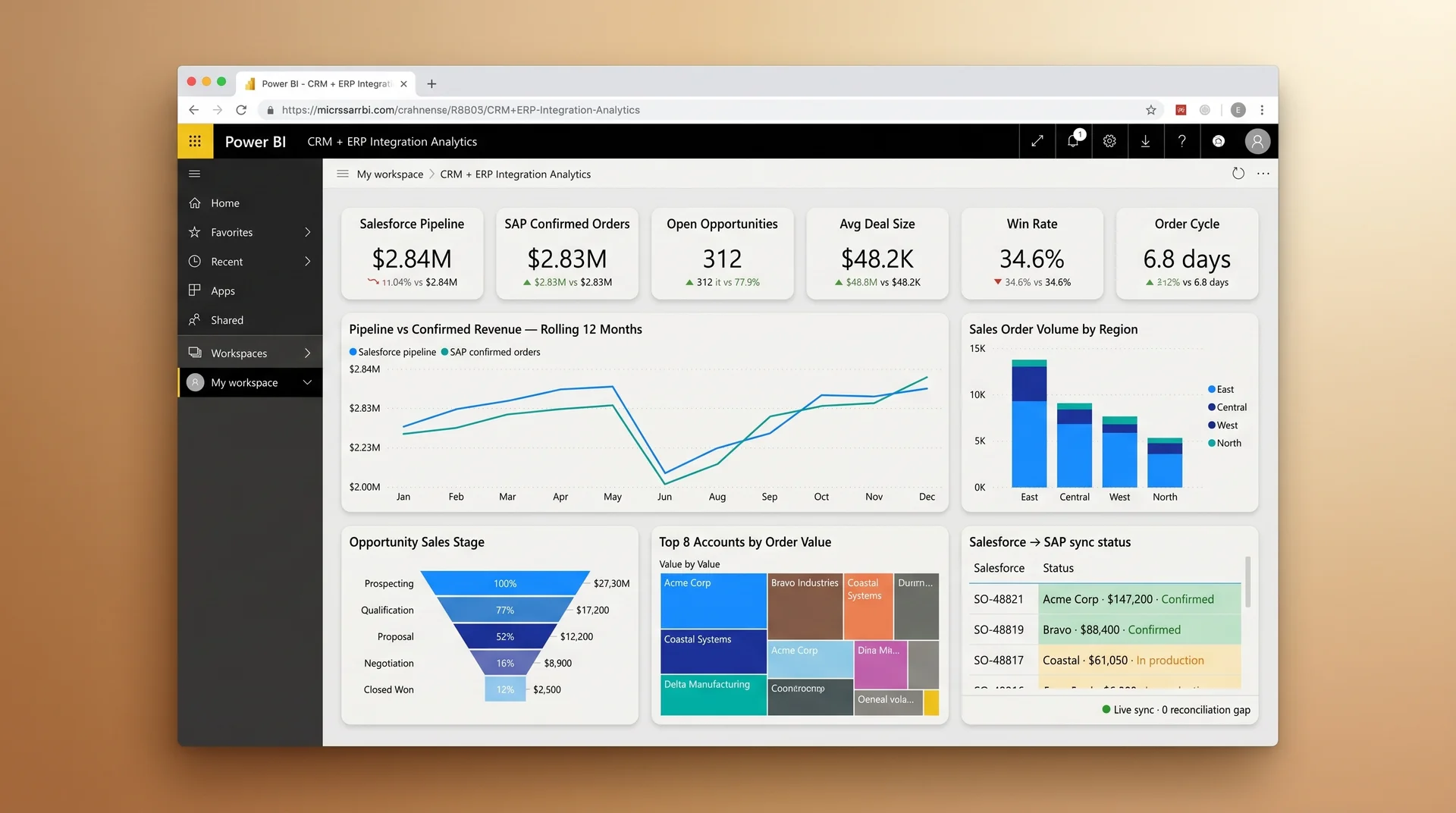
We connected the CRM and ERP platforms for real-time sync of accounts, contacts, opportunities, and sales quotes. Automated call logging replaced manual activity tracking. A unified analytics dashboard gave sales and operations leaders a single view across both systems. The result: fewer handoff errors, faster order fulfillment, and pipeline data the finance team could trust at month-end.
Most Salesforce SAP integrations break six months after go-live. Here is why ours do not.
Other integration partners install a connector, map the obvious fields, and leave. Then Salesforce releases a new version. Or SAP updates a module. Or your team adds a custom object. The integration stops working silently, and nobody knows until a customer calls.
Differentiation · Salesforce SAP integration team, field mapping review
What typical integration consultants deliver
- Generic middleware connectors that map standard fields and drop your custom ones
- No error handling, so failed syncs disappear until a customer notices a wrong order
- Integration logic only they can maintain or change after go-live
- Per-connection licensing that increases cost every time you add an object or a field
What Redefine delivers on every Salesforce SAP integration
- Custom field mapping built around your actual Salesforce object model and SAP configuration
- Validation, retry logic, and alerting built into every connector so failures never disappear quietly
- Full code ownership at handoff so your team or any developer can maintain and extend the integration
- Structured runbooks delivered at handoff with every flow, mapping, and alert threshold documented
Salesforce SAP integration: what to expect before, during, and after your project
A Salesforce SAP integration creates a live data bridge between your Salesforce CRM and your SAP ERP system. Opportunity data from Salesforce flows into SAP as sales orders. Account and contact records stay in sync between both platforms. Inventory and pricing data from SAP shows up in Salesforce without manual lookup. Fulfillment status from SAP updates the Salesforce record your sales team already watches.
A standard Salesforce SAP integration covering order-to-cash, account sync, and pricing sync typically goes live in six to ten weeks. Projects with complex custom objects in Salesforce, non-standard SAP modules, or multi-currency and multi-company requirements run eight to fourteen weeks. We publish a line-by-line delivery timeline before any work begins so your teams can plan around each milestone.
We use both, depending on your setup. Pre-built middleware connectors speed up standard field mappings between common Salesforce and SAP objects. For organizations with custom Salesforce objects, non-standard SAP modules, or business rules that generic connectors miss, we build custom integration logic. That includes transformation layers, validation rules, and error-handling workflows. Your data moves exactly the way your business requires, and you are never limited to what a template supports.
On the SAP side, we work with SAP S/4HANA, SAP ECC, SAP Business One, and SAP Business ByDesign. On the Salesforce side, we integrate with Sales Cloud, Service Cloud, CPQ, and Revenue Cloud. If your organization runs a specific module or edition not listed, describe it in your brief and we will confirm fit before scoping begins.
Every Salesforce SAP integration engagement includes system discovery and field mapping, object and data model alignment between Salesforce and SAP, connector build or configuration, end-to-end testing with record reconciliation, error-handling and alerting setup, and a structured handoff with documented runbooks. For teams that need ongoing coverage, we offer monitoring retainers. Those retainers cover incident response, object additions, and platform-version changes as your stack grows.
Tell us what your sales team can't see in Salesforce. We'll scope the SAP connection.
Every integration is scoped before work starts. You get line-by-line pricing, and there is no commitment to receive a proposal.
Response in 48 hours
A Salesforce SAP integration specialist reviews every brief
Proposal in 3 days
Line-by-line scope with field mapping plan and timeline
200+ integrations delivered
Across Salesforce, ERP, and analytics platforms
Full code ownership
No middleware subscription, no vendor dependency
Brief received
We'll review your Salesforce and SAP setup and send a scoped integration proposal within 3 business days.
We can scope and ship your Salesforce SAP integration in weeks
No commitment. No pitch. A line-by-line proposal built around your Salesforce object model and your SAP configuration.
Submit your brief · call within 48 hours · scoped proposal in 3 days · Sprint 1 within 1 week of sign-off