Shopify ERP integration that ends the spreadsheet between your store and your back office.
Shopify ERP integration services that move orders, inventory, and customer records between your store and your ERP automatically. Your team stops rekeying data. Your finance team closes books faster. Your customers stop getting oversold.
integration projects delivered · Shopify, ERP, and ecommerce platforms
Hero · Shopify storefront and ERP in live sync

Your Shopify store sells fast. Your back office catches up slowly.
Without a live Shopify ERP integration, every order starts a chain of manual work. Someone exports it. Someone re-enters it. By the time inventory updates, you have already oversold three products.
What breaks without Shopify ERP integration
Shopify shows stock that your ERP already sold
Your storefront and warehouse have no live stock sync. Oversells happen every day, and your support team handles the fallout..
One person re-enters every Shopify order into your ERP each morning
Manual entry that introduces errors and creates a bottleneck your whole fulfillment chain depends on.
Customer records in Shopify and your ERP never match
Finance and fulfillment work from different versions of the same customer with different addresses.
Fulfillment status never reaches Shopify without someone copying it
Customers email asking where their order is because tracking never updated on their end.
#SH-10482 · Sarah M.
3x Valve Kit Pro · $184.00
12s ago
#SH-10481 · TechBuild Corp
10x Mounting Bracket · $620.00
1m 44s ago
#SH-10480 · GlobalParts Ltd
50x Sensor Array · $4,250.00
8m 12s ago
#SH-10479 · Maria R.
1x Starter Kit · $89.00
14m 01s ago
84 orders synced today · 0 manual entries · 0 errors · inventory current to 90 seconds
What your team loses every month without a Shopify ERP integration
Manual data sync is not free. Slide the bars below to see what staff time, oversells, and error correction cost you each month. Then compare that number to a custom Shopify ERP integration.
Estimated monthly cost of staying disconnected
Total monthly cost of inaction
$0
Annual equivalent: $0
A custom Shopify ERP integration pays for itself in 60 to 90 days. That payback applies to any store processing 50 or more orders per day.
Six outcomes your store and operations team feel from day one
A Shopify ERP integration is not just order sync. It changes how your entire operation runs. Orders move. Inventory stays accurate. Fulfillment updates. Finance closes faster. No one touches a spreadsheet.
Orders flow from Shopify to your ERP automatically
Every Shopify order triggers a sales order in your ERP within seconds. No export, no re-entry, no batch file.
Inventory in your ERP writes back to Shopify in real time
Stock levels update on Shopify product pages the moment inventory changes in your ERP, so oversells stop permanently.
Fulfillment status pushes to Shopify without manual entry
When your ERP ships an order, tracking numbers update the Shopify order automatically. Customers stop emailing to ask where their package is.
Customer records sync between Shopify and your ERP
New Shopify customers create accounts in your ERP with correct addresses, account codes, and pricing tiers already set.
Validation logic catches bad records before they hit your ERP
Mismatched SKUs, missing fields, and duplicate records are caught at the integration layer with a clear error log so nothing fails silently at 2 a.m.
Full code ownership and documented runbooks at handoff
Everything we build is yours. No per-connection fee. No middleware subscription. No vendor lock-in.
From manual inventory and data silos to a live Shopify-to-ERP sync
A regional dealer selling B2B and B2C needed to replace a slow, monolithic site. Their legacy ERP held inventory that never showed online. No live data sync existed. Operations ran on manual processes that created bottlenecks across every department.
Operational friction before integration
- Inventory and parts data were incomplete or unavailable online, limiting customer access
- No integration between the website, the legacy ERP, and marketing tools
- Manual processes, data silos, and missed automation across all three operational systems
Inventory visible online after ERP integration
Systems integrated: storefront, ERP, and email marketing
Manual data transfers after go-live
Case Study · Live inventory dashboard, ERP to storefront
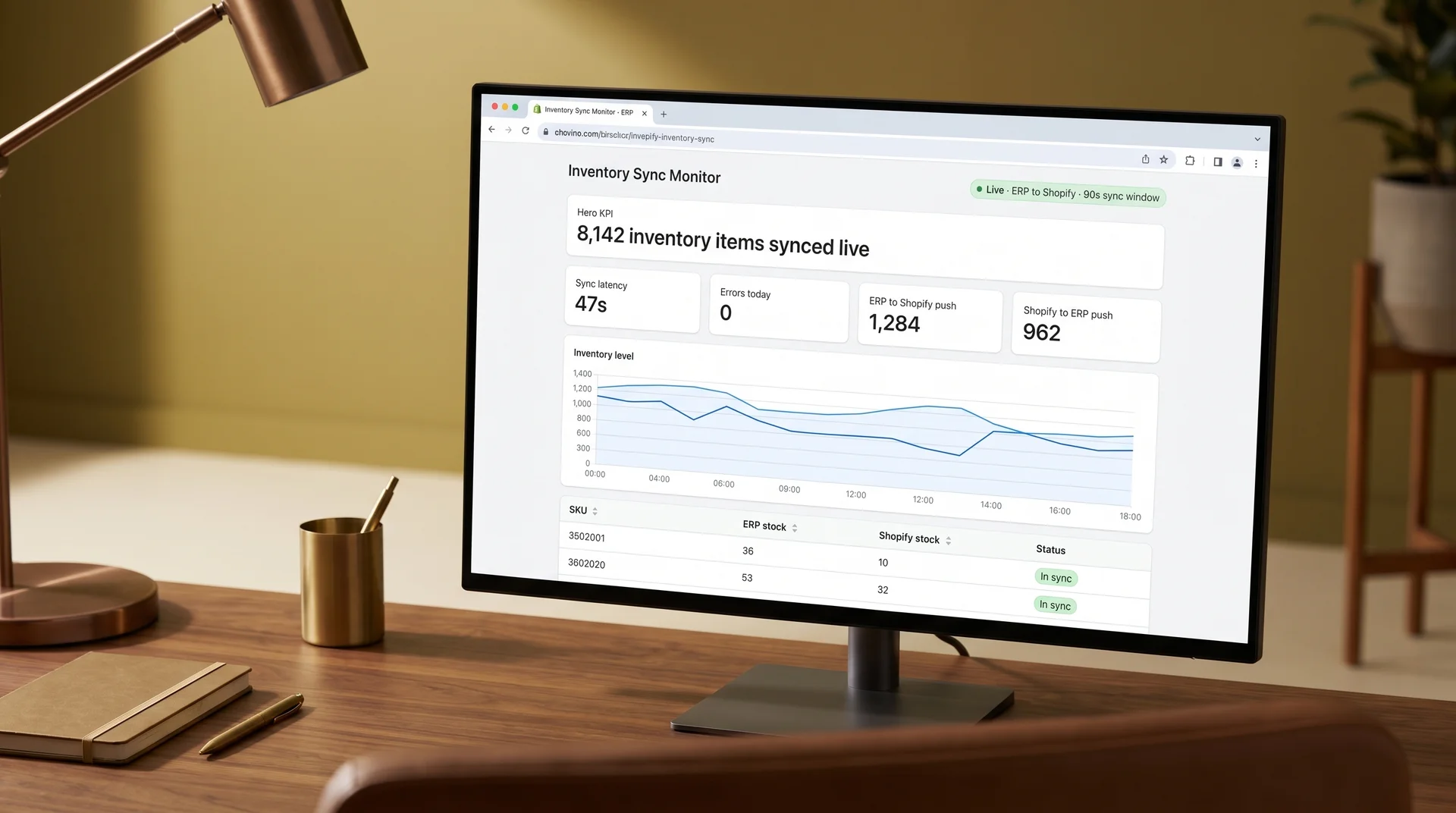
We connected the new ecommerce platform directly to the legacy ERP through its APIs. Equipment inventory and parts data now sync in real time. The integration removed every manual data transfer between systems. Marketing workflows trigger automatically based on inventory levels and customer behavior.
Pre-built connectors break when your Shopify store or ERP updates. Custom builds don't.
A generic Shopify ERP integration connector maps the 20 fields every store shares. Your store has fields it has never seen. When Shopify pushes a breaking API change, that connector breaks silently. Orders pile up unsynced.
Differentiation · Shopify ERP integration developer, field mapping review

What pre-built connectors deliver
- Standard field mappings that drop your custom metafields and ERP columns
- Silent failures when Shopify updates its API or your ERP version changes
- Per-connection monthly fees that double in price each renewal cycle
- No documentation, no error logs, and no runbooks when something goes wrong
What Redefine delivers on every Shopify ERP integration
- Custom Shopify ERP integration built around your exact metafields, product variants, and ERP object model
- Validation, retry logic, and alerting built into every flow so failures surface before customers notice
- Full code ownership transferred at handoff with no ongoing per-connection subscription
- Structured runbooks and flow documentation so your team owns the Shopify ERP integration going forward
What Shopify merchants ask before starting an ERP integration project
A Shopify ERP integration creates a live data bridge between your Shopify storefront and your ERP. Orders placed on Shopify flow into your ERP as sales orders or purchase orders automatically. Inventory levels in your ERP push back to Shopify in real time. Your product pages always show accurate stock. Customer and account records stay in sync across both platforms. Fulfillment status from your ERP updates the Shopify order without anyone touching it manually.
Our Shopify ERP integration services support Microsoft Dynamics 365 Business Central, Microsoft Dynamics NAV, SAP Business One, SAP S/4HANA, NetSuite, Acumatica, and custom ERPs that expose an API or support file-based exchange. If your ERP is not listed, describe it in your project brief and we will confirm technical fit before scoping begins.
A standard custom Shopify ERP integration covering order sync, inventory writeback, and customer data sync typically goes live in five to eight weeks. Projects with multi-location inventory, multi-currency pricing, complex product variants, or non-standard ERP modules run eight to twelve weeks. We publish a line-by-line delivery timeline before any work begins so your operations and development teams can plan around each milestone.
We use both, depending on your stack. Pre-built connectors accelerate standard field mappings for common Shopify and ERP object pairs. For merchants with custom Shopify metafields, non-standard ERP configurations, or business logic that generic connectors cannot handle, we build custom Shopify ERP integration logic with transformation rules, validation layers, and error-handling workflows so your data moves exactly as your business requires.
Every Shopify ERP integration engagement includes a system discovery and field mapping specification, object alignment between Shopify and your ERP, connector build or configuration, end-to-end testing with record reconciliation, error-handling and alerting setup, and a structured handoff with documented runbooks. For merchants that need ongoing coverage, we offer monitoring retainers that handle incident response, new object additions, and platform-version changes as your stack evolves.
Tell us what your team enters manually between Shopify and your back office. We send back a scoped integration plan.
Scoped before work starts. Line-by-line pricing. No commitment to receive a proposal.
Response in 48 hours
A Shopify ERP integration specialist reviews every brief
Proposal in 3 days
Line-by-line scope with field mapping plan and timeline
200+ integrations delivered
Across Shopify, Dynamics 365, SAP, NetSuite, and Acumatica
Full code ownership
No middleware subscription, no per-connection fee
Brief received
We'll review your Shopify and ERP setup and send a scoped integration proposal within 3 business days.