AI Governance for Commerce
Stop AI from publishing compliance risks across your store
Every AI output your platform generates gets scored for compliance risk before it reaches customers. Redefine applies the same brand guardrails, review gates, and audit trail across content, product data, and marketplace listings.
120+
enterprise commerce deploymentsPIM ·
CMS · Marketplace

Pending AI Output Review4
flagged
Product description: SKU-4421
AI confidence: 61% · Brand voice deviation
Marketplace listing: Amazon US
AI confidence: 88% · Regulatory claim flagged
Homepage hero copy: EN-AU
AI confidence: 94% · Passed guardrails
The Problem with Ungoverned AI
AI without governance creates compliance exposure at scale
Old Way: Isolated AI
- AI runs in each module independently with no shared policy engine
- Content publishes without compliance scoring or human approval gates
- No audit trail links AI actions to specific users, timestamps, or change context
- Brand voice guardrails applied inconsistently across regions and channels
- Access anomalies go undetected until an incident surfaces manually
Redefine: Unified AI
Governance
- Single governance policy engine applies the same rules across product information management, content management, marketplace, and commerce
- AI-generated compliance risk scored before any output reaches publish or marketplace feeds
- Complete audit log records every AI action with user, timestamp, and approved version
- Brand voice and compliance guardrails enforced identically across every region and channel
- AI detects off-hours access, bulk exports, and permission escalation in real time

Key Capabilities
Every AI output governed before it reaches your customers
No other commerce platform applies one governance policy across every AI-generated surface. Redefine scores, gates, and audits AI outputs from a single control layer that spans your entire stack.
AI Compliance Risk Scoring
Every AI-generated product description, content management copy block, and marketplace listing receives a compliance risk score before it can be published. Scores surface regulatory language, brand voice deviations, and missing required disclosures.
Risk Score: SKU-7102High
Detected: regulatory claim, missing safety data sheet reference
AI Output Review Queue
Flagged AI outputs route to a structured review queue. Assigned reviewers approve, reject, or edit before changes propagate. No AI content bypasses the human gate when a risk threshold is exceeded.
3Pending human review
12Approved today
Audit Log for AI Actions
Every AI-generated change is recorded with user identity, timestamp, source model, confidence score, reviewer decision, and approved version. The audit trail is immutable and exportable for compliance review or investigation.
14:32:07 · AI enriched SKU-4421 · by system
14:33:41 · Flagged: risk score 78% · routed to J. Park
14:47:15 · Approved with edits · by J. Park
14:47:16 · Published to product detail page · version 3
AI Confidence Scoring
Each AI output carries a confidence score. Low-confidence outputs are automatically routed for review. High-confidence outputs that pass guardrails can publish without blocking your team.
Brand Voice Guardrails
Brand tone, terminology, prohibited claims, and required disclosures are defined once and enforced across every AI output. The same rules apply whether AI generates a product detail page title, a content management hero block, or a marketplace listing.
AI Access Anomaly Detection
AI monitors user behavior patterns across your platform and flags off-hours access, bulk data exports, unusual permission escalation, and access pattern deviations before they become incidents.
Anomaly detected: bulk export 02:14 UTC
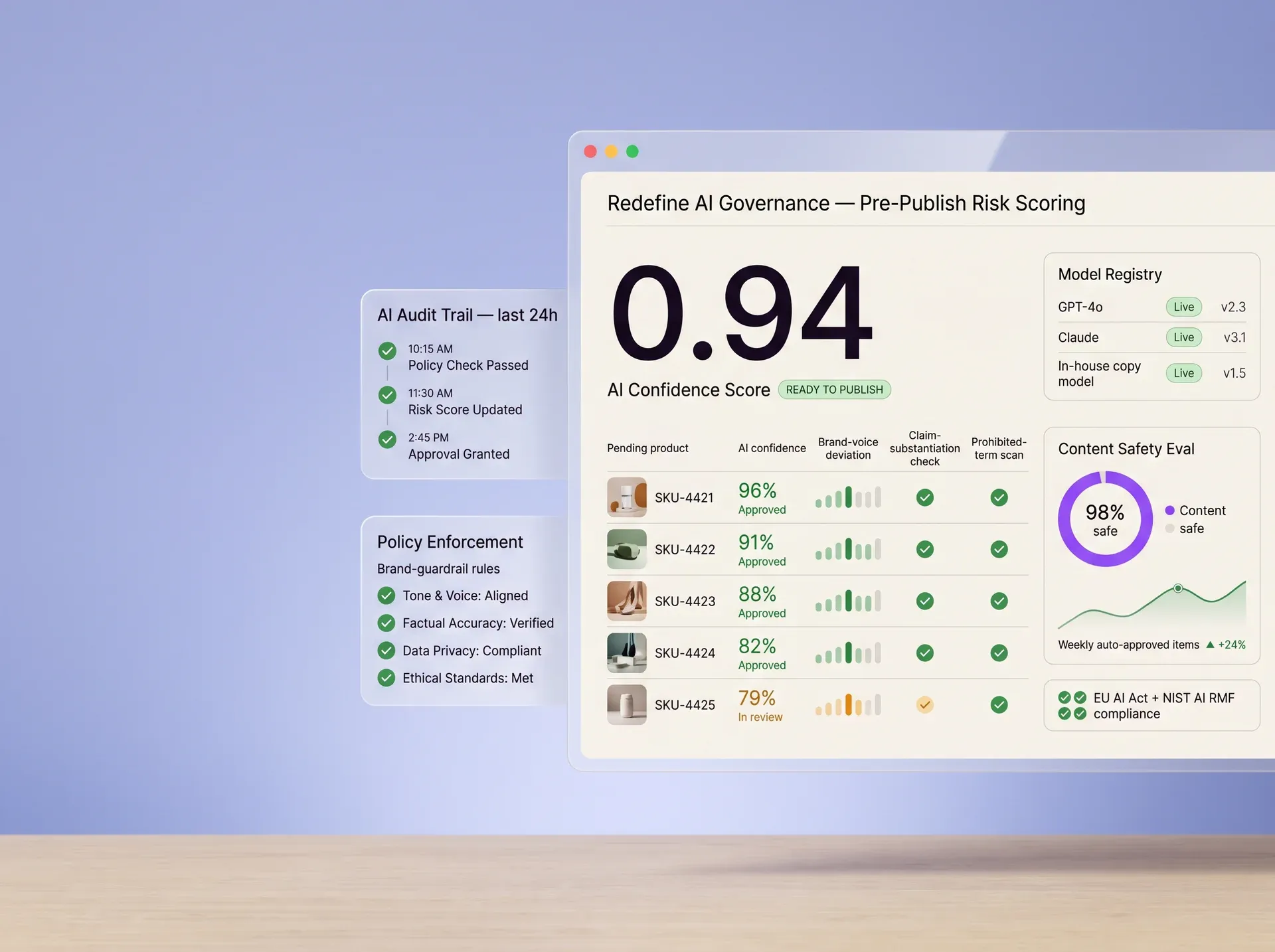
One governance layer, every AI surface
Most commerce platforms govern AI inside individual modules. A content management AI tool checks tone. A product information management AI tool checks data completeness. But no shared policy connects them.
Redefine's AI governance layer sits above every module. The same compliance rules, brand guardrails, and human approval gates apply whether AI is generating product copy, marketplace listings, or content management blocks. You configure the policy once. It runs everywhere.
Product
information management enrichmentContent
managementMarketplace
listingsCommerce
descriptionsReport
summaries
How It Works
From AI output to published content in a governed workflow
Click any node to see how the governance layer intercepts, scores, and routes AI outputs before they reach your customers.
1. AI generates output
Product copy, listing, content management block, report summary
2. Compliance risk scored
Regulatory language, brand voice, required disclosures checked
3. Risk threshold check
High risk:
Review
queueLow risk:
Auto-publish
4. Human approval gate
Assigned reviewer: approve, reject, or edit with comment
5. Audit log entry and publish
Immutable record written, content published to channel
Step 1 of 5
AI generates output
AI runs inside product information management, content management, commerce, or marketplace modules as your team works. It generates product descriptions, listing copy, content management hero blocks, or analytics summaries.
AI is generating: product description for SKU-7891
Generating copy block... model: gpt-4o · confidence: calculating...
Step 2 of 5
Compliance risk scored
The governance engine intercepts every AI output before it can be saved or published. It checks against your defined brand voice rules, regulatory vocabulary, required disclaimers, and prohibited claim patterns.
Brand
voice alignment
Regulatory language
Required disclosures
Overall risk score78%: High
Step 3 of 5
Risk threshold check
Your team defines risk thresholds. Outputs above the threshold route automatically to the human review queue. Outputs that pass go directly to publish with a confidence score logged to the audit trail.
Risk score 78% exceeds threshold (60%). Routing to review queue.
Assigned to: J. Park (Content Compliance Lead)
Auto-publish would apply to outputs scoring below 60% with all guardrails passing.
Step 4 of 5
Human approval gate
The assigned reviewer sees the flagged output, the AI confidence score, and the specific guardrail violations. They can approve as-is, edit inline, or reject and provide a reason that feeds back to the AI model context.
SKU-7891: Flagged claim "clinically proven"
"Clinically proven formula delivers..."
Reviewer note: removed unsubstantiated claim, approved v2
Step 5 of 5
Audit log entry and publish
Every decision in the workflow is written to the immutable audit log before the content publishes. The log records the AI model, confidence score, flagged items, reviewer identity, edit reason, and the final approved version.
PUBLISHED · SKU-7891 product detail page copy · 14:52:03 UTC
Reviewer: J. Park · Decision: approved v2
Edit: removed "clinically proven" claim
AI model: gpt-4o · Confidence: 94% (post-edit)
Version: 2 · Locked: yes
Proof
Compliance-ready from day one
Fintech / Regulated
Services

Client
FinTech Organization
A regulated financial services organization operating cloud-native commerce infrastructure under strict compliance requirements.
Problem
Legacy infrastructure lacked governance frameworks, strong access controls, and the auditability required by regulators. Compliance expectations were evolving faster than their platform could adapt.
Result
0%
Audit-ready infrastructure
Security controls, governance frameworks, and identity and access management policies established a compliance-ready foundation. Every access event was traceable. Audit processes that previously took weeks were completed in hours.
Platform Architecture
AI governance is only possible on a unified platform
Point-solution AI tools cannot share a governance layer because they have no shared data model. Redefine's AI governance works because product information management, content management, order management, marketplace, and commerce are all native to the same platform. The policy engine reads from one source of truth.
Unified data layer
Product information management, content management, order management, commerce, marketplace all native. One record. One policy.
Cross-module policy engine
One set of governance rules applied consistently regardless of which module triggered the AI output.
Real-time anomaly detection
Platform-wide behavioral baseline. AI flags deviations across every user session, not just inside one tool.
Immutable audit log
Every AI action written to a tamper-proof log with full context. Exportable for auditors on demand.
Governance policy active across all
modules
Product Information Management
Governed
Content Management
Governed
Marketplace
Governed
Commerce
Governed
Reports
Governed
AI Governance Policy Engine
Risk Scoring
Review Queues
Audit Log
Why Redefine
No other platform governs AI across every commerce surface
Other implementation partners offer AI features inside individual tools. None apply a unified governance policy across all AI outputs. That gap creates compliance exposure your team has to patch manually.
Typical Partner Approach
AI features exist inside individual tools with no shared governance layer
No cross-module audit log linking AI actions to user decisions and approvals
Compliance risk scoring is manual or absent before AI content publishes
Access anomaly detection requires a separate security tool and manual correlation
Redefine AI Governance
Single cross-module governance policy engine covering every AI surface natively
Unified immutable audit log recording all AI actions, user decisions, and approval context
Automated compliance risk scoring before any AI output reaches publish or channel feeds
AI-native access anomaly detection built into the platform with no additional tooling

Why unified governance is a harder problem than it looks
Applying a governance layer to AI inside one module is straightforward. Applying the same policy across product information management, content management, order management, marketplace, and commerce simultaneously requires all of those modules to share a data model, an identity layer, and a common policy engine.
That architecture is only possible when the modules are native to the same platform. Redefine is built this way. Most other platforms are not.
Best-Fit Use Cases
Built for commerce teams managing AI at scale
Enterprise catalog teams
AI enriches hundreds of stock-keeping units daily. Governance ensures every description that reaches publish has passed compliance scoring, brand voice checks, and human approval when needed.
Regulated product categories
Healthcare, supplements, financial products, and consumer goods with mandatory disclosure requirements. AI governance flags non-compliant claims before they reach marketplace listings or product detail pages.
Multi-region brands
Regional compliance requirements differ. Governance rules are configured per locale and enforced automatically, ensuring AI outputs for EU, US, and Asia-Pacific markets each meet their local standards.
Security-conscious operators
Teams that need to detect unusual access patterns, bulk exports, or permission escalation before they become incidents. AI anomaly detection works across your entire user base and session history.
Marketplace-heavy operations
AI generates listings for Amazon, eBay, and regional marketplaces at volume. Governance prevents prohibited claims, incorrect attributes, and brand-inconsistent copy from being syndicated automatically.
Audit-driven compliance programs
Organizations that require demonstrable AI oversight for SOC 2, ISO 27001, or internal audit programs. The immutable log and review queue provide the evidence trail regulators expect.
Related Modules
AI governance connects every layer of your platform security
Access and Permissions Management
Role-based access controls that integrate with AI governance to enforce least-privilege principles across every AI-enabled workflow.
Identity and Security
Single sign-on, multi-factor authentication, and identity governance controls that feed the AI anomaly detection baseline with real user identity context.
Audit and Traceability
Platform-wide audit logging that records AI actions alongside human decisions. Every change is traceable from source to publish.
Governance Controls
Publish gates, approval workflows, and policy enforcement across your entire commerce stack. AI governance operates inside this layer.
Governance, Security and Compliance Hub
The full governance suite covering access, identity, audit, compliance, and AI governance in one unified product.
AI and Automation
The AI capabilities that governance applies to. Enrichment, content generation, listing automation, and conversational tools all governed by the same policy layer.
Is This Right for You?
AI governance is a fit if your team faces these situations
Good Fit
- You use AI to generate product copy, listings, or content management blocks at volume
- Your products sit in regulated categories where prohibited claims create legal risk
- You need a demonstrable audit trail of AI decisions for internal or external compliance programs
- You have multiple regions with different compliance requirements for AI-generated content
Probably Not a Fit
- You publish fewer than 50 AI-generated outputs per month and have no regulatory exposure
- Your team manually reviews every AI output before it saves, with no plans to scale AI use
- You do not currently use AI to generate commerce content and have no plans to do so
Not sure? Tell us your situation and we'll be straight with you.
Frequently Asked Questions
Questions teams ask before deploying AI governance
Only for outputs that exceed your defined risk threshold. Low-risk, high-confidence AI outputs can publish automatically with no human step required. Your team only sees outputs that genuinely need a review. In practice, teams report faster overall publishing because the AI handles first drafts and governance catches issues before they create rework.
Each AI output is evaluated against a rule set you configure: prohibited claim patterns, required disclosures, brand voice parameters, and regulatory vocabulary lists. The engine assigns a risk score between 0 and 100. You set the threshold above which outputs require human review. Scores and the specific violations that triggered them are stored in the audit log with every output record.
Yes. Governance rules are configured per locale, channel, and product category. EU listings can require specific regulatory disclosures while US listings apply a different rule set. The policy engine applies the correct rules based on the destination channel and locale of each AI output automatically.
The AI builds a behavioral baseline per user based on normal working hours, access frequency, data volumes, and permission levels. It flags deviations including off-hours access to sensitive areas, bulk data export events above normal thresholds, permission escalation attempts, and access patterns that match known credential compromise signatures. Alerts route to your security team with full session context.
The audit log records user identity, timestamps, AI model used, confidence score, governance decision, reviewer action, and final approved version for every AI-generated change. It is immutable once written and exportable in formats your auditors can review. Most customers use it directly as evidence for AI oversight controls in SOC 2 Type II and ISO 27001 assessments. Your compliance team can confirm fit against your specific control framework before you commit.
Get Your AI Governance Plan
Tell us what you need governed
Submit your brief and we'll map the AI governance layer your platform needs and show you exactly how it will work for your catalog.
Form
Call within 48 hours · proposal in 3 days · Sprint 1 in 1 week of sign-off
Brief received
We'll review your AI governance situation and send a scoped proposal within 3 business days. You'll hear from us within 48 hours to confirm receipt and align on timing.
Response within 48 hours
Proposal in 3 days
120+ deployments
You Own the Config

"We needed AI governance that covered every surface where AI touches our catalog, not just one tool inside our product information management system. Redefine's policy engine runs the same rules across product data, marketplace feeds, and content management blocks. The audit log alone saved us three weeks preparing for our last compliance review."
Director of Commerce Operations · Regulated Consumer Goods
See AI Governance in Action
Every AI output scored, gated, and audited before it reaches your customers
Walk through a live demo of the risk scoring queue, the review workflow, and the audit log. See how governance applies across your full platform in one session.
No commitment. No pitch. See it working on your catalog scenario.
Submit brief, call within 48 hours, scoped proposal in 3 days, Sprint 1 in 1 week of sign-off