Operations Reporting Software
Know about ops problems before your customers do
Redefine surfaces service-level agreement breaches, inventory exceptions, and fulfillment delays in role-specific dashboards. Your operations team sees what needs attention, not everything at once.

The Operations Reporting Problem
Siloed reports don't show you the full picture
Most platforms report on one product area at a time. Your order data lives in your Order Management System, your inventory data lives in a warehouse system, and your supplier data lives in a spreadsheet. By the time you assemble the picture, it's yesterday's problem.
Without Unified
Operations Reporting
- Service-level agreement breaches are discovered after the customer complains, not before dispatch
- Inventory reports and order reports live in separate tools with no correlation layer
- Carrier performance is invisible until month-end, when it's too late to reroute
- Supplier delays surface in customer service tickets, not in a supplier scorecard
- Returns analysis requires a manual spreadsheet export every week
With Redefine
Operations Reporting
- Service-level agreement at-risk orders flagged automatically, 4 hours before breach window closes
- Cross-platform view correlates Product Information Management completeness, Order Management System status, and inventory in one panel
- Live carrier performance tracked by route, zone, and carrier contract for daily decisions
- Supplier scorecards with on-time delivery, lead-time drift, and defect rate by vendor
- Automated returns analysis with root-cause tagging, updated on every sync cycle

Live Operations Exception Monitor
Every exception, ranked by operational impact
The operations exception monitor groups live alerts by domain: fulfillment, inventory, carrier, and supplier. Click any exception to drill into the detail panel. Redefine builds this layer on top of your existing Order Management System, Warehouse Management System, and Enterprise Resource Planning data.
Overall Operations
Health82% healthy
● 41 Healthy● 6 Warning● 3 Critical
CriticalFulfillment
14 orders at service-level agreement risk
Breach window closes in under 3 hours
WarningFulfillment
Pick queue backlog: Zone C
32 orders pending, 18-minute average delay
CriticalInventory
3 stock-keeping units below safety stock
Estimated stockout in 48 hours
WarningInventory
Aging stock: 89 units over 90 days
Holding cost increasing $340 per week
WarningCarrier
Carrier A: on-time rate 71%
Down from 94% over last 30 days, Southeast region
CriticalSupplier
Supplier B: 2 overdue purchase orders
$48K in stock delayed 11 days
Click any exception to see the detail panel.
Critical: Fulfillment
Service-Level Agreement
14 Orders at Service-Level Agreement Risk
Breach window closes in under 3 hours. These orders require immediate re-routing or escalation.
#ORD-449812Zone B2h 14m
left
#ORD-449788Zone D2h 41m
left
#ORD-449751Zone A3h 02m
left
#ORD-449702Zone C3h 28m
left
+ 10 more at-risk
orders
Recommended Action
Prioritize Zone B pick queue. Assign 2 additional
pickers. Re-route Zone D orders to Carrier B express lane.
Warning: Pick Queue
Backlog
Zone C Pick Backlog: 32 Orders
Average delay: 18 minutes. Current throughput: 4.2 orders per hour versus target 7.0 orders per hour.
32
Pending
4.2
Orders per hour
18m
Avg delay
Throughput trend (last 6 hours)
Recommended Action
Reassign 3 pickers from Zone A (currently idle).
Estimated queue clearance: 78 minutes.
Critical: Inventory
Risk
3 Stock-Keeping Units Below Safety Stock
Estimated stockout within 48 hours. Active marketplace listings will be suppressed automatically if stock hits zero.
SKU-WH-0042
Blue Crew Neck L
4 units left
Safety: 25
SKU-WH-0118
Black Zip Hoodie XL
7 units left
Safety: 20
SKU-WH-0291
Navy Polo M
2 units left
Safety: 30
Recommended Action
Trigger emergency purchase order with Supplier C
(2-day lead time). Pause marketplace listings for SKU-WH-0291 pending restock.
Warning: Inventory
Aging
89 Units Aged Over 90 Days
Holding cost is increasing $340 per week. Markdowns or liquidation decisions are needed by end of this week.
89
Aged units
$340
Cost per week
90 to 120 days52 units
120+ days37 units
Recommended Action
Apply 20% markdown to 120+ day units. Review 90 to
120 day cohort for bundle opportunities before next buying cycle.
Warning: Carrier
Performance
Carrier A On-Time Rate: 71%
Down from 94% over the past 30 days. Concentrated in the Southeast region, primarily ground service level.
Last 7 days
71%
Last 30 days
94%
Carrier B (alternative)
96%
Recommended Action
Temporarily shift Southeast ground shipments to
Carrier B. Raise service ticket with Carrier A account manager. Review contract service-level
agreement credits.
Critical: Supplier
Delay
Supplier B: 2 Overdue Purchase Orders
$48,000 in stock delayed 11 days. 3 marketplace listings are at risk of suppression due to projected stockout.
PO-2024-0887
240 units apparel
11 days late
$28,800
PO-2024-0891
160 units accessories
8 days late
$19,200
68%
On-time rate (90 days)
3
Listings at risk
Recommended Action
Escalate to Supplier B account manager. Source
backup quantity from Supplier D (longer lead, available stock). Flag for supplier scorecard
review.
Key Capabilities
Every operational metric your team acts on
Redefine builds role-specific operations reporting across fulfillment, inventory, suppliers, carriers, and returns. Each report is designed for the person who acts on it, not just the person who reads it.
Order Fulfillment and Service-Level Agreement Performance
Track on-time fulfillment rates, service-level agreement breach history, and at-risk order queues in real time. Break down performance by warehouse zone, carrier, and time window.
Service-Level Agreement Compliance Rate
97.4%
+2.1% versus last month
Average Fulfillment Time
4.2 hrs
-0.8 hrs versus last month
At-Risk Orders Today
14
Breach window under 3 hours
Orders Shipped Today
328
On track versus target 340
Inventory Turnover and Stock Aging
Know your fastest and slowest movers. Flag aging stock before holding costs compound. Track turnover by stock-keeping unit, category, and location.
Turnover
ratio (average)8.4x
Units aged 90+ days89 units
Supplier and Purchase Order Performance
Score each supplier on on-time delivery, lead-time drift, defect rates, and purchase order accuracy. Build vendor accountability with data, not emails.
Supplier A96% on-time
Supplier B68% on-time
Supplier C91% on-time
Returns and Refund Analysis
Classify returns by root cause: wrong item, quality issue, sizing, or buyer remorse. Track refund cycle time and resolution cost per return type.
2.3%
Return rate
1.8 days
Average resolution
Carrier and Shipping Cost Reporting
Compare cost per shipment across carriers and service levels. Identify zones where you're overpaying and routes where performance has degraded.
Average
cost per shipment$4.82
Best
carrier (Southeast)Carrier B: $3.90
Worst
carrier (Southeast)Carrier A: $6.10
Product Information Management to Order Management System Correlation
Our differentiating capability: operational reporting that correlates Product Information Management completeness scores with marketplace listing suppression and Order Management System fulfillment delays in a single view.
Example insight
"SKU-0042 has a 63% Product Information Management score.
This correlates with 3 marketplace suppression events and an average 6-hour Order Management System
delay on this stock-keeping unit."

Client Proof
From $14M to $90M with unified operations reporting

Result
0M+
Annual revenue reached from under $14M at engagement start
Scale
30+
Storefronts and over 1 million inventory items unified in one reporting layer
Efficiency
0%
Reduction in manual reporting overhead through automated warehouse and
operations dashboards
The Problem
A large promotional apparel business operated across 30 stores, over one million
inventory items, and multiple backend platforms. Manual processes, fragmented analytics, and no
cross-platform visibility slowed decisions, constrained warehouse operations, and capped growth.
The Solution and Result
Custom Power BI dashboards were built on top of Dynamics 365 Enterprise Resource
Planning, providing real-time visibility into sales, operations, and financial performance across all
locations. Automated warehouse workflows and cross-platform reporting eliminated manual overhead. The
platform scaled annual revenue from under $14M to over $90M while maintaining operational clarity across
a dramatically larger operation.
Source: Parsons Kellogg, Promotional Products, USA. Operations reporting built on Microsoft Power BI, Dynamics 365 Enterprise Resource Planning, and custom headless commerce architecture.
Platform Architecture
One data layer across every operations system
Redefine connects your Order Management System, Warehouse Management System, Enterprise Resource Planning, carrier application programming interfaces, and supplier feeds into a unified semantic model. Role-based security ensures warehouse managers see their metrics and executives see the full picture. No manual exports. No fragmented spreadsheets.
Data
Sources
Order Management System
Warehouse Management System
Enterprise Resource Planning (Dynamics 365, Business Central,
Navision)
Carrier Application Programming Interfaces
Supplier Feeds and Purchase Order Systems
Product Information Management Data Quality Layer
Semantic Layer
Unified Data Model
Standardized key performance
indicators across all sources. Single version of truth for every operations metric.
Row-Level Security
Users see only data for their
role, region, or warehouse zone. Configured at the model level.
Exception Engine
Rule-based alerting triggers
exception flags before thresholds are breached, not after.
Refresh Frequency
Near real-time streaming for
service-level agreement and exception data. Daily batch for trend and aging reports.
Role-Based Outputs
Warehouse Manager Dashboard
Operations Director Summary View
Supplier Scorecard Portal
Carrier Performance Report
Exception Alert Emails and Slack
Scheduled PDF and Excel Exports
Why Redefine Beats Siloed Reporting Tools
Cross-platform visibility that other tools don't offer
Other analytics platforms report on one product area at a time. Redefine builds a single reporting layer that connects Product Information Management, Order Management System, Warehouse Management System, Enterprise Resource Planning, carriers, and suppliers so your operations team never has to switch tools to get the full picture.
Cross-Platform, Not Siloed
Typical analytics platforms report by product module. Redefine builds one unified layer across Order Management System, Warehouse Management System, Enterprise Resource Planning, Product Information Management, carriers, and suppliers. You stop stitching together five dashboards to understand one problem.
What this means:
One dashboard, full operations picture
Role-Specific, Not Generic
Generic tools show everything to everyone. Redefine builds separate views for warehouse managers, operations directors, and executives, each filtered by their scope and secured at the data model level, not with manual tab hiding.
What this means:
Each person sees what they act on
Exception-First, Not Report-First
Most tools make you find problems inside a report. Redefine surfaces exceptions before they reach report time, flagging at-risk service-level agreement orders, low-stock situations, and carrier degradation automatically as conditions change.
What this means:
Problems surface before they escalate
Best-Fit Use Cases
Operations teams who get the most from this reporting
Promotional and apparel brands
Multi-store, multi-warehouse operations
Brands operating 10 or more storefronts with separate warehouse zones need cross-location service-level agreement tracking, inventory visibility, and supplier scorecards in one view. Manual reporting across locations is not scalable.
Business-to-business and wholesale commerce
Approval-based purchasing and purchase order tracking
Business-to-business operations with high-volume purchase order workflows need supplier performance tracking, purchase order status visibility, and lead-time drift reporting. Spreadsheet-based purchase order tracking creates blind spots in procurement decisions.
Marketplace sellers
Service-level agreement compliance across channels
Marketplace sellers operating under strict carrier service-level agreement agreements need exception alerting before breach, not post-breach reporting. Carrier performance and zone-level cost reporting drive channel profitability decisions.
Manufacturing and distribution
Production-to-delivery reporting chains
Manufacturers need reporting that links production schedules, inventory movements, and outbound fulfillment performance. Disconnected Enterprise Resource Planning and warehouse reporting creates gaps in production-to-delivery visibility.

Related Modules
Complete your analytics picture
Operations reporting connects to the broader Redefine analytics suite. Combine operations data with commerce metrics, executive dashboards, and scheduled alerts for a complete view across your organization.
Analytics and Reporting Hub
The parent module for all reporting. Configure data connections, set key performance indicator governance, and manage report distribution across the organization.
Explore Analytics Hub →Commerce Reporting
Revenue, conversion, and channel performance reporting. Pair with operations data to correlate fulfillment delays with abandoned checkout rates and marketplace performance.
Explore Commerce Reporting →Executive Dashboards
Roll up operational metrics into board-ready executive views. Service-level agreement compliance rate, supplier health, and fulfillment efficiency presented as strategic key performance indicators for leadership decisions.
Explore Executive Dashboards →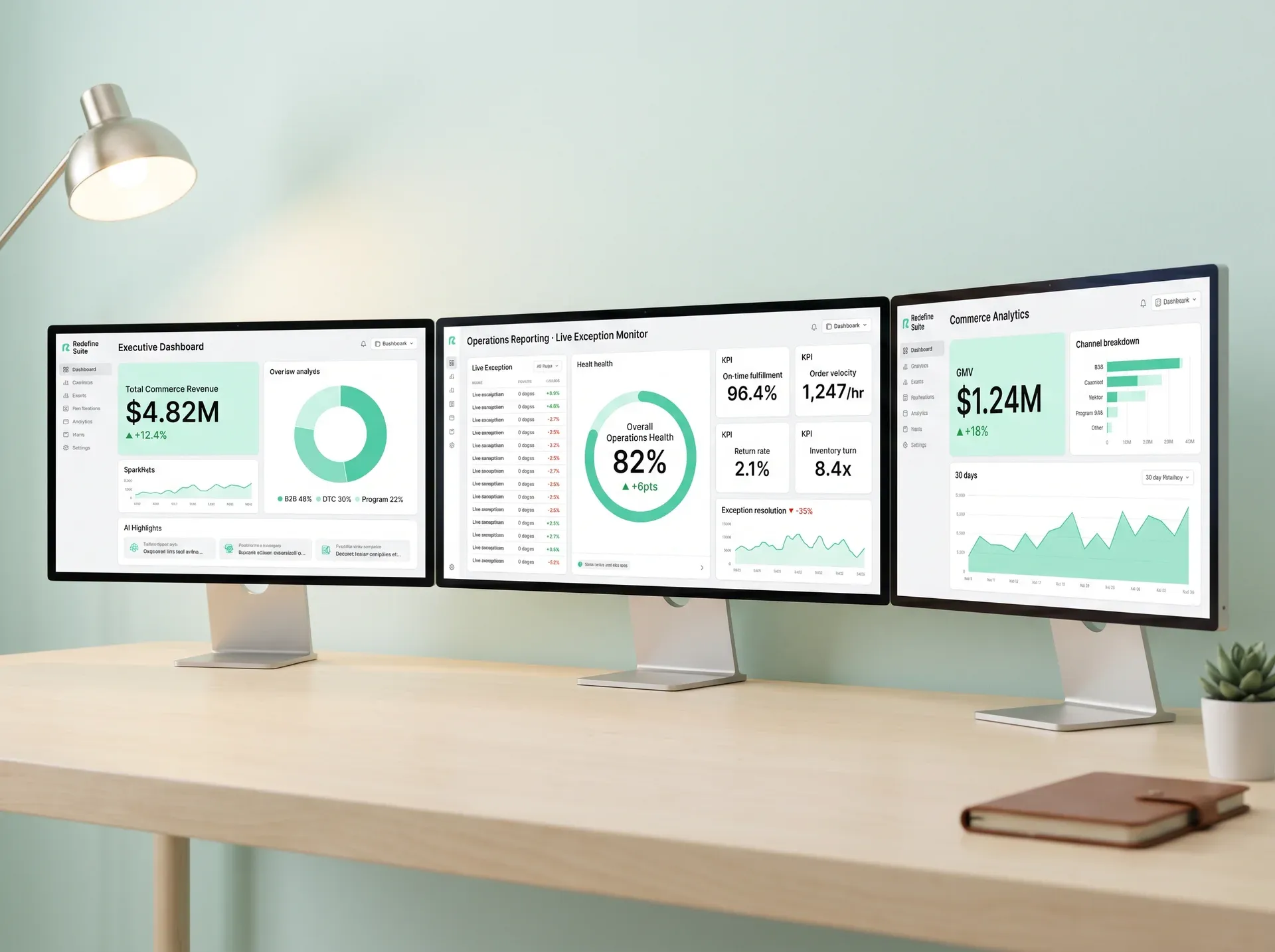
Common Questions
Questions before you commit
Redefine connects to your existing systems. We build the reporting layer on top of your Order Management System, Warehouse Management System, Enterprise Resource Planning, and other platforms using application programming interface integrations and data connectors. You don't need to migrate your operations to get unified reporting.
Service-level agreement exception alerts use near real-time data refresh, updating every 5 to 15 minutes depending on source system capabilities. For high-frequency Order Management System data, we use streaming pipelines to reduce latency. Historical and trend reports run on daily batch cycles. Your configuration brief will confirm what's achievable with your specific stack.
A standard operations reporting build runs 4 to 6 weeks depending on the number of source systems and report types. Sprint 1 delivers data connection and semantic model setup. Sprint 2 delivers the first role-based dashboards and exception rules. Sprint 3 handles scheduled exports, alerts, and stakeholder sign-off. Your team spends approximately 2 to 3 hours per week on reviews and feedback.
Row-level security is configured at the semantic model level, not through manual report filtering. Warehouse managers see their zone. Regional directors see their region. Executives see everything. Security is role-based and driven by your existing user directory, so team changes update automatically without touching the report layer.
Built-in Order Management System and Enterprise Resource Planning reports show you data from that one system. They don't correlate it with your carrier performance, supplier purchase order status, Product Information Management completeness scores, or marketplace listing health. Redefine builds the cross-platform layer that turns system-level data into operational decisions, and adds the exception alerting that built-in tools almost never include.
Fit Check
Is this the right engagement for you?
Good Fit for
Redefine
- You operate across multiple warehouses or fulfillment zones
- Your operations data lives across 2 or more systems with no unified view
- Service-level agreement compliance, supplier performance, or carrier cost are business-critical metrics
- Your team spends hours per week building manual reports from exports
- You use Dynamics 365, Business Central, Shopify, BigCommerce, or a custom Enterprise Resource Planning
Not the Right Fit
- You operate a single-location business with a single system and low order volume
- Your built-in Order Management System or Enterprise Resource Planning reports already cover everything your operations team needs
- You're looking for a self-serve business intelligence tool with no implementation component
- Marketing attribution or customer analytics (not operations) is your primary reporting need
Not sure? Tell us your situation and we'll be straight with you. Describe your setup →
Get Your Scoped Proposal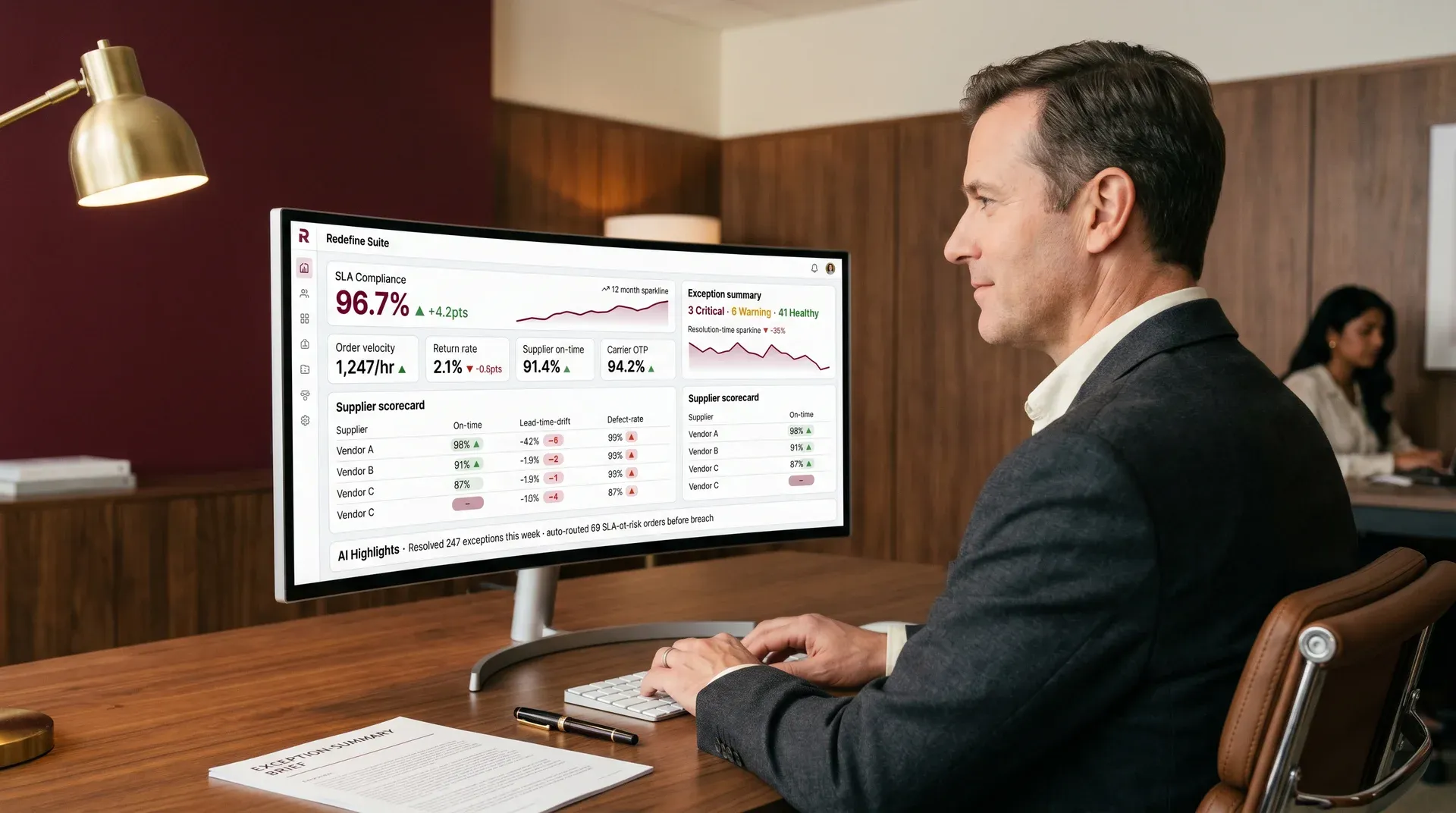
Tell us about your operations reporting situation
Every operations reporting engagement is scoped before work starts. Line-by-line pricing. No commitment to receive a proposal.
Submit brief → call within 48 hours → scoped proposal in 3 days → Sprint 1 within 1 week of sign-off
Call within 48 hours
Proposal in 3 days
100+ reporting builds delivered
You own all reports and models

Get Your Scoped Proposal
Tell us about your operations reporting situation
Every operations reporting engagement is scoped before work starts. Line-by-line pricing. No commitment to receive a proposal.
Submit brief → call within 48 hours → scoped proposal in 3 days → Sprint 1 within 1 week of sign-off
Call within 48 hours
Proposal in 3 days
100+ reporting builds delivered
You own all reports and models
Brief received
We'll review your situation and send a scoped operations reporting proposal within 3 business days.
Your Operations Reporting Brief
Call within 48 hours · proposal in 3 days · Sprint 1 within 1 week of sign-off
Ready to See It in Action?
See your operations reporting and dashboards
No commitment. No pitch. Walk through an operations reporting build with a Redefine specialist and see what the exception monitor, service-level agreement tracking, and supplier scorecards look like with your data.