Order and Inventory Operations
Every order. Every channel. One queue.
Redefine order management system receives orders from your business-to-business portal, direct-to-consumer storefront, marketplace channels, and program stores in a single unified queue. No switching systems. No missing orders. No operations debt.
186
projects completed120+
brands served
Submit your brief → call within 48 hours → scoped proposal in 3 days → Sprint 1 within 1 week of sign-off
Your team's time investment across a full order management system rollout is typically 3 to 4 hours per week: one sprint review, async feedback on configuration, and a final quality assurance sign-off. We handle everything else.

The real cost of disconnected operations
Five systems. Four spreadsheets. Zero visibility.
Old Way
- Separate tools for business-to-business orders, direct-to-consumer fulfillment, and marketplace syncing
- Manual re-entry between systems causes errors and delays
- Returns processed in a different queue from the original sale
- No single view of backorders, holds, or fraud flags across channels
- Operations teams spend 40% of their day copy-pasting between dashboards
Redefine OMS
- One queue for business-to-business, direct-to-consumer, marketplace, and program store orders
- Application programming interface, Electronic Data Interchange, and CSV import eliminates manual channel reconciliation
- Returns, edits, and cancellations processed in the same system
- Real-time fraud flags, hold management, and exception queue
- Your operations team works orders instead of managing system friction

How it works
From order received to fulfillment confirmed
Click any node to explore the order lifecycle. Every step handles real edge cases: fraud holds, split shipments, backorders, and multi-location routing.
1
Order IngestionOrders arrive via application programming interface, Electronic Data Interchange, or CSV from every channel
2
Validation and Fraud CheckRules engine flags holds, fraud signals, and missing data
3
Routing DecisionRoute to best fulfillment location based on stock and priority
4
Fulfillment and SplitFull, partial, or split shipments dispatched with tracking
5
Customer NotificationAutomated status updates sent at every milestone
Order ingestion from every channel
Orders arrive in a single normalized queue regardless of source. Application programming interface webhooks, Electronic Data Interchange batches, and CSV imports all produce identical internal order objects.
- Business-to-business portal orders with purchase order numbers and account codes
- Direct-to-consumer storefront orders with customer profiles
- Marketplace channel orders with external identifiers preserved
- Program store orders with budget allocation and approval state
#ORD-88421
Acme Corp · Business-to-Business Portal
#ORD-88422
Direct-to-Consumer Storefront · Shopify
#ORD-88423
Marketplace · Amazon
#ORD-88424
Program Store · Corporate Gear
4 new orders
2 processing
0 errors
Validation and fraud hold management
Every order passes through a configurable rules engine before entering the fulfillment queue. Suspicious orders are held, not lost.
- Address validation and payment verification on arrival
- Fraud score threshold configurable per channel type
- Exception queue routes flagged orders to operations review
- Release or cancel from exception queue with one click
#ORD-88319 · Fraud Hold
Score: 87/100 · Mismatched billing address
#ORD-88301 · Address Error
USPS validation failed · needs correction
Intelligent routing to best fulfillment location
Routing rules factor in stock levels, proximity, carrier performance, and business priority. No manual routing decisions.
- Multi-location stock awareness with real-time visibility
- Service level agreement-based routing prioritization per order type
- Fallback routing when primary warehouse is out of stock
- Supplier direct routing for drop-ship stock keeping units
Routing Decision
for #ORD-88422
Warehouse A · Chicago
92% score
Warehouse B · Dallas
64% score
Drop-ship Supplier
31% score
Routed to Warehouse A automatically
Split orders and partial shipment management
When stock is spread across locations, the order management system splits orders automatically and coordinates each shipment separately. The customer sees one unified order.
- Multi-warehouse split with individual tracking numbers
- Backorder items held and released when stock arrives
- Pre-orders queued and processed on release date automatically
- Partial shipment invoicing matched to actual dispatched items
Shipment 1 of 2
3x SKU-4421-BLK · Chicago
Tracking: 1Z9887A20343251780 · In Transit
Shipment 2 of 2
1x SKU-4421-WHT · Backorder
Estimated arrival: June 3 · Awaiting Stock
Automated status tracking and customer notifications
Every milestone triggers a notification. Customers know their order status in real time without contacting support.
- Confirmed, dispatched, in-transit, and delivered events
- Email and short message service notifications configurable per channel type
- Backorder estimated time of arrival updates sent automatically when stock lands
- Customer self-service tracking page without login friction
Order #88422 · Your Shipment
Order Confirmed
May 18, 9:04 am
Dispatched from Chicago
May 18, 2:14 pm
In Transit
Estimated arrival: May 20
Delivered
Key capabilities
Everything your operations team needs to run orders at scale
Redefine order management system ships with every core capability your team needs. No add-ons required for the features that matter.

Centralized order management
One order queue for every channel. Business-to-business purchase orders, direct-to-consumer checkout orders, marketplace orders, and program store requisitions all flow into the same view with full edit, hold, and cancel capabilities.
Order creation, editing, and cancellation
Create orders manually for phone sales or business-to-business key accounts. Edit line items, quantities, addresses, and payment terms after submission. Cancel or hold in one click with full audit trail.
Multi-channel order import
Import orders via REST application programming interface, Electronic Data Interchange 850 purchase orders, and CSV file upload. All three ingestion paths normalize to the same internal order object.
Backorder and pre-order handling
Accept orders for out-of-stock items and queue them automatically. Pre-orders release on a configured date. Customers receive estimated time of arrival updates throughout the wait.
Fraud detection and hold management
Rules-based fraud scoring flags suspicious orders before they enter the fulfillment queue. Your operations team reviews and releases from an exception queue. No order is silently lost.
Distributed Order Management
One order management system. Every channel. No sync lag.
Other order management system tools consolidate marketplace and direct-to-consumer orders but keep business-to-business portal orders siloed. Redefine receives every order type in the same normalized queue. This is the distributed order management difference.
Explore Order and Inventory Operations0
channel types unified
0%
order visibility
0
manual re-entry
Client result
Order management that scales to $6M and beyond

Company
Eyeglasses123
Online
Retail · EyewearWhat they do
Branded sunglasses and eyeglasses sold across Shopify and external
marketplaces with a high-volume dropshipping model.
Problem
Rapid growth across multiple marketplaces with no system to synchronize
inventory, manage returns, or track orders in real time. Manual processes could not scale.
Result
$0M
Annual revenue achieved after order management system implementation
unified order flow, automated restocking alerts, and eliminated manual channel reconciliation.
Solution
A centralized order management system was implemented to enable real-time order tracking and stock synchronization across all channels. Shopify was integrated with external marketplaces to automate data flow. A custom inventory management system provided automated restocking alerts, consolidated sales tracking, and improved supplier performance visibility.
Why Redefine
Other order management system tools handle orders. Redefine connects your entire operation.
Standalone order management system platforms look strong in isolation. The gap appears when your business-to-business portal, your program store, your content management system, and your reporting all need to speak to the same order data.
| Capability | Typical standalone order management system | Redefine |
|---|---|---|
| Order sources unified | Marketplace and direct-to-consumer only.
Business-to-business portal orders handled separately. | Business-to-business, direct-to-consumer,
marketplace, and program stores in one queue |
| Content management system and storefront integration | Separate systems, sync required | Natively connected to Redefine storefront and
content management system |
| Program store and budget controls | Not available in most order management system
tools | Budget redemption and approval workflows built
in |
| Reporting and analytics | Basic order reports. Advanced analytics sold
separately. | Fulfillment key performance indicators, channel
performance, and exception analytics |
| Workflow automation | Trigger-based rules only. No approval
routing. | Full approval routing and workflow automation
platform |
| Implementation support | Self-serve with optional paid professional
services | Full implementation team included. Sprint 1 in one
week. |
Platform integrations
Connect every channel in your stack
Redefine order management system integrates with the tools your team already uses. Application programming interface-first architecture means any channel that can send an order can plug in.
Business-to-Business Commerce Portals
Customer-specific pricing,
purchase order numbers, account-based access
Direct-to-Consumer Storefronts
Shopify, BigCommerce,
headless storefronts via webhook
Marketplace Channels
Amazon, eBay, and custom
marketplace feeds via Electronic Data Interchange or application programming interface
Program Stores
Budget redemption, approval
workflows, and fulfillment routing
Enterprise Resource Planning and Finance Systems
Microsoft Dynamics,
NetSuite, and other enterprise resource planning platforms via application programming interface
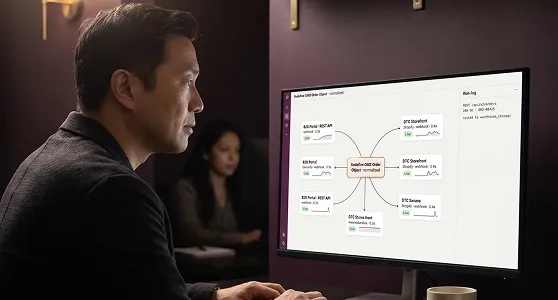
"order_id": "ORD-88425",
"source": "b2b_portal",
"channel": "api",
"status": "processing",
"routed_to": "warehouse_chicago"
Is this right for you
Redefine order management system is built for specific operations
Strong fit
- You sell through business-to-business, direct-to-consumer, and marketplace channels simultaneously
- Your operations team spends time reconciling orders across systems manually
- You run program stores, team stores, or budget-based purchasing
- You handle backorders, pre-orders, or split fulfillment regularly
- Your order management system is isolated from content management system, reporting, and workflow tools
Not a strong fit
- You sell on a single channel with a fully adequate existing setup
- You process fewer than 50 orders per month with no growth plans
- You need a point-of-sale or physical retail point-of-sale integration only
Not sure? Tell us your situation and we will be straight with you.
Tell Us Your Situation →
Frequently asked questions
What operations teams ask before switching order management systems

Yes. Redefine order management system is purpose-built to receive orders from business-to-business portals, direct-to-consumer storefronts, marketplace channels, and program stores simultaneously. All orders land in one queue with normalized data regardless of source. This is the core differentiator from tools that handle marketplace and direct-to-consumer orders but treat business-to-business portal orders as a separate workflow.
Orders for out-of-stock stock keeping units are accepted and held in a backorder queue. When stock arrives, the order is released automatically to fulfillment without manual intervention. Customers receive an estimated time of arrival update on the original backorder and a dispatch notification when the item ships. Pre-orders follow the same logic with a configured release date instead of a stock trigger.
Yes. When order line items need to ship from different locations, the order management system splits the order automatically. Each shipment gets its own tracking number. The customer sees a unified order view with status for each shipment. Partial invoicing matches what was actually dispatched so your finance team receives accurate billing data.
Fraud detection uses a configurable rules engine that scores each order on arrival. Thresholds are set per channel type. Orders that exceed your configured score are moved to an exception queue rather than dropped or auto-cancelled. Your operations team reviews flagged orders and either releases them to fulfillment or cancels with a reason code. Full audit trail maintained.
The order management system supports REST application programming interface webhooks for real-time order push, Electronic Data Interchange 850 purchase order format for business-to-business trading partner integrations, and CSV file upload for batch imports from legacy or manual systems. All three ingestion paths normalize to the same internal order object so fulfillment and reporting work identically regardless of how the order arrived.
Sprint 1 begins within one week of sign-off. A standard multi-channel order management system rollout covering channel connections, routing rules, and exception queue configuration runs across 4 to 6 sprints depending on integration complexity. Your team commits 3 to 4 hours per week for sprint reviews and async feedback. The Redefine implementation team handles configuration, integration, and quality assurance.
Get your scoped proposal
Tell us what your operations team handles manually
Describe your current order flow situation. We will review it and send a scoped proposal showing exactly how Redefine order management system fits your operation.
No commitment. No pitch. Submit your brief and get a straight answer on whether Redefine is the right fit for your operation.
Brief received
We will review your situation and send a scoped proposal within 3 business days. Expect a call within 48 hours.
Form
One system for all your orders
Stop reconciling. Start shipping.
See exactly how Redefine order management system would receive and route your orders from every channel in a single workflow.
No commitment. No pitch. Submit your brief and get a straight answer.
Submit your brief → call within 48 hours → scoped proposal in 3 days → Sprint 1 within 1 week of sign-off