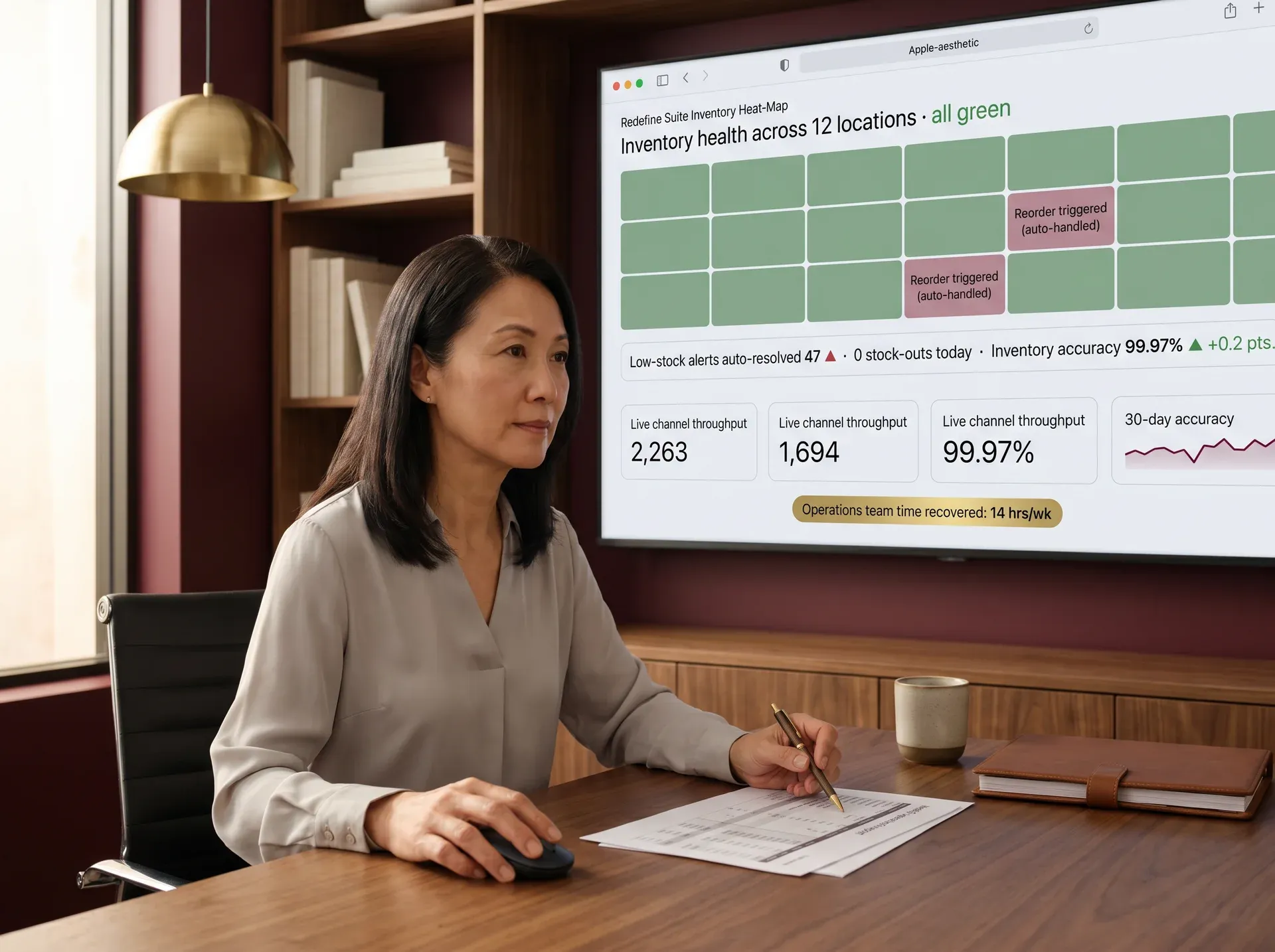
Order and Inventory Operations
Every unit. Every location. Real-time visibility that powers every channel.
Overselling, stock-out surprises, and manual reconciliation cost you revenue every day. Redefine gives your business-to-business portal, direct-to-consumer storefront, marketplace listings, and program store one shared, live inventory record.
120+ projects completed80+ brands served

The Problem Today
Inventory that lags behind reality breaks everything downstream.
When your stock record updates every few hours, or only on manual import, your sales channels lie to customers. One wrong number causes oversells, emergency fulfillment, and lost trust.
Batch syncs every 4 hours
Stock levels on your storefront are hours out of date. High-velocity stock-keeping units oversell before anyone notices.
Manual reconciliation each morning
Your ops team compares warehouse exports to storefront counts every day. 12 wasted hours per week that do not add value.
Fragmented data across systems
Enterprise resource planning, warehouse management system, and storefront hold different numbers. Nobody trusts the system of record.
Reorder triggers arrive too late
Stock-out alerts fire after the customer already sees an out-of-stock message. Seven missed reorder events every month on average.
Live read by every channel simultaneously
Every storefront, portal, and marketplace queries one live record. No cache lag. No sync window. Availability reflects reality.
Unified multi-location view
All warehouses, third-party logistics partners, and store locations reported in one dashboard. Ops teams see the full picture before the morning standup.
One source, all channels
Business-to-business portal, direct-to-consumer, marketplaces, and program stores share a single availability record. Oversells become structurally impossible.
Artificial intelligence-driven reorder triggers
Low-stock alerts fire automatically at configurable thresholds. Reorder actions reach suppliers before customers see an out-of-stock message.

How It Works
From fragmented stock data to live visibility in 10 days.
We connect your enterprise resource planning system, warehouses, and sales channels to one unified inventory record. Your team goes live with accurate, real-time stock counts before the next batch-sync disaster.
1
Day 1
Enterprise resource planning and warehouse connector setup
Map stock locations, sync enterprise resource planning item master, validate opening balances.
2
Day 3
Multi-location inventory rules configured
Assign safety stock buffers, reorder points, and channel allocation rules per location.
3
Day 5
Channel availability mapped
Business-to-business portal, direct-to-consumer storefront, marketplace feeds, and program stores wired to the live record.
4
Day 10
Go-live: alerts and reporting active
Low-stock alerts, reorder automation, and operations dashboards turned on. All channels reading live.
Item Master Sync: Microsoft Dynamics 365
| SKU | Item Name | ERP Qty | Mapped |
|---|---|---|---|
| RD-1042 | ProGrip Handle Kit | 847 | Live |
| RD-1087 | Carbon Frame Set | 112 | Live |
| RD-2014 | Alloy Wheel Set | 33 | Pending |
| RD-3001 | Brake Cable Set | 2,341 | Live |
4,218 of 4,219 stock-keeping units mapped. 1 pending manual review
Multi-Location Inventory Rules: RD-1042
Chicago DC (Primary)
Available: 612 • Safety stock: 50
Reorder at
100 units
LA Fulfillment (West)
Available: 189 • Safety stock: 25
Reorder at
50 units
Toronto 3PL
Available: 46 • Safety stock: 40
Near threshold
Live Stock Feed: All Channels
Business-to-Business Portal
(Wholesale)Live • 847
units
Direct-to-Consumer StorefrontLive • 847
units
Amazon MarketplaceLive • 300 units
(capped)
Program Store (Corporate)Live • 200 units
(reserved)
Last updatedNow (real-time)
Inventory Health: Live
Total stock-keeping units tracked
4,219
Locations synced
12
Channels live
4 / 4
Low-stock alerts
3 active
All channels reading live. Zero batch sync lag.
Key Capabilities
Everything your inventory operation needs in one connected module.
Real-time inventory levels across all locations
One live count. Every warehouse, third-party logistics partner, store room, and pop-up location updates in real time so your channels always show what you actually have.
Redefine only: Inventory is live-read simultaneously by your business-to-business portal, direct-to-consumer storefront, marketplace listings, and program store. Not broadcast via scheduled sync.
Low-stock alerts and reorder automation
Configurable thresholds trigger alerts and supplier reorder actions before you hit zero. Artificial intelligence-powered signals adapt to seasonal demand patterns.

Multi-location warehouse tracking
All warehouses, third-party logistics partners, and store locations in one unified view. Track transfers, adjustments, and receipts in real time.
Serial and lot number tracking
Full traceability from receipt to dispatch. Required for regulated industries and high-value product lines.
Inventory forecasting and demand planning
Artificial intelligence-assisted demand signals surface replenishment needs before they hit safety stock. Reduce holding costs and stockout risk simultaneously.
Bundle and kit inventory reservation
When a bundle sells, component-level inventory is reserved immediately across all relevant channels. No manual calculation. No oversell on constituent stock-keeping units when a kit is in-flight.
Barcode and scan-based receiving
Goods-in captured by scan at the dock instantly updates on-hand quantities. No re-keying. No delay between physical receipt and system record.
Proof
Unreliable inventory costs more than a platform migration.

## 72x72
DrivingI
Business-to-Business Promotional Products
What they do
An established business-to-business promotional products company operating complex catalogs, customer-specific pricing, and approval-based purchasing workflows across distributed sales channels.
Problem
Inventory syncing was unreliable. Catalogs loaded slowly. Customer approvals were manual. System data was fragmented across enterprise resource planning, customer relationship management, and marketing tools, creating operational bottlenecks that blocked growth.
Result
100% live inventory
Real-time inventory synchronized directly from Microsoft Dynamics across all customer accounts. Operational friction eliminated. Internal teams regained confidence in system accuracy and the architecture now supports scalable growth.
See the full Order Management System and Order and Inventory Operations hub for adjacent proof.
Cost Of Inaction
Every hour your inventory lags, this counter runs.
Batch syncs cost real revenue. An average mid-market merchant loses 2.4% of monthly gross merchandise value to oversells and stock-outs when inventory is not live. On $2M monthly gross merchandise value that is $48,000 per month, $576,000 per year, bleeding through a solvable operations gap.
Oversell cost (monthly)
$0
Refunds, emergency shipping upgrades, and customer churn from unfulfilled orders when your channels oversell due to stale stock data.
Operations reconciliation hours (weekly)
0
Hours your operations team spends manually comparing warehouse exports to storefronts and correcting inventory discrepancies each week.
Missed reorder events (monthly)
0
Stock-out events per month where the trigger came after the customer saw an out-of-stock message, not before from an automated alert.
Best-Fit Use Cases
Who gets the most from Redefine inventory visibility
Business-to-business wholesalers and distributors
Running large catalogs across multiple buyer accounts and warehouses. Need accurate available-to-promise at order entry.
Multi-channel direct-to-consumer brands
Selling on direct-to-consumer, Amazon, and retail channels simultaneously. Need one source of truth to prevent oversells across competing sales surfaces.
Corporate program stores
Running employee reward or kit-fulfillment programs. Need inventory reserved per program without cannibalizing other channel stock.
Third-party logistics-managed fulfillment
Using third-party logistics partners for warehousing. Need external location data pulled into the same live visibility layer without custom integrations.
Specialty and regulated manufacturers
Tracking serial and lot numbers for warranty, recall, or compliance. Need full chain of custody from receipt to dispatch in one record.
High-volume promotional businesses
Managing thousands of stock-keeping units across seasonal campaigns and kit assemblies. Need bundle reservation and real-time demand signals to avoid premature stock-outs.
Integrations And Architecture
One platform. Every system connected.
Redefine connects your enterprise resource planning system, warehouse management system, third-party logistics partner, and all commerce channels without a middleware patchwork. Inventory flows from physical receipt to every channel in real time.
Stock sources
Enterprise Resource Planning (Dynamics, SAP,
NetSuite)
Item master, on-hand quantities, purchase order receipts, and adjustments synced in real time via native connectors.
Warehouse management system and third-party logistics
systems
Warehouse management system or third-party logistics application programming interface connected for pick, pack, ship, and receive events.
Scan-based receiving
Barcode and radio frequency identification scan events update on-hand counts at goods-in. No rekey delay.
Redefine Inventory Core
Single live record. All channels read from here.
Real-time
Commerce channels (live read)
Business-to-Business Wholesale Portal
Direct-to-Consumer Storefront
Marketplace Feeds (Amazon, eBay)
Program and Team Stores
Why Redefine
Standalone inventory tools stay isolated. Redefine connects the whole operation.
Other inventory management products look strong operationally but exist in a silo. Your storefront, marketplace feeds, order routing, workflows, and reporting all still need separate connectors. With Redefine everything shares one platform, one data layer, and one admin.
| Capability | Typical inventory tool | Redefine |
|---|---|---|
| Live channel reads | Scheduled sync (15 minutes to 4 hours) | Real-time read by all channels simultaneously |
| Business-to-business portal integration | Separate connector required | Native, same platform |
| Order routing aware | No, routing in separate order management system | Inventory feeds routing engine natively |
| Program store reservation | Not supported | Native per-program inventory allocation |
| Reporting and analytics | Requires separate business intelligence export | Built-in operations dashboards and key performance
indicator reporting |
| Bundle reservation | Manual or post-order | Automatic component reservation at order creation |

Common Questions
Questions buyers ask before switching inventory platforms.
A sync schedule, even every 15 minutes, creates a window where oversells are possible. Real-time means every channel queries the live record at the moment of display and order creation. No stale number is ever shown. The gap matters most on high-velocity stock-keeping units where a 15-minute window can result in dozens of oversells.
Yes. Redefine connects to Microsoft Dynamics, SAP, NetSuite, and other enterprise resource planning systems via application programming interface. Your enterprise resource planning system remains the system of record for finance and procurement. Redefine reads stock levels and receipt events from the enterprise resource planning system and publishes them to all commerce channels. No replacement of your enterprise resource planning system is required.
Redefine allows you to set channel-specific inventory caps and allocation rules. You can reserve a percentage of stock for Amazon, cap the direct-to-consumer storefront at a safety buffer, and prioritize business-to-business orders, all from one rules engine. Every channel reads the same live record but your allocation logic controls what each channel sees as available.
At the moment an order is created for a bundle or kit, Redefine immediately reserves the component-level inventory quantities across all relevant locations. Other channels see the updated available quantity in real time. There is no manual calculation or delayed reservation that allows a second order to oversell the same components.
Most clients go live with real-time inventory across all channels in 10 business days from signed scope. Day 1 to 3 covers enterprise resource planning connector setup and item master validation. Day 3 to 5 covers location rules and channel allocation configuration. Day 5 to 10 covers channel wiring, alert setup, and go-live sign-off. Your team contributes approximately 2 to 3 hours per week during this period.
Is This Right For You
A good fit, and an honest not-fit.
Redefine is a strong fit if:
- You sell across at least two channels and manage stock across two or more physical locations.
- You have experienced oversells, emergency shipping costs, or customer complaints caused by stale inventory data.
- Your operations team reconciles inventory manually each week and wants that time back.
- You want inventory, order routing, fulfillment, and commerce channels managed from one platform without middleware.
Not the right fit if:
- You run a single-location, single-channel store with under 200 stock-keeping units where a nightly sync is sufficient.
- You need a standalone warehouse management system with deep warehouse floor management. Redefine connects to your warehouse management system rather than replacing it.
- You are looking for a consumer inventory application rather than an enterprise commerce operations platform.
Not sure? Tell us your situation and we will be straight with you.
Get Started
Tell us where your inventory breaks today.
Submit a brief and we will scope a live inventory setup that fits your channels, locations, and enterprise resource planning system. You get a detailed proposal in 3 business days. No commitment, no pitch.

Real deliverable: scoped inventory configuration plan
Submit Your Brief
Form
Brief received.
We will review your inventory situation and send a scoped proposal within 3 business days. Expect a call within 48 hours.
Response within 48 hours
Proposal in 3 days
120+ projects delivered
You own all code and configuration
Ready When You Are
Stop reconciling inventory. Start selling with confidence.
One live record. Every channel reads it. Oversells become structurally impossible. Your operations team stops firefighting and starts focusing on growth.
No commitment. No pitch. Just a scoped proposal for your specific situation.