Order Routing Software
Every order to the right location without manual rules
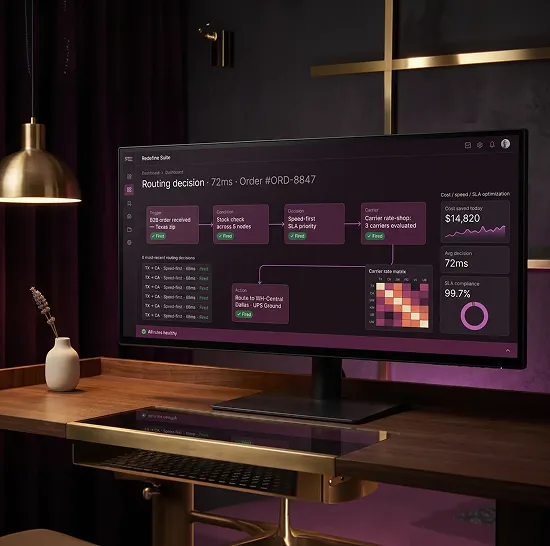
Redefine's order routing engine reads order origin, inventory availability, carrier cost, and fulfillment priority simultaneously, then sends each order to exactly the right warehouse, third-party logistics provider, drop-ship supplier, or fulfillment partner without human intervention.
280+ projects completed
150+ brands served
Average routing decision
<80ms
Per order across all channels, warehouses, and carrier options combined.

Order #OriginRouted ToStatus
#ORD-8821Direct to ConsumerWH-EastRouted
#ORD-8822B2B3PL-WestRouted
#ORD-8823MarketplaceSupplier-APending
#ORD-8824Program StoreWH-CentralProcessing
#ORD-8825Direct to ConsumerDrop-shipRouted
Why routing breaks at scale
Manual routing rules don't survive growth
The old way
Spreadsheet routing tables reviewed weekly
Warehouse assignments drift out of date as inventory shifts, leading to mis-routes and delays.
One generic rule set for all channels
B2B orders, direct-to-consumer orders, and marketplace orders treated identically, service level agreements and priorities ignored.
Carrier rate shopping done manually each morning
Teams compare rates in carrier portals before releasing orders, adding hours of delay every day.
Drop-ship routing requires supplier emails
Supplier purchase orders sent by email, acknowledged by email, no live status, constant follow-up.
With Redefine
routing
Live inventory read at routing time
Routing decisions use real-time stock levels across all locations, no stale spreadsheet needed.
Origin-aware rule sets per channel
B2B, direct-to-consumer, marketplace, and program store orders each follow their own routing logic from one engine.
Carrier rates evaluated automatically at routing time
Every eligible carrier evaluated before the order is assigned. Lowest cost that meets the window wins. No manual lookup required.
Supplier portal connected to Order Management System directly
Drop-ship orders flow to suppliers through a live portal with acknowledgment, status, and tracking in one queue.

Cost of waiting
Every day without smart routing costs more than you think
Enter your order volume and average order value. Watch what manual routing is costing you right now.
Your operation
50500
orders/day5,000
$25$85 average order
value$500
1%4% error
rate15%
2 hours18
hours48 hours
Revenue at risk right now
$0
and growing every second you read
this
Mis-routed/day
20
orders
Delay cost/day
$1,700
in at-risk revenue
Annual exposure
$620K
in routing losses
These numbers reflect conservative estimates based on re-ship cost, carrier penalty, and customer churn from late orders. Your actual exposure may be higher if your current system has no visibility into mis-route frequency.
Book A Routing ReviewRouting capabilities
Every routing decision covered
Warehouse, carrier, supplier, third-party logistics, and channel-origin routing in a single engine. No middleware. No separate tools for each fulfillment path.
Core
100%
Warehouse routing by region and carrier
Route orders to the nearest stocked warehouse or to the carrier with the best rate-to-service-level-agreement ratio. Rules configured per product category, region, and order size.
Core
Live
Drop-ship and supplier order routing
Drop-ship orders route directly to the right supplier through the Redefine supplier portal. Acknowledgment, fulfillment status, and tracking return to the Order Management System automatically.
AI-Powered
Auto
Rate shopping and carrier selection
The engine evaluates all eligible carriers at routing time and picks the lowest cost option that meets the delivery window. No manual rate lookups. No spreadsheet carrier matrices.
AI-Powered
Smart
Priority-based routing by cost, speed, availability
Define routing priorities per channel and order type. Cost-first for standard direct-to-consumer. Speed-first for B2B service-level-agreement orders. Availability-first when stock is split across locations.
Core
4→1
Third-party logistics and fulfillment partner routing
Route orders to third-party logistics partners by product category, geographic zone, or fulfillment service-level-agreement tier. Multiple third-party logistics relationships managed from one routing rule set, no duplicated configurations.
Differentiator
Origin-aware
Channel-origin routing logic
Routing rules that understand whether an order comes from a B2B account, a direct-to-consumer storefront, a marketplace, or a program store, and apply completely different fulfillment logic for each without needing separate Order Management System instances.
How it works
From order received to fulfillment dispatched in seconds
The routing engine runs automatically on every inbound order. Your team sees the decision. The work is already done.
1
Order captured from any channelB2B portal, direct-to-consumer storefront, marketplace, or program store, one inbound queue.
2
Origin and priority rules evaluatedChannel type, account tier, and service-level-agreement requirement determine which rule set applies.
3
Live inventory and carrier data checkedReal-time stock at every warehouse and third-party logistics provider. Carrier rates pulled live before assignment.
4
Fulfillment location assigned and notifiedWarehouse, third-party logistics provider, or supplier receives the order. Tracking returns to the originating channel automatically.
5
Status synced back to all surfacesB2B portal order status, marketplace listing availability, and program store dashboard all updated in real time.
OrderChannelItemsValueStatus
#ORD-9001Direct to
Consumer3 items$142Routing
#ORD-9002B2B18 items$2,160Routing
#ORD-9003Marketplace1 item$67Queued
Client result
Routing built for mixed fulfillment models

Premium collectibles platform serving both B2B and B2C buyers, requiring precise inventory control, international drop-ship routing, and domestic third-party logistics fulfillment from a single system.
The challenge
Standard ecommerce workflows were not sufficient to support pre-orders, limited inventory releases, flexible payment plans, and mixed fulfillment models. High-value collectibles required precise inventory control and reliable handling of manufacturer-direct international shipping alongside domestic fulfillment partners.
The solution
A flexible fulfillment architecture was introduced to support domestic shipping partners and manufacturer-direct international fulfillment. Real-time routing logic and tax handling configured to ensure accuracy. Admin workflows gave granular control over order processing and inventory allocation without increasing operational friction.
The result
0
fulfillment models unified
Flexible payment options, controlled inventory release, and advanced fulfillment workflows improved operational efficiency and customer confidence. The platform scaled its catalog and handled increasing demand while maintaining reliability.
Routing architecture
One engine. Every fulfillment path.
Redefine's routing engine sits at the center of your fulfillment stack. It reads every available data source before making each decision and writes the outcome back to every connected surface.
Inputs read at routing time
- Live inventory at all locations
- Order origin and channel type
- Carrier rate live feeds
- Service level agreement and priority tier
Decision engine
- Rule evaluation under 80 milliseconds
- Origin-aware logic branching
- Priority weighting applied
- Fallback routing on failure
Fulfillment destinations
- Owned warehouses
- Third-party logistics partners
- Drop-ship suppliers
- International manufacturers
Status written back to
- B2B portal order status
- Marketplace listing feed
- Program store dashboard
- Customer tracking email
Live routing activity
Orders routed today
1,247
Average decision time
74ms
Active fulfillment
destinations
6
Routing accuracy
99.7%
Best-fit use cases
Who gets the most from smart routing
Multi-warehouse direct-to-consumer brands
You operate two or more warehouses and want every order sent to the nearest stocked location without a routing spreadsheet. Speed-first or cost-first, set the priority, let the engine decide.
B2B sellers with service level agreement tiers
Enterprise accounts need guaranteed 48-hour dispatch. Standard accounts accept 5-day windows. Routing applies different carrier and warehouse logic per account tier automatically, no manual override needed.
Marketplace and multichannel sellers
Amazon, eBay, and direct-to-consumer orders arrive simultaneously. Each marketplace has different service-level-agreement requirements and penalties. Channel-origin routing ensures each order follows the right fulfillment path for that platform.
Drop-ship heavy operations
A significant portion of your catalog ships direct from suppliers. Routing identifies drop-ship stock keeping units and routes those orders through the supplier portal without touching your warehouse queue.
Program and corporate stores
Program store orders often need to ship to employee addresses across multiple regions. Routing assigns the nearest stocked location per recipient address, reducing carrier cost and delivery time per participant.
Third-party-logistics-first fulfillment models
You rely on multiple third-party logistics partners for different product categories or regions. Routing assigns each order to the right third-party logistics provider based on inventory location, category rules, and service level agreement without manual dispatch.

Related modules
Routing connects to every part of your operation
The routing engine does not operate in isolation. Every decision it makes reads live data from inventory, Order Management System, and supplier systems, and writes outcomes back to every connected surface automatically.
Order Management System
Central queue for all inbound orders. Routing
engine sits inside the Order Management System layer.
Inventory Visibility Software
Live stock across all locations. Routing reads this
in real time on every order.
Supplier Operations
Drop-ship supplier portal. Orders routed here flow
through the supplier's acknowledgment queue.
Fulfillment Operations
Pick, pack, and ship workflows at each location
routing sends orders to.
Multi-Location Inventory Control
Stock reservation and transfer between locations
when routing needs to split an order.
Returns and Exception Management
Routing exceptions, holds, and return routing, all
managed in one exception queue.

Why Redefine
Routing tools that are isolated from commerce miss the point
Other implementation partners build strong operational layers. But when those systems sit disconnected from your storefront, B2B portal, marketplace feeds, and program stores, routing decisions cannot use full context, and the status never writes back where it needs to go.
| Capability | Typical partner | Redefine |
|---|---|---|
| Warehouse and carrier routing rules | ||
| Drop-ship and supplier routing | ||
| Automated carrier rate shopping | Partial | |
| Channel-origin routing logic (B2B versus direct-to-consumer versus marketplace versus program) | Not included | |
| Status sync back to B2B portal, marketplace, program store | Requires middleware | |
| Supplier portal connected directly to Order Management System (no middleware) | Not included | |
| Live inventory read at routing time (not batch-synced) | Batch only |
Questions
Frequently asked questions
Each order arriving in the Order Management System carries a channel tag, B2B account, direct-to-consumer storefront, marketplace listing, or program store. The routing engine reads that tag first and branches into the appropriate rule set. A B2B enterprise account order might apply speed-first logic with express carrier eligibility. A standard direct-to-consumer order might apply cost-first logic with economy carriers. A marketplace order might apply platform-specific service-level-agreement rules. All from the same engine, no separate configurations per system.
Yes. Routing rules are managed through an admin interface. Operations managers can add or modify rules, warehouse priority sequences, carrier preferences, region assignments, drop-ship thresholds, without writing code or submitting a development ticket. Rule changes take effect immediately on the next inbound order.
Fallback routing sequences are configured per rule set. If WH-East is out of stock for a product, the engine automatically evaluates the next destination in the priority sequence, WH-West, then 3PL-Central, then drop-ship supplier. The fallback is immediate and does not require a human decision or a failed order to be manually re-queued.
Routing works with partners that connect via REST application programming interface, electronic data interchange, or the Redefine supplier portal. For owned warehouses, native integration is available. For third-party logistics partners and suppliers with their own systems, standard data formats are supported. Partners without application programming interface access can use the supplier portal for order acknowledgment, status updates, and tracking, no custom development required on their side.
Initial routing configuration is completed in Sprint 1 of an Order Management System implementation. For a two-warehouse plus one third-party logistics setup with standard channel rules, live routing is active within the first two weeks. More complex configurations with five or more fulfillment destinations and multiple channel-origin rule sets take an additional sprint to validate before going live on full order volume.
Yes. When an order contains items stocked across different locations, the engine can split the order into multiple shipments routed to the appropriate fulfillment partners. Each shipment gets its own carrier assignment. The customer receives a single consolidated tracking notification. Split rules are configurable, you define when splitting is preferred versus when backorder hold is preferred based on your fulfillment policy.
Is this right for you
Good fit and not a fit
Good fit
- You operate two or more warehouses or third-party logistics providers and routing assignments are currently manual or rule-based in a spreadsheet.
- You sell across multiple channels, marketplace, direct-to-consumer, B2B, and each has different service-level-agreement or carrier requirements.
- Drop-ship makes up a significant share of your catalog and supplier acknowledgment is currently done by email.
- You need fulfillment status to update your B2B portal, marketplace listings, and program store dashboard in real time without middleware.
Not a fit
- You ship all orders from a single warehouse with no plans to add fulfillment locations or drop-ship suppliers.
- Your order volume is under 50 orders per day and routing decisions require no more than one rule per channel.
- You operate on a single channel only and have no plans to add B2B, marketplace, or program store selling.
Not sure? Tell us your situation and we'll be straight with you.
Submit Your Situation →Get started
Submit your brief. Get a scoped routing proposal.
Tell us what your fulfillment operation looks like. We'll scope how the routing engine fits, which rules apply to your channels, and what Week 1 looks like in 3 business days.
Your team's time investment across a full routing configuration is typically 2 to 3 hours per week, one sprint review, async feedback on rule sets, and a final go-live sign-off. We handle the mapping, testing, and integration work.
Brief received
We'll review your routing situation and send a scoped proposal within 3 business days.
Tell us about your operation
Form
Response
Within 48 hours
Proposal
3 days
Projects
280+ done
Ownership
You keep the code
Stop routing orders by hand
See the routing engine route a real order in under 90 seconds
No pitch. No commitment. We show you how origin-aware routing works on orders like yours, then scope what it takes to go live.