Returns and Exception Management
Stop losing revenue to returns chaos and exception backlogs
Every unresolved exception is a delayed refund, a frustrated customer, and a stock record that is wrong. Redefine closes the loop automatically across return merchandise authorization, inventory, product information manager, and marketplace channels in one connected workflow.
42
projects completed30+
brands served

The Problem Today
Returns handled in isolation create compounding damage
Old Way
- Return merchandise authorization created in order management system, inventory never updated, marketplace still shows zero stock
- Exception queue grows unchecked: duplicate orders, payment holds, and address errors handled manually
- Returned item condition not captured, product data stays unchanged, grading done on a spreadsheet
- Refund or store credit decisions made outside the order system, no audit trail, no reporting
With Redefine
- Return received, inventory updated in real time, product information manager condition attribute updated, marketplace listing notified automatically
- Exception dashboard surfaces all errors, holds, and duplicates in one queue with resolution prompts and priority scoring
- Inspection workflow captures condition grade, routes item to appropriate bin, and writes condition back to product information manager record
- Refund, exchange, or store credit issued from within the order, full audit log, included in returns analysis report

How It Works
From return initiated to inventory restored in under 4 minutes
Your customer initiates a return. Your inventory and channel data update before your team reviews the first item.
RMA #RP-4492Label
Sent
CustomerJordan T.
Order#ORD-88231
ProductRunning Shoe, Size 10
ReasonWrong size received
Customer photo uploaded
## Image placeholder · 400 ×
120
Carrier label emailed, return
tracked
Condition GradingGrade
A, Resellable
Packaging intact
No visible damage
All accessories present
Routing binBin A-12,
Resell
Product information manager condition attribute update queued, will write on save
Running Shoe, Size 10 • SKU RS-10-BLK
Inventory
before3 units
Inventory
now4 units
Direct-to-consumer storefrontUpdated
Marketplace listingUpdated
Business-to-business portalUpdated
Product information manager conditionWritten
Resolution appliedRefund
Issued
Amount$129.00
MethodOriginal payment
method
Audit logWritten to
order
Returns analysis reportIncluded
Key Capabilities
Every returns workflow your operations team needs
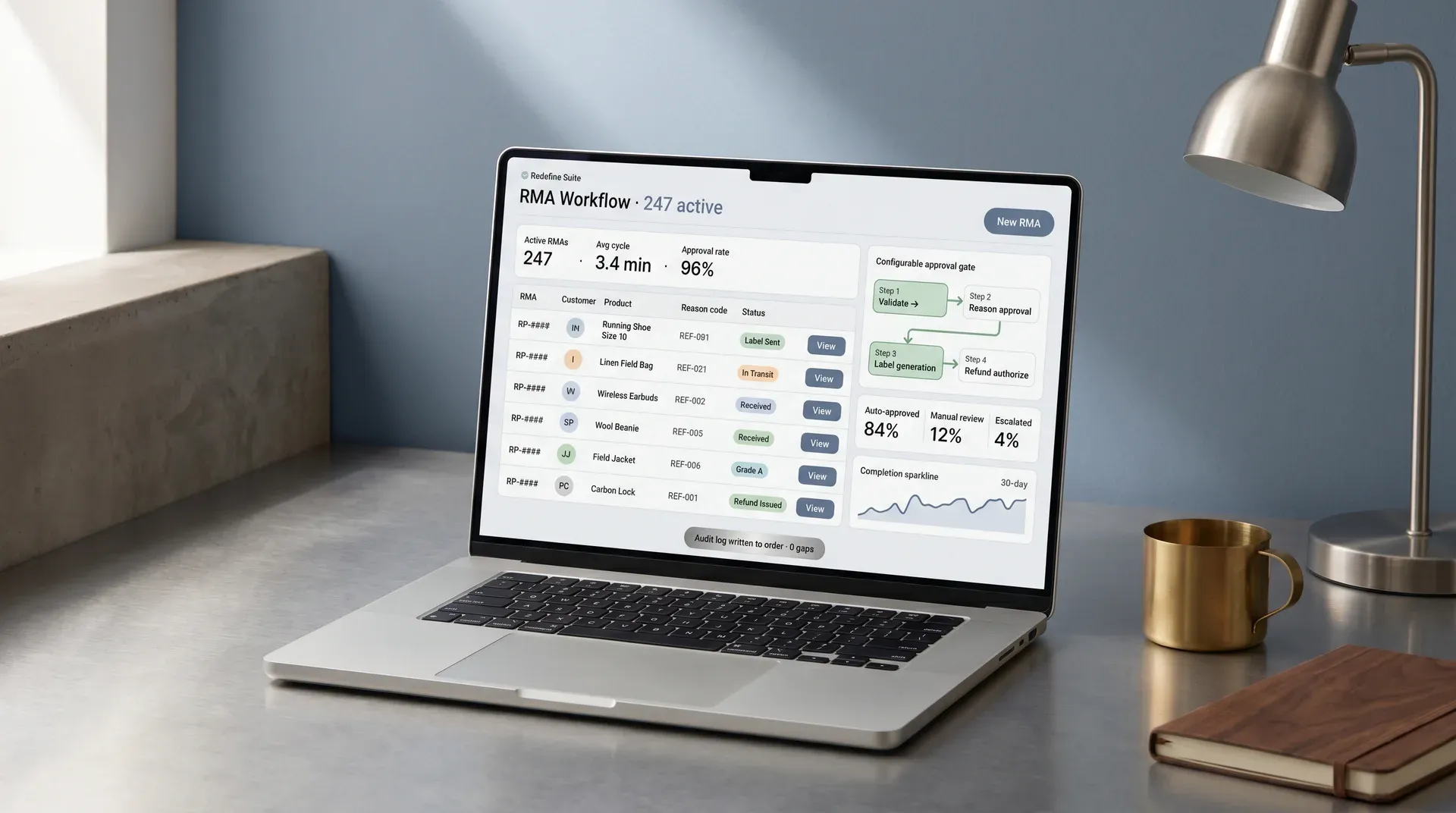
Return Merchandise Authorization Workflow
Full return merchandise authorization workflow with configurable approval gates, reason codes, and label generation. Every return merchandise authorization traces back to its originating order and channel.
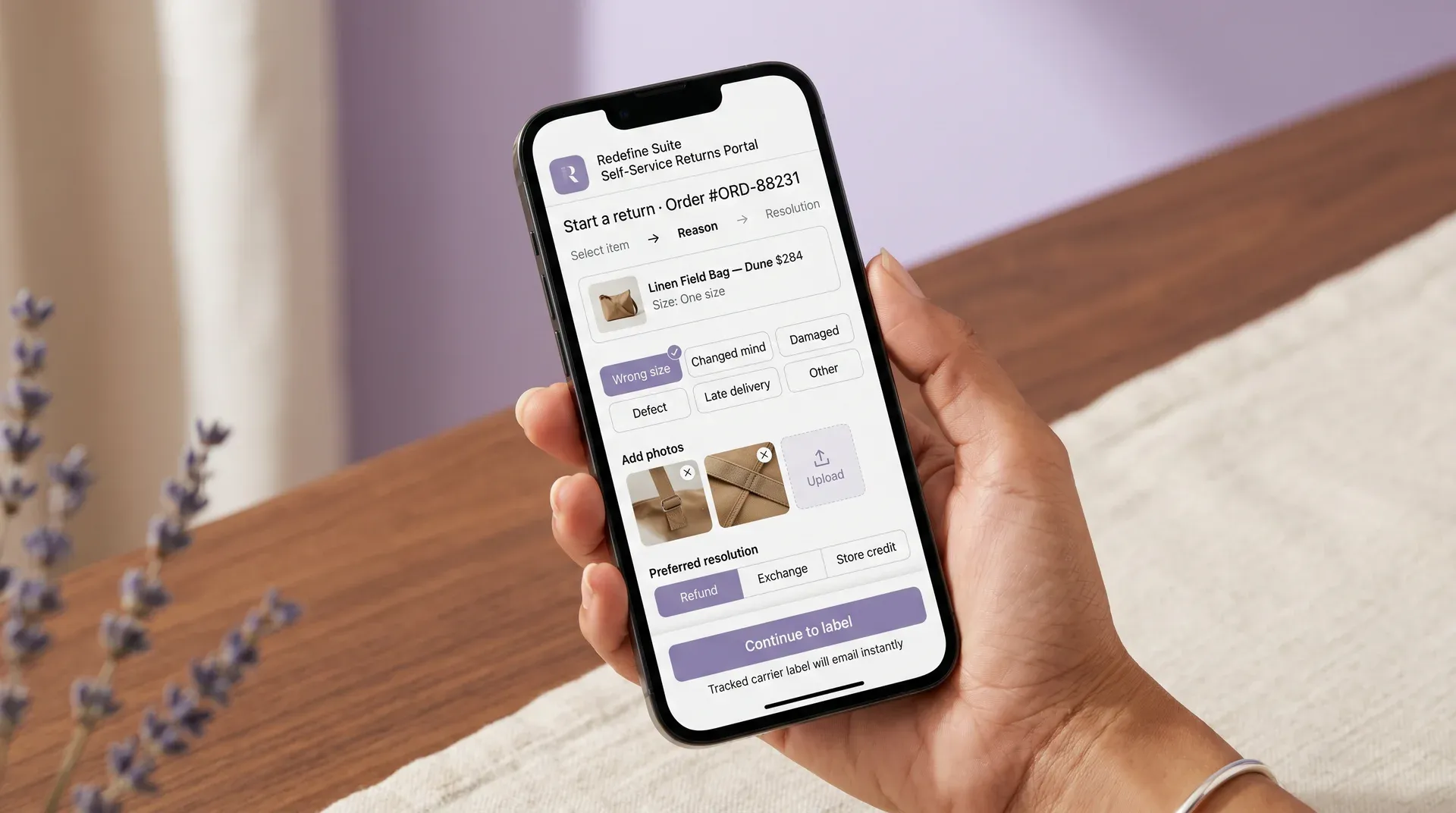
Self-Service Returns Portal
Branded portal lets customers initiate returns without contacting support. Capture reason codes, upload photos, and choose resolution preference at initiation, not on the phone.
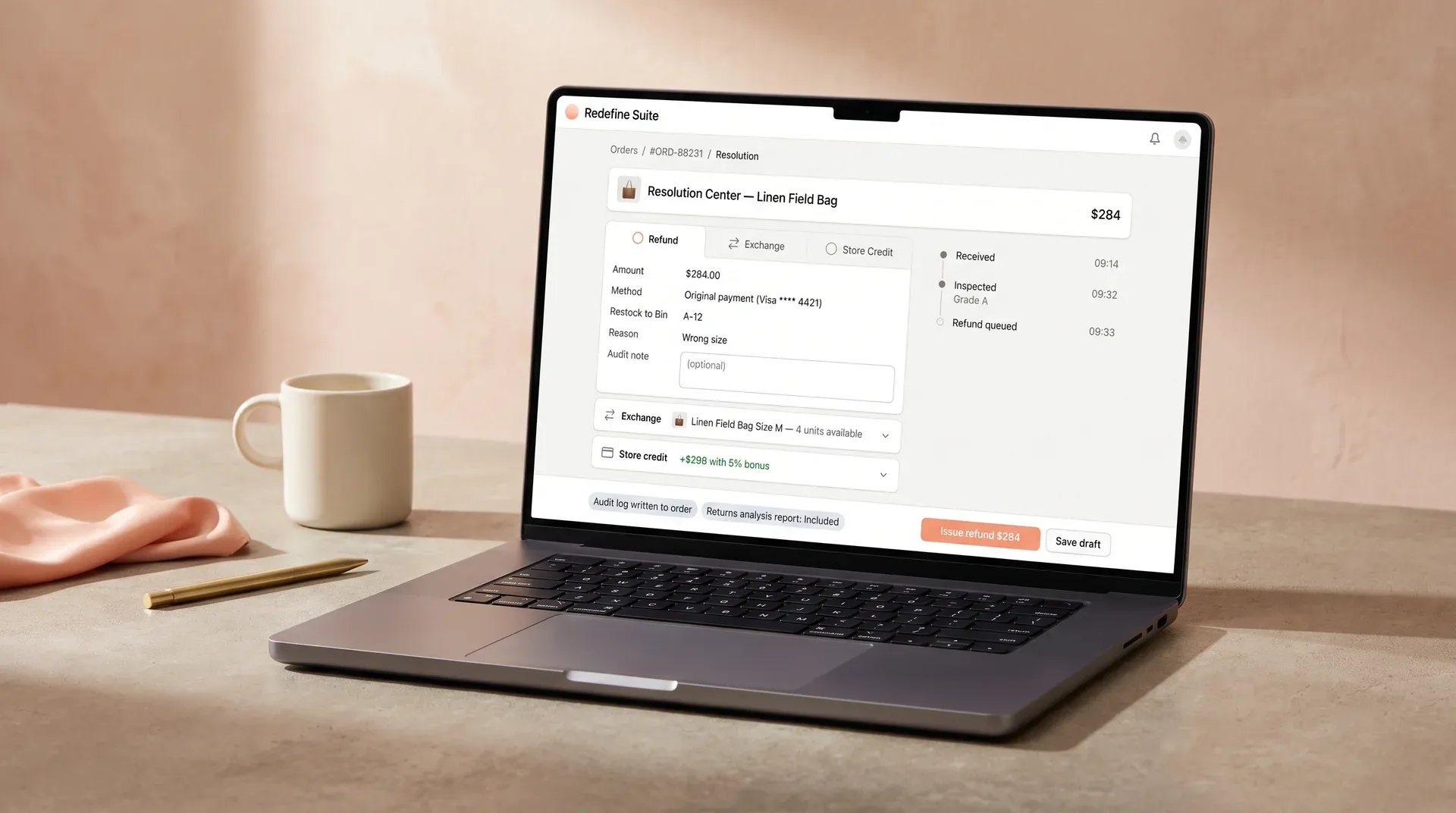
Refund, Exchange, and Store Credit
Issue refunds to original payment method, create exchanges against live inventory, or convert return value to store credit. All three resolution types handled from within the original order record.
Return Inspection and Condition Grading
Staff-guided inspection workflow assigns a condition grade (A, B, C, or scrap), routes items to the right bin, and writes the condition attribute back to the product information manager product record. No spreadsheet, no manual data entry.
ConditionsA / B / C / Scrap
Product
information manager write-backAutomatic
RMA #RP-4493Grade
A
RMA #RP-4494Grade B
RMA #RP-4495Scrap
Product information manager updateWritten
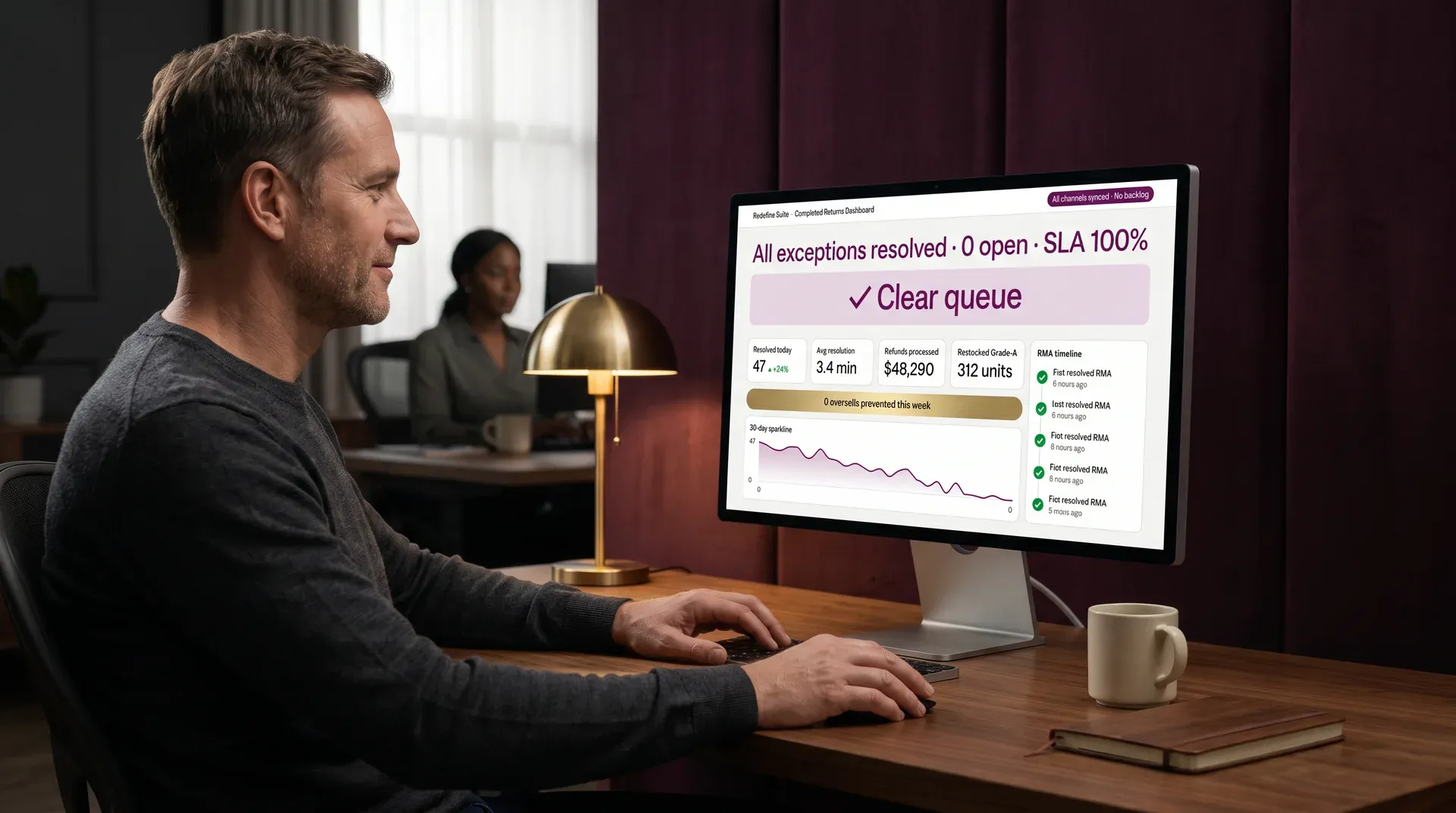
Exception Management Dashboard
One queue for all order errors, payment holds, address failures, and duplicate orders. Priority scoring means your team resolves the highest-impact exceptions first, not the most recent ones.
Payment holdHigh priority
Duplicate orderMedium
Address errorMedium
Proof
Returns automation that scaled a multi-channel retailer to $6M

Company
Eyeglasses123
Online
Retail • EyewearMulti-channel eyewear retailer selling across Shopify and external marketplaces.
Problem
Rapid marketplace growth with no automation for returns. Inventory was out of sync across channels. Managing returns and restocking required manual steps in multiple systems, creating errors and overhead that could not scale.
Solution
A unified order management system was implemented with real-time stock synchronization across all channels, automated restocking alerts, and efficient returns management that reduced manual processing across Shopify and marketplace platforms.
Result
$0M
Annual revenue scaled to $6M. Operational costs reduced through automation and improved supplier oversight. Inventory accuracy and order fulfillment efficiency improved across all channels.
Platform Architecture
Returns that cascade across every connected system
Other operations platforms process returns inside the order management system only. Redefine's returns module is connected to inventory, product information manager, marketplace channel, and program store simultaneously. One return event propagates everywhere.
Trigger
Return received and inspected
RMA #RP-4492
Condition gradeA
Cascade (real-time)
Systems updated simultaneously
Inventory countPending
Product information manager conditionPending
Marketplace listingPending
Business-to-business portal availabilityPending
Outcome
No downstream errors
Oversells preventedZero
Manual data entryEliminated
Resolution timeUnder 4 min
No other operations platform does this. Other platforms process returns inside the order management system only. Redefine cascades the return state to product information manager, marketplace listing, and inventory simultaneously because all three share the same platform kernel, not three APIs bolted together.
Why Redefine
What other operations platforms cannot do
| Capability | Typical operations platform | Redefine |
|---|---|---|
| Return merchandise authorization workflow with configurable approval gates | ||
| Self-service returns portal with reason codes and photo capture | ||
| Inventory update on return receipt (real-time) | ||
| Product information manager condition attribute write-back on inspection | ||
| Marketplace listing notification on return receipt | ||
| Exception dashboard with priority scoring |
Best-Fit Use Cases
Built for operations teams that cannot afford returns errors
Multi-channel retailers
Selling across direct-to-consumer, marketplace, and business-to-business. Returns on one channel should not leave another channel with stale inventory. Redefine ensures every channel sees the update before your next customer checks out.
High-return categories
Apparel, footwear, and electronics see return rates above 20%. Manual returns processing at that volume creates a backlog that compounds into oversells, angry customers, and missed restocking revenue.
Business-to-business order management
Business-to-business returns come with credit note requirements, account-level return policies, and specific resolution workflows per account. Redefine handles account-level return rules without building custom logic for each buyer.
Related Products and Integrations
Returns that feed every downstream system
Order Management System
All returns trace back to the
originating order. Return merchandise authorization, resolution, and audit logs live on the order
record.
Order management
→Inventory Visibility Software
Return receipt updates the live
inventory count in real time, available to all connected channels and storefronts simultaneously.
Inventory
visibility →Order and Inventory Operations Hub
Returns and exceptions are one
module in the full operations platform that includes routing, fulfillment, supplier operations, and
inventory management.
Operations hub
→Is This A Fit?
This module is built for you if...
Good Fit
- You receive more than 50 returns per month and each one requires a manual inventory update
- You sell across at least two channels and returns on one channel do not currently update availability on the others
- Your exception queue is reviewed by a person, not resolved by a rule
- You need condition grading captured at inspection and want that data in your product records, not just in a warehouse spreadsheet
Not A Fit
- You have a single storefront with fewer than 10 returns per month and a simple refund process
- You do not sell returned or refurbished inventory and have no need for condition grading or product information manager write-back
- You are looking for a standalone returns application with no connection to your broader order or inventory systems
Not sure? Tell us your situation and we will be straight with you.
Common Questions
What teams ask before they commit
You configure the trigger. Many operations teams prefer to update inventory on receipt and refine the condition grade afterward. Others hold the inventory update until inspection is confirmed. Both workflows are supported, and the trigger rule is set per return reason code so your process stays consistent without manual decisions each time.
Yes. Exception rules, priority scoring, and auto-resolution logic are configured in the admin interface. Your operations team defines which exception types get auto-resolved, which require human review, and which trigger an escalation alert, without writing code or submitting a support ticket.
The inspection workflow writes to a configurable condition attribute on the product information manager product record. You map which attribute receives the grade value (A, B, C, or scrap) during setup. Once written, that attribute is available to any connected channel, including marketplace listings that display product condition, and to any workflow or rule that acts on condition data. If you resell B-grade inventory as refurbished, the listing can update automatically based on that attribute without a manual step.
Yes. Return window, accepted reasons, and resolution options can be configured per account group or buyer tier. A business-to-business buyer on a 30-day return window sees different options than a business-to-consumer customer on a 14-day policy. Policy enforcement is automatic so your team does not review every request for eligibility manually.
Returns and refund analysis is a dedicated report within the operations platform. It covers return rate by product, stock-keeping unit, and channel, reason code distribution, resolution outcome split (refund versus exchange versus store credit), average resolution time, and exception count and resolution rate. You can schedule these reports and configure alerts when return rate on a specific product exceeds your threshold.
Get A Scoped Proposal
Tell us what your team handles manually today
We will show you exactly where returns automation recovers operations time and prevents inventory errors for your specific channel setup.
Call within 48 hours
Proposal in 3 days
42 projects delivered
You own the code
Brief received
We will review your situation and send a scoped proposal within 3 business days.
Form
Ready When You Are
Stop resolving returns one at a time
Your returns process should not require three systems, two spreadsheets, and a message to update inventory. Let us scope what automation looks like for your operation.