Process automation consulting is a service in which specialists analyze how work flows through a business, remove waste from those processes, and then implement the right automation, such as workflow software, API integration, robotic process automation (RPA), or AI agents. Redefine Innovations runs it in five phases: discover and map, redesign, match each step to a tool, build in waves, and measure and govern.
Most automation projects fail at the process, not the software.
Your team already knows where the manual work lives: copy and paste between systems, approvals stuck in inboxes, reports rebuilt every Monday. Miro's 2025 Momentum at Work research found that knowledge workers spend three hours on maintenance work for every one hour of strategic work. Much of that is manual handoffs: 57% redo work across different tools.1
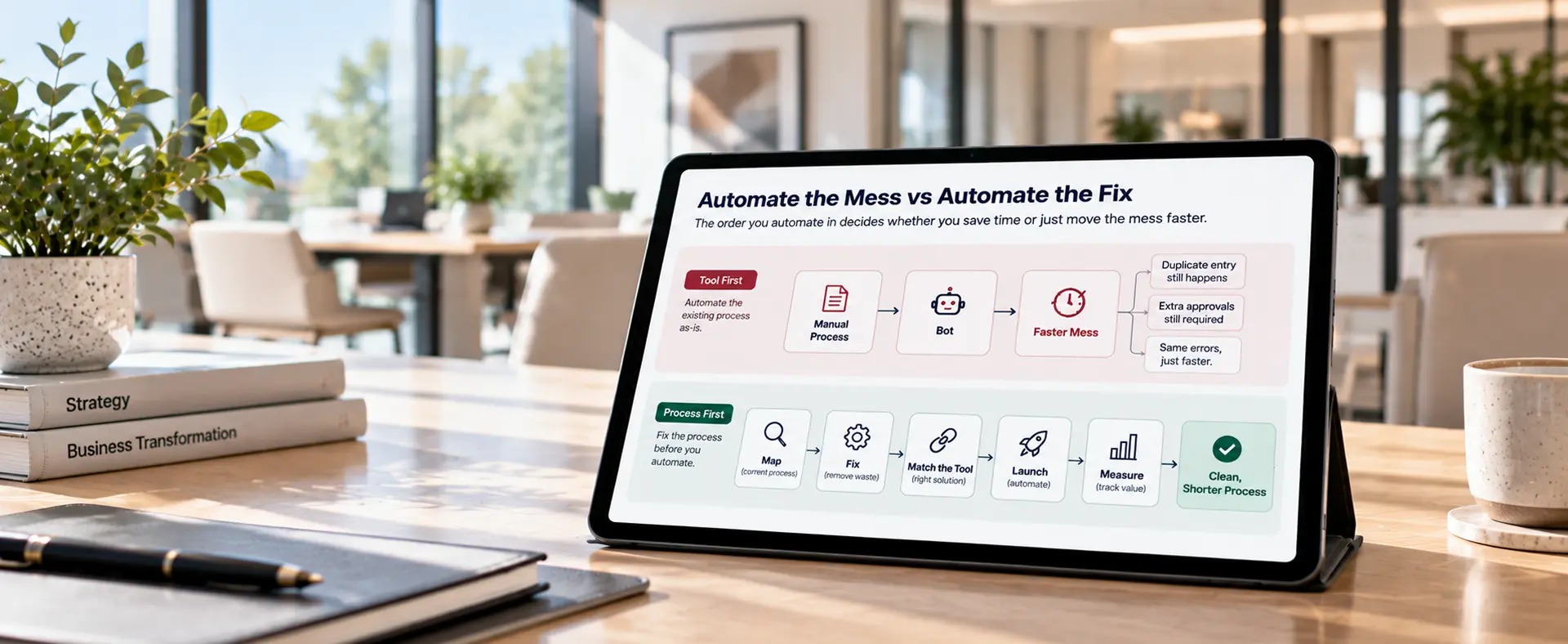
Process automation consulting exists to fix that, but the order matters. Buy a bot first and you automate the mess. Map the process first and you automate the right steps once. That is why our business process consulting team treats automation as a process problem first.
This guide explains the five-phase model Redefine Innovations uses and how we choose between workflow rules, integration, RPA, and AI agents.
What Is Process Automation Consulting?
Process automation consulting is a service where outside specialists study how work moves through a business, redesign the steps that waste time, and then implement the right automation technology.
Process automation consulting differs from buying software: a vendor sells one tool, while a consulting partner stays tool-neutral until the process is clear.
A good consulting engagement covers four jobs: choosing what to automate, fixing the process, building the automation, and governing it.
When a company combines several of these technologies across many processes, Gartner calls it hyperautomation. Redefine delivers all four jobs through its consulting services team.
Why Do Automation Projects Stall Without a Consulting Model?
Automation projects usually stall because of process and planning, not technology. McKinsey estimates that currently demonstrated technologies could, in theory, automate activities that account for about 57% of US work hours.2 The gap between that potential and real results comes down to process and planning.
In Deloitte's 2022 intelligent automation survey, 74% of organizations were already implementing RPA, yet 41% had no enterprise-wide automation strategy, and the average pilot took 22 months to pay back.3
Three failure patterns repeat:
- Automating a broken process. The bot runs faster, but the waste stays.
- Choosing the tool first. A team buys an RPA license, then hunts for tasks.
- No owner after launch. A bot breaks, and nobody owns the fix.
McKinsey's fix: reimagine whole workflows, not single tasks.2 That thinking drives our digital transformation consulting work and the model below.
How Does Process Automation Consulting Work? Our Five-Phase Model
Process automation consulting at Redefine runs in five phases, each ending with a deliverable the client keeps. The first automation typically goes live about 6 to 12 weeks after kickoff.
| Phase | What we do | What you get | Typical timing |
|---|---|---|---|
| 1. Discover and map | Interview process owners, map workflows, measure cycle times | Current-state maps and a ranked opportunity list | About 2 weeks |
| 2. Redesign | Remove waste, fix handoffs, write business rules | Future-state process design | 1 to 2 weeks |
| 3. Match the tool | Assign workflow, integration, RPA, or AI to each step | Solution design and business case | 1 to 2 weeks |
| 4. Build and launch | Build in waves, test with real data, train your team | Working automations in production | 2 to 6 weeks per wave |
| 5. Measure and govern | Track KPIs, monitor, and improve | Results reporting and a runbook | Ongoing |
Redefine's readiness assessments, audits, and workshops offer a fixed-scope way to start.

Phase 1: Discover and Map the Real Process
Phase 1 captures how work actually happens. We interview the people doing the work, map each process in BPMN, and use process mining tools such as Celonis to measure cycle time and error rate.
How we score automation candidates
Every process gets an Automation Fit Score: five criteria, each rated 1 to 5. Scores of 18 or more out of 25 go to the top of the roadmap.
| Criterion | Scores 1 when... | Scores 5 when... |
|---|---|---|
| Volume | It runs a few times a month | It runs hundreds of times a month |
| Rule clarity | Most steps need judgment | Written rules cover every step |
| Exception rate | Most cases need special handling | Few cases fall outside the rules |
| System access | No API and unstable screens | Clean APIs on every system |
| Cost of the manual work | Low effort and low error cost | High labor hours or costly errors |
What you get from Phase 1
Phase 1 delivers process maps with named owners, KPI baselines, and a ranked list of automation candidates. This is the core of Redefine's 14-day process audit, which our team has delivered more than 100 times. When current tools are part of the problem, we pair the audit with a technology stack assessment.
Phase 2: Fix the Process Before You Automate It
Process redesign, the second phase of our model, is the step most automation vendors skip, and it often holds the biggest savings. Workflow optimization means removing steps before automating them.
The process improvement fixes we make most often:
- Cut approval layers that add delay but no control
- Standardize inputs so requests arrive complete
- Remove duplicate data entry
- Write business rules down
When an approval truly needs to stay, we route it by rule instead of by inbox, the way Redefine's approval workflow software does.
"Fix it, then automate it. Never the other way around."Our rule
Phase 3: Match Each Step to the Right Automation
In Phase 3, we assign each process step to the lightest automation that does the job reliably.
Workflow and business rules
Approvals, routing, and forms usually need only a workflow engine or low-code tool that follows written rules. A shared workflow rules engine keeps that logic in one place.
System integration
When systems need to share data, an API integration or iPaaS platform beats a bot, because it does not break when a screen changes. MuleSoft's 2026 benchmark found the average enterprise runs 957 applications, and only 27% of them are connected.4 We confirm what connects to what with a five-day integration assessment.
Robotic process automation
Robotic process automation (RPA) is software that mimics a person clicking through application screens.
RPA consulting: when bots make sense
RPA platforms such as UiPath, Automation Anywhere, and Microsoft Power Automate fit high-volume work in legacy systems with no API and stable screens.
Good RPA candidates
- Keying invoices into an older ERP
- Moving data between portals that offer no API
When we recommend against a bot
We recommend against RPA when the screen changes often, exceptions are frequent, or an API exists. A bot in those spots creates maintenance work, not savings.
Intelligent document processing and AI agents
Unstructured work, like reading invoices and emails, suits intelligent document processing (IDP) and AI agents, with human review of uncertain cases.

Phase 4: Build, Test, and Launch in Waves
Phase 4 builds automations in small waves. Each wave covers one to three processes, runs against real data in testing, and goes live only after the process owner signs off.
We test with real exceptions, run old and new side by side, and hand process owners a runbook.
Most automations touch a system of record, so Redefine's ERP integration specialists plan those connections from day one.
Phase 5: Measure, Govern, and Keep Improving
Phase 5 keeps automations paying off after launch. We track the KPIs set in Phase 1: cycle time, error rate, hours saved, and cost per transaction.
The more mature organizations in Deloitte's 2022 survey reported an average cost reduction of 32%.3
Governance sets who owns each automation, who approves changes, and what happens on failure: alerts, a manual fallback, role-based access, and an audit trail that supports SOC 2 reviews. For the math behind the business case, read Redefine's guide on how to calculate AI automation ROI.

Worked Example: Automating Invoice Processing
Take an accounts payable team handling 2,000 invoices a month. These numbers are illustrative, not from a specific client.
| Step | Before | After |
|---|---|---|
| Handling | 8 minutes of manual entry each | IDP reads invoices; ERP integration matches POs |
| Approvals | Three layers, by email | One rule-based approval for invoices over a set amount |
| Legacy vendor portal | Manual download | One RPA bot |
| Manual time | About 267 hours a month | About 40 hours of exception handling, plus approvals for high-value invoices |
With 85% of invoices flowing through untouched, the team reviews only about 300 exceptions a month. The same pattern fits order entry and employee onboarding, common starting points for internal process automation.
How Do AI Agents Fit Into Process Automation Consulting?
AI agents extend process automation to work that needs judgment. An agent can read a customer email, pull the order, and draft the reply.
McKinsey's 2025 State of AI survey found workflow redesign has the biggest effect on gen AI's EBIT impact, yet only 21% of gen AI users had fundamentally redesigned at least some workflows.5
Gartner predicts that over 40% of agentic AI projects will be canceled by the end of 2027 because of escalating costs, unclear business value, or inadequate risk controls.6
Redefine's agentic AI consulting starts agents on narrow, reviewable tasks, keeps a human in the loop for anything that moves money or changes a customer record, and logs every agent action.
Automation Consulting vs In-House: How to Choose
A consulting partner usually reaches results faster and chooses tools without bias, while an in-house team keeps long-term ownership. Many companies use a partner first, then hand over.
| Factor | In-house team | Automation consulting partner |
|---|---|---|
| Speed to first result | Slower while the team learns tools | Faster, with a proven method |
| Tool choice | Often tied to tools you already own | Tool-neutral selection |
| Process redesign | Hard to challenge your own process | Outside view of waste |
| Long-term ownership | Stays inside the company | Needs a planned handover |
What to look for in a process automation consulting partner
- Tool-neutral advice, not a single-vendor reseller
- A process redesign phase before any build
- Integration skills, not only RPA
- Agreed KPIs and an ownership plan before go-live
When you do not need a consultant
You likely do not need outside help for simple, single-system tasks a Zapier-style tool can handle, or if your team already has automation skills. See our comparison of in-house teams vs consulting partners.
Process Automation Readiness Checklist
Fewer than four checked? Start with a digital maturity assessment.
Frequently Asked Questions
What does a process automation consultant do?
A process automation consultant assesses how work flows through your business, redesigns inefficient steps, and chooses the right automation technology for each step. The consultant then builds and tests the automation, trains your team, and measures cycle time, errors, and cost after launch.
How much does process automation consulting cost?
Automation consulting cost depends on how many processes, systems, and integrations are involved. Most engagements start with a fixed-fee audit or assessment, and each build wave is then priced separately. You approve spending one wave at a time.
How long does a process automation project take?
In Redefine's model, discovery takes about two weeks, redesign and tool selection take two to four weeks, and the first automation typically goes live about 6 to 12 weeks after kickoff.
What is the difference between RPA consulting and process automation consulting?
RPA consulting focuses on software bots that copy human clicks. Process automation consulting covers the whole process, including redesign, integration, and AI, and uses RPA only where bots fit best.
Is business process consulting the same as automation consulting?
Not quite. Business process consulting decides how work should flow, who owns each step, and which steps to remove. Automation consulting adds the technology that runs the improved process. Redefine's model combines both, so the redesign and the build stay in one plan.
Which processes should a company automate first?
Start with high-volume, rules-based, stable processes that have a clear owner and a measurable cost, such as invoice processing, order entry, or employee onboarding. A score of 18 or more on the Automation Fit Score marks a strong candidate.
What are the benefits of process automation consulting?
The main benefits are shorter cycle times, fewer errors, lower cost per transaction, and staff freed for higher-value work. A consulting partner also lowers the risk of automating the wrong process or buying a tool that does not fit.
How do you measure process automation ROI?
To measure process automation ROI, compare baseline cycle time, error rate, and labor hours with the same numbers after launch, then subtract build, license, and maintenance costs. Review the numbers monthly, because value drops when a process or system changes.
Can AI agents replace RPA?
Not entirely. AI agents handle unstructured inputs such as emails and documents, while RPA and APIs still run fixed, rules-based steps more cheaply and predictably. Most mature programs use both.
How is Redefine's model different from a large consulting firm?
Large consulting firms often split strategy from delivery, so one team writes the plan and another builds it. Redefine keeps discovery, build, and support with one team. See the Big Four consulting alternative page for a full comparison.
The Bottom Line
Process automation consulting works when it follows the process, not the tool: map it, fix it, match each step to the right automation, launch in waves, and measure everything.
Redefine client Parsons Kellogg grew revenue sixfold from a $14M baseline alongside process automation and unified reporting work.
If you want a clear automation plan before any build starts, begin with a strategy roadmap workshop.
"Automate the right work, in the right order, and measure what it saves."The Redefine process automation model
Not sure which process to automate first?
Send us one workflow that eats your team's time. We will map it, show you what to fix before automating, and tell you honestly whether automation is worth it.
Sources & Citations
Primary research used for the statistics in this guide (all links checked September 2026):
- Miro, "2025 Momentum at Work Report (press release via Business Wire, September 2025)": knowledge workers spend three hours on maintenance work for every one hour of strategic work; 57% redo work across different tools. Survey of 6,148 full-time knowledge workers in eight markets.
- McKinsey Global Institute, "Agents, robots, and us: Skill partnerships in the age of AI (November 2025)": demonstrated technologies could in theory automate about 57% of US work hours; larger gains require reimagining workflows rather than a task-based approach.
- Deloitte Insights, "Automation with intelligence: 2022 intelligent automation survey": 74% implementing RPA, 41% without an enterprise-wide automation strategy, 22-month average pilot payback, 32% cost reduction reported by more mature organizations. 479 executives in 35 countries.
- MuleSoft, "Agentic Transformation Reaches New Heights: 2026 Connectivity Benchmark Report Insights (February 2026)": average enterprise runs 957 applications with only 27% connected. 1,050 IT leaders surveyed.
- McKinsey, "The state of AI: How organizations are rewiring to capture value (March 2025)": workflow redesign has the biggest effect on EBIT impact from gen AI; 21% of gen AI users have fundamentally redesigned some workflows.
- Gartner, "Gartner Predicts Over 40% of Agentic AI Projects Will Be Canceled by End of 2027 (June 2025)": over 40% of agentic AI projects forecast to be canceled by end of 2027 due to escalating costs, unclear business value, or inadequate risk controls.
Operations insights, no fluff
One short email a month on process automation, integration, and AI projects that pay off.
You're in, check your inbox to confirm.