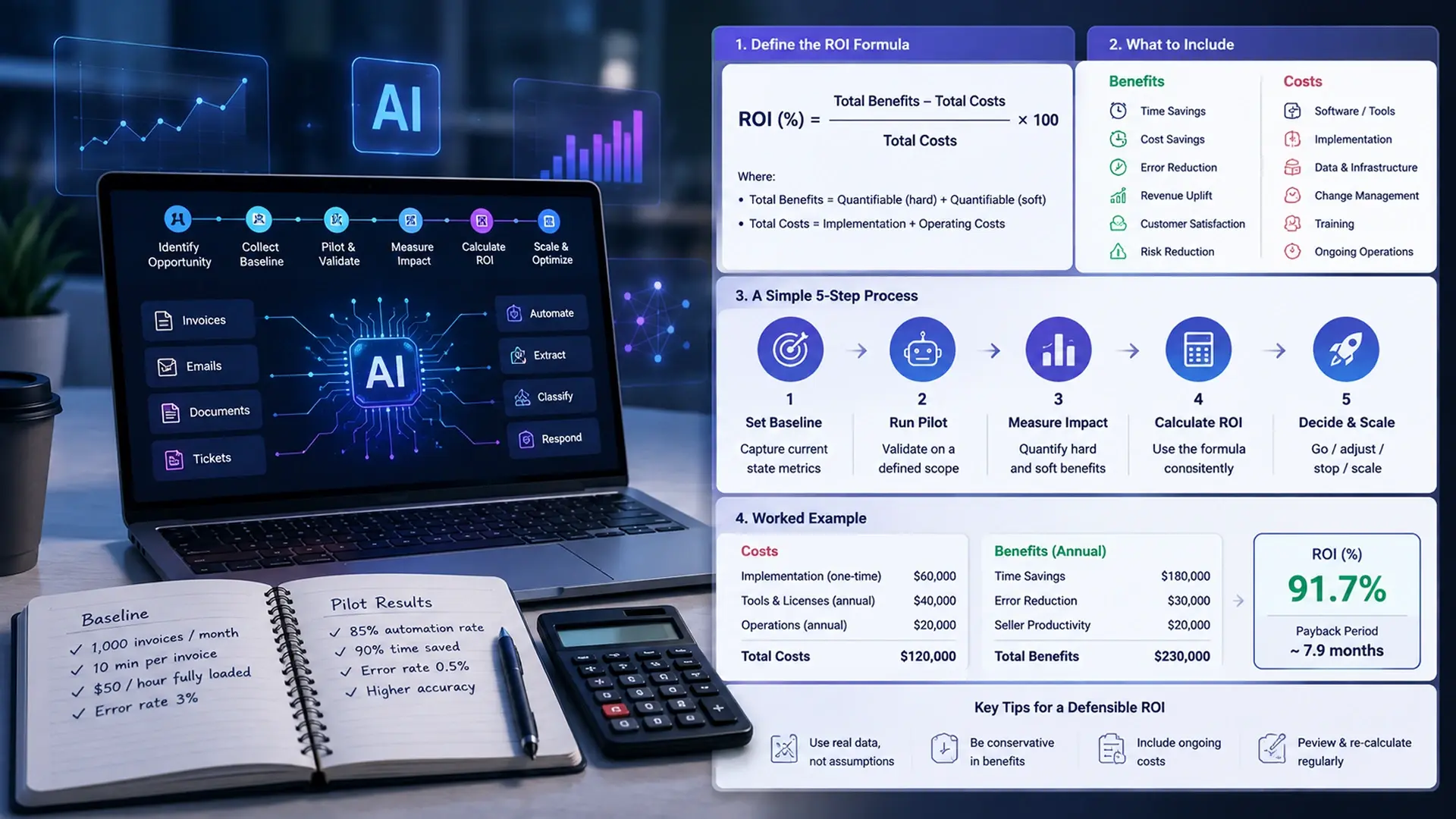
AI automation ROI measures the financial return an AI-enabled process produces compared with the full cost of designing, building, running, governing, and improving that automation. A defensible number accounts for adoption, output quality, and human review, not just the theoretical time an AI system could save.
Your team launched an AI assistant, or automated a chunk of a workflow, or turned on an AI agent to handle a slice of customer service. People use it. Tasks look faster. The pilot channel in Slack is full of good vibes. Then someone on the finance side asks the question that actually matters: what financial value did this create?
If you cannot answer that with a number, you do not have AI automation ROI yet. You have activity. Usage, model accuracy, and task completion are useful signals, but none of them prove a return. Time saved does not automatically equal money saved, and a technically excellent pilot can still produce a weak business case if nobody connects it back to a specific process, a real baseline, and a full accounting of what it cost to build and run it, exactly the scoping work a structured AI consulting engagement is meant to provide.
The stakes are real. The U.S. Census Bureau's Business Trends and Outlook Survey found that AI use among U.S. businesses held between 17% and 20% from December 2025 through May 2026, climbing to 37% among firms with 250 or more employees.1 Adoption is real and still growing. Proof of financial return is a separate question entirely. Deloitte's State of Generative AI in the Enterprise survey found that just 35% of organizations were tracking ROI closely enough to actually measure and communicate the value their generative AI initiatives created.4 Both numbers are true at once, and this guide walks through a practical framework for landing on the right side of that gap: how to define the process, set a baseline, total the real cost, calculate savings and revenue, adjust for adoption, and land on an AI automation ROI figure you can defend in front of your CFO. If you want a structured way to score your own use cases first, our AI readiness assessment is a good place to start.

What AI automation ROI actually means
AI automation ROI compares the measurable financial benefit of an AI-enabled process against the total investment behind it. The basic version looks the same as any ROI formula you already know.
AI automation ROI (%) = [(Total AI benefits - Total AI costs) ÷ Total AI costs] × 100
Say an AI automation project produces $300,000 in annual financial benefit and costs $180,000 a year to implement and operate. The math reads [($300,000 - $180,000) ÷ $180,000] × 100, which lands at 66.7%. That does not mean the company sees $300,000 land in the bank account. The benefit usually blends several kinds of value: released labor capacity, avoided hiring, fewer errors, faster collections, incremental revenue, and lower risk exposure. A credible ROI calculation separates cashable savings, capacity gains, and strategic value instead of lumping everything into one impressive-looking number.
The label "AI implementation ROI" and "automation ROI" get used almost interchangeably in practice, but AI adds a layer that older, rules-based automation projects never had to deal with: the output itself is not always predictable, and that changes how you have to measure it. Teams weighing build options for the first time often bring in outside AI development services at exactly this stage, before the cost and benefit assumptions get locked in.
Why AI ROI is harder to prove than regular automation ROI
Traditional workflow automation runs on fixed rules, so the same input produces the same output every time. AI does not work that way, and that difference shows up directly in your ROI math.
- Outputs are probabilistic. The same request can produce slightly different results, so quality and exception rates directly affect the financial value you can claim.
- Productivity is not automatically savings. Freeing up 10 hours a week only creates financial value once that time gets redirected into avoided hiring, less overtime, or higher-value work.
- The pilot is not the mature result. Prompt refinement, workflow tweaks, and added guardrails usually change the economics after the first few weeks, for better or worse.
- Value shows up across categories. Cost reduction, productivity, revenue, retention, and risk reduction can all move at once, and a narrow before-and-after comparison misses most of it.
- Adoption decides how much value actually lands. A technically strong tool still produces a weak ROI if employees do not trust it, use it inconsistently, or spend too much time double-checking its output.
Federal Reserve research shows the upside is real: U.S. workers who use generative AI report saving an average of 5.4% of their work hours, or roughly 2.2 hours in a 40-hour week, and one in five frequent users save four hours or more.2 The catch is what happens after that time gets freed up. Deloitte's State of Generative AI in the Enterprise survey found that only 35% of organizations were tracking ROI closely enough to actually measure and communicate the value their generative AI initiatives created.4 That is not a technology problem so much as a measurement problem, and it is exactly the gap this guide, and our AI services team, are built to close.
A strong measurement system connects every link in that chain. Most weak ROI claims stop at the first link and call it a day.
Not sure which of your AI use cases would actually pay off?
A short discovery workshop usually surfaces the answer fast.
The risk-adjusted AI ROI formula to use
The basic ROI formula works for a boardroom slide, but it overstates value if you skip adoption, quality, and probability of success. Use this expanded version instead.
Risk-adjusted AI ROI (%) = [(Annual financial benefits × probability of realization) - annualized total costs] ÷ annualized total costs × 100
Broken out further, so every input maps to something you can actually go measure:
AI ROI = [(Cost savings + revenue gains + cost avoidance + risk reduction value) × adoption rate × success rate - total AI costs] ÷ total AI costs × 100
- Cost savings: a real reduction in spend, such as lower overtime, less outsourcing, or reduced processing cost.
- Revenue gains: incremental revenue from higher conversion, faster response times, or reduced churn.
- Cost avoidance: future spending you no longer need, like a hire you can now skip.
- Risk reduction value: the expected financial value of fewer errors, less downtime, or lower compliance exposure.
- Adoption rate: the share of eligible users or transactions that actually run through the AI-supported workflow.
- Success rate: the share of AI-assisted tasks completed at an acceptable quality level without excessive correction.
Microsoft's guidance on measuring the ROI of AI agents recommends defining a value baseline up front and then tracking adoption, quality, and outcome signals as separate, named metrics rather than treating usage alone as proof of financial success.5 That is exactly the discipline the formula above forces you into, and it is the same discipline our AI strategy consulting team builds into every engagement before a single line of code gets written.
How to calculate AI automation ROI, step by step
Formulas only work once you feed them real numbers. Here is the sequence that produces numbers worth trusting, the same intake sequence our AI delivery and governance team runs on every new engagement.
Step 1. Define the process and business outcome before you calculate anything
Do not start with a broad goal like "use AI to improve productivity." Start with a defined workflow, population, unit of work, and measurable outcome.
- Weak: use generative AI to help customer service agents.
- Strong: use an AI assistant to cut average handling time on Tier 1 order-status inquiries by 25%, while holding satisfaction and escalation rates steady.
Write a one-line value hypothesis before you build anything: "If we apply AI to [process], we expect to move [metric] from [baseline] to [target], creating roughly [financial value] over [time period]." Name a financial owner and an operational owner for that hypothesis. Both jobs matter, and they are rarely the same person. If you need a neutral outside voice to pressure-test that hypothesis, an enterprise AI consulting partner can usually get you there in a single working session.
Step 2. Set a real pre-AI baseline
You cannot calculate a return without knowing what the current process actually costs. Pull transaction volume, average handling time, headcount, error rate, and cost per transaction from a representative period, long enough to smooth out seasonal swings and unusual incidents.
Current annual process cost = Annual transaction volume × current cost per transaction, or current labor cost = employees × hours on the process × fully loaded hourly cost. Use fully loaded cost, meaning salary plus benefits, taxes, equipment, and overhead, not just the number on a pay stub. A baseline built on base salary alone will understate your eventual savings and undercut your own business case.
Need help pulling a clean baseline together?
An AI readiness assessment scores your data and process before you build anything.
Step 3. Add up the full cost of AI implementation
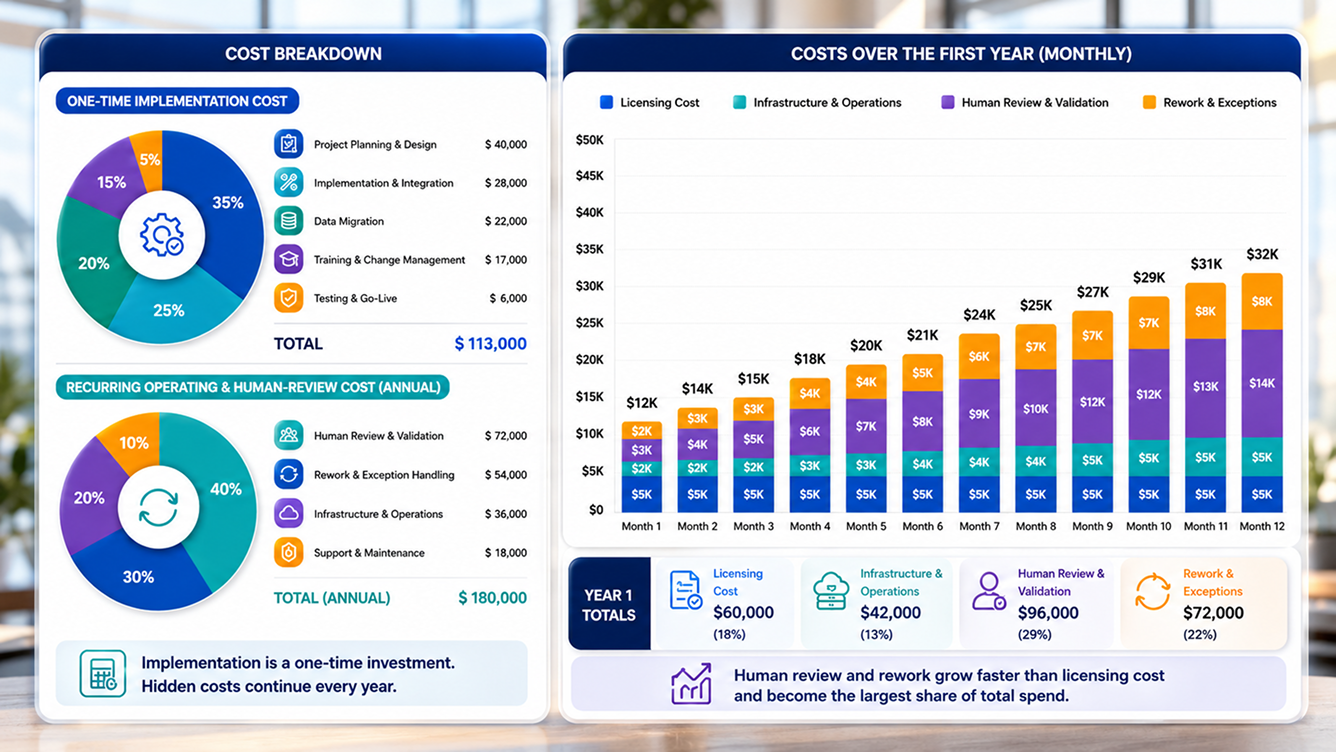
This is where most AI implementation ROI estimates quietly fall apart. Teams budget for the model and the integration, then forget data preparation, governance, and the ongoing cost of human review.
| Cost category | Usually one-time | Usually recurring |
|---|---|---|
| Discovery, data prep, model selection | Yes | Occasional refresh |
| Integration & development | Yes | Enhancements |
| Software licenses & model consumption | No | Yes |
| Human review & quality assurance | No | Yes |
| Governance, monitoring & security | Setup only | Yes |
| Training & change management | Yes | Refreshers |
| Rework & exception handling | No | Yes, and often underestimated |
Total AI cost = initial implementation cost + recurring operating cost + human oversight cost + change-management cost + expected rework cost. That last item matters more than it looks. Parallel-running an old and new process, fixing incorrect AI output, and re-testing after a model or price change are the hidden costs that show up three months into a project, right when leadership expected the numbers to look clean. An outside AI data readiness assessment before you build is the fastest way to surface these costs early instead of three months in.
Step 4. Calculate your AI cost savings
Start with labor efficiency. Annual labor value = hours saved per task × annual task volume × fully loaded hourly cost. Saving 12 minutes per invoice across 30,000 invoices a year at a $38 fully loaded hourly cost works out to 0.2 hours × 30,000 × $38, or $228,000 in annual labor capacity.
Do not report that figure as $228,000 of cash savings. Sort it into one of four buckets: cashable savings (an actual drop in spend, like lower overtime or fewer outsourced transactions), capacity value (employees complete more work without adding headcount), redeployment value (staff move to higher-value tasks), or cost avoidance (a planned hire the company no longer needs). Only the first and last belong in a hard, cash-linked ROI figure.
Layer in error-reduction savings the same way: error-reduction value = reduction in annual errors × average cost per error, where cost per error includes rework, refunds, replacement shipments, and the manager time spent chasing the mistake down. Our AI product development team builds this cashable-versus-capacity classification into the delivery plan from day one, not after launch.
Step 5. Add revenue, risk reduction, and cost avoidance
AI automation ROI should never stop at cost reduction. For conversion-driven work, use gross profit rather than raw revenue: incremental profit = additional conversions × average order value × gross margin. A site moving from 2.4% to 2.6% conversion on 500,000 annual sessions, at a $150 average order and 35% gross margin, adds 1,000 orders and roughly $52,500 in incremental gross profit.
For risk reduction, use expected-value thinking: expected annual risk cost = probability of the event × its financial impact. If a compliance incident carries an 8% annual probability and a $500,000 impact, the expected cost is $40,000. If AI-assisted monitoring cuts that probability to 3%, the expected cost drops to $15,000, a $25,000 annual risk-reduction value. Treat this as a separate, clearly labeled line rather than folding it into cash savings, since it represents an averted cost rather than money that actually moved. Programs that lean on autonomous agents for this kind of monitoring, like the ones our agentic AI team builds, tend to make that averted-cost math easier to defend in front of finance.
"AI activity tells you the model is working. AI automation ROI tells you whether the business is."On the gap between usage and value
Step 6. Adjust for adoption, quality, and human review
This is the step that separates a defensible number from an optimistic one. Take your theoretical benefit and run it through three filters in order.
Say a project could theoretically save $200,000 a year, but only 60% of eligible users actually adopt it: $200,000 × 60% = $120,000. Of that AI output, only 80% is usable without major correction: $120,000 × 80% = $96,000. Reviewers then spend 1,000 hours a year checking and correcting output at $45 an hour, a $45,000 cost. Net annual benefit: $96,000 - $45,000 = $51,000, a very different number from the $200,000 the project deck originally promised.
Realized AI value = theoretical benefit × adoption rate × acceptable-output rate - review and rework cost. Track eligible-user adoption, acceptance rate, correction rate, and human-review hours as ongoing metrics, not one-time assumptions, since all four tend to shift as a rollout matures.
Want governance and adoption tracking built in from the start?
Risk scoring and audit trails go into the architecture, not bolted on after launch.
Worked example: a full AI automation ROI calculation
A distributor wants to automate order entry from emailed purchase orders. Here is the whole calculation, start to finish.
- Current process: 45,000 orders a year, 10 minutes of manual entry per order, $36 fully loaded hourly cost, a 4% order-entry error rate at $28 average cost per error.
- AI-supported process: 6 minutes saved per order, 85% of orders actually processed through the automation, a 92% acceptable-output rate, 1.5 minutes of human review per order, and an error rate that falls from 4% to 1.5%.
- Gross labor capacity: 45,000 × 6 minutes ÷ 60 × $36 = $162,000.
- Adjusted for adoption and quality: $162,000 × 85% × 92% = $126,684.
- Human-review cost: 45,000 × 85% × 1.5 minutes ÷ 60 × $36 = $34,425.
- Net labor value: $126,684 - $34,425 = $92,259.
- Error-reduction value: 45,000 × (4% - 1.5%) = 1,125 errors avoided, at $28 each = $31,500.
- Total annual quantified benefit: $92,259 + $31,500 = $123,759.
- Annualized AI cost: $40,000 implementation (amortized over three years) + $24,000 software and model consumption + $18,000 monitoring and support + $8,000 governance = $90,000.
- AI automation ROI: [($123,759 - $90,000) ÷ $90,000] × 100 = 37.5%.
That 37.5% is a real, defensible number, and it does not even include softer upside like avoided recruitment, faster order confirmation, or extra transaction capacity. Present those separately once you have evidence for them, rather than baking assumptions into the headline figure. This is the same walkthrough our AI ROI assessment produces for your own numbers, not a hypothetical distributor's.
Hard ROI vs. soft ROI of AI
Most finance and operations teams end up drawing a clean line between hard ROI, which affects cost or profit directly, and soft ROI, which covers outcomes like employee experience, customer satisfaction, and decision quality. Both matter. They should never share the same line item.
| Hard ROI (cash-linked) | Soft ROI (experience-linked) |
|---|---|
| Reduced overtime and outsourcing cost | Employee satisfaction and retention |
| Avoided headcount | Faster access to knowledge or information |
| Increased gross profit from conversion or retention | Improved decision quality |
| Reduced fraud, refunds, or penalties | Better customer experience scores |
| Lower cost per transaction | Organizational resilience and agility |
You can track soft benefits, but do it responsibly. Instead of claiming "AI created $200,000 through higher employee satisfaction," report the actual movement: "Employee satisfaction rose 12%, and voluntary turnover fell 3 percentage points; finance will evaluate the recruitment and productivity impact after a full year." That version survives a boardroom challenge. The first one does not. Our AI governance consulting practice builds this hard-versus-soft split into every reporting dashboard we stand up for clients.
Common AI ROI mistakes to avoid
- Counting every saved minute as cash. Time only becomes money once the business actually uses or removes the released capacity.
- Ignoring adoption. A tool used by 30% of the eligible population cannot deliver 100% of the forecast benefit, no matter how good the model is.
- Ignoring human review. Correction, escalation, and governance work can materially change the economics of a project.
- Using revenue instead of gross profit. Incremental revenue needs to be adjusted for the cost of delivering it before it counts as return.
- Excluding data and integration costs. These often run larger than the software license itself.
- Comparing against an unrealistic baseline. Match volumes, time periods, and process conditions, or the comparison means nothing.
- Claiming causation from correlation. If sales rise after a rollout, confirm the AI actually caused the increase before you claim the credit.
- Stopping measurement after launch. Model costs, adoption, and data quality all drift over time, and your ROI figure should be revisited on a schedule, not treated as a one-time exercise.
Federal Reserve research shows AI adoption already reaches the majority of the U.S. workforce, with 78% of workers employed at firms that have adopted AI in some form.3 Yet Census Bureau data shows only 17% to 20% of businesses report actual AI use in their day-to-day operations.1 That gap between "adopted somewhere" and "used in the exact workflow you are measuring" is exactly why industry-wide averages make a useful sanity check on your own estimate, not a benchmark you should assume your project will automatically hit. If you would like a second pair of eyes on your own estimate before you present it, our AI ROI assessment stress-tests it against your actual data.
Key takeaways
- AI automation ROI compares real financial benefit against the full cost of an AI project, not just the license fee.
- Adjust every forecast benefit for adoption rate, output quality, and human-review cost before you call it realized value.
- Keep hard, cash-linked ROI separate from soft, experience-linked ROI so leadership can see exactly what is proven versus assumed.
- Measure once at launch, then again on a regular cadence. AI cost, adoption, and data quality all shift, and your ROI number should move with them.
Frequently asked questions
Here are the questions finance and operations leaders ask most before they sign off on an AI automation budget. If yours is not covered, our AI services team is happy to walk through it live.
How do you calculate AI automation ROI?
Subtract total AI costs from total AI benefits, then divide by total AI costs and multiply by 100. The full calculation also needs to account for adoption rate, output quality, and human review time, since a benefit that never gets adopted or that requires heavy correction never turns into real financial return.
What costs should be included in AI implementation ROI?
Include development, data preparation, integrations, licensing, training, change management, governance, infrastructure, monitoring, and ongoing human oversight. Many businesses only budget for the software itself and miss data engineering, review time, and rework, which is exactly what makes early ROI estimates look better than the real result.
How do you calculate AI cost savings?
Multiply the verified reduction in labor hours, errors, or processing time by their financial value, then classify the result as cashable savings, freed-up capacity, or avoided future spending. Only cashable savings and confirmed cost avoidance belong in a hard ROI number.
Does employee time saved count as ROI?
Only once the organization actually uses that released time, whether that means avoiding a planned hire, cutting overtime, redirecting staff to higher-value work, or processing more transactions with the same headcount. Time saved that nobody redirects anywhere is a productivity gain, not a financial return.
What is a good ROI for an AI project?
There is no universal number. The right threshold depends on your cost of capital, risk tolerance, payback expectations, and what else that budget could fund instead. Most finance teams look for a positive benefit-cost ratio plus a payback period the business can tolerate, rather than chasing one fixed percentage.
How long does it take to see ROI from AI?
It depends on process complexity, data readiness, integration work, and adoption speed. A narrow, high-volume workflow can show measurable value within a few months, while a cross-functional or heavily regulated rollout often takes two to three quarters before the numbers settle into something you can trust.
How do you measure the business value of AI?
Measure it across categories rather than one number: cost savings, revenue gains, risk reduction, quality improvement, employee experience, and customer experience. Track hard, cash-linked metrics separately from soft, experience-linked metrics so leadership can see exactly which claims are proven and which are still assumptions.
Should soft benefits be included in AI ROI?
You can track soft benefits like employee or customer satisfaction, but keep them separate from your validated financial ROI unless you can draw and defend a direct line to cost or revenue. Blending soft and hard benefits into one number is one of the fastest ways to lose the finance team's trust.
Sources & citations
We leaned on primary, U.S.-focused data wherever it exists rather than global averages, since the two often tell different stories for a U.S. business case. For a deeper look at how these numbers apply to your own stack, see our AI services overview.
- U.S. Census Bureau, Business Trends and Outlook Survey (BTOS), "AI Use at U.S. Businesses": AI adoption among U.S. businesses by firm size and sector, December 2025 through May 2026.
- Federal Reserve Bank of St. Louis, "The Impact of Generative AI on Work Productivity": average share of work hours U.S. workers save using generative AI, and the share of frequent users saving four or more hours a week.
- Board of Governors of the Federal Reserve System, FEDS Notes, "Monitoring AI Adoption in the U.S. Economy": Survey of Business Uncertainty data on the share of the U.S. labor force employed at AI-adopting firms.
- Deloitte AI Institute, "The State of Generative AI in the Enterprise": U.S. enterprise survey on generative AI ROI tracking, realization, and expectations.
- Microsoft Learn, "Measure the Return on Investment (ROI) and Business Value of AI Agents": guidance on separating adoption, quality, and outcome signals when measuring AI agent value.
Figures were current as of research in mid-2026 and are reviewed roughly every quarter. Survey-based ROI and adoption figures shift as adoption matures, so confirm current numbers directly with the cited source before building a formal business case.

Umang Patel
Co-owner | Ecommerce Architecture, Systems & Integrations
Umang Patel has worked in ecommerce and technology since 2001. He specializes in backend systems, ecommerce architecture, ERP and platform integrations, automation, and reverse engineering complex business processes. At Redefine Innovations, he leads technolo
Areas of expertise: Ecommerce Architecture • Backend Systems • ERP Integration • Automation • Headless Commerce • Reverse Engineering