
Agentic AI in ecommerce refers to autonomous or semi-autonomous AI systems that pursue shopping or retail goals for customers and businesses. Unlike a standard chatbot, an agent can plan the steps a task needs, pull real product and operational data, weigh the options against your constraints, and then act: building a cart, checking stock, or starting a checkout.
Picture your next customer. They do not open your homepage, scroll your category pages, or click a search ad. They tell an AI agent what they need, and the agent finds it, compares it and, in a growing number of cases, buys it. That shift already has a name: agentic commerce.
You do not have to take this on faith. Google, OpenAI, Visa, Stripe and a long list of retailers have all shipped real infrastructure for it since late 2025. Google's Universal Commerce Protocol, OpenAI's Agentic Commerce Protocol and Visa's Trusted Agent Protocol now let agents discover products, hold a cart, and complete a purchase, and they do it inside a chat window or an AI search result rather than on your website.
That does not mean your website is going away. It means your website's job is changing. You are no longer optimizing only for a person with a mouse. You are also optimizing for a machine that reads your product data, checks your stock, and decides whether to recommend you at all. This guide walks through what agentic AI in ecommerce actually is, how it works, where it creates value, where it creates risk, and what a retailer should do about it starting now.

What is agentic AI in ecommerce?
Most ecommerce AI you have used so far predicts, recommends or responds. It suggests a product, answers a support question, or scores a transaction for fraud. It leaves the final decision and the final action to a person. Agentic AI closes that gap. It interprets a goal, plans the steps the goal requires, calls the tools it needs, and carries out the resulting action.
A practical definition
An agentic system usually combines seven things: a defined objective, a way to reason and plan tasks, memory or context about the user and the task, access to tools and data through APIs, the ability to take real actions, a feedback loop to check whether the action worked, and rules that require human approval for anything sensitive. Remove any one of these and you have a chatbot or an automation script, not an agent.
What is agentic commerce?
Agentic commerce is the use of these AI agents inside the commercial journey itself: discovery, comparison, decision-making, purchasing, fulfillment and post-purchase support. Visa describes it as commerce experiences where AI agents help consumers or businesses discover products, make decisions and complete parts of the purchasing journey, from comparing options to initiating and completing a checkout with the user's permission.
Agentic AI versus generative AI
These two terms get used interchangeably far too often, and the difference matters for how you plan around them.
| Capability | Generative AI | Agentic AI |
|---|---|---|
| Primary function | Produces content or answers | Pursues and completes a goal |
| Interaction | Responds to a prompt | Initiates and sequences its own actions |
| Tool access | Optional | Central to how it operates |
| Memory | Usually limited to the conversation | Can retain task and user context |
| Decision-making | Suggests an action | Selects and executes an action |
| Ecommerce example | Writes a product description | Finds products, checks stock, starts checkout |
Agentic AI versus chatbots and ordinary automation
Chatbots answer inside a fixed conversational script. Rule-based automation fires on a fixed trigger, like an abandoned-cart email. Recommendation engines predict what you might like. An agent is different because it works out, on its own, which steps and which tools a given goal requires. A lot of content published under the "agentic AI" banner right now is really describing ordinary personalization or a scripted chatbot. Treat that distinction as the first filter when you evaluate a vendor's claims.
Not sure where your store falls on this spectrum?
We map your current stack against the agentic commerce maturity levels below and tell you what to fix first.
How do autonomous shopping agents actually work?
Walk through a concrete example. A shopper types: "Find a waterproof hiking jacket under $200, available in medium, with delivery before Friday and free returns." Here is what a well-built agent does with that sentence.
- Interpret the intent. The agent pulls out the product category, the budget ceiling, the size, a performance requirement, a delivery deadline and a return-policy preference.
- Build a task plan. It lays out a sequence: search eligible retailers, retrieve candidate products, filter out unavailable variants, compare price and policy, rank the results, then either ask for approval or start checkout.
- Pull structured data. It reads product feeds and product pages, inventory APIs, pricing engines, reviews, and shipping and return data. OpenAI's own commerce documentation states plainly that structured product feeds help ChatGPT surface products with accurate pricing, availability and seller context, which tells you exactly where the agent is looking first.
- Evaluate the options. It weighs your stated requirements against product attributes, total delivered cost, delivery time, seller reputation and return terms.
- Use tools to act. It can add an item to a cart, apply a promotion, check loyalty eligibility, reserve inventory, generate an order, initiate payment, or schedule delivery.
- Monitor the outcome. After the purchase, it can track the shipment, flag a delay, trigger a reorder, or start a return if something goes wrong.
Why this matters for your product pages: an agent never sees your homepage, your lifestyle photography or your brand story the way a person does. It reads your structured data feed. If your attributes are incomplete or vague, it recommends a competitor instead. That single fact should reshape how you prioritize your product content roadmap this year.
From ecommerce automation to agentic commerce
Agentic AI did not appear overnight. It sits at the end of a five-stage progression that most retailers have already lived through part of.
- Stage 1, rules-based automation: abandoned-cart emails, fixed replenishment reminders, trigger-based discounts.
- Stage 2, predictive ecommerce AI: product recommendations, customer segmentation, demand forecasting, fraud scoring.
- Stage 3, generative AI assistance: conversational product discovery, AI-drafted descriptions and support replies.
- Stage 4, semi-autonomous agents: the agent researches and recommends, but a person approves the purchase or any sensitive action.
- Stage 5, autonomous commerce: the agent coordinates discovery, selection, payment and fulfillment on its own, inside permissions you set in advance.
McKinsey frames this as an automation curve rather than a single leap. How much a shopper delegates to an agent depends as much on how comfortable they are handing over control as it does on what the technology can already do. Its research also points to a fourth level worth watching closely, where agents work against a standing goal rather than a one-off order, something like "keep our household essentials under $300 a month" or "never let us run out of baby formula," with the agent handling the ongoing follow-through.
Ten high-value applications of agentic AI in retail
Here is where the theory turns into something you can actually plan a budget around. Each of these use cases already has real infrastructure behind it in 2026.
01 Autonomous shopping assistants
An agent discovers, evaluates and purchases products inside boundaries a shopper sets. A recurring household-purchase agent, for example, reorders an approved product automatically once inventory runs low.
02 Conversational product discovery
An agent turns a natural-language goal, like "office welcome kits for 50 remote employees," into a shortlist and a next step, replacing a keyword search with a real conversation about what the shopper actually needs.
03 Dynamic merchandising
An agent adjusts product rankings, featured collections, cross-sells and bundles based on live inventory, demand and margin, instead of a merchandiser updating rules by hand every week.
04 Personalized promotions
An agent decides which offer or loyalty benefit fits a specific customer, while still respecting your margin rules and eligibility limits, so discounting stays targeted instead of blanket.
05 Inventory and replenishment management
An agent watches stock levels, demand signals, supplier lead times and seasonal patterns, then recommends or initiates a reorder before a stockout costs you a sale.
06 Dynamic pricing and margin optimization
An agent weighs demand, stock exposure, competitor pricing and margin thresholds. Keep a human in the loop here. Pricing decisions carry fairness, explainability and regulatory exposure that a rules-only system can miss.
07 Customer-service resolution
An agent finds the order, checks return eligibility, and runs the whole approval and refund workflow end to end, instead of routing every step through a queue.
08 Fraud detection and transaction review
An agent coordinates signals across identity, payment behavior, device data, order history and agent authorization to flag a transaction before it clears, not after.
09 Marketing and retail-media orchestration
An agent continuously coordinates audiences, budgets and creative variants across product feeds and sales channels, closing the loop faster than a quarterly campaign review ever could.
10 Supplier and supply-chain coordination
An agent monitors supplier performance, compares procurement options, flags late orders, and reroutes inventory across warehouses within the rules you have approved.
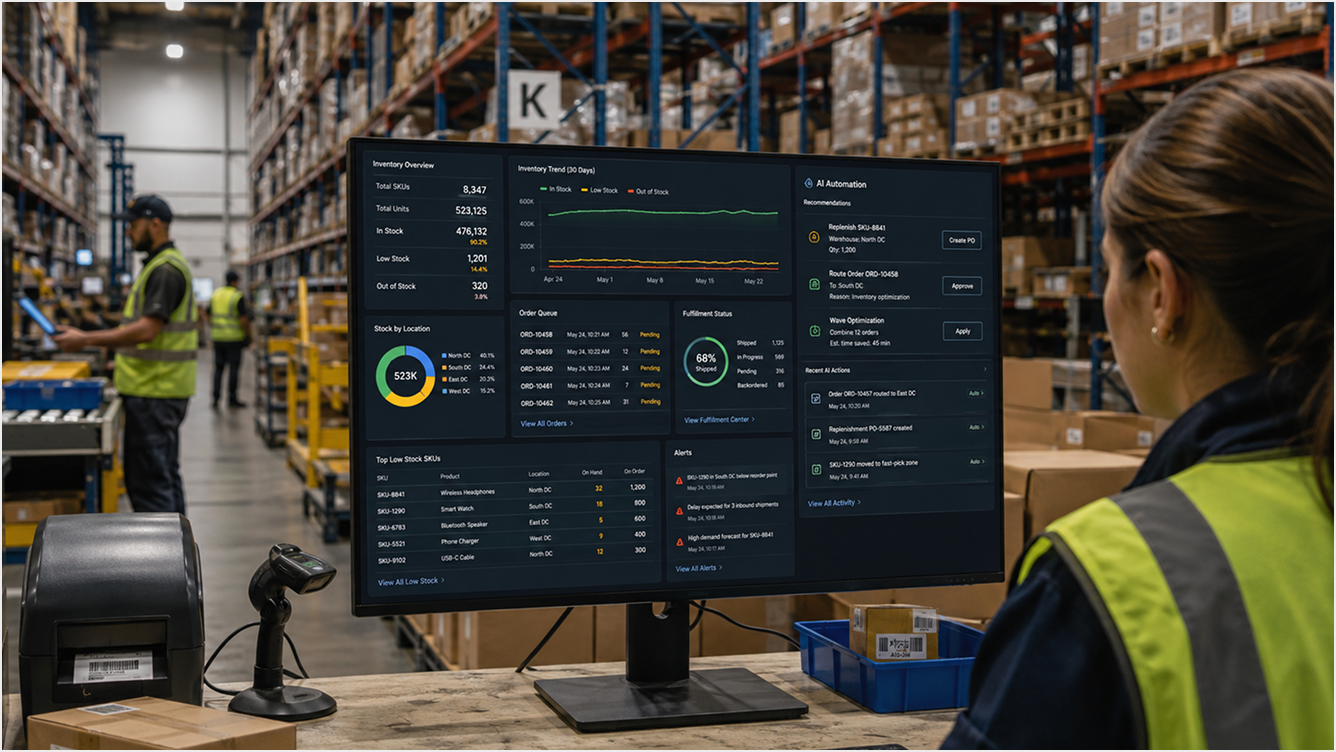
Want to see this run on your own catalog?
Our AI and automation layer works on your live product data, not a generic demo.
Building trust in agentic checkout and payments
None of this works if a merchant cannot tell a legitimate shopping agent from a scraper or a fraud bot. That is exactly the problem the industry spent 2025 and early 2026 solving.
OpenAI's Agentic Commerce Protocol, built with Stripe, lets a shopper complete a purchase inside ChatGPT while the merchant stays the merchant of record, accepts or declines the order, and handles fulfillment and support as they always have. Google's Universal Commerce Protocol does something similar across Search, Gemini and other Google surfaces, and requires explicit, verifiable shopper authorization for every transaction. Visa's Trusted Agent Protocol, developed with Cloudflare, gives merchants a cryptographic way to verify that an incoming request really is an approved agent acting with a shopper's permission, rather than a bot testing stolen card numbers. Visa reported that AI-driven traffic to US retail sites surged more than 4,700 percent in the twelve months before the protocol launched, which explains why merchants needed this so urgently.
For your own checkout, plan around five things: a way to verify agent identity, a permission model that lets shoppers set spending limits or one-time approval, tokenized payment credentials so the agent never holds a raw card number, a complete audit trail and access control of what the agent did and why, and a clear path for the shopper to dispute or return an agent-placed order under the same protections they would get from a purchase they made themselves.
Risks and limitations of autonomous commerce agents
A credible article about agentic AI has to be honest about where it can go wrong. Here is what deserves real attention before you expand any pilot.
- Incorrect decisions. An agent can misread a specification, an availability flag, or a return policy, especially when your own data sources disagree with each other.
- Outdated product data. If your feed, your API and your product page do not match, an agent may recommend something that is out of stock or priced incorrectly, which lands as a broken promise to the shopper.
- Unauthorized purchases. Weak permission models, unclear intent, or a compromised account can let an agent place an order nobody actually wanted.
- Prompt injection. An attacker can hide instructions inside a product description, a review, or a page an agent reads, attempting to manipulate what it does next.
- Bias in ranking. Independent research, including work reviewed by the California Management Review, has found that AI agents can systematically favor certain platform picks or familiar brands over sponsored or lesser-known listings, which is worth knowing if you rely on paid placement today.
- Loss of the direct customer relationship. When an outside agent owns discovery and comparison, you can lose direct traffic, first-party data, and the chance to differentiate on anything the agent does not weigh into its decision.
- Accountability questions. Who is responsible when an agent buys the wrong thing? How do you prove the shopper actually consented? These are live legal questions without one settled answer yet, so treat this as a reason to get your own legal counsel involved early, not as a reason to avoid agentic commerce altogether.
"The retailers that win the agentic era will not simply be the ones with the biggest AI budget. They will be the ones whose product data an agent can actually trust."Redefine Innovations, ecommerce platform team
How retailers can prepare for agentic commerce
You do not need to solve every risk above on day one. You need a sequence. Here is the order that actually works.
- Audit your product data. Check completeness, accuracy, variant consistency, taxonomy and identifiers in your product information management system before you touch anything else.
- Add complete structured data. Prioritize Product, Offer, AggregateRating, Review, ProductGroup and MerchantReturnPolicy markup, matched exactly to your live feed.
- Improve feed freshness. Keep your product pages, merchant feeds and inventory system reading from one source of truth so an agent never sees two different prices for the same item.
- Make product pages decision-ready. Every page should answer who the product is for, what problem it solves, what its real limitations are, and whether it can be returned, in plain language.
- Expose real-time commerce APIs. Product search, inventory lookup, cart creation and order status all need to be callable through your commerce platform, not just visible on a rendered page.
- Define agent permissions. Decide explicitly, through your governance and access controls, what an agent can read, what it can change, and what always needs a person to sign off.
- Set human approval thresholds. Start with risk-based limits rather than full autonomy from the first day.
- Build observability. Track agent decisions, tool failures, overrides and customer complaints in your analytics and reporting layer from week one, not after something breaks.
Want this built for you instead of around you?
Our platform wires PIM, ERP, inventory and checkout into one connected system agents can actually read.
The Redefine Agentic Commerce Maturity Model
Most retailers ask "are we ready for agentic AI?" as if the answer were yes or no. It never is. Use this five-level model instead to see exactly where your store sits today and what the next step actually looks like.
| Level | Capability | Example |
|---|---|---|
| 1 | Rules-based automation | Triggered emails, fixed replenishment reminders |
| 2 | AI assistance | Product recommendations, demand forecasting |
| 3 | Agent-supported decisions | AI compares products and drafts a recommendation for a person to approve |
| 4 | Bounded autonomy | Agent executes approved tasks inside a spending limit or category rule |
| 5 | Autonomous orchestration | Multiple agents complete an end-to-end workflow, from discovery to fulfillment |
Most retailers we work with sit somewhere between level 2 and level 3 today. That is a completely reasonable place to be. The mistake is trying to jump straight to level 5 before your product data and permission rules can support it.
Agentic AI in B2B ecommerce
B2B buying is, honestly, a better early fit for agents than most consumer categories. It already runs on repeat orders, approved catalogs, contract pricing, budget limits and multiple layers of approval, which are exactly the structured conditions an agent needs to add value without adding risk.
Picture a promotional-products distributor that receives a request for 500 branded onboarding kits. An agent identifies eligible products, checks decoration requirements, validates inventory, calculates delivery timelines, applies the account's contract pricing, and builds and routes a quote for approval, all before a rep would have finished reading the initial request. This example is illustrative, but every piece of it depends on your order and inventory operations talking directly to your ERP, not living in a spreadsheet.
The real blocker for most B2B teams is not the AI model. It is account-specific catalogs, negotiated pricing, credit terms and minimum order quantities that live in disconnected systems. Solve that integration problem first, through an omnichannel commerce platform tied to your ERP, and an agent has something reliable to act on.
Key takeaways
- Agentic AI in ecommerce moves AI from recommending an action to completing it, across discovery, checkout, service and fulfillment.
- Real protocols already exist for this: Google's UCP, OpenAI's ACP and Visa's Trusted Agent Protocol all launched between late 2025 and early 2026.
- McKinsey projects agents could mediate $3 trillion to $5 trillion in global commerce by 2030, but adoption will be uneven by category.
- Your product data, your system integrations and your permission rules, not a single AI tool, determine whether agents can transact reliably on your store.
- Start with a contained pilot and bounded autonomy. Expand only after you can measure accuracy, override rate and customer outcomes.
Frequently asked questions
What is agentic AI in ecommerce?
Agentic AI in ecommerce refers to autonomous or semi-autonomous AI systems that pursue shopping or retail goals on behalf of customers and businesses. Unlike a standard chatbot, an agent can plan a sequence of steps, pull in product and operational data, weigh options, decide, and take an action such as building a cart or starting checkout.
What is an ecommerce AI agent?
An ecommerce AI agent is software that reasons about a commerce goal, such as finding a product or resolving a return, and uses connected tools like product feeds, inventory APIs and payment systems to complete the relevant task without a person carrying out each step manually.
How is agentic AI different from an ecommerce chatbot?
A chatbot generally answers questions inside a fixed conversational script. An agent plans and sequences multiple steps on its own, calls tools and APIs, and can take real actions such as adding an item to a cart, applying a promotion or starting a checkout session.
Can AI agents make purchases automatically?
Yes, technically, where a merchant supports it. Whether an agent completes a purchase on its own depends on the retailer's integrations, the permissions the shopper grants, the payment authorization method used, and the checkout protocol the merchant has adopted.
Will AI shopping agents replace ecommerce websites?
Websites are unlikely to disappear, but a growing share of discovery and even checkout activity is shifting into AI interfaces such as chat apps and AI-powered search. Retailer websites increasingly need to double as data and API sources for agents, not just storefronts for people.
How can ecommerce sites optimize for AI shopping agents?
Publish complete and current structured data, keep product feeds accurate and frequently refreshed, expose real-time pricing and inventory through APIs, write product content that answers concrete questions, and state shipping, return and warranty terms clearly and consistently.
Is agentic commerce safe?
Agentic commerce introduces new risk categories, including unauthorized purchases, prompt injection and agent impersonation. Protocols from Visa, Google and OpenAI address identity verification, authorization and audit trails, but retailers still need their own permission rules, spending limits and human approval thresholds.
Does agentic AI work for B2B ecommerce?
Yes. B2B buying often involves repeat orders, approved catalogs, contract pricing and multiple approvals, which are exactly the structured, rules-based conditions where an agent can add the most value with the least risk.
Sources & citations
- Google, "New tech and tools for retailers to succeed in an agentic shopping era": announcement of the Universal Commerce Protocol (UCP), January 2026.
- OpenAI, "Buy it in ChatGPT: Instant Checkout and the Agentic Commerce Protocol": launch of ACP, built with Stripe, September 2025.
- Visa, "Visa Introduces Trusted Agent Protocol": the 4,700 percent AI-traffic surge figure and the agent-verification framework, October 2025.
- McKinsey & Company, "Agentic commerce: How AI shopping agents can change retail": the $3 trillion to $5 trillion global estimate and the automation-curve framework, January 2026.
- Retail Dive, "US agentic commerce revenue forecast to reach $1 trillion by 2030", reporting on an ICSC and McKinsey & Company study: the 68 percent and 62 percent consumer-adoption figures, May 2026.
- Google Cloud, "Agentic commerce is here: How retailers can prepare for the new shopping era": guidance on structured data and agent-ready infrastructure.
- Visa, "Trusted Agent Protocol" documentation: cryptographic agent identity verification for merchants.
- California Management Review, UC Berkeley Haas School of Business, "The Shopper Schism: Competing When AI Agents Become Your Customer": research on ranking bias in AI shopping agents, February 2026.
Figures were current as of research in mid-2026. Adoption forecasts vary widely by research firm depending on how each defines "agentic commerce," so treat any single number as directional rather than exact, and check the primary source for the latest figures before you build a business case around it.

Umang Patel
Co-owner | Ecommerce Architecture, Systems & Integrations
Umang Patel has worked in ecommerce and technology since 2001. He specializes in backend systems, ecommerce architecture, ERP and platform integrations, automation, and reverse engineering complex business processes. At Redefine Innovations, he leads technolo
Areas of expertise: Ecommerce Architecture • Backend Systems • ERP Integration • Automation • Headless Commerce • Reverse Engineering