Integration project scoping is the process of defining which systems will connect, which data moves between them, in which direction, how often, and what happens when a sync fails. System integration services are priced from that scope. At Redefine, a two-system integration typically costs $8,000 to $18,000 and goes live in 4 to 6 weeks, while multi-system builds with custom logic take 8 to 14 weeks and are priced individually. More systems, two-way syncs, legacy software, EDI, and real-time requirements raise the quote.
Every request for system integration services starts with the same question: what will this cost? The honest answer depends on your scope.
The average organization now runs 957 applications, and only 27% of them are connected.1 So two companies asking for the same Shopify to ERP connection can face very different projects.
If your team still re-keys orders between systems every day, automated order synchronization is usually the first flow worth scoping.
A quick disclosure: Redefine Innovations sells integration work, with more than 200 integration projects completed and 80-plus systems connected. A clear scope helps you most, whoever you hire.
What Are System Integration Services?
System integration services connect separate software systems so they share data automatically. A systems integration company, also called a system integrator or SI, links your ERP, CRM, ecommerce platform, warehouse, EDI trading partners, and analytics tools so a change in one system appears in the others without manual entry.
IT integration, the broader practice of connecting software, data, and infrastructure, needs upkeep whenever a vendor changes an API. That is why Redefine's integration services hand over full code ownership, documentation, and a runbook at go-live.
What Does Integration Project Scoping Include?
Integration project scoping answers five questions before any code gets written:
- Which systems. Every endpoint, its version, and how it exposes data (REST, GraphQL, SOAP, SFTP, EDI, or a database).
- Which data flows. Orders, inventory, customers, products, invoices, and shipments, plus the direction each one moves.
- When and how often. Real-time webhooks, scheduled batches, or on-demand triggers.
- What changes in transit. Field mappings, unit conversions, SKU logic, and tax and pricing rules.
- What happens on failure. Retries, dead-letter queues, alerts, and who fixes what.
Skipping scoping costs money. PMI's 2018 Pulse of the Profession survey found that 52% of projects experienced scope creep or uncontrolled changes to scope,2 and MuleSoft's 2026 benchmark found that 26% of IT projects missed their delivery date in the prior year.1 If you do not yet know what your current systems can support, a technology stack assessment answers that first.
"The scope of an integration project is the sum of its data flows. Price the flows, not the logos."The scoping rule
What Goes in an Integration Scope Document?
An integration scope document, often attached to the statement of work (SOW), should contain these seven sections:
| Section | What it covers |
|---|---|
| System inventory | Each system, version, hosting, API type, and rate limits |
| Data flow diagram | Every flow, its direction, trigger, and frequency |
| Field mapping | Source field, target field, and transformation rule for each record type |
| Error handling | Retry logic, dead-letter queue, alerts, and escalation owner |
| Assumptions and exclusions | What the price does not include, such as data cleanup or new vendor licenses |
| Timeline and milestones | Sprint plan, testing window, and go-live date |
| Change process | How a change order gets requested, priced, and approved |
If you cannot fill this in yet, a short process audit documents them first.
What to Bring to Get an Accurate Integration Quote
To get an accurate integration quote, bring facts about how your business runs, not a technical spec:
Your systems list
Name every platform and version, such as Shopify Plus, NetSuite, ShipStation, and HubSpot.
Your top three data flows
Describe what moves where today and who moves it, for example "our team copies web orders into the ERP twice a day."
Volumes and timing
Share orders per day, SKU count, peak spikes, and how fresh data must be. A 15-minute sync and a 60-second sync are different builds.
Known data quality problems
Flag duplicate customers or messy SKUs early. In a 2026 Drexel LeBow and Precisely survey of 505 data leaders, data quality ranked as the top challenge in seven of eight areas studied, including data integration.3 Good data integration services put cleanup rules in the scope instead of leaving them for a change order.
Budget range and deadline
A budget range lets a partner suggest the right approach, such as a phased rollout.
What Drives Integration Project Cost?
Six factors drive most integration project cost:
| Cost driver | Lower cost | Higher cost |
|---|---|---|
| Number of systems | Two systems, one pair | Four or more systems sharing records |
| Data flows | One or two one-way flows | Many two-way flows with conflict rules |
| Sync timing | Scheduled batch | Real-time, event-driven |
| API quality | Modern, documented REST or GraphQL API | Legacy, on-premise, or undocumented system |
| Transformation logic | Direct field mapping | Custom pricing, units, kits, or tax rules |
| Compliance and uptime | Standard logging | EDI mandates, audit trails, strict SLAs |
Complexity matters more than system count. A two-system ecommerce ERP integration with kits and B2B price lists can cost more than a four-system build with simple mappings.
How Much Do System Integration Services Cost?
On Clutch's system integrator directory, system integration firms list hourly rates from $25 to $300, and commonly listed average project sizes run from $10,000 to $49,999 for smaller builds and $50,000 to $199,999 for mid-market work, with larger programs in the $200,000-plus bands.4
Redefine Innovations publishes its own ranges as a concrete reference point:
- Single-pair integration: a two-system build, such as an API-based order sync, typically costs $8,000 to $18,000 depending on complexity.
- Multi-system integration: priced individually after scoping, because flows and rules vary so widely.
- Integration assessment: $2,500 for a 2-day audit (up to 3 systems), $5,500 for a 5-day audit (up to 6 systems), or $9,500 and up for a 10-day audit covering enterprise and EDI scope.
Beyond labor, budget for iPaaS licenses, vendor API fees, data cleanup, and post-launch monitoring.
A Shopify NetSuite integration with a clean catalog sits near the low end. The same pair with custom fulfillment logic costs more.

How Long Does a System Integration Project Take?
At Redefine Innovations, a system integration project typically takes 4 to 14 weeks from signed scope to go-live, depending on the number of systems and the complexity of the business rules.
| Project type | Typical timeline | What adds time |
|---|---|---|
| Single-pair integration | 4 to 6 weeks | Two-way syncs, custom fields |
| Multi-system build with custom logic | 8 to 14 weeks | Conflict rules, legacy APIs, data cleanup |
| EDI trading partner onboarding | Scoped per partner | Partner testing and certification cycles |
| Pre-build integration assessment | 2 to 10 days | Number of systems and integration points |
A single pair such as a Shopify to Microsoft Dynamics 365 integration usually sits at the short end of these ranges.
Prebuilt Connector vs iPaaS vs Custom API Integration
The approach you choose, from prebuilt connectors to custom API integration services, changes both the upfront quote and the yearly cost after launch. iPaaS means integration platform as a service, a hosted platform for building and running integrations.
| Approach | Best for | Cost pattern |
|---|---|---|
| Prebuilt connector | Standard flows between popular apps | Low build cost, monthly fee, limited logic |
| iPaaS (MuleSoft, Boomi, Celigo) | Many systems and a team to run the platform | Platform license plus build hours |
| Custom API integration | Unique rules, legacy systems, or no connector | Higher build cost, no platform license, full ownership |
Architecture matters too: point-to-point integrations suit two or three systems, while a hub-and-spoke middleware layer scales better past four.
Custom API integration services make sense when your rules do not fit a connector, or when three years of licenses would cost more than the build.
How Integration Consulting Turns a Brief into a Quote
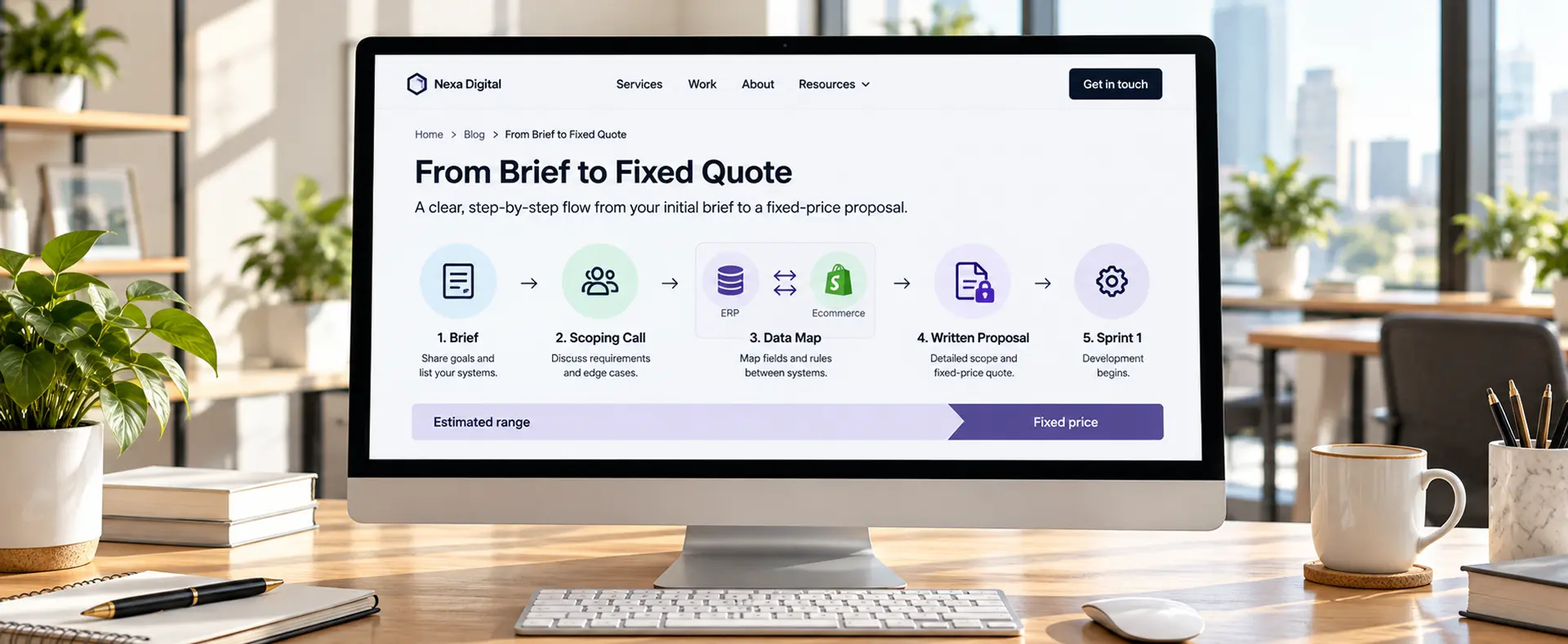
Integration consulting is the advisory work of assessing your systems, designing the data flows, and choosing the integration approach before build. At Redefine, the path from brief to quote has five steps:
- Brief. You list the systems and the manual work between them.
- Scoping call. A 30-minute call within 48 hours to confirm flows, volumes, and constraints.
- Discovery phase. Engineers review API docs, schemas, and live traffic. For undocumented systems, this becomes a short paid phase, with a fixed build price after it instead of open-ended time and materials.
- Written proposal. Within 3 business days: a data-flow diagram, field mappings, error handling, a line-item price, and a timeline.
- Sprint 1. Build starts within a week of sign-off, with scope locked.
If the integration is part of a bigger decision, such as replacing an ERP, start with broader IT consulting. Never integrate into a system you plan to retire.
What Are Enterprise Integration Services?
Enterprise integration services connect core business systems, such as ERP, CRM, EDI, warehouse, and finance, across many departments, trading partners, and locations.
EDI and trading partners
Retailers often require ASC X12 EDI documents (850 purchase orders, 855 acknowledgments, 856 ship notices, 810 invoices), and each partner has its own rules, so EDI integration gets scoped per partner.
ERP as the system of record
When SAP, Microsoft Dynamics 365, or NetSuite owns inventory and finance, every flow must follow its posting logic. Scope ERP integration around approvals and month-end close, not just field names.
AI on top of connected data
AI raises the stakes on integration: 82% of IT leaders cite data integration as one of their biggest challenges when using AI.1 Scope the data flows your AI agents will need now.
Red Flags in an Integration Quote
The biggest red flags in an integration quote are missing details that later become change orders:
- A single total with no line items
- No field mappings or data-flow diagram
- Error handling and retries marked "optional"
- An hourly rate with no go-live date
- A price given before anyone asked about volumes or data quality
Teams that need integration rescue services often pay twice for the same integration.
"The cheapest integration quote is often the one that left the hard parts out."A common mistake when comparing integration partners
How to Compare Quotes from a Systems Integration Company
To compare integration quotes fairly, check the same six items in each one:
- Scope detail: are all systems, flows, and mappings written down?
- Reliability: are retries, dead-letter queues, and alerts included?
- Timeline: is there a committed go-live date?
- Client time: how many hours a week will your team spend on reviews and testing?
- Ownership: do you receive the source code, documentation, and runbook?
- Support: what are post-launch response times, and what do they cost?
Ask for a similar past project: a partner that has built a CRM ERP integration like yours spots risks earlier. Redefine's work for distributor Pima Controls, for example, began with duplicate ERP and CRM entry that hid live inventory from sales.
Integration Scoping Checklist
Use this checklist before you request an integration quote:
Start with the flow that costs you most today. For many sellers, that is inventory synchronization.
Frequently Asked Questions
How much does a simple system integration cost?
A simple two-system integration typically costs $8,000 to $18,000 at Redefine, depending on complexity.
How long does a system integration project take?
At Redefine Innovations, a single-pair integration typically takes 4 to 6 weeks from sign-off to go-live. Multi-system builds with custom logic take 8 to 14 weeks.
How long does it take to get an integration quote?
With a clear brief, a written integration proposal takes about 3 business days.
What is the difference between an integration scope and an estimate?
An estimate is a price range based on assumptions. A scope lists every system, data flow, field mapping, and failure rule, so the price can be fixed.
Do I need an integration assessment before getting a quote?
An integration assessment helps most with three or more systems, legacy software, EDI, or unclear data ownership.
Is iPaaS cheaper than custom API integration?
iPaaS is often cheaper in year one, but its license fees recur, so compare three-year totals.
Can the scope change after I sign an integration contract?
Yes, through a written change order process. A detailed scope keeps changes small and priced up front.
How much client time does an integration project need?
Most IT integration projects need a few hours a week from your team for sprint reviews and acceptance testing.
Who owns the integration code after launch?
The client should own the integration code, documentation, and runbook. Confirm it in the contract.
What makes an integration quote go up?
Integration quotes go up with more systems, two-way syncs, real-time needs, legacy APIs, custom rules, EDI, and poor data quality.
Final Thoughts: Scope First, Then Price
An accurate integration quote comes from a scope that names every system, data flow, and failure rule before build.
Bring your systems list and volumes to the first call, ask for the data map in writing, and compare what each quote includes. The rule holds for on-premise software, cloud platforms like AWS and Azure, and older desktop tools connected through application integration: scope first, then price.
"You cannot price what you have not mapped."The core rule of integration project scoping
Tell us which systems you need to connect
Share where your team re-keys data today. We will reply within 48 hours, then send a written scope with a data-flow diagram, field mappings, a line-item price, and a go-live date within 3 business days. No commitment required.
Explore Redefine system integration services
Sources & Citations
Primary research and directory data used for the statistics in this guide:
- MuleSoft, "2026 Connectivity Benchmark Report Insights" (February 2026, 1,050 IT leaders): average of 957 applications with 27% connected; 26% of IT projects not delivered on time in the prior 12 months; 82% cite data integration as a top AI challenge.
- Project Management Institute, "Pulse of the Profession 2018": 52% of projects completed in the prior 12 months experienced scope creep or uncontrolled changes to scope.
- Drexel University LeBow College of Business and Precisely, "2026 State of Data Integrity and AI Readiness" (505 data and analytics leaders): data quality ranked as the top challenge in seven of eight areas surveyed, including data integration.
- Clutch, "Top System Integration Companies" (September 2026 listings): listed hourly rates from $25 to $300, with most average project sizes in the $10,000 to $49,999 and $50,000 to $199,999 bands.
Integration insights, no fluff
One short email a month on integrations, data flows, and connected systems that pay off.
You're in, check your inbox to confirm.