EDI (electronic data interchange) is the standard format retailers and suppliers use to swap business documents computer to computer. For a US retail supplier, it usually means four X12 documents: the 850 purchase order, 855 acknowledgment, 856 ship notice, and 810 invoice. Setup typically takes 4 to 8 weeks per retailer.
Who this is for: You make or distribute a product, and a retailer just told you: "You need EDI to keep selling to us." You have a deadline, a small team, and no idea where to start. This page is for you. It assumes no technical background, and by the end you can pick a setup model this week.
A retailer's EDI requirement comes with a deadline and rules that keep getting stricter.
Walmart, for example, tightened its rules for ship notices in May 2024. A ship notice must now arrive before the truck, match the purchase order line by line, and match what is physically in the trailer.1 Suppliers that miss those rules get rejections, receiving delays, and eventually deductions.
Most explanations of EDI come from EDI software vendors. They define the acronym, list their connectors, and stop at the sale. They rarely cover the mapping errors and ship notice rejections that start after go-live, which is where suppliers actually lose money.
Redefine works on the other side of the project, connecting ERPs, storefronts, warehouses, and trading partners through its integration services. This page gives a plain definition, the document flow, the three setup models with dated cost ranges, and the errors to plan for.
What Is EDI?
EDI, or electronic data interchange, is a standard way for two companies' systems to exchange business documents, such as purchase orders and invoices, without anyone typing them in. Both sides agree on one format, so a retailer's order arrives in the supplier's system as data, not as a PDF.
In the US, that format is almost always ANSI X12. The Accredited Standards Committee X12 maintains the standard for retail, transportation, healthcare, and finance, and publishes a new release each January.2 Each document type has a three-digit number called a transaction set: the 850 is a purchase order and the 810 is an invoice. Partners outside the US often use a different standard, EDIFACT.
A concrete example of EDI
A retail buyer approves an order for 1,200 water bottles. The retailer's system sends an 850 purchase order. The supplier's EDI setup receives it, checks it, and loads it into the order system. Nobody opens an email or copies a SKU. Later, the supplier's 856 ship notice lists exactly what is on the truck, and its 810 invoice bills for what shipped.
What EDI is not
- Not a single product. EDI is a format. A supplier still needs software or a provider to send and receive it.
- Not email with attachments. A PDF purchase order still needs someone to re-key it. EDI removes that step.
- Not a one-time project. Retailers update their EDI rules, so the setup needs an owner after launch.
EDI is one link in a longer chain. After the order arrives, it still has to reach the warehouse and invoicing, which is why many suppliers pair EDI with order-to-fulfillment integration.
How Does EDI Work, Step by Step?
EDI works in a fixed loop: the retailer sends an order, the supplier confirms it, tells the retailer what is shipping, and sends an invoice. Each step is a separate EDI document, and the retailer checks each one against its rules.
- The retailer sends an 850 purchase order. The order travels over a secure connection, usually AS2 or a value-added network (VAN).
- The supplier's system returns a 997 acknowledgment. This automatic receipt confirms the file arrived and is readable.
- The supplier sends an 855 PO acknowledgment. It confirms what the supplier can fill and flags changes to quantity, price, or date.
- The supplier picks, packs, and labels the order. GS1-128 carton labels must match the data in the coming ship notice.
- The supplier sends an 856 advance ship notice. The ASN lists every carton and item on the truck, and must arrive before the truck.
- The retailer validates the ASN. Walmart returns a 997, then an 824 application advice if the ASN breaks a rule, flagged as a warning or as an error the supplier must fix before the truck arrives.
- The supplier sends an 810 invoice. The retailer matches the invoice against the order and the ASN before paying.
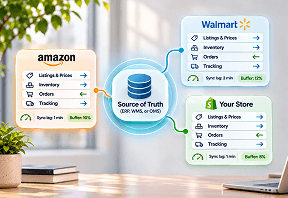
Behind the scenes, a translator converts each X12 file into fields the supplier's ERP understands, and back again. That translation is called mapping, and it is where most of the work sits. If the storefront, warehouse, and ERP already disagree on stock and order status, fix that first with order synchronization, or EDI will send those mistakes to the retailer faster.
Which EDI Documents Will a Retailer Ask For?
Most US retailers ask suppliers for the same core set of EDI documents: the 850, 855, 856, 810, and 997. Some also want an 846 inventory report or 860 order changes. The retailer's EDI implementation guide lists the exact set and the rules for each.
| Document | Plain-English name | Sent by | Why it matters |
|---|---|---|---|
| 850 | Purchase order | Retailer | Starts every order. An error here carries into every later document. |
| 997 | Functional acknowledgment | Both | Proves a file arrived and could be read. |
| 855 | PO acknowledgment | Supplier | Confirms what will ship. Some retailers set a deadline for it. |
| 856 | Advance ship notice (ASN) | Supplier | Lists what is on the truck. A common chargeback trigger, because it must match the physical shipment and arrive first. |
| 824 | Application advice | Retailer | Reports business-rule warnings and errors in a document the supplier sent. |
| 810 | Invoice | Supplier | Gets the supplier paid. Must match the order and the ASN. |
| 846 | Inventory inquiry or advice | Supplier | Shares stock levels, common for dropship and online programs. |
| 860 / 865 | PO change and change acknowledgment | Retailer / Supplier | Handles edits to an open order. |
What "EDI compliant" means for a small supplier
Being EDI compliant means a supplier can send and receive the retailer's required documents, in its format and on its timeline, and has passed the retailer's testing. Getting there takes seven steps.
- Request the retailer's EDI guide. Ask the buyer for the guide and a testing contact. Typical effort: one day.
- List the required documents and deadlines. Note each transaction set and when it must be sent. Typical effort: half a day.
- Choose web, managed, or ERP-integrated EDI. Match it to volume and retailer count. Typical effort: one to two weeks.
- Prepare GS1 barcodes and carton labels. The 856 and the labels must match. Typical effort: one to two weeks without an existing GS1 company prefix.
- Map and connect each document. The provider or integrator maps each document to the supplier's systems. Typical effort: days for web EDI, weeks for ERP-integrated EDI.
- Pass the retailer's test cycle. Send test documents until the retailer certifies the connection. Typical effort: one to four weeks.
- Go live and monitor every ASN. Check 997 and 824 messages daily for the first month.
Step efforts are planning estimates. Across the whole process, EDI provider Orderful puts traditional implementation at 4 to 8 weeks per trading partner.4
When a 3PL picks and ships the retail orders, the ASN has to come from the 3PL's scan data, not from the order system. That link is separate work, covered by 3PL integration services.
Web EDI vs Managed EDI vs ERP-Integrated EDI
Choose web EDI for a handful of orders a week with one retailer. Choose managed EDI to have a provider run the connection. Choose ERP-integrated EDI when order volume is growing and re-keying already costs time and errors.
| Factor | Web EDI | Managed EDI | ERP-integrated EDI |
|---|---|---|---|
| How it works | Staff key or click each document in a web portal | A provider runs translation, mapping, and partner connections | EDI documents flow straight into and out of the ERP |
| Best for | Low volume, one or two retailers | Teams with no in-house EDI skills | Growing volume, several retailers, ERP in place |
| Re-keying | Yes, between the portal and the ERP | Often, unless the ERP is also integrated | No |
| Typical monthly cost | About $60 to $250 plus per-document fees (sources 3, 5) | About $1,000 to $5,000 for small to mid-sized suppliers (source 4) | Provider or VAN fees plus integration upkeep |
| Typical setup cost | About $75 per retailer (source 3) | About $1,000 to $5,000 per retailer (source 4) | Integration project, scoped per ERP and retailer |
| Ongoing staff effort | High, grows with every order | Low, but changes wait on the provider | Low, plus exception monitoring |
| Main risk | Typing errors on ASNs and invoices | Slow change requests | Mapping gaps if testing is rushed |
The low end is published. One web EDI price page lists a $62 monthly subscription, a $75 setup fee per trading partner, and document fees from $2.10 down to $0.35 each as volume rises.3 EDI provider Orderful puts traditional full-service EDI at $1,000 to $5,000 per month for small to mid-sized operations, plus $1,000 to $5,000 to set up each partner.4
Do you need EDI software, or can your ERP handle EDI?
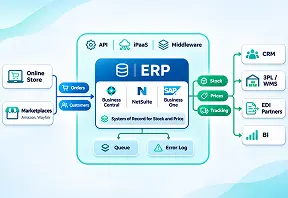
An ERP holds the order data, but it rarely reads and writes X12 on its own. Dynamics 365 Business Central, NetSuite, and most other ERPs still need an EDI translator or provider to convert files and manage retailer connections. ERP-integrated EDI means that translator talks to the ERP directly, so nobody re-keys orders.
A supplier does not have to replace its current EDI provider or VAN to get there. Redefine's EDI integration services connect an existing provider to the ERP and test each document against each retailer's rules, because each retailer reads the same X12 document in its own way.
The rule of thumb: If someone copies data between an EDI portal and the ERP every day, the business has already outgrown web EDI.
What Does EDI Cost to Set Up and Run?
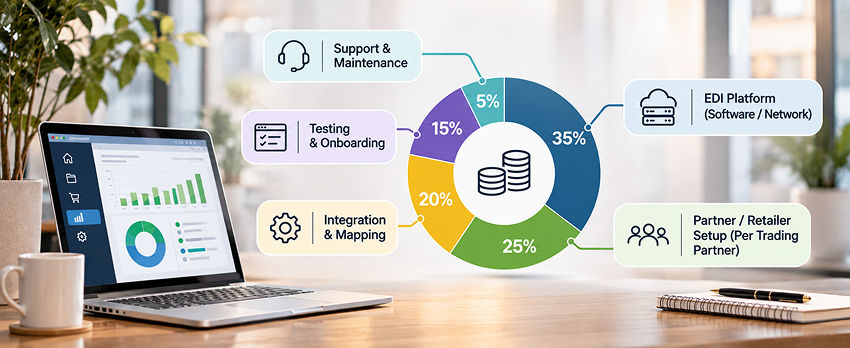
EDI costs range from about $60 a month for a basic web portal to $50,000 or more for an on-premise ERP project. Four things set the total: the number of retailers, the documents each requires, monthly order volume, and whether EDI connects to the ERP.
| Cost line | What drives it | Published range | Source |
|---|---|---|---|
| Web EDI subscription | Plan tier | $0 to $249 per month at entry level | Capterra, Sep 2026 (5) |
| Per-document fees | Order volume | $2.10 down to $0.35 per document; $0.44 to $0.85 per order on another plan | Edict Systems, May 2025 (3); Capterra (5) |
| Per-retailer setup | Number of retailers | $75 (web EDI) to $1,000 to $5,000 (full service) | Edict Systems (3); Orderful, Sep 2026 (4) |
| Full-service or managed EDI | Volume, VAN, support | $1,000 to $5,000 per month | Orderful (4) |
| On-premise EDI build | ERP, mapping, staff | $50,000 to $200,000, plus $20,000 to $50,000 a year | Orderful (4) |
| Cloud ERP-integrated EDI | ERP and retailers | Scoped per project | Redefine range pending |
| Staff time and chargebacks | Manual keying and ASN accuracy | Not on any price page | Track your own |
A September 2026 review of EDI software found entry plans from $0 to $249 per month, but noted that the advertised tier may not include every document a retailer needs.5 Check the plan against the retailer's document list before comparing prices.
The line most budgets miss is staff time. A purchase order keyed by hand costs minutes, but a ship notice keyed wrong can cost a deduction. Count both before comparing plan prices.
Suppliers that also sell through Shopify, BigCommerce, or Adobe Commerce can scope both order flows into one ERP project with ecommerce and ERP integration, so wholesale and online orders share the same stock numbers.
What Goes Wrong After Go-Live (and How to Avoid It)
Most EDI problems start after the retailer certifies the connection, when real orders, cartons, and exceptions arrive. The usual causes are ship notices that do not match the truck, mapping gaps, missed acknowledgments, and item data that does not match the retailer's records.
| What breaks | What it looks like | How to prevent or fix it |
|---|---|---|
| ASN does not match the truck | 824 errors, receiving delays, chargebacks | Build the 856 from warehouse scan data, not from the order |
| ASN sent late | Shipment arrives before the ASN | Send the 856 at ship confirmation and alert on any delay |
| Mapping gaps | A field the test files never used breaks a live order | Test with real order variety: backorders, split shipments, multi-store POs |
| Missed 997 or 824 | Rejections nobody sees until a deduction arrives | Route every acknowledgment and 824 to a shared exception queue |
| Item and price mismatches | Invoice rejected, payment delayed | Keep UPCs, costs, and pack sizes in sync with the retailer's item file |
| Retailer rule changes | Files that passed last month now fail | Assign an owner to read retailer bulletins and retest each quarter |
The cost of these errors is real. A 2017 industry analysis listed example compliance fines of $500 for an improper ASN and $150 for a purchase order received on paper instead of through EDI.6 Fee schedules vary by retailer and change over time, so check the current vendor compliance guide for each account.
Most of these are data problems, not EDI problems. If the ERP's stock count is wrong, a perfectly formatted 856 still reports the wrong quantity. Fixing stock accuracy at the source with inventory synchronization removes a whole class of ASN errors.
What to do if chargebacks have already started
Pull the last 90 days of 824 messages and deductions and group them by cause. Two or three causes usually explain most of the cost. When the connection itself keeps failing, an integration rescue can stabilize it without starting over.
EDI go-live readiness checklist
- We have the retailer's current EDI implementation guide
- We know every required document and its deadline
- Our GS1 carton labels match our 856 data
- We tested backorders, split shipments, and multi-store orders
- Every 997 and 824 lands in a queue someone checks daily
- Item, UPC, and cost data match the retailer's item file
- One named person owns EDI after launch
"Go-live is when the retailer stops testing you and starts fining you."The part most EDI guides skip
Frequently Asked Questions
What is replacing EDI?
No standard has replaced EDI for big-box retail orders. Walmart tightened its EDI ship notice rules in 2024 rather than moving away from EDI. Choose EDI when a retailer requires it. Choose APIs for real-time needs such as live inventory or marketplace feeds. Most suppliers run both, with an API integration layer beside EDI.
| Factor | EDI | API |
|---|---|---|
| Required by big-box retailers | Usually | Sometimes, alongside EDI |
| Timing | Batch, minutes to hours | Real time |
| Standard | X12, one shared format | Each partner defines its own |
| Best for | Orders, ASNs, invoices | Inventory, pricing, marketplace feeds |
How long does it take to set up EDI with a new retailer?
Plan for about 4 to 8 weeks per retailer, the range EDI provider Orderful gives for traditional setups. The steps: get the retailer's EDI guide (one day), choose a setup model (one to two weeks), map and connect (days to weeks), and pass the retailer's testing (one to four weeks). Fast error fixing shortens testing most.
Do I need a separate EDI setup for each retailer?
A supplier needs one EDI setup, but a separate map and test cycle for each retailer. Walmart, Target, and Home Depot all use X12, yet each sets its own required fields, label rules, and timing. After the first retailer goes live, adding the next one is mostly mapping and testing, not new software.
What is the difference between AS2 and a VAN?
Both move EDI files securely. AS2 is a direct, encrypted internet connection between two partners. A VAN (value-added network) is a third-party mailbox service that relays files to many partners. Many retailers accept either. A VAN is simpler with many partners, while AS2 avoids per-document VAN fees.
Is EDI hard to learn?
The concepts are simple once the four core documents make sense. The hard part is detail, because each retailer's guide sets its own rules for the same document. A team does not need to read raw X12, but one person should own the retailer guides and the exception queue.
Does EDI work with Shopify or other ecommerce platforms?
Not natively for retail EDI. Shopify, BigCommerce, and Adobe Commerce handle online orders, while EDI handles retailer orders. The usual approach connects both to the ERP, so the ERP stays the single record for stock, orders, and invoices across every channel.
Got an EDI deadline from a retailer?
Send us the retailer's EDI guide and a short description of your current order flow. We will tell you which setup model fits, what it will take, and where errors are likely, even if the answer is a simple web portal.
Sources & Citations
Standards bodies, retailer guidance, published price pages, and industry research used for the rules and figures on this page (all accessed 4 November 2026):
- SPS Commerce, "What Is an ASN? Understanding Walmart's Updated Validation Process" (updated 20 June 2024): Walmart's stricter ASN rules from May 2024 and its 997 and 824 warning and error process.
- ASC X12, X12 EDI Standard, Release 008060 (published 11 March 2025): ANSI-accredited standard maintained by the Accredited Standards Committee and published each January.
- Edict Systems, WebEDI Pricing Tiers (page updated 30 May 2025): $62 monthly subscription, $75 per trading partner setup, document fees from $2.10 to $0.35.
- Orderful, "EDI Pricing: How Much Does EDI Cost in 2026?" (updated 30 September 2026): traditional full-service EDI at $1,000 to $5,000 per month and per partner setup; 4 to 8 weeks per partner; on-premise builds at $50,000 to $200,000. Orderful is an EDI provider.
- Capterra, EDI Software Pricing Models (18 September 2026): entry EDI plans from $0 to $249 per month and $0.44 to $0.85 per order on a usage-based plan.
- Descartes Systems Group, Getting in Charge of Chargebacks (white paper, 2017): example fines of $500 for an improper ASN and $150 for a manual or paper PO.

Umang Patel
Co-owner | Ecommerce Architecture, Systems & Integrations
Umang Patel has worked in ecommerce and technology since 2001. He specializes in backend systems,
ecommerce architecture, ERP and platform integrations, automation, and reverse engineering complex
business processes. At Redefine Innovations, he leads technology and project teams building scalable
systems across both B2B and DTC ecommerce environments.
Areas of expertise: Ecommerce
Architecture • Backend Systems • ERP Integration • Automation • Headless Commerce • Reverse Engineering