Who this is for: This guide is for IT and systems leads, and controllers, at mid-market manufacturers and distributors. If your week sounds like "our team re-keys every web order into the ERP and errors keep piling up," and leadership just asked what integration would take, you will leave with the methods, the cost range and the timeline in hand.
What Is ERP Integration?
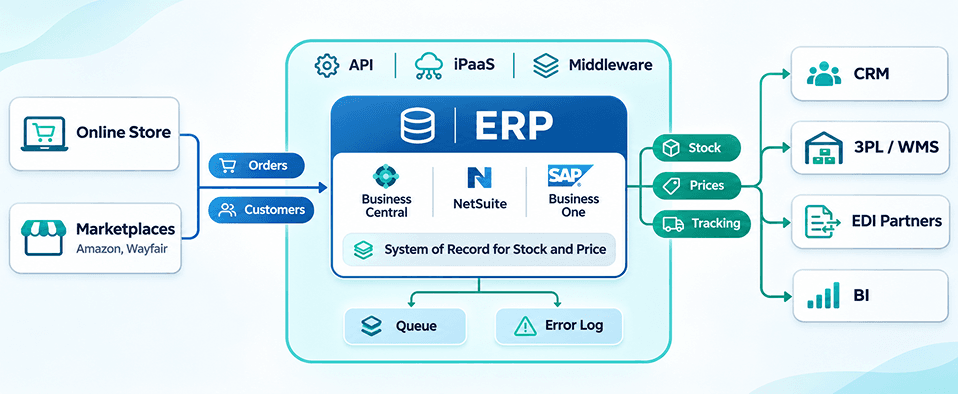
ERP integration, also called ERP system integration, is the process of connecting an ERP system to other business applications, such as an ecommerce store, CRM, 3PL or marketplace, so data flows between them automatically. Instead of a person re-keying each web order, the order lands in the ERP in seconds, and stock and prices flow back to the store.
A concrete example: a buyer orders on your Shopify store at 9:02. By 9:03 the integration has created a sales order in Business Central with the right customer, price list and tax, reserved the stock, and pushed the new available quantity back to the store and to Amazon. Nobody touched a keyboard.
Under the hood, the integration reads from one system and writes to another through an interface the ERP exposes. Business Central, for example, publishes a REST salesOrder resource for exactly this job.2 Every integration also settles three things: what moves, which way it moves, and which system owns each record.
ERP integration benefits and challenges
| Benefits | Challenges |
|---|---|
| No re-keying of orders, customers or invoices | No agreed system of record for stock, price or customers |
| Stock that matches across the store and marketplaces | Duplicate or dirty data in the ERP |
| Faster order-to-cash and fewer shipping errors | Legacy ERPs with no modern API |
| One version of price lists and customer terms | Syncs that fail silently with no alert owner |
| Reporting from one source instead of exports | API version changes that break old connections |
What Systems Connect to an ERP?
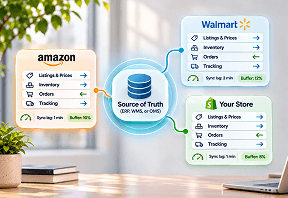
The systems that usually connect to an ERP are your online store, marketplaces, CRM, 3PL or warehouse system, EDI partners and BI. The ERP is normally the system of record for stock, price and financials, and each system connects through the interface the ERP publishes.
| System | Data that moves | Direction | System of record |
|---|---|---|---|
| Online store (Shopify, BigCommerce, Adobe Commerce) | Orders, customers, stock, prices | Orders in, stock and prices out | ERP |
| Marketplaces (Amazon, Wayfair, Walmart) | Listings, orders, returns, stock | Both ways | ERP for stock |
| CRM (Dynamics 365 Sales, Salesforce, HubSpot) | Accounts, quotes, credit terms | Both ways | CRM for contacts, ERP for terms |
| 3PL or WMS | Shipments, tracking, receipts | Both ways | ERP for stock value |
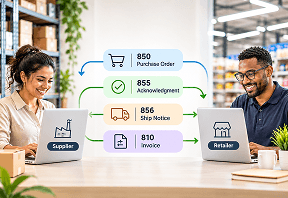
| EDI partners | Purchase orders, ASNs, invoices | Both ways | ERP |
How common mid-market ERPs connect
| ERP | Integration interface | Official reference |
|---|---|---|
| Microsoft Dynamics 365 Business Central | REST API v2.0 (OData) | Microsoft Learn 2 |
| Oracle NetSuite | SuiteTalk REST and SOAP web services | Oracle NetSuite docs 3 |
| SAP Business One | Service Layer (OData web API) | SAP Help 4 |
How to work out which tools to connect to your ERP
- List every system that touches an order. Include spreadsheets. (1 to 2 hours)
- Name your ERP and its interface. Check the table above. (30 minutes)
- Assign a system of record. One owner each for items, stock, price, customers. (Half-day workshop)
- Count the volume. Orders per day, SKUs, price lists. (1 hour)
- Mark direction and timing. One-way or two-way, real time or batch. (1 to 2 hours)
- Rank each flow by pain. Hours lost and errors per week. (1 hour)
- Pick the first connection. Highest-pain flow first. (30 minutes)
Redefine example: MAXIMUM
MAXIMUM Weather Instruments connected Business Central to its web stores, Amazon and Wayfair through one admin platform. Places to update a price or stock count went from 4 to 1, and manual data entry on marketplace listings fell 80%. Read the MAXIMUM Business Central and marketplace case study (updated Nov 2026).
What Are the 4 ERP Integration Methods?
The four ERP integration methods are point-to-point, enterprise service bus (ESB), iPaaS and API-led integration. Most ERP integration software, from prebuilt connectors to iPaaS platforms such as Celigo, Boomi and MuleSoft, fits one of these four. The right one depends on how many systems you connect and how custom your rules are.
| Method | How it works | Best for | Watch out for | Typical cost shape 5 |
|---|---|---|---|---|
| Point-to-point (incl. prebuilt connectors) | A direct link between two systems | One or two connections with stable rules | Becomes a tangle past 3 or 4 systems | $5,000 to $25,000 upfront; $0 to $5,000 a year |
| ESB | A central bus, usually on-premise, routes messages | Large estates with many on-premise systems and an integration team | Heavy to run; overkill for most mid-market teams | Highest: enterprise build plus a specialist team |
| iPaaS | Cloud platform with connectors and visual flows | Standard flows between popular SaaS apps | Subscription grows with flows; custom logic gets awkward | $5,000 to $20,000 upfront; $3,000 to $30,000 a year |
| API-led | Code calls each system's API through a small hub with a queue and error log | Custom B2B pricing, legacy ERPs, 3 or more systems | Needs monitoring and an owner for API changes | $15,000 to $75,000+ upfront; 15% to 20% of build a year |
- One store and one ERP, standard flows: a prebuilt connector or iPaaS is usually fastest.
- Three or more systems or custom pricing: an API-led hub keeps the logic in one place.
- Legacy ERP: expect custom adapters (REST, SOAP, flat file or database) whatever the method.
Pick the method your team can maintain. IT teams already spend 36% of their time designing, building and testing custom integrations,1 so retries, a dead-letter queue and clear alerts matter more than the tool's brand.
How Much Does ERP Integration Cost?
Independent planning ranges put mid-market ERP integration solutions at $5,000 to $120,000+ over three years, depending on the method and number of systems.5 Fixed-price builds can come in lower: Redefine publishes single connections from $3,200 and a four-plus system hub from $16,000.6
| Scope | Independent planning range (Craftware, Oct 2026) | Redefine fixed price (Nov 2026) |
|---|---|---|
| Single connection | $5,000 to $25,000 upfront (prebuilt connector) | From $3,200 per endpoint; from $4,200 store to ERP |
| Two-way, multi-system | $15,000 to $75,000+ upfront (custom API) | From $16,000 for a hub of 4 or more systems |
| iPaaS subscription | $3,000 to $30,000 a year | Not needed for API-led builds |
| Upkeep, custom builds | About 15% to 20% of build cost a year | Scoped separately |
| Scoping | Varies by vendor | $800 audit, credited against the build |
| 3-year total, mid-market | $5,000 to $120,000+ | Depends on scope |
Then cost what re-keying already costs you. A worked example from Redefine's pricing page: four systems, 10 manual hours a week at $65 an hour, is $33,800 a year. Recover 65% of that time and you save about $21,970 a year, so a $12,800 build pays back in roughly 30 weeks.
The real comparison: Compare the build price with what manual re-keying costs you each year, not with zero.
ERP licensing and rollout sit outside this budget. If you are still implementing, see our Dynamics 365 implementation cost guide.
How Long Does ERP Integration Take?
ERP integration takes from about two weeks to three months, depending on method and scope. A native Business Central integration typically runs 4 to 10 weeks,5 while Redefine's fixed-scope builds take 12 to 18 days per connection and 6 to 12 weeks for a multi-system hub.6
| Scope | Typical timeline | Source |
|---|---|---|
| 3PL to ERP | 10 to 14 days | Redefine fixed scope |
| CRM to ERP | 12 to 16 days | Redefine fixed scope |
| Ecommerce store to ERP | 14 to 18 days | Redefine fixed scope |
| Native Business Central integration | 4 to 10 weeks | Craftware, Oct 2026 |
| Multi-system ERP hub | 6 to 12 weeks | Redefine fixed scope |
| Hypercare after go-live | 30 days | Redefine fixed scope |
- Audit the schema. Map fields, owners and error cases.
- Build the first sprint. Highest-pain flow first.
- Test with real data. Real orders, edge cases and failures on staging.
- Go live and monitor. Watch closely for 30 days.
Data quality, the age of the ERP's API, and how fast your team signs off on mappings decide where you land. Budget 2 to 3 hours a week of your own team's time for reviews.
Are You Ready for ERP Integration? (Checklist)
You are ready for ERP integration when re-keying data costs more each year than a connection would cost to build, and you can tick most of the ten items below. For most teams that point arrives when a second sales channel goes live.
- We listed every system that touches an order, including spreadsheets
- We know our ERP, its version and its integration interface
- We named one system of record for items, stock, price and customers
- We know our order volume, SKU count and number of price lists
- We marked each flow as one-way or two-way, real time or batch
- We cleaned duplicate customers and items in the ERP
- We have a sandbox or staging environment for testing
- We chose who gets alerted when a sync fails
- We named an owner with 2 to 3 hours a week for reviews
- We costed today's manual work so we can measure payback
Hold off if you are changing ERP in the next few months. And if the store platform itself is the bottleneck, read 7 signs your ecommerce platform is holding back growth before you budget for connectors.
Frequently Asked Questions
What are the 7 steps for successful ERP implementation?
- Define requirements. (2 to 4 weeks)
- Select the ERP and partner. (4 to 8 weeks)
- Design processes and the data model. (2 to 4 weeks)
- Migrate and clean data in parallel. (3 to 6 weeks)
- Configure and integrate the store, CRM and 3PL. (4 to 12 weeks)
- Test end to end, including month-end close. (2 to 4 weeks)
- Train and go live, then run hypercare. (2 to 4 weeks plus 30 days)
Which ERP is most used in the USA?
There is no official US-only count, but install data points to Microsoft Dynamics. In 6sense's 2026 tracking, Microsoft Dynamics leads with 24.4% of tracked ERP installs, ahead of SAP ERP (10.8%) and SAP S/4HANA (10.6%), and 75% of tracked NetSuite customers are US-based.7 Business Central suits Microsoft 365 shops, NetSuite suits cloud-first growth firms, and SAP suits complex global operations.
What is replacing ERP?
Nothing replaces ERP outright. Choose a cloud ERP if your current ERP is the bottleneck; choose composable tools connected around the ERP if channels and data flow are what slow you down.
| Option | What it is | Choose it if |
|---|---|---|
| Cloud ERP | A SaaS ERP such as Business Central or NetSuite | Your on-premise ERP has no modern API or support is ending |
| Composable ERP | A core ERP for finance plus best-of-breed apps linked by APIs | You need flexibility in specific areas |
| Commerce operations layer | An order, product and channel platform between the ERP and every channel | Many stores and marketplaces overload the ERP |
Is ERP integration the same as ERP implementation?
No. Implementation installs and configures the ERP itself, takes months and changes how finance and operations work. Integration connects that ERP to your store, CRM and 3PL, takes weeks per connection, and changes how data moves. Plan integrations inside the implementation, not after it, and check each ERP's API before you sign.
Do I need an iPaaS to connect Shopify to my ERP?
Not always. An iPaaS or prebuilt connector suits standard order and stock flows. Custom B2B pricing, bundles or a modified ERP often make a direct API build simpler and cheaper to run. Compare the yearly subscription against a one-time build plus upkeep over three years before you choose.
What happens if an ERP integration breaks?
A well-built integration queues the failed record, alerts a named owner and retries once the cause is fixed, so no order is lost. If yours fails silently, or nobody owns the alerts, fix that first, before you add any new connection.
Next Step
Start with one connection, usually orders and stock, with one system of record and one owner for every alert. Run the readiness checklist, cost your manual work, then get a fixed price and go-live date for that first build before you commit to a platform subscription.
Your next step: scope your first connection with our ecommerce ERP integration services. Bring your ERP, your store and your daily order volume.
Still re-keying web orders into your ERP?
Send your ERP, store and order volume. We will map the flows, name the system of record for each, and send a fixed price and go-live date for your first connection.
Sources & Citations
- MuleSoft, "Agentic Transformation Reaches New Heights: 2026 Connectivity Benchmark Report Insights" (5 Feb 2026): survey of 1,050 IT leaders: organizations average 957 applications, 27% are connected, and IT teams spend 36% of their time on custom integrations.
- Microsoft Learn, Business Central API v2.0: salesOrder resource type (accessed 4 Nov 2026): official REST resource an integration calls to create sales orders in Business Central.
- Oracle NetSuite, Overview of SuiteTalk REST Web Services (accessed 4 Nov 2026): official NetSuite web services interface for reading and writing records.
- SAP, Working with SAP Business One Service Layer (latest, accessed 4 Nov 2026): official OData-based web API for SAP Business One.
- Craftware Technologies, "CRM-ERP Integration Cost: 2026 Price Ranges & TCO" (updated 9 Oct 2026): independent mid-market planning ranges by method, $5,000 to $120,000+ over three years, 15% to 20% yearly upkeep on custom builds, 4 to 10 weeks for a native Business Central integration.
- Redefine Innovations, ERP integration services: published pricing and timelines (accessed 4 Nov 2026): single endpoint from $3,200, store to ERP from $4,200, ERP hub from $16,000, $800 audit, 12 to 18 days per endpoint, 6 to 12 weeks multi-system.
- 6sense, NetSuite ERP market share and competitors (2026): technographic install data by company domain: Microsoft Dynamics 24.4%, SAP ERP 10.8%, SAP S/4HANA 10.6%; 75% of tracked NetSuite customers are in the United States.

Umang Patel
Co-owner | Ecommerce Architecture, Systems & Integrations
Umang Patel has worked in ecommerce and technology since 2001. He specializes in backend systems,
ecommerce architecture, ERP and platform integrations, automation, and reverse engineering complex
business processes. At Redefine Innovations, he leads technology and project teams building scalable
systems across both B2B and DTC ecommerce environments.
Areas of expertise: Ecommerce
Architecture • Backend Systems • ERP Integration • Automation • Headless Commerce • Reverse Engineering