AI search optimization makes your pages easy for ChatGPT, Google AI Overviews, and Copilot to find, quote, and cite. Let AI crawlers reach your pages, answer each buyer question plainly, back it with specific facts, and track buyer prompts monthly. Pew found clicks on regular Google results fall from 15% to 8% when AI summaries appear.
Who this is for: You lead marketing or growth at a US ecommerce brand or B2B manufacturer. Your traffic is flat, and when you ask ChatGPT or Google about your category, competitors keep showing up in the answer instead of you. You want a plan your team can apply page by page, and a way to prove it is working.
Your buyers still search. They just read the answer before they read your page.
Google now shows AI summaries on a large share of searches, and those summaries change behavior. In Pew Research Center's study of 68,879 real Google searches, people clicked a traditional result on 8% of visits that showed an AI summary, compared with 15% when no summary appeared. They clicked a link inside the summary only about 1% of the time.1
So the goal has shifted. Ranking still matters, because AI tools pull from the web. But the brands that win are the ones the answer names and links. For a store or a manufacturer, that work sits right next to the ecommerce SEO your category and product pages already need, not in a separate silo.
This guide covers how AI tools pick sources, seven page changes with effort estimates, what is different for ecommerce and B2B catalogs, the crawler checks, the off-site signals AI trusts, and a monthly tracking setup. We also share what we learned from our own pages that AI already cites.
What Is AI Search Optimization?
AI search optimization means making your site and your brand's presence on the web easy for AI answer engines to reach, understand, and choose as a source. You will also see it called GEO (generative engine optimization), AIO, or LLM SEO. The labels differ; the job is the same.
It does not replace SEO. Google says its AI features are rooted in the same core ranking and quality systems as regular Search. It also says you do not need an llms.txt file, special schema, tiny content chunks, or a special writing style for AI.2 What Google does ask for is content with a real point of view, first-hand experience, and clear sections and headings.
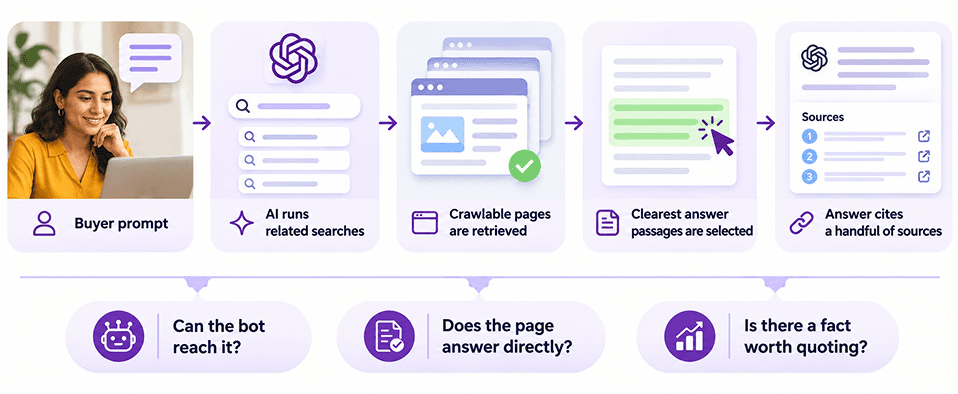
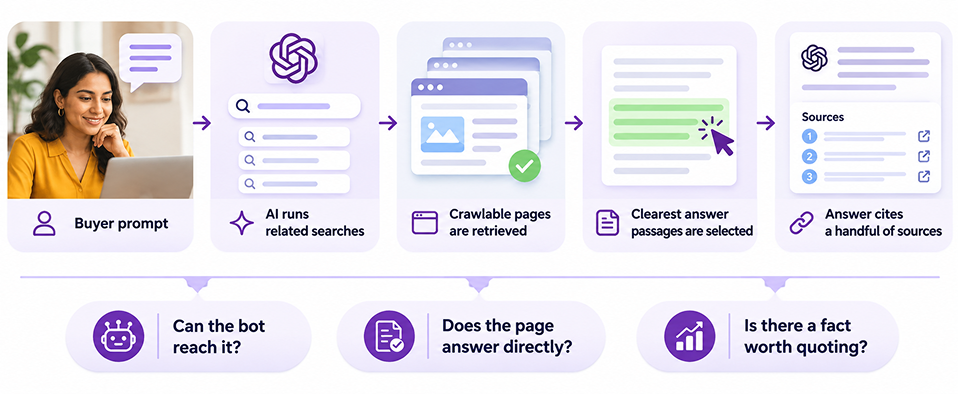
What changes is the unit of competition. Classic SEO competes for a position among ten links. AI search competes for a passage inside one answer that may cite only a handful of sources. That rewards three things:
- Access: the bots that feed each AI tool can crawl and render your page.
- Clarity: each section answers one buyer question plainly, near the top.
- Evidence: the page holds specific facts, numbers, and names worth quoting, with a source and a date.
For large catalogs and multi-site B2B brands, this becomes a template problem, not a page problem. That is where enterprise SEO practices such as template-level fixes pay off, because one change reaches thousands of pages.
How Do ChatGPT and Google AI Choose Sources?
ChatGPT and Google AI choose sources in two steps. First, they run one or more web searches on the prompt, often several related ones. Then they pick crawlable pages that answer each part most clearly and credibly. Ranking gets you considered. A clear, specific answer gets you cited.
Google calls the first step query fan-out: AI Overviews and AI Mode may run several related searches across subtopics to build one response.2 Bing's rewritten Webmaster Guidelines, published in February 2026, name GEO directly and list what helps a page get cited in Copilot: state facts directly, use consistent entity names, keep each URL to one topic, and put essential information near the top.3
What our own cited pages have in common
On 4 Nov 2026, DataforSEO found Redefine Innovations cited in 8 Google AI answers across 8 US prompts, covering about 720 AI searches a month.4 All 8 citations went to four service pages, and none to a blog post. We reviewed those four pages the same day:
| Cited page | Plain answer near the top | Comparison table | FAQ questions | Named-client numbers | Visible date | Named author |
|---|---|---|---|---|---|---|
| CRM integration services | Yes, under What are CRM integration services? | Yes, 3 ways to link a CRM | 7 | Yes | Yes | No |
| EDI integration services | Yes, under What are EDI integration services? | Yes, 3 ways to handle partner EDI | 7 | Yes | Yes | No |
| Marketplace and channel management | Yes, first sentence | Side-by-side layout only | 5 | Yes | No | No |
| Forms and workflow software | Yes, second sentence | Yes, 5-platform comparison | 5 | Yes | No | No |
The pattern is consistent. Every page answers what is this? in plain words near the top, every page has an FAQ, and every page backs its claims with client results. On our EDI integration services page, for example, that means a named client whose stock accuracy rose from 86% to 98.6%. Our CRM integration services page and forms and workflow software page both compare options in a real table. Just as telling: none of the four has a named author, so bylines were not what earned these citations.
The pattern: AI tools quote the page that defines the thing plainly, compares the options, and proves it with numbers.
7 Page-Level Changes That Earn Citations
To optimize your website for AI search, make each key page answer one buyer question plainly, prove it with specific sourced facts, and compare the options side by side. The seven changes below do that, in priority order. Start with your top 10 to 20 revenue pages, not the whole site.
This is not writing for robots. Google says AI systems understand synonyms and meaning, so you do not need a special style. These changes are simply clear writing for buyers, which also happens to be easy to quote.
- Answer the main question near the top. Define what the page offers or explains in plain words in the first lines, or under a question H2. Effort: low, 30 min per page.
- Rewrite H2s as buyer questions. Turn Our Approach into the question a buyer types. Effort: low, 20 min per page.
- Add one specific, sourced fact per section. Swap an adjective for a number, named system, price range, timeline, or client result, with a source and date. Effort: medium, 1 to 2 hrs per page.
- Put comparisons in real HTML tables. Move option, cost, and feature comparisons out of images and tabs into an HTML table. Effort: medium, 1 hr per table.
- Add an FAQ of 5 to 7 real buyer questions. Use questions from sales calls and support tickets, answered in 40 to 80 words each. Effort: medium, 1 hr per page.
- Keep one topic per URL and one name per thing. Split pages that answer several questions, and name each product and service the same way everywhere. Effort: medium, 2 to 4 hrs per cluster.
- Show who wrote it and when. Add a named author, reviewer, and a visible Last updated date. It builds reader trust, though our own cited pages show it is not what gets you cited. Effort: low, 15 min per page.
| # | Change | Priority | Effort | Time per page |
|---|---|---|---|---|
| 1 | Plain answer near the top | High | Low | 30 min |
| 2 | Question-based H2s | High | Low | 20 min |
| 3 | Specific, sourced, dated facts | High | Medium | 1 to 2 hrs |
| 4 | HTML comparison tables | High | Medium | 1 hr per table |
| 5 | FAQ of real buyer questions | Medium | Medium | 1 hr |
| 6 | One topic per URL, consistent names | Medium | Medium | 2 to 4 hrs per cluster |
| 7 | Byline, reviewer, last updated | Medium | Low | 15 min |
Before and after: rewriting a page to be citable
| Element | Before (typical service intro) | After (plain, specific, sourced) |
|---|---|---|
| Opening line | In today's fast-moving digital world, managing many sales channels can be a real challenge for growing brands. | Marketplace management software keeps listings, stock, and prices in sync across every marketplace, and flags rejected listings before they cost sales. |
| Proof | We help brands of all sizes grow faster. | A named client result or a sourced figure with a date, such as days to launch a new channel. |
| Structure | Long paragraphs under headings like Why Us. | Question H2s, a comparison table, and a short FAQ. |
| Freshness | No date. | Visible Last updated date. |
The after column follows the same pattern as our marketplace and channel management page, which Google AI cites for three variants of ecommerce channel management. If your team needs help producing this kind of page at scale, our content marketing services pair writers with the people who know the product.
What Changes for Ecommerce and B2B Sites?
Ecommerce and B2B sites carry most of their facts in product data, not blog posts. So beyond the page changes, keep your feeds, product pages, and spec data complete and consistent, because that is what AI tools read when buyers ask about products.
Google says Merchant Center feeds and Google Business Profiles can help products and local business details appear in AI responses, alongside regular results.2 For catalog businesses, that turns feed quality into an AI visibility task.
| Area | Ecommerce brands | B2B manufacturers and distributors |
|---|---|---|
| Product data | Complete Merchant Center feed with price, availability, and GTIN that match the page | Part numbers, specs, and tolerances identical across your site, distributor pages, and catalogs |
| Product pages | Product schema matching the visible price; reviews rendered in the HTML | Spec sheets in HTML, not only in PDF downloads |
| Category or application pages | An intro that answers best X for Y, plus a comparison table | Pages that answer which X for this application or industry |
| Buying facts | Shipping, returns, and stock stated plainly | Lead times, minimum order quantities, and certifications stated plainly |
| Local presence | Store or pickup locations in Google Business Profile | Plants, showrooms, and service centers in Google Business Profile |
B2B buyers often ask AI tools to shortlist suppliers before they contact anyone. If your specs live only in PDFs and your part numbers differ between your site and your distributors, AI tools struggle to match you to the question. Our B2B marketing services start with those catalog basics before any campaign.
Technical Checks: Bots, Rendering, and Schema
The technical changes that help pages get cited are about access: let each AI tool's search bot reach your pages, serve key content in the HTML, and opt in to Google's generative AI features in Search Console. A blocked bot or a JavaScript-only page cannot be cited, however good the writing is.
Know which AI crawler does what
| Bot | Owner | What it does | If you block it | Our default |
|---|---|---|---|---|
| OAI-SearchBot | OpenAI | Finds and surfaces sites in ChatGPT search | Your site is not shown in ChatGPT search answers | Allow |
| GPTBot | OpenAI | Crawls content that may train OpenAI models | No effect on ChatGPT search; separate setting | Business decision |
| ChatGPT-User | OpenAI | Fetches a page when a user asks ChatGPT; robots.txt may not apply | Not used for search inclusion | Do not block at the firewall |
| Googlebot | Crawls for Search, including AI Overviews and AI Mode | You drop out of Search and its AI features | Allow | |
| Google-Extended | Controls use in Gemini training and grounding outside Search | No effect on Search or AI Overviews | Business decision | |
| Bingbot | Microsoft | Crawls the Bing index that grounds Copilot answers | You lose Bing and Copilot visibility | Allow |
| PerplexityBot | Perplexity | Surfaces and links sites in Perplexity; not used for training | You drop out of Perplexity results | Allow |
| Claude-SearchBot | Anthropic | Indexes pages to improve Claude's search answers | Lower visibility in Claude search results | Allow |
| ClaudeBot | Anthropic | Collects content that may train Anthropic models | Excludes future content from training | Business decision |
These roles come from each vendor's own documentation. OpenAI notes that sites opted out of OAI-SearchBot will not appear in ChatGPT search answers, Anthropic separates Claude-SearchBot from its training crawler, and Perplexity publishes IP ranges so you can verify its bots.5
Run these checks in order
- Opt in to generative AI features in Search Console. Google says your site must be included in Search Console's generative AI features setting to appear in them. Confirm it. Effort: 10 min.
- Read robots.txt for every search bot. Confirm OAI-SearchBot, Googlebot, Bingbot, PerplexityBot, and Claude-SearchBot are allowed on key folders. Effort: 15 min.
- Check CDN and firewall bot rules. Bot protection on Cloudflare, Akamai, or a WAF often blocks AI crawlers that robots.txt allows. Allowlist verified bots. Effort: 30 to 60 min.
- Confirm 200 responses in server logs. Check 30 days of logs: each bot should get 200s, not 403s or challenge pages. Effort: 1 to 2 hrs.
- Test key content without JavaScript. Load each template with JavaScript off. Answers, prices, specs, and tables must be in the HTML. Effort: 30 min per template.
- Review snippet directives. Look for nosnippet and max-snippet on Google, and NOCACHE or NOARCHIVE on Bing, which limit Copilot use. Effort: 15 min.
- Keep structured data accurate. Google says AI search needs no special schema, but still recommends structured data for rich results. Keep Product, Organization, Article, and BreadcrumbList values matching the page. Effort: 1 hr per template.
- Submit sitemaps and turn on IndexNow. Submit sitemaps in Search Console and Bing Webmaster Tools, and use IndexNow for fast Bing updates. Effort: 30 min.
Most of these checks live with developers, not marketers. Our technical SEO team runs them as one review across Search Console, robots.txt, CDN rules, logs, and rendering.
About llms.txt: You do not need an llms.txt file. Google says Google Search does not use it, so it neither helps nor hurts there. Fix access and content first.
Off-Site Mentions That AI Trusts
AI tools also cite what other sites say about you. Video platforms, official documentation, community forums, and review sites often appear beside brand websites, so being named accurately in those places raises your odds of showing up in the answer.
For questions containing ai search optimization, DataforSEO counted 231 Google AI answers on 4 Nov 2026. YouTube links appeared 167 times across them, and the single most-cited page was Google's own AI optimization guide.4 Official guidance and video carry real weight.
- Publish short explainer videos on YouTube for your priority topics, with a clear title and a full transcript, and embed them on the matching page.
- Answer real questions in communities such as Reddit and industry forums, as a named person, without links in every reply.
- Keep brand facts consistent everywhere across your site, Google Business Profile, LinkedIn, marketplaces, and distributor directories.
- Earn reviews and listings on sites buyers in your category trust, such as G2 for software and trade directories for manufacturing.
- Publish original data such as a pricing survey or benchmark, which gives journalists and AI tools something specific to cite.
Avoid shortcuts. Google discourages inauthentic mentions and mass-produced pages for every query variation, and Bing lists prompt injection as abuse. If outdated or negative third-party mentions shape what AI says about you, reputation management is the honest fix.
How to Track AI Citations
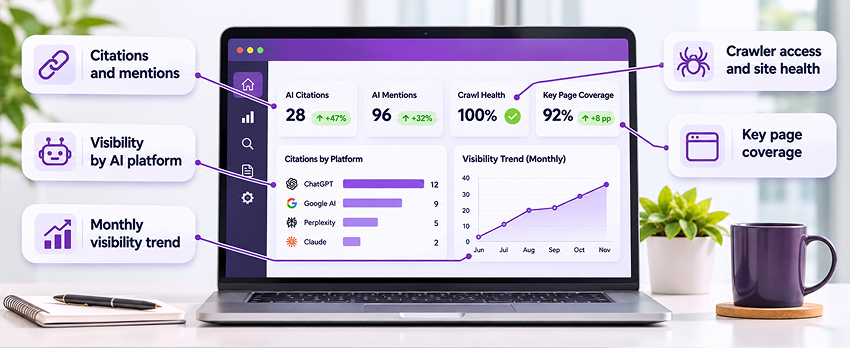
To track whether AI tools mention your brand, keep a fixed list of buyer prompts, check it in Google AI and ChatGPT every month, and pair it with Search Console's Generative AI performance report and AI referral traffic in GA4. Most of this takes about half a day a month once set up.
- Build a prompt library. List 20 to 50 prompts buyers actually ask, from sales notes and keyword data. Effort: 2 to 3 hrs once.
- Record a baseline. Run each prompt in Google AI and ChatGPT and log who gets cited, before you change anything. Effort: about 2 hrs.
- Use Search Console's Generative AI performance report. Google points site owners to this report to see how content performs in AI features on Search and Discover. Effort: 30 min a month.
- Add an LLM mentions tool, with care. Tools such as DataforSEO or Semrush estimate mentions from sampled prompts. Treat them as directional, not ground truth; Google warns that no third-party tool sees its internal systems. Effort: 30 min a month.
- Create an AI referrals channel in GA4. Group chatgpt.com, perplexity.ai, copilot.microsoft.com, claude.ai, and gemini.google.com into one channel. Effort: 1 hr once.
- Check AI bot activity in logs. Confirm AI search bots still reach key pages after site changes. Effort: 30 min a month.
- Review at 3 and 6 months. Compare cited prompts, AI referrals, and leads to the baseline, then rewrite pages still not cited. Effort: 2 hrs per review.
If your GA4 setup cannot separate AI referrals today, GA4 consulting fixes the channel grouping, and Google Search Console consulting helps you read the new AI reports.
A 90-Day AI Search Optimization Plan
A realistic AI search optimization plan takes about 90 days: fix access and set the baseline in month one, rewrite your highest-value pages and product data in month two, and build off-site mentions and review results in month three.
| Phase | What you do | Output |
|---|---|---|
| Days 1 to 30: Access and baseline | Opt in to generative AI features in Search Console. Run the crawler, CDN, log, and rendering checks. Build the prompt library, record the baseline, and set up tracking. | Bots confirmed, baseline logged, tracking live |
| Days 31 to 60: Pages and product data | Apply the seven page changes to your top 10 to 20 revenue pages. Fix feed gaps, spec pages, and part-number consistency. | 10 to 20 citable pages and a cleaner catalog |
| Days 61 to 90: Mentions and review | Publish one or two explainer videos, answer community questions, tidy listings, and run the first monthly review. | First trend report and next rewrite list |
Set expectations honestly. No one can guarantee a citation, and anyone who promises one is guessing. A fair goal is your first cited prompt within three to four months on pages that already rank. If you would rather start with a full picture of what blocks you today, an SEO audit covers the technical and content side in one pass.
"You cannot force an AI tool to cite you. You can make your page the easiest one to quote."The principle behind every step in this plan
AI Search Optimization Checklist
Use this before you call a page done:
- The site is included in Search Console's generative AI features setting
- OAI-SearchBot, Googlebot, Bingbot, PerplexityBot, and Claude-SearchBot can reach the page
- Key content, tables, prices, and specs load in the HTML without clicks or JavaScript
- The page answers its main buyer question plainly near the top
- Every H2 is a buyer question, answered in its first one or two sentences
- At least two specific facts carry a named source and a date
- At least one comparison sits in a real HTML table
- An FAQ answers 5 to 7 real buyer questions
- Product feed and structured data match the visible page
- The page's prompts are in the prompt library with a baseline logged
Once pages pass, tracking becomes a reporting job. Our analytics and reporting services can fold AI visibility into the dashboards your team already reads.
Frequently Asked Questions
Is AI search optimization different from SEO?
It builds on SEO rather than replacing it. Google says its AI features rely on the same core ranking and quality systems as regular Search, so crawlable, useful pages still come first. The difference is the goal: instead of winning one of ten links, you want a passage of your page quoted inside an answer, which rewards plain answers, tables, and specific facts.
Do I need an llms.txt file to show up in AI answers?
No. Google says Google Search does not use llms.txt, so creating one neither helps nor hurts there, and no major AI search tool requires it for citation. If you add one, treat it as optional. Crawler access, rendering, and the content of your key pages matter far more.
Should I block GPTBot or ClaudeBot?
That is a business decision about model training, not visibility. OpenAI and Anthropic both run their training crawlers separately from their search bots, so you can block GPTBot and ClaudeBot from training on your content and still allow OAI-SearchBot and Claude-SearchBot. Blocking a search bot is what removes you from that tool's answers.
Does schema markup get my pages into AI Overviews?
Not on its own. Google says AI search needs no special schema, though it still recommends structured data for rich results. Keep Product, Organization, Article, and BreadcrumbList markup where they fit, and make every value match the visible page. Mismatched markup does more harm than missing markup.
How long does it take to get cited?
There is no fixed timeline and no guarantee. Changed pages need to be recrawled and reindexed, and AI answers shift as models and sources update. A fair goal is a first cited prompt within three to four months on a page that already ranks, measured monthly against a baseline you recorded before making changes.
Does this work on Shopify and BigCommerce stores?
Yes. The same access, clarity, and evidence rules apply, with platform quirks. Theme apps can hide content behind JavaScript, review widgets often load after the page, and feed apps can drift from what the product page shows. Check rendered HTML on product and category templates first. We handle those details in our Shopify SEO services and BigCommerce SEO services.
Your Next Step
Pick five pages that drive revenue today. Run the access checks on them this week, add a plain answer and a comparison table to each, and log a baseline for the prompts they should win. That small test will tell you more than any audit deck.
We are applying the same plan to our own blog content, starting from the 8 Google AI citations our service pages already earn, and we will update this page with what changes. For a look at how we approach search for a consumer brand, see our Narragansett Beer case study.
Want to know which buyer prompts mention your competitors instead of you?
We will check your key pages and product data for AI crawler access, rendering, and answer structure, log your baseline in Google AI and ChatGPT, and hand you a prioritized fix list. No guaranteed citations, just an honest starting point.
Explore Redefine Innovations SEO services, including AI search visibility
Sources & Citations
Facts verified: 4 Nov 2026. Primary research and official documentation used in this guide:
- Pew Research Center, "Google users are less likely to click on links when an AI summary appears in the results" (22 Jul 2025): 8% vs 15% click rate on traditional results, about 1% on summary links, 68,879 searches from 900 US adults.
- Google Search Central, AI optimization guide (updated 10 Jul 2026) and AI features and your website (updated 10 Dec 2025): core ranking systems, no llms.txt or special schema needed, query fan-out, Merchant Center and Business Profile, Search Console generative AI setting and report, caution on third-party tools.
- Search Engine Journal, "Bing adds GEO to official guidelines, expands AI abuse definitions" (27 Feb 2026): Bing Webmaster Guidelines on GEO, Copilot directives, and AI manipulation.
- DataforSEO AI Optimization API (LLM Mentions, Google and ChatGPT, US), pulled 4 Nov 2026, plus Redefine Innovations' review of its four cited pages the same day: 8 Google AI mentions worth about 720 monthly AI searches; 231 answers for ai search optimization questions with 167 YouTube links.
- AI crawler documentation (accessed 4 Nov 2026): OpenAI crawlers, Anthropic crawlers (7 Apr 2026), and Perplexity crawlers: bot roles, robots.txt behavior, and published IP ranges.

Umang Patel
Co-owner | Ecommerce Architecture, Systems & Integrations
Umang Patel has worked in ecommerce and technology since 2001. He specializes in backend systems,
ecommerce architecture, ERP and platform integrations, automation, and reverse engineering complex
business processes. At Redefine Innovations, he leads technology and project teams building scalable
systems across both B2B and DTC ecommerce environments.
Areas of expertise: Ecommerce
Architecture • Backend Systems • ERP Integration • Automation • Headless Commerce • Reverse Engineering