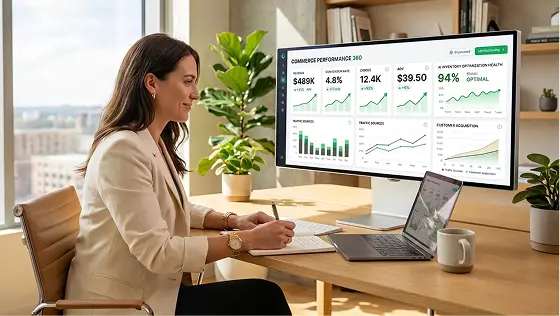
Planning an acquisition or merger?
- ERP, CRM, and ecommerce platform mergers
- Vertical and horizontal integration roadmaps
- 20+ years delivering integration projects
No obligation, just a clear answer on what your integration would take.
Choosing the right integration strategy can be the difference between controlling your market and being squeezed out of it. This guide covers vertical integration company examples, what companies use vertical integration today, and how horizontal and vertical integration examples from the real world can inform your own decisions.

How Integration Strategy Shows Up in Ecommerce and ERP Projects
In real ecommerce operations, vertical and horizontal integration rarely stay as boardroom theory. They show up as platform decisions: who owns inventory data, who controls fulfillment rules, whether supplier feeds are trusted, how product information flows into the storefront, and whether finance can reconcile revenue after a new acquisition.
Redefine perspective: integration is usually a systems problem before it is a growth story
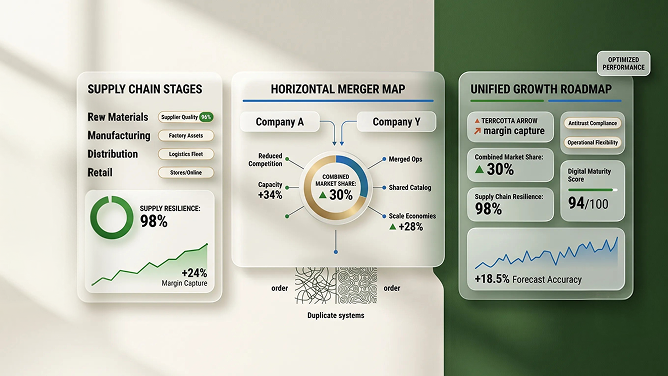
When a brand moves closer to the customer through direct-to-consumer commerce, marketplace expansion, owned fulfillment, or supplier portals, the practical work is usually ERP integration, CRM, ecommerce integration, PIM, analytics, and data migration alignment. When a company expands horizontally through acquisition, the immediate challenge is often duplicate systems, mismatched SKU structures, inconsistent customer records, and reporting that no longer reflects one clean operating model.
1. What is Vertical Integration? (And Which Companies Use It?)
Vertical integration is a strategy in which a company expands its operations along its own supply chain, taking control of production stages above (upstream) or below (downstream) its current position. Rather than relying on external suppliers or distributors, the company brings those functions in-house, either by building them from scratch or through acquisition.
The goal is greater control over quality, cost, and delivery at every stage. A retailer that acquires its manufacturer is integrating backward; a manufacturer that buys a retail chain is integrating forward. Both are forms of vertical integration, just in opposite directions.
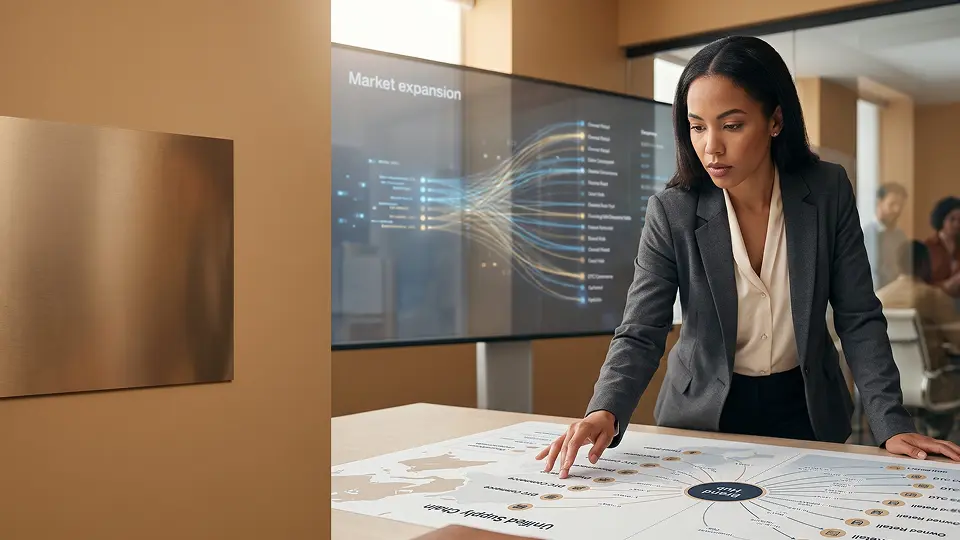
Vertical monopoly vs. horizontal monopoly: Taken far enough, vertical integration can create a vertical monopoly, where one firm controls an entire supply chain from raw material to final sale. Understanding vertical vs. horizontal monopoly matters here: a vertical monopoly arises through supply chain control, while a horizontal monopoly forms through market-level consolidation of competitors. A horizontal monopoly arises when one company acquires enough competitors at the same industry level to dominate the entire market. Both forms attract antitrust scrutiny; make sure your strategy stays within legal bounds.
1.1 Types of Vertical Integration Strategies
There are two primary directions of vertical integration: backward (upstream) and forward (downstream). A third, partial form (sometimes called balanced integration) combines elements of both.
01 Backward (Upstream) Integration
A company acquires or builds the suppliers that feed its production. A car manufacturer that buys a steel supplier, or a coffee chain that purchases its own farms, is integrating backward. The goal is to reduce input costs and secure supply. In ecommerce, this often manifests as building proprietary ecommerce integrations that connect suppliers directly to your fulfilment stack.
For you Reduces dependency on third-party suppliers
02 Forward (Downstream) Integration
A company acquires distribution channels or retail outlets closer to the end consumer. A manufacturer that opens its own branded stores is integrating forward. This improves margins and gives direct access to customer data. For brands moving into direct-to-consumer, a well-built ecommerce storefront is often the most cost-effective way to execute this move.
For you Cuts out the middleman and improves customer insight
03 Balanced (Full) Integration
A company controls the entire supply chain, from raw materials through to retail. This is the most capital-intensive form but offers the highest degree of control. Luxottica (see §1.4) is the textbook example.
For you Maximum control, maximum complexity: reserved for market leaders
In ecommerce specifically, vertical integration often shows up as custom integrations that link disparate parts of the business. For example, connecting a Stamps.com shipping module directly to an order management system so preferred carriers are selected automatically based on price and destination. The principle is the same: bring more of the process under your direct control. If your systems still operate in silos, ERP integration is often the first practical step toward that kind of vertical control.
1.2 Advantages of Vertical Integration
Vertical integration's central benefit is control: cost, quality, and competitive positioning. Here are five concrete advantages:
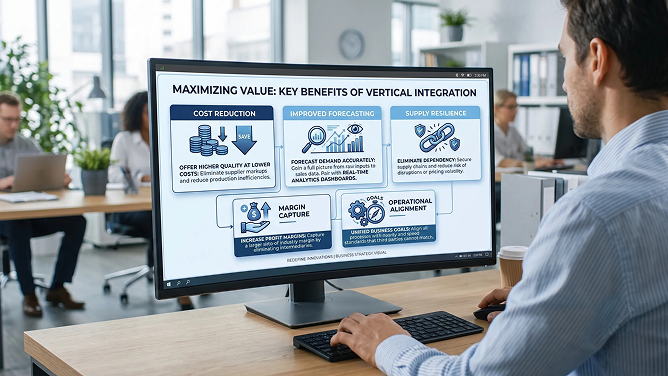
- Offer higher-quality products at lower costs by eliminating supplier markups and reducing production inefficiencies.
- Forecast demand more accurately because you see the full picture, from raw input levels to sales data, without relying on third-party reports. Pairing this with real-time analytics dashboards compounds the advantage significantly.
- Eliminate dependency on external suppliers, reducing the risk of supply disruptions or being held hostage on pricing.
- Capture a larger slice of industry margin at every stage of the value chain, rather than sharing it with intermediaries.
- Align every process with your business goals, setting quality and speed standards that no outsourced supplier would match.
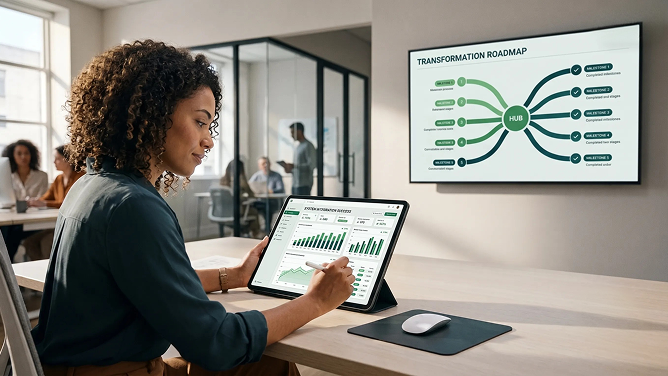
Practical note: Don't integrate for the sake of control. Every stage you bring in-house needs to be profitable on its own terms. Run the numbers on acquisition cost, operating overhead, and the competitive advantage you'll actually gain before committing. A business consulting engagement can help you model this objectively before you sign anything.
1.3 Disadvantages of Vertical Integration
The same control that makes vertical integration attractive also introduces significant operational and financial risk. Be clear-eyed about these before pursuing a deal:
- Your responsibility expands dramatically: you now have to ensure every acquired business meets demand, not just your core product.
- Excessive market control can invite antitrust scrutiny. Regulators in many jurisdictions actively investigate vertically integrated firms for anti-competitive behavior.
- Strategic acquisitions require substantial capital, not just for the purchase price, but for integration, systems alignment, and ongoing operations.
- Management bandwidth is finite. If you cannot effectively manage the acquired businesses, your existing retail operations will suffer.
Rule of thumb: Before any integration move, model out not just the acquisition cost but the ongoing operational expenses. Integrations that look cheap to buy are often expensive to run.
1.4 Vertical Integration Company Examples & Vertically Integrated Brands
Luxottica is the definitive example of vertical integration done at scale. You've heard of Ray-Ban, Oakley, Prada eyewear, and Chanel glasses: Luxottica owns all of them, along with the retail chains that sell them and the labs that manufacture the lenses. It's one of the most studied vertically integrated brands in the world. Source: EssilorLuxottica brand portfolio
With a direct-to-consumer network of approximately 18,000 stores, plus a portfolio that includes brands such as Ray-Ban, Oakley, Persol, Oliver Peoples, and Vogue Eyewear, EssilorLuxottica gives readers a modern example of how brand, manufacturing, wholesale, and retail control can reinforce one another. Source: EssilorLuxottica direct-to-consumer network
Other well-known vertical integration companies include:
- Apple: designs its own chips (M-series, A-series), operating systems, hardware, retail stores, and services, making it one of the most recognisable vertically integrated brands in tech.
- Amazon: a vertical integration company example spanning warehousing, logistics, cloud (AWS), and its own private-label products, all feeding into a single retail ecosystem.
- Tesla: manufactures its own batteries, builds its own charging infrastructure, and sells directly to consumers through company-owned showrooms, bypassing the traditional dealership model.
- Zara (Inditex) designs, manufactures, distributes, and retails its own clothing, completing the supply chain loop in weeks rather than months. The speed is largely a product of intelligent process automation across design-to-shelf workflows.
"The ability to control your supply chain is the ability to control your destiny as a business."A principle that Luxottica has demonstrated in practice for decades
Beyond full vertical integration, companies can also pursue quasi-vertical integration: long-term supply contracts or minority stakes in suppliers that provide preferential access without the full cost of acquisition. This is worth considering if full ownership is outside your capital reach.
2. Horizontal Integration in Strategic Management
Horizontal integration is a strategy in which a company acquires or merges with competitors operating at the same level of the value chain, with the goal of increasing market share, reducing competition, and achieving economies of scale. Unlike vertical integration, it doesn't extend the supply chain; it widens the company's footprint within its existing industry layer.
The strategic rationale typically includes one or more of these objectives:
- Increase production capacity and serve a larger customer base without starting from scratch.
- Reduce direct competition by bringing a rival under the same corporate umbrella.
- Enter new geographic markets quickly through an established local player.
- Achieve economies of scale that lower per-unit costs and improve margins.
2.1 Advantages of Horizontal Integration
When a competitor is facing sustainability challenges, acquiring them can create more value for both companies than allowing them to fail or be absorbed by another rival. The combined entity benefits from shared infrastructure, pooled knowledge, and a stronger negotiating position with suppliers and buyers alike. Bringing two distinct technology stacks and brand presences together post-acquisition is a significant undertaking, and digital transformation consulting is often what separates clean integrations from chaotic ones.
By merging with a competitor at your industry level, you simultaneously reduce the number of rivals in the market and increase your combined revenue base. This dynamic is particularly powerful in consolidating industries where a handful of dominant players are emerging. Once market share is secured, the next lever is usually multi-channel marketing to activate the larger combined customer base efficiently.
Legal caution: Horizontal integration must not produce a monopoly that violates applicable antitrust law. Always conduct legal due diligence before pursuing a merger or acquisition of a direct competitor.
2.2 Disadvantages of Horizontal Integration
The main risks of horizontal integration are reduced operational flexibility, cultural conflict, and regulatory intervention. Each deserves serious attention before proceeding.
- Merging organizations lose flexibility: combined policies, systems, and processes can slow decision-making and reduce agility.
- When two firms have divergent cultures or operating philosophies, integration can produce years of internal friction rather than the synergies the deal promised.
- Legal barriers are real and increasingly enforced. Regulators in the U.S. and EU have both the authority and the appetite to block deals they deem anti-competitive.
Case study (2015): Sysco's proposed acquisition of US Foods was blocked by a federal judge on the grounds that the combined company would have controlled approximately 75% of the U.S. food services distribution market, a clear example of a horizontal deal that went too far. Source: FTC case record
2.3 Horizontal Integration Examples: Companies That Merged to Grow
Pfizer's rise to become one of the world's largest pharmaceutical companies is a textbook example of horizontal integration executed over decades. Through a sustained series of acquisitions, including Warner-Lambert, Pharmacia, and Wyeth, Pfizer built a portfolio of drugs, research capabilities, and global distribution that no single company could have assembled organically in the same timeframe. Source: Pfizer/Wyeth announcement
Other notable horizontal integrations include:
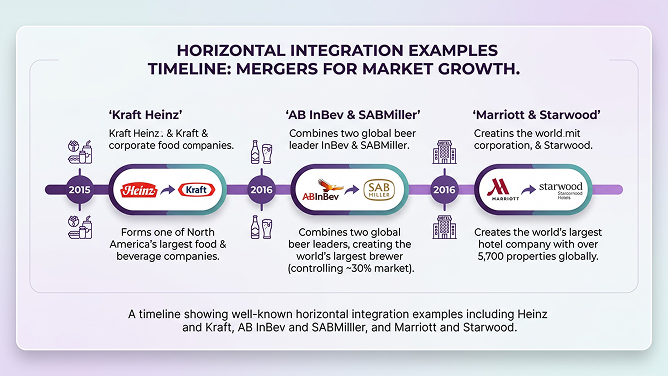
- AB-InBev & SAB Miller (2016): creating the world's largest beer company, controlling roughly 30% of global beer sales. Source
- Heinz & Kraft (2015): forming the third-largest food and beverage company in North America.
- Marriott & Starwood Hotels (2016): producing the world's largest hotel company, with over 5,700 properties in 110 countries. Source

The recurring theme: horizontal integration works best when the combined entity achieves a meaningful improvement in economies of scale, market access, or cost structure that neither company could reach independently.
3. Vertical vs. Horizontal: Key Differences & Integration Strategy Examples
The fundamental difference comes down to direction: vertical integration moves along the supply chain; horizontal integration moves across the competitive landscape. Which integration strategy is right for your business depends on your goals, your capital position, and your competitive environment.
Understanding both also explains a well-studied question in business history: how did horizontal and vertical integration lead to larger companies? In short, vertical integration allows a company to capture margin at every supply chain stage, reducing costs and increasing quality simultaneously. Horizontal integration allows a company to scale revenue rapidly by eliminating competitors and pooling resources. Used together, they compound: a company that controls its supply chain and dominates its market tier is structurally hard to displace. The technology equivalent of this today is a unified system integration layer that connects every business function (ERP, commerce, CRM, and analytics) so the entire organisation operates from a single source of truth.
| Dimension | Vertical Integration | Horizontal Integration |
|---|---|---|
| Direction | Along the supply chain (upstream or downstream) | Across the same industry level (competitors) |
| Primary goal | Supply chain control, cost reduction, quality | Market share, economies of scale, reduced competition |
| Capital requirement | High (building or acquiring new capabilities) | High (acquisition premiums for competitors) |
| Regulatory risk | Moderate (vertical monopoly concerns) | High (antitrust scrutiny for market concentration) |
| Best for | Companies with supply chain inefficiencies or quality issues | Companies in consolidating industries seeking scale |
| Real-world example | Luxottica (design → manufacturing → retail) | Pfizer (serial pharmaceutical acquisitions) |
Looking for a concrete example for horizontal integration alongside a vertical one? Pfizer (horizontal) and Luxottica (vertical) are the most instructive pairing: one expanded across its industry tier, the other expanded down its supply chain. For vertical integration and horizontal integration examples studied together, the Luxottica case is particularly instructive: the company used both strategies simultaneously, acquiring brands horizontally while deepening vertical control over manufacturing and retail. The most sophisticated integration strategy examples in business history almost always combine both approaches over time.
Integration Readiness Checklist Before You Move
Before pursuing a vertical acquisition, horizontal merger, or large-scale systems consolidation, leadership should know whether the operating model can absorb the change. Use this checklist before scoping the deal, platform migration, or integration roadmap.
Key Takeaways
- Vertical integration = control over your supply chain (upstream or downstream). Best for reducing costs and improving quality.
- Horizontal integration = acquiring competitors at your industry level. Best for gaining market share and achieving scale.
- Both require substantial capital and carry regulatory risk; do your due diligence before proceeding.
- Model the ongoing operating costs, not just the acquisition price. Hidden costs often exceed the purchase price within three years.
- The two strategies can and often do work together; many of the world's most successful companies use both.
- Always involve legal counsel early. Antitrust risk is real and can unwind deals even after they appear closed.
Sources
To improve trustworthiness, major company examples and antitrust references in this guide were checked against official company, investor-relations, regulatory, or primary-source material where available.
- EssilorLuxottica eyewear brand portfolio and direct-to-consumer network for vertical integration context.
- Tesla Form 10-K for business segment, manufacturing, sales, services, energy generation, and storage context.
- Inditex annual accounts for design, procurement, manufacturing, logistics, distribution, physical-store, and online-platform value-chain language.
- IKEA value chain for product development, design, supply, manufacture, and sales context.
- AB InBev/SABMiller completion announcement and European Commission merger approval summary for horizontal integration context.
- Marriott/Starwood completion announcement for the hotel industry horizontal integration example.
- FTC Sysco/US Foods case record for the antitrust-risk example.
- Pfizer/Wyeth announcement for pharmaceutical acquisition context.
Frequently Asked Questions
What is vertical integration?
Vertical integration is a business strategy where a company expands control over its supply chain by moving upstream toward suppliers or downstream toward distribution and retail. The goal is more control over cost, quality, inventory, delivery, and customer experience.
What is horizontal integration?
Horizontal integration is a business strategy where a company acquires or merges with a competitor operating at the same stage of the value chain. It is usually used to increase market share, expand capacity, enter new regions, and gain economies of scale.
What is the difference between vertical and horizontal integration?
Vertical integration moves along the supply chain, while horizontal integration moves across the competitive landscape. Vertical integration is about controlling more stages of production and distribution; horizontal integration is about combining competitors or similar businesses.
What are examples of vertical integration?
EssilorLuxottica, Tesla, IKEA, Inditex/Zara, Apple, and Amazon are commonly discussed examples because each controls important parts of its value chain, such as design, manufacturing, distribution, retail, logistics, direct sales, or technology infrastructure.
What are examples of horizontal integration?
Examples include AB InBev combining with SABMiller, Marriott acquiring Starwood Hotels, Kraft and Heinz merging, and Pfizer expanding through pharmaceutical acquisitions such as Wyeth.
What is a vertical acquisition example?
A vertical acquisition example is a retailer acquiring a manufacturer or a manufacturer acquiring a distributor. In ecommerce, a practical version may be a brand acquiring a fulfillment partner, bringing warehousing in-house, or building direct integrations with suppliers and ERP systems.
Is Amazon vertically or horizontally integrated?
Amazon is often discussed as vertically integrated because it controls major parts of its commerce value chain, including marketplaces, warehouses, logistics capabilities, private labels, and cloud infrastructure. It has also used acquisitions, so its strategy is not purely one category.
Is Apple a vertically integrated company?
Apple is widely considered vertically integrated because it controls product design, chips, operating systems, services, retail stores, and a tightly managed customer experience, even though it still works with external manufacturing partners.
Can a company use both vertical and horizontal integration?
Yes. Many large companies use both over time. A company may acquire competitors to expand market share and also bring suppliers, distribution, or customer-facing channels under greater control.
What should ecommerce brands audit before integration?
Ecommerce brands should audit SKU data, customer data, ERP readiness, CRM overlap, order routing, fulfillment operations, inventory accuracy, financial reporting, analytics, platform dependencies, and migration risk before pursuing vertical or horizontal integration.
What are the main risks of horizontal integration?
The main risks are cultural conflict, system duplication, customer disruption, integration cost, slower decision-making, and antitrust scrutiny if the combined company controls too much of a market.
How did horizontal and vertical integration lead to larger companies?
Horizontal integration helps companies grow by acquiring customers, capacity, and market share quickly. Vertical integration helps companies capture more margin and control more of the customer experience. Used together, they can create larger, more defensible businesses.

Kristina Brown
Director of Business Development
Kristina drives new client growth and partnership strategy at Redefine Innovations, and is the first point of contact for brands scoping a paid search or ecommerce engagement. She has spent over a decade helping ecommerce brands turn ad spend into measurable revenue, covering PPC and CRO, SEO, and ecommerce strategy. A proud mum to a two-year-old who already has strong opinions about everything, she brings that same decisive energy to every client conversation.