Connect every platform your business runs on.
Salesforce to NetSuite. Dynamics 365 to Shopify. SAP to your ecommerce stack. We build managed connections so your data moves on its own. to your ecommerce stack. Integrating platforms is what Redefine does, building managed connections that stop data from living in silos and start the systems talking.

Every platform. One integration partner.
Choose your platform below to see exactly how Redefine connects it into your stack, what data moves where, and what a scoped build looks like.

Salesforce Integration Services
Connect Salesforce to your ERP, ecommerce, and marketing stack. Real-time opportunity-to-order sync, bi-directional contact data, and custom object mapping that fits your workflow and marketing stack.
HubSpot Integration
Sync HubSpot deals, contacts, and pipeline data with NetSuite, Shopify, or your ERP. Keep sales and operations in lockstep. NetSuite, Shopify, or your enterprise resource planning system. Keep sales and operations in lockstep.
Microsoft Dynamics 365
ERP to ecommerce. CRM to warehouse. Finance to storefront. Dynamics 365 integration built by a certified Microsoft solutions partner.
NetSuite Integration
Orders, inventory, and financials flowing live from Shopify or Salesforce into NetSuite. No custom scripts that break on release.
SAP Integration
SAP connections to CRM, supply chain, and ecommerce platforms. RFC, IDoc, and REST protocols matched to your SAP version.
Shopify Integration
Connect Shopify to ERP, 3PL, CRM, and marketing platforms. Webhooks, REST API, and GraphQL-native connections that survive platform updates.
Adobe Commerce Integration
Adobe Commerce integrations for B2B and B2C. ERP, PIM, OMS, and logistics connections with full support for custom extensions. enterprise resource planning, product information management, order management, and logistics platforms, with full support for custom extensions.
BigCommerce Integration
Automate order routing, inventory, and fulfillment between BigCommerce and your back-end systems. Stencil-native and API-first architecture.
MuleSoft Integration
Anypoint Platform design, API-led connectivity, and managed MuleSoft implementations for multi-system integration programs. implementations for enterprise integration programs.
Zapier Integration
When Zapier workflows outgrow no-code limits, we migrate to maintainable custom integration architecture without losing the automations your team relies on.
Boomi Integration
Boomi AtomSphere process design, deployment, and optimization. Connect legacy systems to cloud platforms without ripping out existing infrastructure. Connect legacy systems to cloud platforms without ripping out existing infrastructure.
Workato Integration
Workato recipe development, connector customization, and multi-team integration governance for growing operations teams. governance for enterprise automation programs.
Snowflake Integration
Feed operational data from Salesforce, ERP, and ecommerce platforms into Snowflake for unified reporting, data products, and machine learning pipelines.
Oracle Integration
Oracle Fusion, E-Business Suite, and Oracle Integration Cloud connections for enterprise finance, supply chain, and operations workflows.
ServiceNow Integration
Connect ServiceNow ITSM and CSM modules to Salesforce, ERP, and operations platforms. Automated ticket routing and asset lifecycle management included. Management modules to Salesforce, enterprise resource planning, and operations platforms for automated ticket routing and asset lifecycle management.
QuickBooks Integration
Ecommerce orders, invoices, and customer records flowing automatically into QuickBooks Online or Desktop. Eliminate manual re-entry and reconciliation backlog.
Celigo Integration
Celigo Integrator.io flow builds, NetSuite SmartConnectors, and custom integration app development for mid-market operations.
Marketo Integration
Sync Marketo lead scoring, campaign activity, and contact data with Salesforce and ecommerce platforms. Closed-loop revenue attribution built in.
What typical integration partners miss
Most integrators hand you a connector and leave. Redefine scopes, builds, monitors, and maintains the integration as a managed service.
What disconnected platforms actually cost you
- Orders entered manually into the enterprise resource planning system after the sale closes
- Inventory levels lag 24 to 48 hours behind actual warehouse state
- Customer relationship management contacts duplicate when a deal moves to a customer record in the enterprise resource planning system
- Finance reconciles at month end from three separate exports
- A custom Zapier flow breaks every time Shopify releases a new API version
Calculate what integration saves you
Enter your operation's numbers. See what manual data entry costs you each year.
Your current operation
Every type of platform integration your stack needs
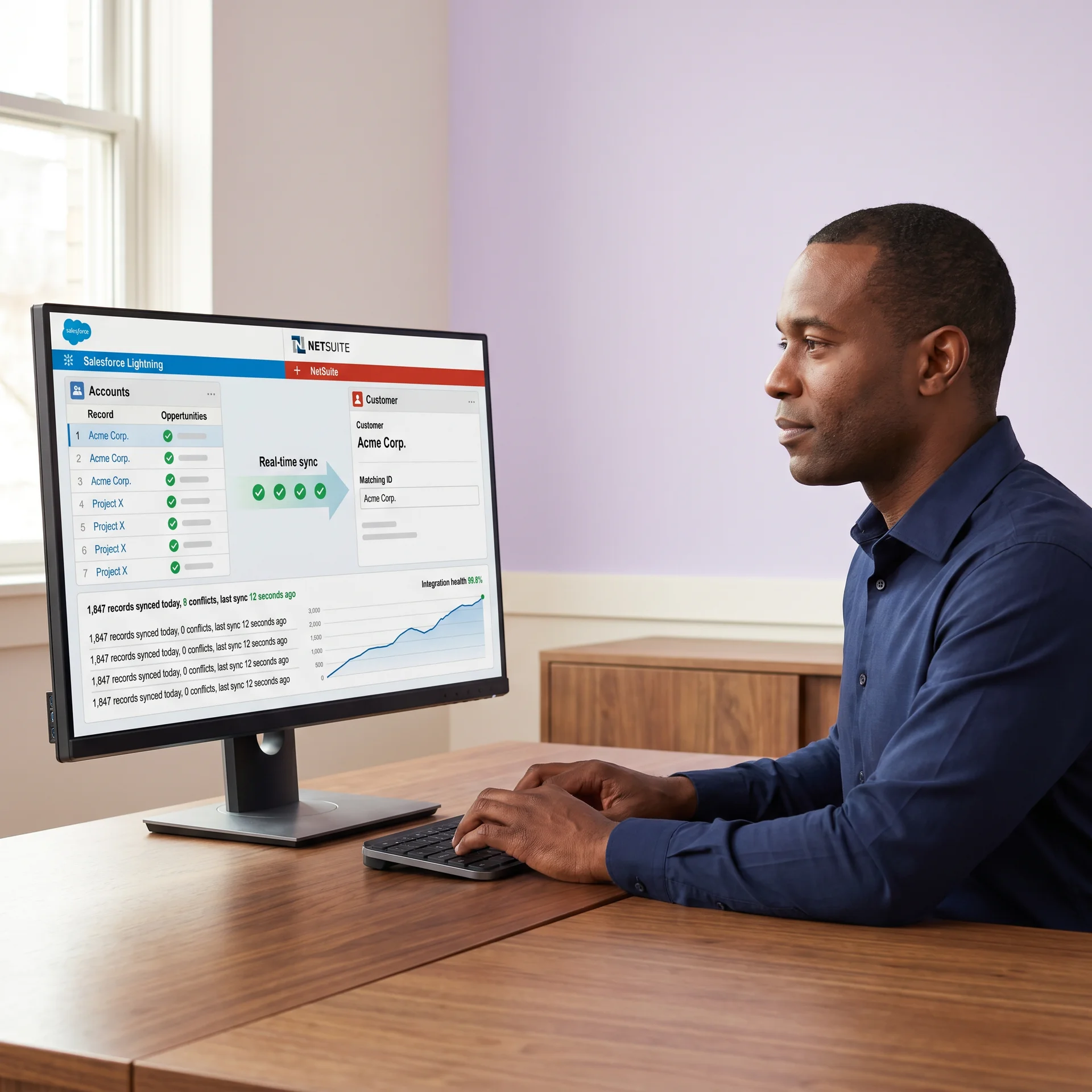
Real-time bi-directional sync
Data flows both ways, on triggers or schedules. An order in Shopify creates a record in your ERP within seconds. A status change in the ERP reflects on the storefront instantly. No polling delay, no daily batch lag.
API-first architecture
REST, GraphQL, SOAP, and webhook-native. No connector blackbox you cannot inspect or extend.
Integration monitoring dashboard
A live view of every data flow, error rate, and sync latency. Shared with your team on day one of go-live.
Error handling and retry logic
Every integration includes dead-letter queues, retry policies, and alerting. Failures surface to your team before customers notice them.
Data transformation and mapping
Field normalization, lookup tables, conditional routing, and custom transformation logic. What leaves Platform A arrives at Platform B clean and usable.
Managed integration maintenance
We handle platform API updates, schema changes, and connector versions before they break anything. You never discover breakage from a customer complaint.
From fragmented B2B stack to live-sync operations

Platform integration services: your questions answered
Most single platform-to-platform integrations complete in 3 to 6 weeks. Think Shopify to Dynamics 365 or Salesforce to NetSuite. Complex multi-system builds with custom data transformation typically run 6 to 12 weeks. We provide a specific timeline in the scoped proposal before any commitment.
Both, depending on your stack and requirements. We work with MuleSoft Anypoint, Dell Boomi, Workato, Celigo, and Zapier as managed platforms when they fit the use case. For performance-critical, high-volume, or legacy system integrations, we build custom API integrations. The scoping call determines the right approach for your specific data flows and volume requirements.
On managed integration engagements, we monitor changelog announcements from every platform we connect for you (Shopify, Salesforce, Dynamics 365, NetSuite, and others). Deprecation updates trigger a planned upgrade before the old endpoint goes dark. You do not hear about it from a customer complaint first. For project-based builds without managed support, we provide full documentation so your team or any developer can maintain the integration.
Not necessarily. If your Zapier workflows are low-volume and not breaking, we keep them and build around them. If specific flows are causing reliability issues, have outgrown Zapier's task limits, or need to handle business-critical data like orders or inventory, we replace those specific automations with maintained custom integrations. We audit your existing automations in the scoping phase and make a recommendation per flow, not a blanket replacement.
Data mapping is a core part of every scoping engagement. We document every source field, target field, and transformation rule before writing a line of code. For complex cases, we build lookup tables, conditional transformation logic, and enrichment pipelines that normalize data before it reaches the destination platform. The mapping document becomes your permanent reference for future changes.
Single platform integrations (one pair, standard data flows) typically scope between $8,000 and $18,000. Multi-platform builds with custom transformation, complex business-to-business workflows, or integration platform as a service implementations run $18,000 to $45,000 and above. Managed integration support retainers start at $1,500 per month per connected pair. All pricing is line-itemized in your proposal before any work begins. No surprise charges.
Submit your brief. Get a scoped proposal.
Tell us which platforms need to connect and what data needs to move. We return a line-item proposal within 3 business days. each other and what data needs to move. We review your situation and return a line-item proposal within 3 business days.
No commitment. No pitch. A scoped proposal that shows exactly what gets built, in what order, at what price.
Submit your integration brief
No commitment. No pitch. Just a scoped proposal.
Brief received
We will review your situation and send a scoped proposal within 3 business days. Expect a call within 48 hours to confirm details.
Stop copying data. Start building on it.
Every hour your team moves data manually is an hour not spent on growth. Connecting your platforms ends that drain. A scoped proposal is free and ready in 3 days. systems is an hour not spent on customers, product, or growth. Integrating platforms ends that drain, and a scoped proposal is free and ready in 3 days.