An AI opportunity assessment is a structured review of a company's workflows, data, and systems that identifies where AI can create measurable value. It scores each AI use case on business impact, feasibility, and risk, then recommends the first project to fund. It differs from an AI readiness assessment, which measures whether an organization can support AI, and from an AI strategy, which sets long-term goals and investment. Redefine Innovations offers a free AI opportunity assessment that also flags which legacy systems need modernization before AI can work.
Get a free AI opportunity assessment
- Top three AI use cases, scored
- One recommended first project
- The data and systems each one needs
- An honest read if AI is not the right fix
Tell us where your team loses the most time. Redefine Innovations will score those workflows and name the first AI project worth funding, at no cost.
Everyone has an AI idea. Very few teams know which one to fund first.
An AI opportunity assessment solves that problem. It looks at how your business actually runs, then shows where AI will save time or money and where it will not. Nearly nine in ten companies now use AI in at least one business function, yet only 37% can point to any impact on EBIT.1 The gap is rarely the model. It is the wrong problem, or the right problem on the wrong data.
A quick disclosure. Redefine Innovations builds AI automation into commerce and operations platforms, and modernizes the legacy systems AI has to talk to. So we see both halves of the problem: the AI idea and the systems underneath it.
What Is an AI Opportunity Assessment?
An AI opportunity assessment is a short, structured review that answers one question: where should AI go first in your business? It reviews three layers: the workflows where people spend hours on repeatable work, the data each AI idea needs, and the systems that hold that data.
The output of an AI opportunity assessment is a ranked shortlist with one recommended first project, not a slide deck of possibilities. From there, you can decide which AI solutions fit, or whether a simpler fix beats AI altogether.
What Does a Free AI Opportunity Assessment Include?
The Redefine Innovations free AI opportunity assessment covers four layers of your business and ends with a written, scored shortlist.
Redefine's free AI opportunity assessment at a glance
| Item | Details |
|---|---|
| Price | Free, with no obligation |
| Format | One 45-minute discovery call, then a written summary |
| Your team's time | About 1 to 2 hours in total |
| Turnaround | Written summary within 5 business days |
| You receive | Top three scored AI use cases, one recommended first project, data and system notes, and any modernization step needed |
| Best for | Mid-market and enterprise teams choosing a first or next AI project |
Which workflows does the assessment review?
The assessment reviews workflows where people move data, answer the same questions, or check the same documents. Strong AI candidates repeat at high volume, follow clear rules most of the time, and carry costly mistakes.
How does the assessment check your data?
For each workflow, the assessment asks what data AI would need, where it lives, and how clean it is. A great idea on messy data is a future project.
How does the assessment map your systems?
The assessment maps which systems hold the data: ERP, CRM, ecommerce platform, spreadsheets, or a custom app built years ago. That map shows whether AI can plug in today or needs a connection first.
Why does process ownership matter?
An AI tool without a process owner rarely sticks, so the assessment names who owns and uses each workflow. When a workflow itself is broken, a deeper process audit fixes it before any automation.
Why Do Most AI Projects Stall Before They Pay Off?
Most AI projects stall for two reasons: they target the wrong problem, or they run on data that is not ready.
AI projects often target the wrong problem
A RAND report notes that, by some estimates, more than 80% of AI projects fail, twice the failure rate of IT projects without AI.2 RAND lists misunderstanding the problem the AI should solve as the most common root cause.
AI projects often run on data that is not ready
Gartner found that 63% of organizations either lack or are unsure they have the right data management practices for AI. In a February 2025 forecast, Gartner predicted that organizations would abandon 60% of AI projects unsupported by AI-ready data through 2026.3 An AI opportunity assessment catches both problems before budget is committed, and a formal AI data readiness assessment goes deeper on the data side.
How Is an AI Opportunity Assessment Different From an AI Readiness Assessment or AI Strategy?
An AI opportunity assessment, an AI readiness assessment, and an AI strategy answer three different questions.
| AI opportunity assessment | AI readiness assessment | AI strategy | |
|---|---|---|---|
| Main question | Where should AI go first? | Are we ready to run AI? | Where is AI taking the business? |
| Focus | Workflows and use cases | Data, skills, tools, governance | Goals, investment, operating model |
| Typical output | Ranked use case shortlist | Readiness scorecard and gap list | Multi-year plan and budget |
| Typical time | Days | About 10 days to a few weeks | Weeks to months |
Which assessment should come first?
The three work best in order. The opportunity assessment finds the use case. A Redefine AI readiness assessment then confirms you can support it at scale; Redefine reports 140+ readiness assessments delivered, with 92% of clients launching a first AI use case within six months. AI strategy consulting connects the best use cases to long-term goals and budgets.
How Does the AI Opportunity Assessment Process Work?
The AI opportunity assessment process runs in five steps.
- Discovery call. Talk with the people who run the work, not just the people who buy software, about where time and money leak.
- Workflow inventory. List 10 to 20 candidate workflows with volume, hours, and error rates for each.
- System and data scan. Check where each workflow's data lives and how AI would reach it. For older stacks, this overlaps with a technology stack assessment.
- Scoring. Score every idea on impact, feasibility, and risk, on the same 1 to 5 scale.
- Shortlist. Deliver the top three use cases, one recommended first project, and what it needs to start.

How Are AI Use Cases Scored?
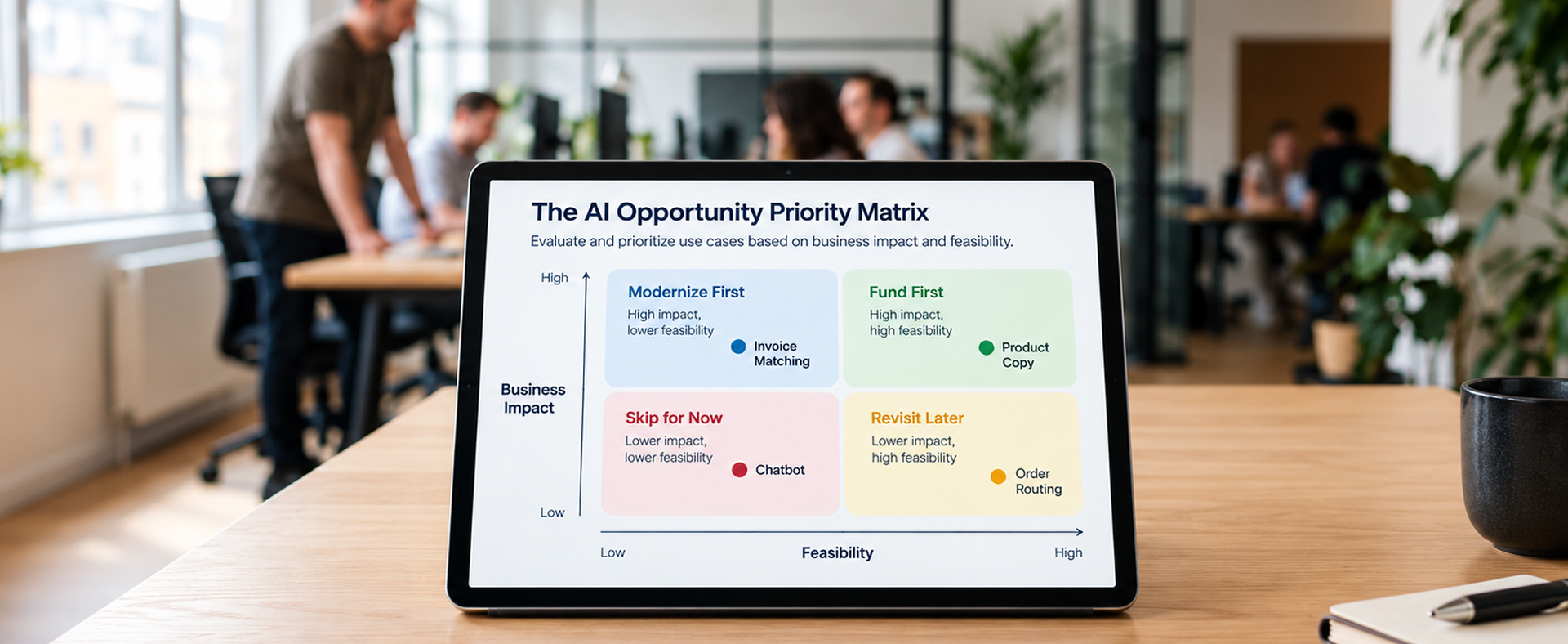
An AI use case assessment scores every idea from 1 to 5 on three lenses: business impact, feasibility, and risk. The maximum total is 15.
What are the three AI use case scoring lenses?
Business impact
Business impact measures how many hours, errors, or dollars a workflow touches each week.
Questions that measure business impact
- How many people touch this work, and for how long?
- What does one mistake cost?
Red flag: business impact nobody can measure
If nobody can say how long a workflow takes today, nobody can prove AI improved it. Set a baseline before scoring.
Feasibility
Feasibility measures whether the data exists and whether AI can reach it. Clean data in a modern system with an open API scores high.
Risk
Risk measures what happens if the AI gets it wrong. A 5 means low risk, such as work a person reviews before it reaches a customer.
What does a scored AI use case shortlist look like?
Example scores for a mid-market distributor:
| Use case | Impact | Feasibility | Risk | Total | Verdict |
|---|---|---|---|---|---|
| Invoice matching | 5 | 4 | 4 | 13 | Fund first |
| Order entry from email and PDF | 5 | 3 | 4 | 12 | Fund first |
| Customer service chatbot | 3 | 4 | 3 | 10 | Revisit later |
| Demand forecasting on a legacy ERP | 5 | 2 | 3 | 10 | Modernize first |
What is the 12-point rule?
The 12-point rule is simple. Fund a use case first when it scores 12 or more out of 15 with no lens below 3. Flag it for modernization first when impact is 4 or higher but feasibility is 2 or lower. Park anything under 10.
To turn impact scores into dollars, a formal AI ROI assessment builds the model, and the Redefine guide on how to calculate AI automation ROI walks through the math.
Which AI Automation Use Cases Pay Off First?
The AI automation use cases that pay off first are high-volume, rule-based workflows where a person can review the output.
Which back-office workflows pay off first?
Finance workflows
Invoice matching
AI reads each invoice, matches it to the purchase order and receipt, and flags only the mismatches for a person.
Why is invoice matching often a quick AI win?
Invoice matching runs at high volume, follows clear rules, and already has a person reviewing exceptions, so it scores well on all three lenses.
Order operations
Order entry from emails and PDFs, order routing, and inventory alerts are strong candidates. AI agents can read an order, check stock, and route it without anyone retyping it.
Which AI use cases fit manufacturers, distributors, and ecommerce?
Manufacturers
Quote preparation, supplier document processing, and maintenance ticket triage.
Distributors
Order entry, pricing and quote requests, and product data cleanup across large catalogs.
Ecommerce businesses
Product descriptions, order status and returns support, and catalog attribute mapping. When a workflow crosses several systems and needs decisions along the way, agentic AI often fits better than a single chatbot.
Why Does Legacy Modernization Matter for AI?
Legacy modernization matters for AI because AI only works as well as the systems it can reach. The average organization runs 957 applications, and only 27% of them are connected. In the same MuleSoft report, 82% of IT leaders named data integration as one of their biggest AI challenges.4
When a high-impact use case scores low on feasibility, the blocker is usually an old ERP, a custom app with no API, or spreadsheet data.
What are the three ways to unblock a legacy system for AI?
Modernize the system
Legacy application modernization moves the core app onto a platform AI can work with. It fits systems you plan to keep for years.
Connect the system
Integration services link the old system to new tools without replacing it. It fits systems that work but sit in a silo.
Expose the data
Custom API development opens a clean door into locked data. It fits when AI needs one or two data points fast.
"An AI project that cannot reach your data is not an AI project. It is a modernization project nobody has scoped yet."Why modernization shows up in every Redefine AI opportunity assessment
How Much Does an AI Opportunity Assessment Cost?
An AI opportunity assessment ranges from free to a paid, fixed-scope engagement, depending on depth.
| Free AI opportunity assessment | Paid AI Discovery Workshop | |
|---|---|---|
| Price | Free | From $4,800 |
| Output | Scored shortlist and a first pick | Opportunity map, risk scorecard, 90-day roadmap, ROI model |
| Timeline | Days | 10 business days |
When is a free AI opportunity assessment enough?
A free assessment is enough to decide whether AI deserves deeper investment right now. When the answer is yes, the Redefine AI Discovery Workshop adds the roadmap and ROI projections for your top three use cases.
Which Enterprise AI Governance Questions Should You Ask Early?
Enterprise AI projects need governance answers before the build starts. Gartner predicts that over 40% of agentic AI projects will be canceled by the end of 2027 due to rising costs, unclear business value, or weak risk controls.5
Data and access questions
- What data can the AI see, and who approves that access?
- Which regulations apply to this workflow?
Oversight and audit questions
- Who reviews AI output before it reaches a customer?
- How do we log, audit, and reverse an AI action?
Enterprise AI consulting builds these answers into the rollout plan, and an AI governance and risk assessment formalizes the controls.
Should You Run the Assessment In-House or With an AI Consulting Firm?
An in-house team knows the workflows best but often lacks time and a neutral scoring method. An AI consulting firm brings a tested framework and an outside view.
Most mid-market companies do best with a mix: internal owners supply the workflows, and an outside team runs the scoring. See Redefine's in-house vs consulting guide for the trade-offs.
What Mistakes Should You Avoid?
- Starting with a tool, then looking for a problem it can solve
- Picking the flashiest idea instead of the highest-scoring one
- Skipping the data check until the build is halfway done
- Ignoring the legacy system the AI depends on
- Running five pilots at once with no owner for any of them
"The most expensive AI project is the one that works perfectly on the wrong problem."A common mistake in AI opportunity assessment
AI Opportunity Assessment Checklist
Use this AI opportunity assessment checklist before, during, or after your assessment.
If your reporting cannot show the before and after, the Redefine data and analytics team can set up the baseline first.
Frequently Asked Questions
What is an AI opportunity assessment?
An AI opportunity assessment is a structured review of your workflows, data, and systems that scores AI use cases on impact, feasibility, and risk and recommends a first project.
Is Redefine's AI opportunity assessment really free?
Yes. Redefine Innovations offers the AI opportunity assessment free with no obligation. Deeper work, like a full roadmap or ROI model, is a separate paid engagement.
How long does a free AI opportunity assessment take?
The Redefine free assessment takes one 45-minute call and about 1 to 2 hours of your team's time, with a written summary within 5 business days.
How much does a paid AI opportunity assessment cost?
Redefine's paid AI Discovery Workshop starts at $4,800 and runs 10 business days. It adds an ROI model and a 90-day roadmap.
What questions does an AI opportunity assessment ask?
It asks which workflows take the most hours, what one mistake costs, where the data lives, how clean it is, and who reviews the output.
What is the difference between an AI opportunity assessment and an AI readiness assessment?
An AI opportunity assessment finds the best AI use cases. An AI readiness assessment checks whether your data, skills, and governance can support AI at scale.
What if our core systems are old?
Old systems are common. The assessment flags which legacy systems block which AI use cases, and whether to modernize, integrate, or build an API first.
Does an AI opportunity assessment cover generative AI and AI agents?
Yes. Document reading, content generation, customer service, and multi-step AI agent workflows are all scored with the same three lenses.
Will Redefine only recommend AI?
No. When a simple rule, an integration, or a process fix beats AI, Redefine Innovations says so in the written summary.
Final Thoughts: Fund One Good Project, Not Ten Pilots
Companies that get value from AI pick better experiments, not more of them. Among McKinsey's AI high performers, nearly three-quarters have fundamentally redesigned workflows around AI, compared with about one-quarter of everyone else.1
What is the next step after an AI opportunity assessment?
After a free AI opportunity assessment, you know where AI fits, where your data is ready, and which old system needs attention first. Redefine AI development services can then build the first project and modernize whatever stands in the way.
"Start with the work your team hates doing. That is usually where AI pays for itself first."The honest takeaway
Not sure where AI fits in your business?
Bring your three most time-consuming workflows and the systems behind them. Redefine Innovations will score them for free and give you an honest recommendation, even if the answer is not AI yet.
Sources & Citations
Primary research used for the statistics in this guide:
- McKinsey & Company, "The State of AI: Global Survey (2026)": nearly nine in ten respondents use AI in at least one function, 37% report some EBIT impact, and nearly three-quarters of high performers redesigned workflows.
- RAND Corporation, "The Root Causes of Failure for Artificial Intelligence Projects and How They Can Succeed (2024)": by some estimates more than 80% of AI projects fail, twice the rate of IT projects without AI; misunderstood problems are the top root cause.
- Gartner, "Lack of AI-Ready Data Puts AI Projects at Risk (February 2025)": 63% of organizations lack or are unsure of AI-ready data practices; forecast that 60% of AI projects unsupported by AI-ready data would be abandoned through 2026.
- MuleSoft, "Connectivity Benchmark Report (2026)": average organization runs 957 applications, 27% connected, and 82% of IT leaders cite data integration as a top AI challenge.
- Gartner, "Gartner Predicts Over 40% of Agentic AI Projects Will Be Canceled by End of 2027 (June 2025)": cancellation drivers include escalating costs, unclear business value, and inadequate risk controls.