Traditional ecommerce connects the storefront and commerce backend within one platform operating model, while headless ecommerce separates the customer-facing frontend and connects it to commerce services through APIs. Traditional platforms usually launch faster and require less engineering overhead. Headless gives teams more frontend freedom and multichannel flexibility, but it also adds technical complexity and often raises total cost of ownership.
Headless commerce is not automatically better. If your ecommerce team hears that it needs to become headless, API-first, composable, or microservices-based simply because those words sound modern, start with the business problem instead. You may need a faster theme, cleaner integrations, better product data, a stronger CMS, or a platform upgrade. None of those problems automatically require a new architecture.
The opposite can also be true. A growing business may reach a point where one tightly integrated storefront slows down multiple brands, regional sites, mobile apps, content-rich experiences, or new digital channels. When that happens, separating the experience layer can remove a real constraint.
So the useful question is not, "Is headless better?" Ask whether headless solves a constraint that creates enough customer or business value to justify the extra development, infrastructure, governance, testing, and maintenance. Current Shopify guidance makes the same basic point: headless is an implementation model, not a default upgrade path, and teams should choose it based on business goals, technical resources, and experience requirements.2
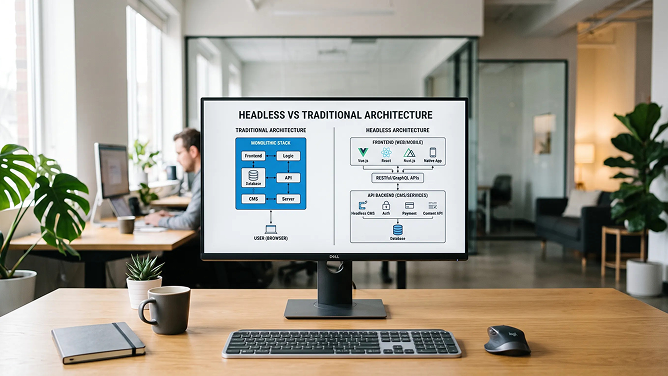
This guide gives you a practical decision framework. You will compare architecture, performance, SEO, content, integrations, developer requirements, maintenance, security, cost, and scalability, then score whether traditional, hybrid, headless, or composable commerce fits your roadmap.
Headless vs traditional ecommerce at a glance
Use this headless commerce comparison as a starting point, not a verdict. The strongest architecture choice usually appears when several requirements point in the same direction.
| Factor | Traditional ecommerce | Headless ecommerce |
|---|---|---|
| Architecture | Frontend and backend operate as an integrated platform | Frontend runs separately and calls commerce services through APIs |
| Initial launch | Usually faster | Usually slower |
| Developer dependency | Lower for routine changes | Higher |
| Frontend flexibility | Strong within platform model | Very high |
| Content experience | Usually platform-led | CMS/framework can be selected independently |
| Performance potential | Strong when optimized | Strong when engineered well |
| SEO responsibility | Many defaults built in | More implementation responsibility |
| Integrations | Apps and supported connectors | API-driven, more ownership |
| Maintenance | More centralized | More components to operate |
| Initial cost / TCO | Usually lower for straightforward needs | Often higher due to custom frontend engineering |
| Best fit | Standard to moderately complex commerce | Differentiated experiences and custom digital touchpoints |
Shopify’s 2026 comparison similarly describes headless as slower to set up, more developer-dependent, and more complex to maintain, while traditional storefronts often launch faster and share more platform infrastructure.2
What is a traditional ecommerce platform?
A traditional ecommerce platform keeps the customer-facing storefront and core commerce capabilities inside one integrated operating model. The platform typically coordinates templates, product data, cart, checkout, accounts, promotions, and orders without requiring you to build a separate frontend application.
Do not confuse “traditional” with “old.” Modern SaaS commerce platforms may run sophisticated distributed infrastructure internally. From your team’s perspective, the meaningful question is how tightly the experience layer depends on the commerce platform. If your business mainly needs reliable B2B, DTC, or multi-brand storefronts with shared data and administration, an omnichannel commerce platform can provide that integrated model without forcing a custom frontend.
How traditional ecommerce works
Shopify, WooCommerce, Adobe Commerce, BigCommerce, and Salesforce Commerce Cloud can all run in traditionally configured models, although several also support headless implementations. The platform name alone does not determine the architecture.
What is headless ecommerce?
Headless ecommerce separates the customer-facing storefront from the commerce backend and connects the two through APIs. The “head” can be a website, mobile app, kiosk, marketplace experience, social interface, or AI shopping surface. The backend can still handle products, prices, inventory, carts, checkout, promotions, taxes, payments, and orders. Adobe currently describes its Commerce storefront model in the same API-first, decoupled terms.3
What changes when you remove the head?
Your frontend team gains control over frameworks, rendering, design systems, content delivery, and release cadence. Your commerce engine stays responsible for transactional logic. That separation can unlock differentiated experiences, but it also creates a new application that your team must build, host, secure, test, monitor, and maintain.
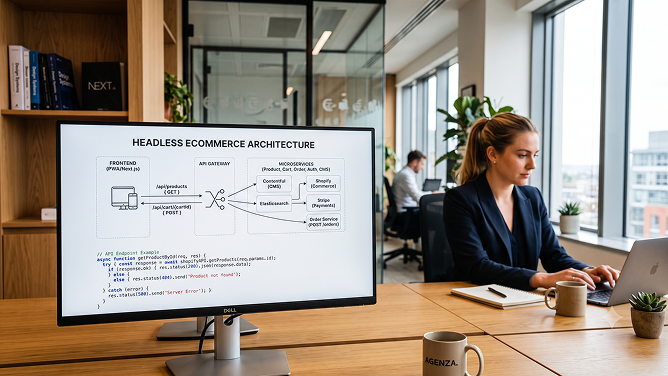
Headless ecommerce architecture explained
Presentation layer
The presentation layer controls UX, navigation, product presentation, content, personalization, and interaction. Teams commonly use frameworks such as Next.js, React, Vue, Nuxt, Hydrogen, or native mobile technologies.
Commerce engine and API layer
The commerce engine provides catalog, pricing, cart, promotions, checkout, and orders. REST, GraphQL, webhooks, and events connect that logic to the frontend and other services. A clean API contract matters more than a trendy framework because every experience depends on reliable data and predictable actions.
CMS and supporting services
A headless stack may use an independent CMS platform for structured content, localization, brand storytelling, and editorial workflows. It may also connect search, personalization, loyalty, tax, reviews, analytics, ERP, PIM, OMS, and AI services. If AI-driven channels are part of your roadmap, a governed AI and automation layer can sit alongside those commerce services rather than becoming a separate source of truth.
The point is not separation for its own sake. Separation creates value only when it lets your organization ship faster, reuse commerce capabilities, or deliver an experience the integrated model cannot support economically.
Headless vs traditional ecommerce: detailed comparison
1. Frontend flexibility
Traditional teams work within platform themes, page builders, template languages, and extension models. That can still deliver a highly customized store. Headless wins when customer experience itself creates competitive advantage and the team needs control over framework, rendering, components, and design systems. Traditional often wins when standard ecommerce UX works and marketers need direct editing without engineering support.
2. Speed to market
Traditional platforms usually launch faster because they already provide storefront, checkout, account pages, hosting, administration, and extension patterns. Headless teams often need to assemble frontend, navigation, search, cart, authentication, analytics, preview, CMS, and deployment workflows. Shopify’s current guidance reflects this trade-off.2
3. Performance
Headless gives developers more control over rendering, caching, CDN strategy, image delivery, code splitting, and edge delivery. That creates performance potential, not a guarantee. Google’s current “good” Core Web Vitals thresholds remain LCP within 2.5 seconds, INP at 200 milliseconds or less, and CLS at 0.1 or less, measured at the 75th percentile.5
Before you replatform for speed, audit third-party scripts, images, apps, JavaScript, tag managers, theme code, hosting, and backend queries. A slow implementation can stay slow after a headless migration.
4. SEO
Traditional platforms often provide sitemaps, canonical controls, metadata, redirects, URL management, and product schema out of the box. Headless gives developers more control over rendering, metadata, structured data, international routing, and templates, but it also makes the team responsible for implementing them correctly. Headless gives you more SEO control, not automatic SEO performance.
5. Content management
Traditional commerce keeps content tools close to the storefront, which simplifies preview and training. Headless lets teams choose a dedicated CMS or DXP and reuse structured content across channels. That matters most when editorial storytelling, localization, or content-heavy buying journeys influence conversion.
6. Omnichannel commerce
Headless can reuse commerce services across websites, apps, kiosks, portals, and emerging interfaces. Traditional platforms also support multiple channels, but custom experiences may stay closer to the vendor’s native model. If marketplace expansion is a major requirement, a unified marketplace and channel management layer can reduce the number of custom channel connections you need to own.
7. Integrations
Traditional platforms benefit from app ecosystems and supported connectors. Headless gives you more API freedom but also more responsibility for monitoring, versioning, retries, failure handling, and synchronization. Strong architecture often starts with reliable shared data, so clean product information management matters whether the storefront is headless or integrated. More integration flexibility always creates more integration responsibility.
8. Developer requirements and maintenance
Traditional platforms let merchandisers and ecommerce admins handle more routine work. Headless usually requires frontend frameworks, APIs, hosting, CI/CD, authentication, testing, monitoring, performance, and security skills. It also splits operating ownership across more components. Centralized order and inventory operations can keep transactional workflows consistent even when the experience layer changes.
9. Total cost of ownership
Compare three-year TCO, not license price. Traditional costs include platform fees, apps, customization, integrations, and support. Headless adds frontend development, hosting, CMS, search, middleware, DevOps, monitoring, QA, security, and ongoing engineering. Shopify currently notes that headless TCO often runs higher because businesses maintain a separate custom frontend environment.2
10. Scalability and security
Modern SaaS platforms already scale infrastructure extremely well, so headless does not automatically “scale better.” Its advantage often shows up in team independence, multiple brands, and multiple experience layers. Security also shifts: the platform may protect core commerce, while your team owns more frontend dependencies, tokens, authentication, API controls, and patching. A shared governance controls layer can help keep permissions and audit rules consistent across a more distributed stack.
Benefits of headless commerce
- Greater frontend freedom. Build experiences outside the limits of a platform theme.
- Independent frontend development. Experience teams can release without changing core commerce logic.
- Multiple touchpoints. Reuse one commerce backend across web, mobile, kiosk, portal, and other interfaces.
- Technology choice. Select CMS, search, personalization, and frontend tools based on actual requirements.
- Faster experimentation in mature teams. Well-governed teams can test and release customer experiences more independently.
- Performance control. Developers control rendering, caching, CDN delivery, and frontend code paths.
Shopify and Adobe both position experience-layer flexibility and multichannel delivery as core headless advantages.2,3
Disadvantages of headless commerce
- Higher implementation cost. You must design, build, integrate, and test a custom storefront.
- Greater developer dependence. Marketers can lose autonomy if preview and content workflows are not designed well.
- More integration failure modes. Each service adds authentication, monitoring, versioning, and synchronization work.
- More complex testing and operations. Teams must test interactions across frontend, APIs, CMS, commerce, search, and analytics.
- SEO needs deliberate implementation. You cannot assume platform defaults will carry over to a custom frontend.
- Overengineering risk. A flexible stack can become slower to change when ownership, standards, and APIs are weak.
Shopify’s 2026 composable guidance makes the same warning: flexibility creates value when the bottleneck is substantial enough to justify the added complexity.4
Benefits and limitations of a traditional ecommerce platform
Where traditional ecommerce is strong
- Faster deployment because core storefront and commerce capabilities already work together.
- Lower technical complexity and fewer independently operated services.
- Easier administration for marketing, merchandising, and ecommerce teams.
- More predictable platform upgrades and a strong extension ecosystem.
- Lower TCO for common commerce requirements.
- Built-in SEO features that reduce custom implementation work.
Where traditional ecommerce can become restrictive
- Platform templates can constrain unusual or highly differentiated frontend experiences.
- Custom mobile, kiosk, portal, or emerging-channel experiences may require more workarounds.
- Capabilities depend more heavily on vendor support and extension models.
- Frontend and backend release dependencies can slow teams when requirements become complex.
Decision principle. A modern traditional ecommerce platform can be the more sophisticated business decision when your organization does not need the flexibility that headless architecture creates.
Headless commerce comparison: which architecture wins by requirement?
| Requirement | Recommended model |
|---|---|
| Fastest launch | Traditional |
| Small development team | Traditional |
| Lowest operating complexity | Traditional |
| Standard online retail | Traditional |
| Highly custom frontend | Headless |
| Multiple custom digital experiences | Headless |
| Content-rich custom buying journeys | Headless |
| Independent frontend teams | Headless |
| Maximum component choice | Composable |
| Multiple specialized backend services | Composable |
| Flexibility without rebuilding everything | Hybrid |
Do not choose based on one feature. A stronger signal appears when several strategic requirements point toward the same architecture and the financial value of solving them exceeds the added cost.

Composable commerce vs headless: what is the difference?
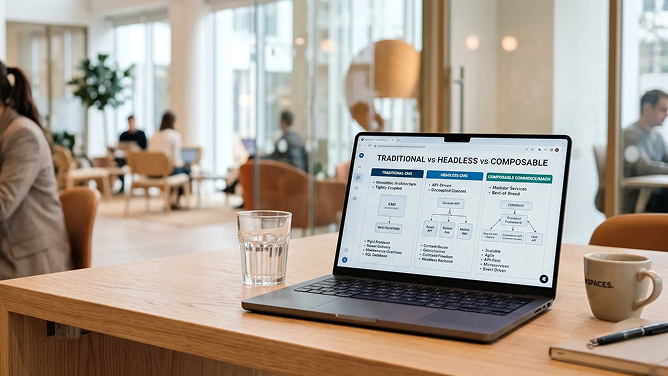
Headless commerce separates the frontend from the commerce backend. Composable commerce goes further by making more parts of the commerce stack independently replaceable, such as CMS, search, identity, pricing, checkout, personalization, or product information. A headless storefront can be part of a composable strategy, but headless alone does not make the whole stack composable.
Shopify’s current composable guidance draws the same distinction and warns teams to match the level of modularity to the business bottleneck, not to architectural fashion.4
| Factor | Headless | Composable |
|---|---|---|
| Frontend decoupled | Yes | Usually |
| Backend modularity | Optional | Core principle |
| Number of vendors | Often lower | Potentially higher |
| Integration complexity | Moderate to high | High |
| Component flexibility | High | Very high |
| Governance requirements | High | Very high |
| Best fit | Custom experience requirements | Complex enterprise architecture |
What about hybrid headless commerce?
Hybrid architecture keeps platform capabilities where they work well and applies headless selectively. You might keep platform-hosted checkout while building a custom storefront, keep the main store integrated while launching a headless mobile app, or use a custom content experience for one region without replacing the entire estate.
Adobe explicitly supports multiple headless and hybrid deployment patterns rather than treating the decision as all or nothing.3
- Choose hybrid when only one experience needs headless.
- Keep checkout platform-hosted when that reduces risk and compliance work.
- Use hybrid for incremental modernization and lower migration risk.
- Use it when budget or team capacity does not justify a full transformation.
"The best ecommerce architecture may be selective rather than ideological."Architecture principle
When should you choose traditional or headless ecommerce?
Choose traditional when
- Your storefront requirements are relatively standard.
- Your current platform provides enough customization.
- Speed to market matters more than architectural flexibility.
- You have a small technical team.
- Marketing needs direct control over frequent changes.
- Apps cover most integration requirements.
- You mainly operate through one web storefront.
- Your current architecture already meets performance targets.
Choose headless when
- Your frontend repeatedly blocks high-value customer-experience requirements.
- You need several differentiated digital touchpoints.
- You have strong internal engineering capability.
- Content and commerce must work together across complex journeys.
- Frontend teams need independent release cycles.
- International experiences differ materially by market.
- You can justify higher TCO with measurable business value.
Example: a single-storefront retailer with two developers, standard PDPs, and slow pages caused by oversized images and third-party scripts probably needs optimization, not a rearchitecture. A global brand running regional storefronts, mobile apps, in-store experiences, and editorial commerce has a much stronger case for reusable API-driven commerce services.
Signs you do not need headless, and signs you may have outgrown traditional
You probably do not need headless if
- Your biggest performance problem is image optimization.
- Third-party scripts make your theme slow.
- You mainly want a visual redesign.
- Your integrations are failing because the integration layer is poorly designed.
- Your product data is incomplete or inconsistent.
- Your team cannot support modern frontend development.
You may have outgrown traditional ecommerce if
- Every meaningful frontend change forces backend compromises.
- You need several custom experiences backed by the same commerce engine.
- Platform templates repeatedly block measurable UX opportunities.
- Content and commerce teams cannot release at the speed the business needs.
- Regional or brand sites duplicate too much development.
- Your roadmap depends on API-driven channels.
- The value of solving these constraints exceeds transformation cost.
"Architecture should solve constraints. It should not become the project."Decision principle
How headless commerce affects SEO
Headless can support excellent SEO, but your implementation must recreate every search-critical behavior that a traditional platform may have handled for you. Google recommends crawlable navigation paths from categories to subcategories to products, and it specifically relies on standard links to discover pages.6
Rendering and crawlability
Use server-side rendering, pre-rendering, or another search-friendly delivery strategy where appropriate. Make sure your primary content and navigation do not depend on user actions that crawlers will not trigger.
Internal linking and pagination
Google generally crawls URLs found in standard anchor links. It does not behave like a human clicking every button, so load-more and infinite-scroll experiences need crawlable URL paths or pagination that exposes all important products.7
Structured data, canonicals, and URLs
Implement Product, Offer, BreadcrumbList, Organization, and eligible review markup deliberately. Google notes that structured data helps it understand ecommerce content, while poor URL and duplicate-handling choices can waste crawl effort.8
Core Web Vitals
Measure LCP, INP, and CLS before and after migration. Google uses Core Web Vitals within broader page-experience systems, but passing the metrics does not guarantee top rankings.9
How much does headless commerce cost?
Avoid universal price ranges. Two headless projects can differ by an order of magnitude because the architecture, integrations, markets, team model, and custom functionality differ.
Initial cost drivers
- Architecture discovery and UX design
- Frontend development and API work
- CMS, search, authentication, and analytics implementation
- ERP, OMS, PIM, payment, tax, and shipping integrations
- SEO migration, QA, performance testing, DevOps, and training
Recurring cost drivers
- Frontend hosting and CDN
- CMS and search subscriptions
- Monitoring and observability
- Integration maintenance
- Frontend engineers and QA
- Security updates and dependency management
Headless TCO = commerce platform + frontend infrastructure + third-party services + implementation + integration + ongoing engineering
Do not ask whether headless costs more in isolation. Ask whether its incremental business value exceeds its incremental cost over three to five years.
How to calculate the business case for headless commerce
- 1. Identify measurable constraints. For example, a campaign takes three weeks to launch, mobile conversion materially trails desktop, or regional sites duplicate the same development work.
- 2. Quantify financial impact. Estimate lost conversion, developer hours, delayed campaigns, duplicated work, maintenance cost, and missed channel revenue.
- 3. Estimate headless TCO. Include implementation plus ongoing engineering, services, hosting, QA, monitoring, and security.
- 4. Estimate incremental benefits. Model faster releases, reduced duplication, new channel revenue, better experimentation, and operational efficiency.
- 5. Calculate ROI. Compare the financial benefits against incremental headless costs.
Headless ROI = (financial benefits − incremental headless costs) / incremental headless costs × 100
Your measurement layer matters after launch too. A unified analytics and reporting setup helps you compare conversion, revenue, release velocity, error rates, and operating cost before and after the change. Always compare headless against an optimized traditional alternative, not against doing nothing.
How to decide: a 10-question headless commerce assessment
Score each statement from 0 to 3. Use 0 for not relevant, 1 for a minor limitation, 2 for a recurring limitation, and 3 for a major strategic constraint.
| # | Assessment statement |
|---|---|
| 1 | Our current frontend repeatedly prevents important customer-experience requirements. |
| 2 | We need multiple custom digital commerce experiences. |
| 3 | Content teams need more independence from the commerce backend. |
| 4 | Our engineering team can build and maintain a modern frontend stack. |
| 5 | Architecture, not implementation quality, constrains frontend performance. |
| 6 | Platform templates prevent measurable conversion opportunities. |
| 7 | Our roadmap requires multiple API-driven channels. |
| 8 | We can support increased integration and DevOps complexity. |
| 9 | We have a clear three-to-five-year ecommerce roadmap. |
| 10 | Expected financial benefit exceeds incremental TCO. |
| Score | Interpretation |
|---|---|
| 0–7 | Traditional architecture is probably sufficient. |
| 8–15 | Optimize the current platform and investigate selective headless use cases. |
| 16–23 | Run a formal headless architecture assessment. |
| 24–30 | Headless or hybrid may have a strong strategic case. |
Treat the score as a prompt for investigation, not an automatic migration trigger.
Headless migration roadmap
- 1. Architecture and business discovery. Document constraints, goals, journeys, integrations, SEO, performance, and development workflow.
- 2. Define the target architecture. Choose the commerce backend, frontend framework, CMS, search, hosting, authentication, analytics, and middleware.
- 3. Assess APIs and integrations. Inventory ERP, CRM, OMS, PIM, payments, tax, and shipping dependencies.
- 4. Implement the frontend. Build navigation, PLP, PDP, search, cart, accounts, content, and localization.
- 5. Protect SEO. Preserve URLs, metadata, canonicals, structured data, redirects, internal links, and XML sitemaps.
- 6. Performance test. Benchmark Core Web Vitals and business metrics against the current site.
- 7. Launch in a controlled way. Consider market, category, hybrid, or A/B rollout patterns.
- 8. Validate after launch. Track conversion, crawl/indexing, revenue, search traffic, deployment velocity, and error rates.

What to ask a headless commerce development partner
- 1. What business constraint does headless solve in our case?
- 2. Would you recommend headless if we did not hire you to build it?
- 3. Which functionality should stay on the commerce platform?
- 4. What is the projected three-year TCO?
- 5. Who maintains the frontend after launch?
- 6. How will you protect SEO during migration?
- 7. How will you monitor API failures and data drift?
- 8. How will marketers preview and publish content?
- 9. How will authentication and customer accounts work?
- 10. What is the rollback plan?
- 11. Could hybrid solve the problem at lower cost?
- 12. Which KPIs will prove the migration succeeded?
Not sure whether headless solves your platform limits or simply adds complexity?
Map your customer experience, integration model, operating ownership, SEO risk, and TCO before you commit to a rebuild.
Frequently asked questions
What is the difference between headless and traditional ecommerce?
Traditional ecommerce keeps the storefront and commerce backend within one integrated platform model. Headless separates the storefront and connects it to commerce services through APIs. The trade-off is straightforward: traditional usually gives you faster setup and simpler operations, while headless gives you more frontend freedom and more technical responsibility.
Is headless ecommerce better than traditional ecommerce?
Not universally. Headless is a better fit when you need differentiated experiences, several digital touchpoints, independent frontend teams, or deep content-commerce integration. Traditional architecture often wins when speed, simplicity, marketer autonomy, lower TCO, and a standard online store matter more.
What are the benefits of headless commerce?
Headless can provide frontend freedom, independent releases, stronger multichannel reuse, broader technology choice, more control over performance engineering, and flexible content delivery. Those benefits matter most when they solve a real business bottleneck rather than simply changing the technology stack.
What are the disadvantages of headless commerce?
Headless usually increases implementation cost, developer dependency, integration work, testing scope, monitoring needs, and operational overhead. It can also create SEO problems if teams do not deliberately implement rendering, metadata, structured data, canonicals, pagination, sitemaps, redirects, and crawlable links.
Is headless commerce faster?
It can be, because developers control rendering, caching, code delivery, images, and CDN strategy. Architecture alone does not make pages fast. A poorly engineered headless storefront can perform worse than a well-optimized traditional theme, so benchmark the real bottleneck before you migrate.
Is headless commerce better for SEO?
Not automatically. Headless gives your team more control over technical SEO, but it also makes your team responsible for more of the implementation. Search performance depends on crawlability, rendering, structured data, internal links, URLs, canonicals, performance, and migration quality.
Is Shopify headless or traditional?
Shopify supports both. Merchants can use an integrated storefront or build a custom headless experience through the Storefront API. Shopify also offers Hydrogen as a React-based headless framework and Oxygen as a hosting environment for Hydrogen storefronts.
What is a traditional ecommerce platform?
A traditional ecommerce platform coordinates the storefront and core commerce functions within one integrated operating model. It commonly manages templates, catalog, cart, checkout, customer accounts, promotions, and orders without requiring a separately hosted custom frontend application.
What is composable commerce vs headless?
Headless separates the presentation layer from the commerce backend. Composable commerce extends modularity deeper into the stack so teams can independently select services such as CMS, search, identity, pricing, checkout, or PIM. A headless storefront can exist without a fully composable backend.
Does headless commerce require microservices?
No. You can build a headless storefront on top of a relatively unified commerce backend. Microservices and headless often appear together because both use APIs and independent components, but one does not require the other.
Does headless commerce cost more?
Often, yes, because you operate a separate frontend and may add CMS, hosting, search, monitoring, QA, DevOps, and more engineering. The real decision should compare three-to-five-year incremental cost with the measurable value that headless could create.
When should you move to headless commerce?
Move when your existing architecture creates measurable constraints around customer experience, channels, content, release velocity, or organization scale that you cannot solve economically through platform optimization. A clear business case should exist before the architecture changes.
Can I migrate to headless gradually?
Yes. Hybrid approaches let you introduce headless selectively, such as a custom mobile app, one regional storefront, or a new content experience, while keeping proven platform capabilities in place. This can reduce risk and spread investment across a controlled roadmap.
Conclusion: choose the architecture that removes your real constraint
Traditional ecommerce remains the right model for many businesses because it can deliver fast launches, strong native functionality, lower technical overhead, and easier maintenance. Headless becomes valuable when your customer experience, channel strategy, team structure, or roadmap has genuinely outgrown what an integrated storefront can support economically.
Base the decision on business requirements, customer-experience constraints, technical capability, channel strategy, total cost of ownership, and expected financial value. Then compare headless against a properly optimized traditional or hybrid alternative.
"The goal is not to build the most advanced ecommerce architecture. It is to build the least complex architecture capable of supporting where the business needs to go next."Conclusion
Key takeaways
- Traditional ecommerce is not outdated. Choose it when speed, simpler operations, and marketer autonomy matter more than custom frontend control.
- Headless separates the storefront from commerce services. That adds frontend freedom, and it also adds engineering, integration, testing, and maintenance work.
- Headless does not automatically improve speed or SEO. Implementation quality still decides both outcomes.
- Pick the least complex model that removes a real constraint. Hybrid and composable options often beat an all-or-nothing rebuild.
Not sure whether headless commerce would solve your platform limitations or simply add more complexity?
Assess your current architecture, operating model, SEO risk, and growth roadmap before you choose traditional, hybrid, headless, or composable commerce.
Sources & citations
- U.S. Census Bureau, Quarterly Retail E-Commerce Sales, Q2 2026: Q2 2026 U.S. ecommerce sales, year-over-year growth, and share of total retail sales.
- Shopify Enterprise, "Headless Commerce: Benefits, Trade-offs, and When To Use" (2026): current comparison of setup speed, developer dependency, maintenance complexity, TCO, and architecture choice.
- Adobe Commerce, Enterprise Reference Architecture: current Adobe description of API-first, decoupled storefront architecture and composable commerce services.
- Shopify Enterprise, "Composable Commerce Platform: Definition, Architecture, Benefits, and How To Choose" (2026): distinction between headless and composable commerce, plus current trade-off guidance.
- web.dev, Web Vitals: current LCP, INP, and CLS thresholds and measurement guidance.
- Google Search Central, "Help Google Understand Your Ecommerce Site Structure": crawlable ecommerce navigation and internal linking guidance.
- Google Search Central, "Pagination, Incremental Page Loading, and Their Impact on Google Search": crawler behavior for pagination, load-more, and infinite-scroll patterns.
- Google Search Central, "Include Structured Data Relevant to Ecommerce": ecommerce structured-data guidance.
- Google Search Central, "Understanding Page Experience in Google Search Results": role of Core Web Vitals within broader page experience and ranking systems.

Umang Patel
Co-owner | Ecommerce Architecture, Systems & Integrations
Umang Patel has worked in ecommerce and technology since 2001. He specializes in backend systems, ecommerce architecture, ERP and platform integrations, automation, and reverse engineering complex business processes. At Redefine Innovations, he leads technolo
Areas of expertise: Ecommerce Architecture • Backend Systems • ERP Integration • Automation • Headless Commerce • Reverse Engineering
Commerce architecture, no fluff
One short email a month on headless, hybrid, and platform strategy.
You're in, check your inbox to confirm.