A computer vision project typically costs $10,000 to $35,000 for a proof of concept, $35,000 to $120,000 for a single use case pilot, and $120,000 to $350,000 or more for a production system. Training data, model customization, cloud or edge hardware, and system integrations drive the cost. Most teams reach a pilot in 3 to 6 months and production in 6 to 12 months.
Get a real number before you fund a build
- Whether your use case is feasible today
- How much data you have and how much you need
- An off-the-shelf vs custom model call
- A phase-by-phase budget and timeline
A short discovery sprint tests your use case on your own images and turns a vague range into a scoped budget and timeline.
Everyone wants to know the computer vision project cost. The honest answer starts with a different question: what does your data look like?
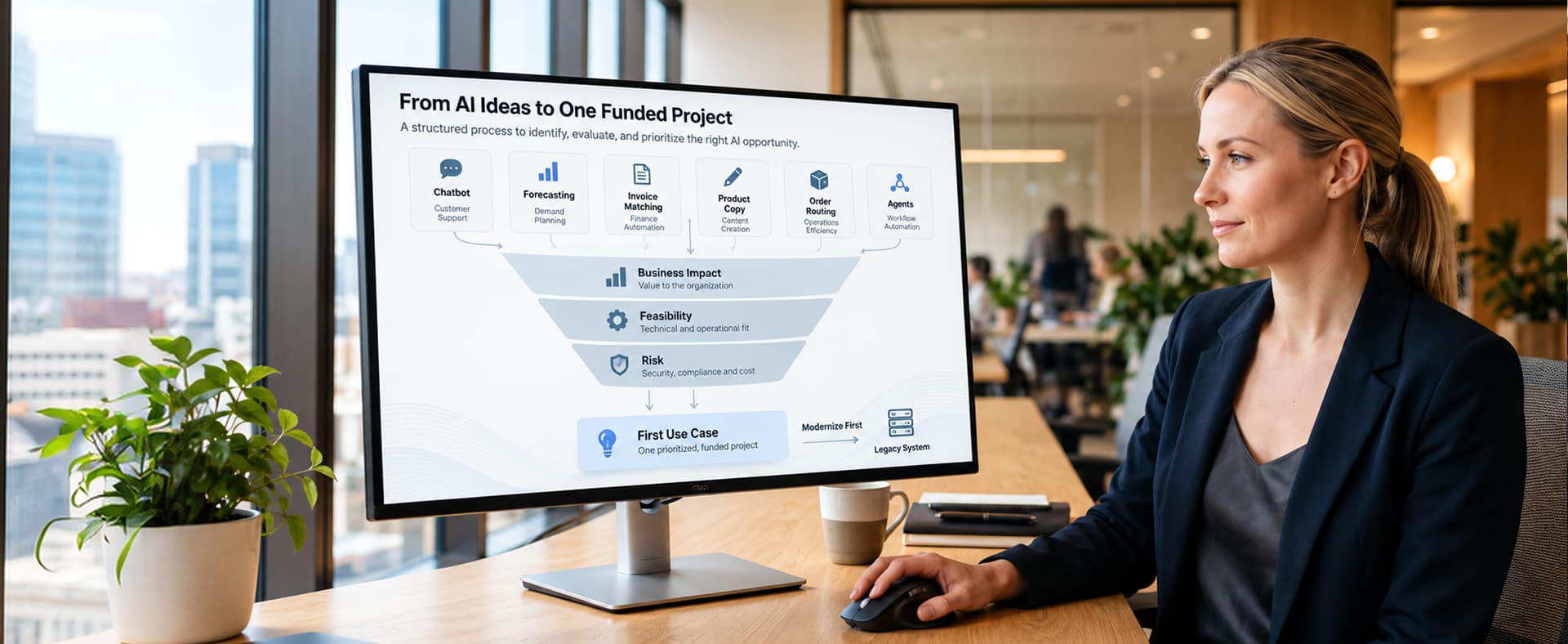
Computer vision is no longer a lab experiment. Teams use it to spot defects on a line, count stock on a shelf, read labels on a pallet, and flag safety risks on a floor. Grand View Research values the global computer vision market at $28.2 billion in 2026, growing 20.1% a year through 2033.1 Nearly nine in ten organizations now use AI in at least one business function.2
Yet most AI projects still stall. RAND found that more than 80% of AI projects fail, twice the rate of IT projects without AI.3 In computer vision, the cause is rarely the algorithm. It is a budget that ignored the data, the cameras, and the systems the model has to feed. At Redefine Innovations, our AI development services team plans for all three from day one.
This guide breaks down what you pay for, what each use case costs, how long each phase takes, and how to build a number you can defend to finance.
What Does a Computer Vision Project Cost?
A computer vision project costs about $10,000 for a simple proof of concept and $120,000 to $350,000 or more for a production system. The final number depends on how much labeled data you need, how custom the model is, and how many systems it connects to.
That range is wide because "computer vision" covers very different jobs. Reading a barcode with a standard API is cheap. Training a custom model to catch hairline cracks on a moving line, across four plants, and pushing each result into your ERP is not.
To see where vision fits next to other AI use cases, visit our AI solutions hub.
Computer Vision Project Cost by Project Type
Computer vision projects move through four stages, and each stage costs more than the one before it. These Redefine planning ranges assume one use case per stage.
| Project stage | Typical cost | Typical timeline | What you get |
|---|---|---|---|
| Proof of concept | $10,000 to $35,000 | 3 to 6 weeks | A model tested on your own images that shows the task is feasible |
| Pilot or MVP | $35,000 to $120,000 | 3 to 6 months | One use case, one site, running on live cameras with a simple dashboard |
| Production system | $120,000 to $350,000 | 6 to 12 months | Hardened model, ERP or WMS integration, monitoring, and retraining |
| Enterprise, multi-site | $350,000 and up | 9 to 18 months | Several use cases or plants, edge devices, and strict compliance needs |
Start at the top row. A proof of concept costs a fraction of a pilot and tells you whether the rest is worth funding. Our AI product development team scopes every build one stage at a time, with a go or no-go call at each gate.
Computer Vision Project Cost by Use Case
Computer vision costs vary most by use case, because each use case needs different data, accuracy, and speed. These Redefine planning ranges cover a pilot through a first production site.
| Use case | Typical cost | Main cost driver |
|---|---|---|
| Text, label, and barcode reading (OCR) | $15,000 to $60,000 | Often starts from an existing API, so integration is most of the work |
| Object, stock, or people counting | $25,000 to $80,000 | Camera placement and handling crowded or blocked views |
| Real-time video analytics (safety, security) | $40,000 to $150,000 | Streaming compute and low-latency alerts |
| Visual defect detection | $60,000 to $250,000 | Rare defect images, expert labeling, and edge devices |
| 3D vision and robotic guidance | $100,000 to $400,000 | Depth cameras, calibration, and tight accuracy targets |
Whatever the use case, the result only pays off when people act on it. Feeding counts, defects, or alerts into the data and analytics dashboards your team already uses is part of the cost, not an extra.
Computer Vision Development Cost Breakdown
Computer vision development cost splits across six components, and data labeling is usually the largest. Here is how a typical custom build divides, as a Redefine planning estimate.
| Cost component | Rough share of budget | What drives it |
|---|---|---|
| Data collection and labeling | 20% to 40% | Image volume, label type, edge cases, domain experts needed |
| Model development and training | 20% to 30% | Custom vs pretrained model, accuracy target, GPU hours |
| Integration and software | 15% to 25% | ERP, WMS, MES, alerts, dashboards, user apps |
| Hardware and deployment | 5% to 20% | Cameras, lighting, edge devices, cloud setup |
| Testing and validation | 5% to 10% | Real-world trials, false positive tuning, sign-off |
| MLOps and monitoring | 5% to 10% | Pipelines, drift alerts, versioning, retraining setup |
Integration often costs as much as the model. A defect alert nobody sees saves nothing, so the result has to reach the system that acts on it. That is where solid API integration services earn their keep.
How Much Does Computer Vision Training Data Cost?
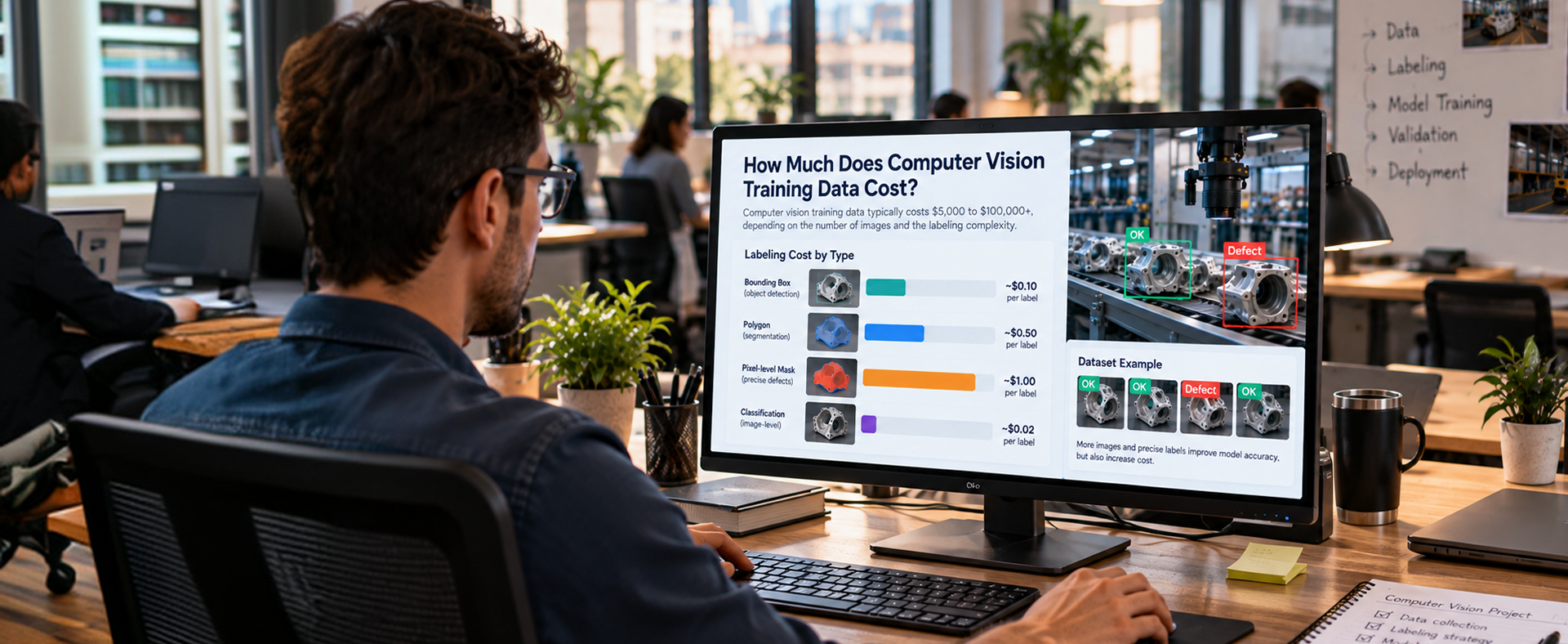
Computer vision training data typically costs $5,000 to $100,000 or more, depending on how many images you need and how precisely each one is labeled. Data is the biggest risk too. Gartner predicts that through 2026, organizations will abandon 60% of AI projects that lack AI-ready data.4
How much data do you need?
A pretrained model fine-tuned for a simple job may need a few thousand images. A custom defect model that has to work across lighting changes, product variants, and camera angles may need tens of thousands. Rare events are the hard part. If a defect shows up once in 5,000 parts, you need a lot of footage to capture enough examples.
What labeling really costs
Say you have 20,000 images with five objects each. That is 100,000 labels. At 10 cents per bounding box, you spend $10,000. At $1 per pixel-level mask, the same dataset costs $100,000. Expert review for safety or defect labels adds more.
Ways to spend less on data
- Start from a pretrained model instead of training from scratch
- Use active learning, so people only label images the model is unsure about
- Pick the simplest label type that answers the business question
- Generate synthetic images for rare defects, then confirm on real ones
Check what you already have first. An AI data readiness assessment shows how much of your footage is usable and how much you still need.
Machine Vision Pricing: Off-the-Shelf API vs Custom Model
Off-the-shelf vision APIs cost a few dollars per 1,000 images, while custom models cost more upfront but fit your exact task. Google Cloud Vision, for example, charges $1.50 per 1,000 images for label detection and $2.25 per 1,000 for object localization after the first 1,000 free units each month.5 At one million images a month, label detection runs about $1,500.
| Factor | Off-the-shelf API | Custom model |
|---|---|---|
| Upfront cost | Low, mostly integration work | Higher, data and training included |
| Ongoing cost | Per-image usage fees | Hosting, compute, and retraining |
| Accuracy on your task | Good for generic objects | Tuned to your parts, products, and defects |
| Time to value | Days to weeks | Months |
| Data ownership | Images sent to a vendor | Stays in your environment if you choose |
If a generic API reaches the accuracy you need, use it. If it cannot see what makes your product good or bad, you need a custom model, often wrapped in custom software development that fits your workflow. Many teams use both.
Cloud vs Edge Computer Vision: Which Costs Less?
Cloud computer vision costs less upfront, while edge computer vision costs less to run at high volume. Where the model runs changes both the first bill and the monthly one.
Where the model runs
Cloud processing
You send images to cloud servers for analysis. Setup is fast and you avoid buying devices, but you pay for compute and bandwidth every month, and results can lag.
When cloud makes sense
- Speed to launch matters more than instant results
- A result can wait a second or two
- You run a handful of cameras, not hundreds
Edge processing
The model runs on a device next to the camera. You pay more upfront for hardware, but you get fast results, lower bandwidth costs, and images that never leave the site.
When edge makes sense
- The system has to act in milliseconds
- Images cannot leave the site for privacy or security reasons
- Many cameras would make cloud bandwidth expensive
Example: a line that rejects parts in milliseconds
A packaging line moving hundreds of units a minute cannot wait for a round trip to the cloud. The camera, the edge device, and the reject arm have to work as one unit, on site.
Do not forget the cameras
Cheap cameras and bad lighting create bad data, and bad data costs you twice. Budget for industrial cameras, mounts, and lighting where the task needs them. Our cloud integration services team maps how cameras, devices, and cloud connect before any hardware gets ordered.
How Long Does a Computer Vision Project Take?
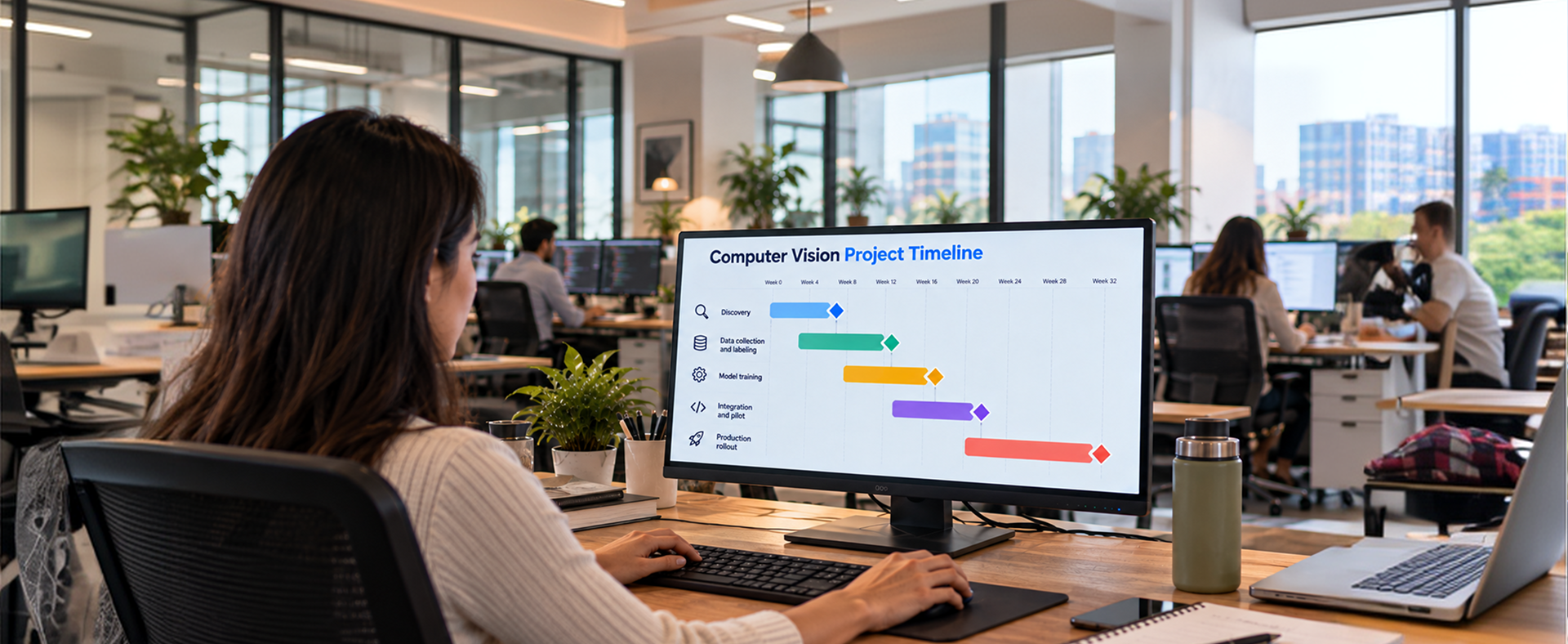
A computer vision project takes 3 to 6 months to reach a working pilot and 6 to 12 months to reach full production. Data collection and labeling is the phase that slips most often.
- Discovery and feasibility (2 to 4 weeks). Define the problem, the accuracy target, and what a wrong answer costs. Test a baseline model on your images.
- Data collection and labeling (4 to 10 weeks). Capture footage, clean it, write labeling rules, and label.
- Model development and training (4 to 8 weeks). Train, test, and tune across several rounds of edge cases.
- Integration and pilot (4 to 8 weeks). Connect the model to your systems and run it live at one site.
- Production rollout (4 to 12 weeks). Harden the pipeline, add monitoring, train users, and expand.
Phases overlap in practice. Redefine Innovations runs every build through a defined AI delivery and governance process, so every phase ends with a decision, not just a demo.
How Much Does It Cost to Maintain a Computer Vision System?
Maintaining a computer vision system typically costs 15% to 25% of the original build cost each year, as a Redefine planning estimate. New products, new packaging, or a lighting change can quietly lower accuracy. That is called model drift, and fixing it costs money.
- Cloud compute or edge device upkeep
- Monitoring for accuracy drops and false alarms
- Labeling new edge cases and retraining the model
- Camera cleaning, replacement, and recalibration
- Security updates and support
You can staff this yourself or hand it to an AI operations services team that watches the models for you.
The real comparison: Compare the three-year cost of the system, not the cost of the first model.
Computer Vision Consulting: In-House Team vs Partner Costs
An in-house computer vision team costs salaries plus the months it takes to hire, while a consulting partner costs more per hour but usually reaches a pilot faster. For reference, US computer and information research scientists earned a median of $67.45 an hour in May 2025, before benefits and overhead.6
Build in-house
You keep full control and build lasting skill. But hiring computer vision and MLOps engineers takes time, and a small team can stall on the first hard problem.
Work with a consulting partner
Good computer vision consulting brings people who have already solved the data, deployment, and integration problems you are about to meet. Compare partners on total cost to a working pilot, not on hourly rate.
Blend the two
Many firms start with a partner and build skill as they go. A dedicated AI development team can run the build while your engineers learn the system.
How to Estimate AI Project Cost and ROI Before You Commit
To estimate AI project cost and ROI, price the problem you are solving, add three years of build and running costs, and divide by the yearly savings to get a payback period.
- Price the problem. Use real scrap, labor, and claims numbers for what defects or manual checks cost today.
- Set the accuracy bar. Decide what accuracy beats your current process. Higher targets cost more.
- Count the data gap. Compare the images you have with the images you need, then price the labeling.
- Add three years of running costs. Include compute, retraining, monitoring, and support.
- Model the payback. Divide the three-year cost by the yearly savings.
Our guide on how to calculate AI automation ROI walks through the formula. To run the numbers with us, book an AI ROI assessment.
Common Mistakes That Inflate AI Implementation Cost
Most AI implementation cost overruns come from six avoidable mistakes:
- Skipping the proof of concept and funding a full build on a hunch
- Underestimating how much labeled data a custom model needs
- Setting a 99% accuracy target when 95% already beats the current process
- Treating integration as a task for after the model works
- Ignoring lighting, camera angles, and site conditions until the pilot
- Launching with no budget for retraining
Most of these come down to governance: who decides what good looks like, and when to stop. Clear AI governance consulting sets those rules before the spending starts.
"A computer vision model is only as good as the images you train it on and the systems you connect it to."A common lesson from stalled computer vision projects
Computer Vision Project Readiness Checklist
If you checked fewer than six, start with an AI readiness assessment before you ask for a quote.
Frequently Asked Questions
How much does a computer vision project cost?
A computer vision project costs $10,000 to $35,000 for a proof of concept, $35,000 to $120,000 for a pilot, and $120,000 to $350,000 or more for production.
How much does an AI project typically cost?
A business AI project typically costs from about $10,000 for a pilot built on an existing API to $500,000 or more for a custom enterprise system. Data, integration, and upkeep drive most of the cost.
What is a computer vision project?
A computer vision project builds software that uses cameras and AI models to see and interpret images or video, such as spotting defects, counting stock, or reading labels.
How expensive is it to build your own AI model?
Training a custom vision model usually costs $35,000 to $250,000, mostly for data and engineering time. Fine-tuning a pretrained model costs far less than training from scratch.
What do computer vision developers charge per hour?
US computer and information research scientists earned a median of $67.45 an hour in May 2025, before benefits. Agency and consulting rates run higher and vary by region and seniority.
What is the biggest cost driver?
Data. Collecting, cleaning, and labeling images often takes 20% to 40% of the budget.
How long does a computer vision project take?
Most projects reach a pilot in 3 to 6 months and full production in 6 to 12 months.
Is an off-the-shelf vision API cheaper?
Yes, for generic tasks such as reading text or tagging common objects. For your own parts or defects, a custom model usually reaches the accuracy you need.
What does it cost to run a model after launch?
Plan 15% to 25% of the build cost each year for compute, monitoring, and retraining.
Should the model run in the cloud or on the edge?
Use the edge when you need instant results or cannot send images off site. Use the cloud when speed to launch matters more.
Can computer vision connect to my ERP?
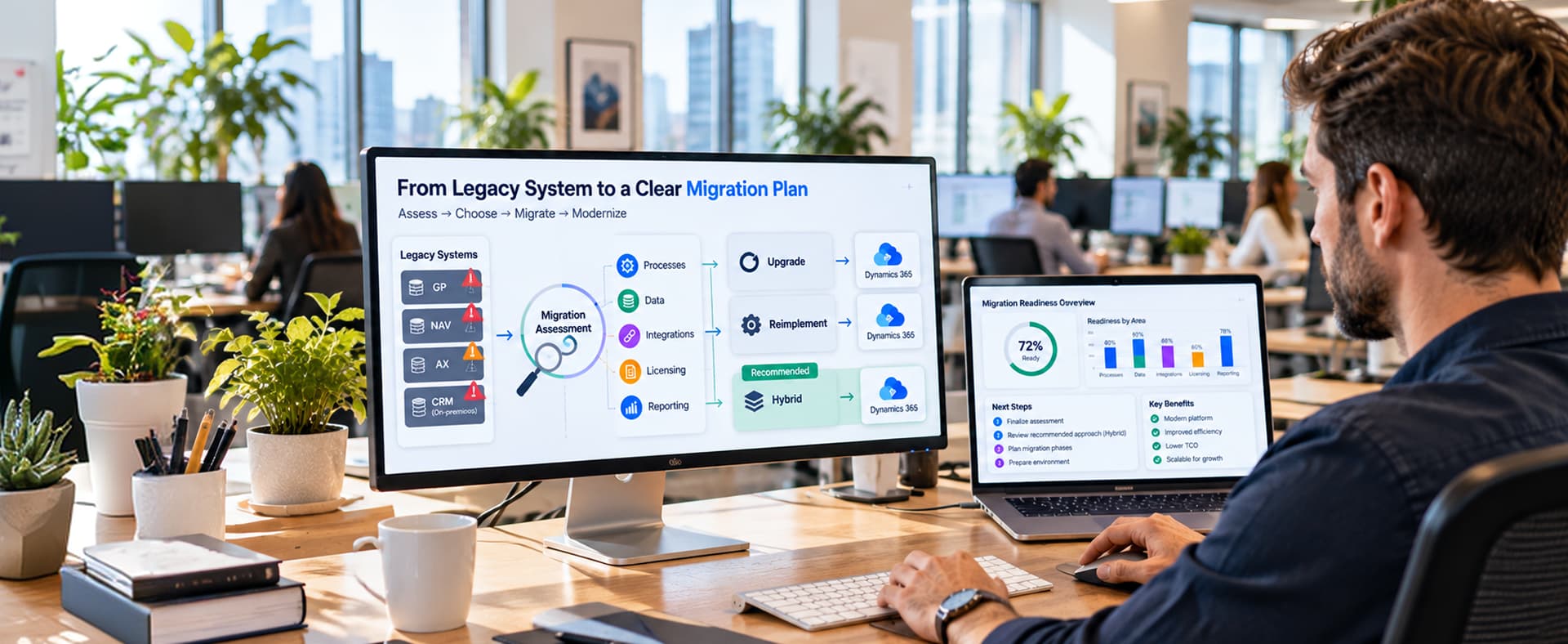
Yes. Results such as defect counts or stock levels can post straight into your ERP through ERP integration services.
Why do computer vision projects fail?
Poor data, unclear goals, and weak integration cause most failures, not the algorithm.
What Is the Real Cost of a Computer Vision Project?
The real cost of a computer vision project is not the price of a model. It is the price of the data behind it, the cameras in front of it, the systems after it, and the upkeep that keeps it accurate.
Get those four right and computer vision pays for itself. Skip them and you risk joining the more than 80% of AI projects that fail.
Start small. Prove the task on your own images. Then scale what works, with a budget that covers year two as well as year one. Our AI strategy consulting team can map that plan with you.
"Fund the proof of concept first. Let the results, not the vendor pitch, decide the rest of the budget."The honest takeaway
Have a computer vision idea but no clear budget?
Send us sample images and the problem you want solved. We will test feasibility, size your data gap, and give you an honest cost and timeline, even if the answer is that an off-the-shelf API is enough.
Sources & Citations
Primary research and official pages used for the statistics and pricing claims in this guide:
- Grand View Research, "Computer Vision Market Size and Share Report, 2026 to 2033": $28.2 billion market in 2026 and 20.1% CAGR from 2026 to 2033.
- McKinsey & Company, "The State of AI (August 2026)": nearly nine in ten respondents report regular AI use in at least one business function.
- RAND Corporation, "The Root Causes of Failure for Artificial Intelligence Projects and How They Can Succeed (August 2024)": more than 80% of AI projects fail, twice the rate of non-AI IT projects.
- Gartner, "Lack of AI-Ready Data Puts AI Projects at Risk (February 2025)": 60% of AI projects without AI-ready data abandoned through 2026.
- Google Cloud, "Cloud Vision API Pricing": $1.50 per 1,000 units for label detection and $2.25 per 1,000 units for object localization after the first 1,000 free units per month.
- U.S. Bureau of Labor Statistics, "Occupational Outlook Handbook: Computer and Information Research Scientists": median pay of $140,300 per year, or $67.45 per hour, in May 2025.