A computer vision pilot is an 8 to 12 week project that tests an AI vision model on real images from your own operation against agreed business metrics, and ends with a go or no-go decision for production. To start one, you need eight inputs: one defined visual decision, real images, camera and site access, labeled ground truth, signed success metrics, system access, named owners, and governance rules.
Not sure your use case is pilot-ready?
- A yes, no, or not yet on your use case
- The images and labels you still need
- Pilot success metrics your team agrees on
- A realistic timeline and budget range
Bring one problem and a handful of sample images. In one working session, we will tell you whether computer vision fits, and what the pilot should prove.
A computer vision demo takes an afternoon. A computer vision pilot that survives the factory floor takes preparation.
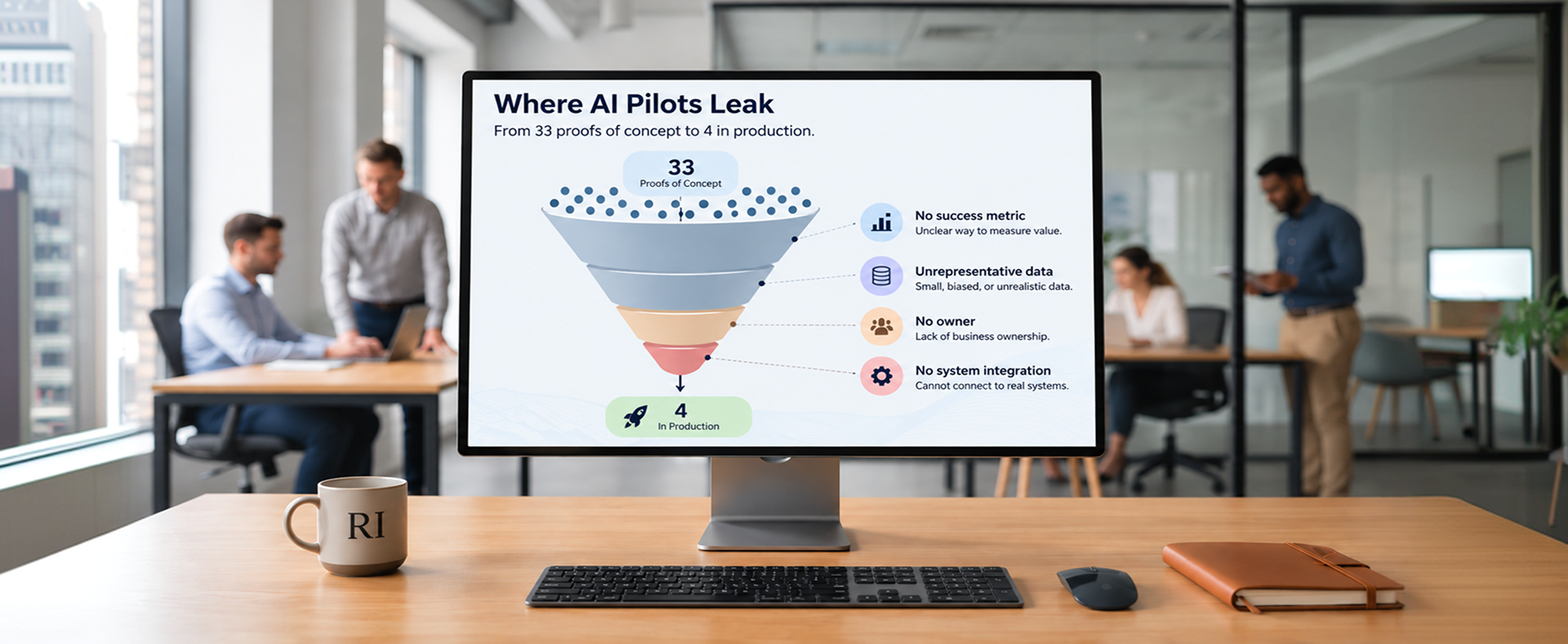
Any vendor can demo a model that spots a scratch on a clean, well-lit sample. Your line is not that sample. Parts arrive at odd angles, and the costliest defect shows up twice a month. That gap is why IDC found that for every 33 AI proofs of concept a company launched, only four reached production.1
So before the Redefine Innovations AI development team writes a line of code, we ask for eight things. When one is missing, the pilot answers the wrong question, and you end up with a nice demo and no decision.
What Do You Need to Start a Computer Vision Pilot?
You need eight inputs before a computer vision pilot starts:
- One business problem. One visual decision and the cost of a miss
- Real images. From your own line, including defects and borderline cases
- Camera and site access. Cameras, lighting, line speed, and network
- Ground truth. A labeling guide and an expert reviewer
- Signed success metrics. Accuracy, false alarms, speed, and savings
- System access. A path into MES, ERP, QMS, or PLC systems
- Named owners. Sponsor, process owner, expert, and IT contact
- Governance rules. Image retention, privacy, and override rules
What Is a Computer Vision Pilot?
A computer vision pilot tests whether an AI model can make one visual decision reliably enough, in your real environment, to change how work gets done.
What a Good Computer Vision Pilot Proves
It proves three things: the model works on your images, results reach the people who act on them, and the business case holds up.
Cameras, labeling, and integration matter as much as the model, so we scope pilots as full AI solutions rather than model experiments.
Computer Vision POC vs Pilot vs Production
Teams mix these terms up, but each stage answers a different question.
| Stage | Question it answers | Typical data | Typical length |
|---|---|---|---|
| Computer vision POC | Can a model see this at all? | Hundreds of images, offline | 2 to 4 weeks |
| Pilot | Does it work on the live line and pay off? | Live camera feed at one site or line | 8 to 12 weeks |
| Production | Can it run every shift, at every site? | All lines, with monitoring and retraining | Ongoing |
Skip the pilot, and you find problems after buying hardware. The same stage-gate thinking drives our MVP development work: test the riskiest assumption first.
Why Most AI Pilot Projects Stall
The models are rarely the problem. The inputs are. Gartner predicts that through 2026, organizations will abandon 60% of AI projects unsupported by AI-ready data, and 63% of organizations either lack or are unsure they have the right data practices for AI.2
McKinsey reports that 44% of organizations now say AI is scaling across the enterprise, yet only 37% attribute any EBIT impact to it.3 Most pilots live and die in that gap.
Vision pilots stall on the same gaps: no success definition, unrealistic images, no owner, and no path into real systems. A short AI strategy consulting engagement catches them early.
What We Need 1: One Business Problem With a Number Attached
"Use AI to improve quality" is a wish. A pilot sounds more like this hypothetical example: "Catch seal defects on Line 3 that cost us about $40,000 a month in returns."
We ask you to name three things:
- The decision: pass or reject, count, locate, read a label, or flag a safety risk
- The baseline: how you make that call today, how fast, and how often you get it wrong
- The cost of a miss: scrap, rework, returns, chargebacks, downtime, or injuries
If you cannot put a number on the problem yet, that is fine. An AI ROI assessment builds that baseline with you, because a pilot with no baseline proves nothing.
What We Need 2: Real Images From Your Real Environment
Your images decide pilot success more than any model choice. We need them from your cameras, lighting, and products, not a catalog shoot.
Volume depends on the stage. Roboflow suggests 50 to 100 images for a first model version, which suits a computer vision POC, and notes that production models may need hundreds or thousands, with many enterprise models reaching high accuracy under 1,000 images.4
For a pilot, plan on hundreds of labeled images per defect class.
What a Useful Computer Vision Image Set Includes
Image Coverage Across Lighting and Conditions
- Every shift, since morning and night lighting differ
- Product variants, colors, and packaging changes
- Edge cases: glare, blur, partial views, and wet or dusty surfaces
Image Coverage Across Defect Types
Include good, borderline, and defective parts for every defect type you care about.
Common Defect Types
A few weeks of normal production usually gives you enough examples.
Rare Defect Types
For a defect seen twice a month, you have two options:
Collect Rare Defect Images Starting Now
Save every flagged part image from today.
Add Synthetic Rare Defect Images
Fill the gap with generated images, but test only on real ones. Our AI data readiness assessment tells you whether your image archive is usable before you pay anyone to label it.
What We Need 3: Camera and Site Access for a Machine Vision Pilot
A machine vision pilot lives or dies on physical details. We need to see, or get video of, the camera spot.
Site Questions for a Machine Vision Pilot
- Existing cameras: model, resolution, frame rate, and mounting
- Line speed and how many items pass the camera per minute
- Lighting, vibration, heat, and dust at the inspection point
- Network and power: can the site run a model on an edge device, or must video go to the cloud?
The cheapest accuracy gain is often better lighting, not a better model. Our manufacturing software development team works with plant engineers on these details.
What We Need 4: Ground Truth From the People Who Know
Models learn from labels, and labels come from the inspectors who make this call today.
Plan for three commitments:
- A labeling guide: one page that defines good, borderline, and defective, with example photos
- Two to four hours a week from one subject matter expert to review labels and edge cases
- A tie-breaker: one person who settles disagreements, since two inspectors often call the same part differently
If your own experts agree only 85% of the time, a model will not reach 99%. We surface that early and version labels and images through our data engineering services.
What We Need 5: Success Metrics Everyone Signs Before Day One
Computer Vision Pilot Targets to Sign Off
We ask operations, quality, IT, and finance to sign off on targets like these:
| Metric | What it measures | Example target |
|---|---|---|
| Recall (catch rate) | Share of real defects the model catches | 95% or higher |
| Precision | Share of flags that are real defects | 90% or higher, so operators trust alerts |
| False alarm rate | Good parts wrongly rejected | Under 2% of good parts |
| Latency | Time from image to decision | Under 200 ms at line speed |
| Uptime | Share of shifts the system runs unattended | 98% over the final 4 weeks |
| Business outcome | Scrap, returns, or labor hours saved | Tied to the baseline from input 1 |
Decide the Recall vs Precision Trade-Off Up Front
When a Missed Defect Costs More
Favor recall, and accept a few extra false alarms.
When a False Alarm Costs More
Favor precision, because needless line stops erode operator trust.
Then translate model metrics into money. Our guide on how to calculate AI automation ROI shows how to separate hard savings from soft benefits.
The rule: If you cannot say what result would make you stop, you are not running a pilot. You are running a demo.
What We Need 6: A Path Into Your Systems
A prediction that stays on a screen changes nothing. The pilot must push results to where work happens.
System Questions for the Pilot
- Which system records the outcome: MES, ERP, WMS, QMS, or a spreadsheet
- Whether a PLC or SCADA system must trigger a reject gate, alert, or line stop
- Who grants API or database access, and how long approval takes
Start access requests in week one, since security reviews often outlast model training. Our ERP integration services team ties every inspection back to the right order and lot.
What We Need 7: A Small Team and Clear Owners
What Your Team Provides for the Pilot
Four named people, not a data science department:
- Executive sponsor: owns the budget and the go or no-go call
- Process owner: runs the line and owns the business metric
- Subject matter expert: labels, reviews, and explains edge cases
- IT or OT contact: handles network, hardware, and system access
What Redefine Brings to the Pilot
We bring the machine learning, engineering, and MLOps skills. If you want that capacity to stay after the pilot, a dedicated AI development team can carry the model into production.
What We Need 8: Privacy, Security, and Governance Guardrails
Cameras capture people, not just products. Settle the rules before the first image moves.
- Where images live, who can see them, and how long you keep them
- Whether faces or personal data need blurring at the edge
- Industry rules, including the EU AI Act where it applies
- Who can override the model, and how you log every decision
These rules shape the architecture, so they come first. An AI governance and risk assessment gives legal, security, and operations one shared rulebook for the pilot.
A Proof of Concept AI Timeline: How a 10-Week Pilot Runs
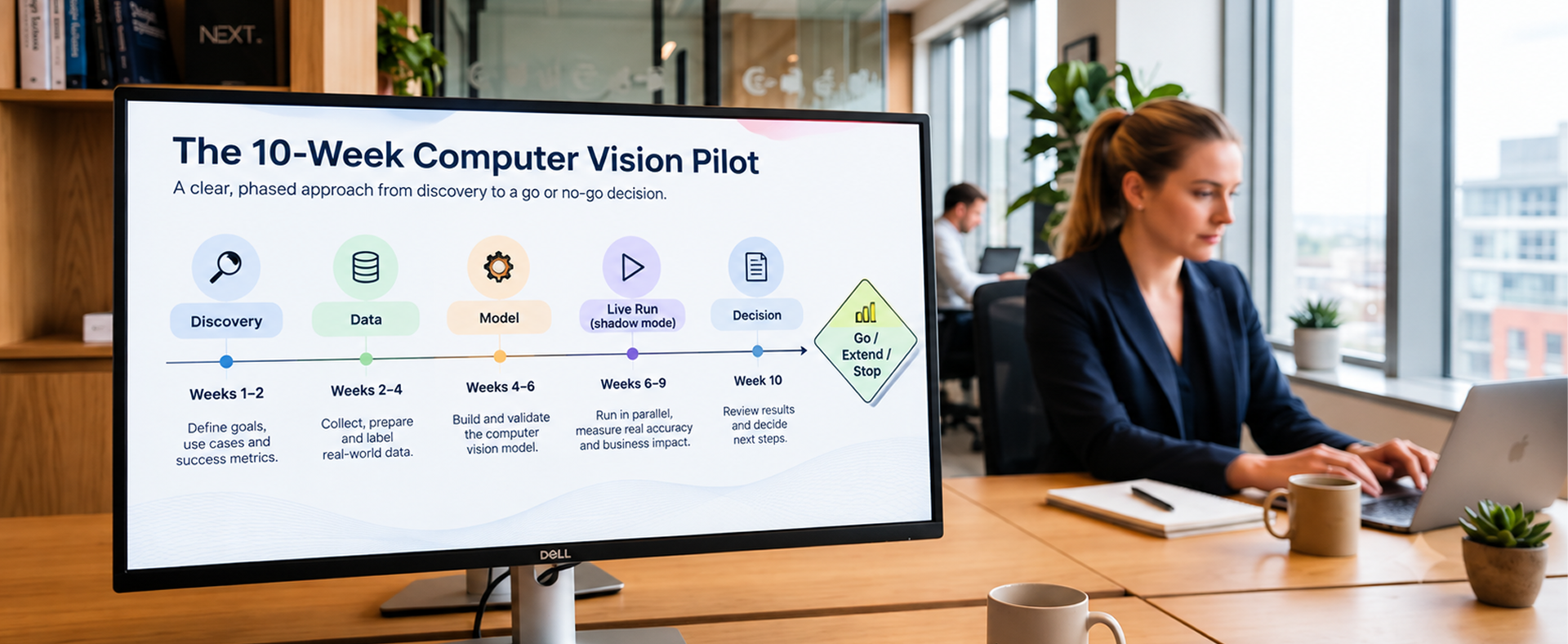
With the eight inputs in place, a typical pilot runs in five phases:
Phase 1: Discovery (Weeks 1 to 2)
Confirm the decision, baseline, metrics, and site. Start access requests.
Phase 2: Data (Weeks 2 to 4)
Collect and label images, then lock a test set nobody trains on.
Phase 3: Model (Weeks 4 to 6)
Train, test on the locked set, and review every miss with your expert.
Phase 4: Live Run (Weeks 6 to 9)
Run in shadow mode beside human inspectors, then connect alerts to real systems.
Phase 5: Decision (Week 10)
Compare results to the signed targets. Go, extend, or stop.
In shadow mode, the model makes calls without acting on them, so you measure real accuracy at zero risk. Our discovery sprint covers weeks one and two for teams that want a fixed-price start.
Common Computer Vision Pilot Mistakes to Avoid
Computer Vision Data Mistakes
- Training and testing on the same images, which inflates accuracy
- Collecting images from one shift only
Computer Vision Process Mistakes
- Chasing 99.9% accuracy when 95% already beats the manual baseline
- Treating integration as a phase two problem
If several of these sound familiar, an AI readiness assessment is a cheaper first step than a pilot.
"A pilot that tests the model but not the workflow proves only half of what you need to know."A common computer vision pilot mistake
Where Computer Vision Pilots Pay Off First
Grand View Research values the computer vision market at $23.6 billion in 2025, with quality assurance and inspection holding the largest share at 26.1%.5
- Manufacturing: surface defects, assembly checks, seal and fill inspection
- Warehousing and logistics: damaged package detection, label and barcode reading, pallet counts
- Retail and ecommerce: shelf gaps, planogram checks, product image tagging
For distribution and fulfillment teams, our logistics software development practice connects vision results to shipping workflows.
Computer Vision Pilot Readiness Checklist and Requirements Template
Readiness Checklist
Tick six or more, and you are ready to start.
One-Page Pilot Requirements Template
Fill in one row per input before the kickoff call:
| Input | What to write down |
|---|---|
| 1. Business problem | The decision, today's error rate, and monthly cost of a miss |
| 2. Images | Where they live, how many, which defects, and which shifts |
| 3. Site | Camera model, lighting, line speed, network, and power |
| 4. Ground truth | Expert name, weekly hours, and the labeling guide link |
| 5. Metrics | Signed targets for recall, precision, false alarms, and latency |
| 6. Systems | Target system, access owner, and approval lead time |
| 7. Owners | Sponsor, process owner, expert, and IT or OT contact |
| 8. Governance | Retention period, privacy rules, and override owner |
During the pilot, we often build a simple Power BI dashboard to track results weekly.
Frequently Asked Questions
Scope and Timeline
How long does a computer vision pilot take?
Most run 8 to 12 weeks once the inputs are in place.
What is the difference between a computer vision POC and a pilot?
A POC tests a model offline. A pilot tests it live, with real users and systems.
Do we need a data science team?
No. You need four named owners. We bring the technical team.
Data and Hardware
How many images do we need to start?
About 50 to 100 for a first POC model, and hundreds per defect class for a pilot. Rare defects may need synthetic data.
Do we need new cameras?
Not always. We test existing cameras first and upgrade only when image quality limits accuracy.
Can the model run without the cloud?
Yes. Edge devices run many models on site, which helps latency and privacy.
Results and Ownership
What accuracy should we expect?
Aim to beat your manual baseline first, then set exact targets in the signed metrics.
Who owns the model after the pilot?
You do. We agree on ownership of models, code, and labeled data before the pilot starts.
What happens if the pilot misses its targets?
You get a clear stop or extend decision and a report on why, which still prevents a failed rollout.
How do we keep accuracy high after launch?
Monitor drift, retrain on new images, and review misses monthly. Our AI managed services handle this for teams that prefer not to staff it.
From Pilot to Computer Vision Implementation at Scale
A successful pilot ends with a decision, a baseline, a trained team, and a connected system. That turns computer vision implementation across more sites into a scaling job, not a restart.
Bring us the inputs you have, and we will help you find the rest. The Redefine Innovations enterprise AI consulting team plans the rollout from day one.
"The best computer vision pilots are designed to become production systems from day one."From pilot to production
Have a visual inspection problem that costs you money every week?
Send us one problem statement and 20 sample images. We will tell you whether a computer vision pilot makes sense, what it should prove, and what we still need, even if the answer is not yet.
Talk to our AI consulting team
Sources & Citations
Primary research and published guidance used for the statistics in this guide:
- CIO, reporting IDC research with Lenovo, "88% of AI pilots fail to reach production, but that's not all on IT (March 2025)": for every 33 AI proofs of concept launched, only four reached production.
- Gartner, "Lack of AI-Ready Data Puts AI Projects at Risk (February 2025)": 60% of AI projects unsupported by AI-ready data abandoned through 2026, and 63% of organizations lack or are unsure of AI-ready data practices.
- McKinsey & Company, "The state of AI in 2026: On the road to ROI (August 2026)": 44% of organizations report AI scaling across the enterprise, up from 38%, and 37% attribute EBIT impact to AI.
- Roboflow, "How Much Training Data Do You Need for Computer Vision?": 50 to 100 images for a first model version, many enterprise models under 1,000 images, and a 70/20/10 data split.
- Grand View Research, "Computer Vision Market Size and Share Report": $23.6 billion market in 2025, with quality assurance and inspection holding the largest share at 26.1%.