
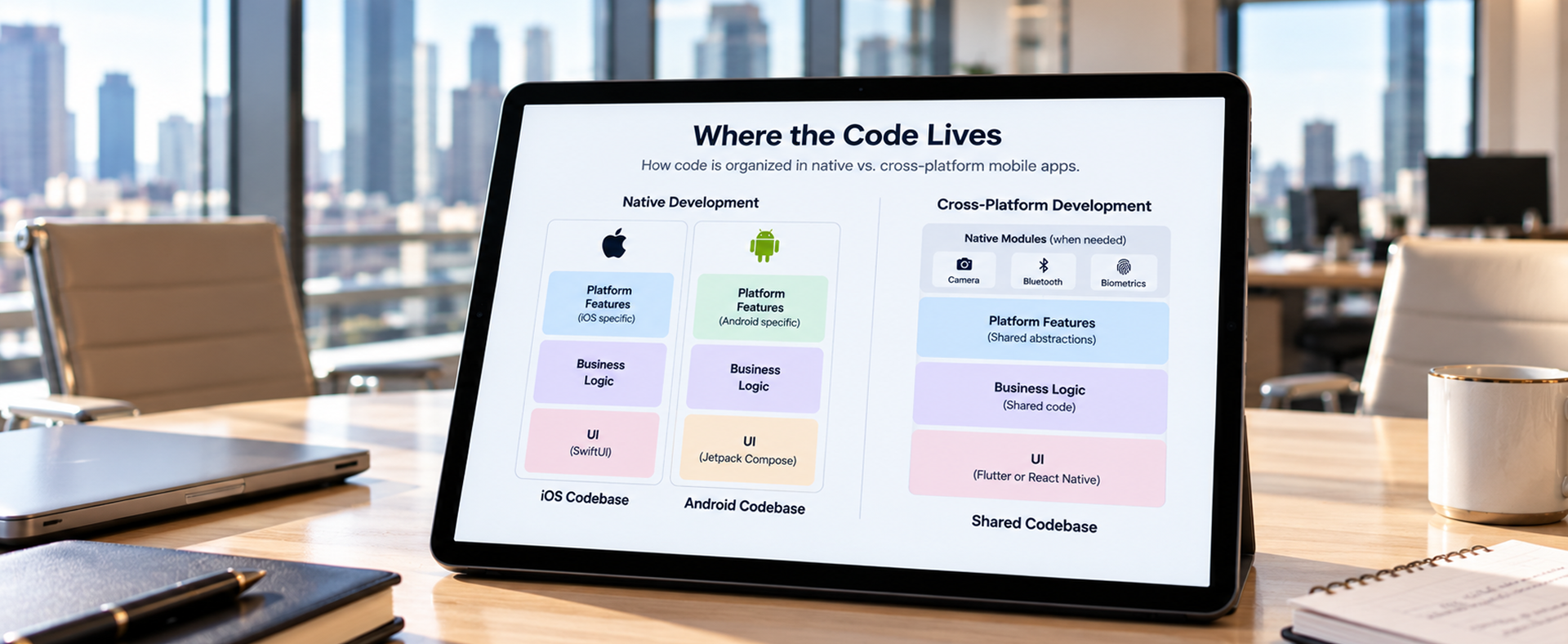
A native app is built separately for each platform, in Swift for iOS and Kotlin for Android. A cross-platform app is built once in a shared framework, such as Flutter or React Native, and runs on both. Native gives the deepest hardware access and day-one OS features. Cross-platform gives one codebase, one team, and a faster, lower-cost launch on both stores.
Every mobile app project hits the same fork early. Build it twice, or build it once?
That is the native vs cross platform app question, and it shapes your budget, team, and roadmap for years. Skipping a store is rarely an option. Android runs on 67.61% of mobile devices worldwide and iOS on 32.36%,1 and Apple says its App Store ecosystem facilitated over $1.4 trillion in developer billings and sales in 2025.2
A quick disclosure, because this is an honest guide. Redefine builds both ways. Our development team ships React Native and Flutter apps, and writes Swift and Kotlin when a project needs native code. So we have no reason to push one answer.
This guide compares both on performance, cost, timelines, and maintenance, then gives you a feature-by-feature way to decide.
What Is the Difference Between Native and Cross-Platform Apps?
Native and cross-platform apps differ in how many codebases you write and which tools you write them in.
Native app development means building one app for iOS and a separate app for Android, each with its platform's own language and interface kit. On iOS, that is Swift and SwiftUI in Xcode. On Android, it is Kotlin and Jetpack Compose in Android Studio.
Cross-platform development means writing one codebase that ships to both stores. Flutter uses the Dart language and draws its own interface. React Native uses JavaScript or TypeScript and renders real native interface components.
Both are forms of mobile app development that ship real store apps. If your users mostly work at a desk, a web application may serve them better than either.
Native vs Cross-Platform App: Side-by-Side Comparison
Native and cross-platform apps trade control for efficiency, as this comparison shows.
| Factor | Native (Swift, Kotlin) | Cross-platform (Flutter, React Native) |
|---|---|---|
| Best for | Hardware-heavy, graphics-heavy, or OS-first apps | Business, commerce, content, and service apps |
| Codebases | Two, one per platform | One shared, plus small native modules |
| Team | iOS and Android specialists | One team, native skills on call |
| Time to launch on both stores | Longer, two builds in parallel | Shorter, one build ships to both |
| Build cost | Higher, most work done twice | Lower, but not half |
| Performance | Best possible, full control | Close to native for most apps |
| New OS features | Available on day one | Often needs a plugin update or custom module |
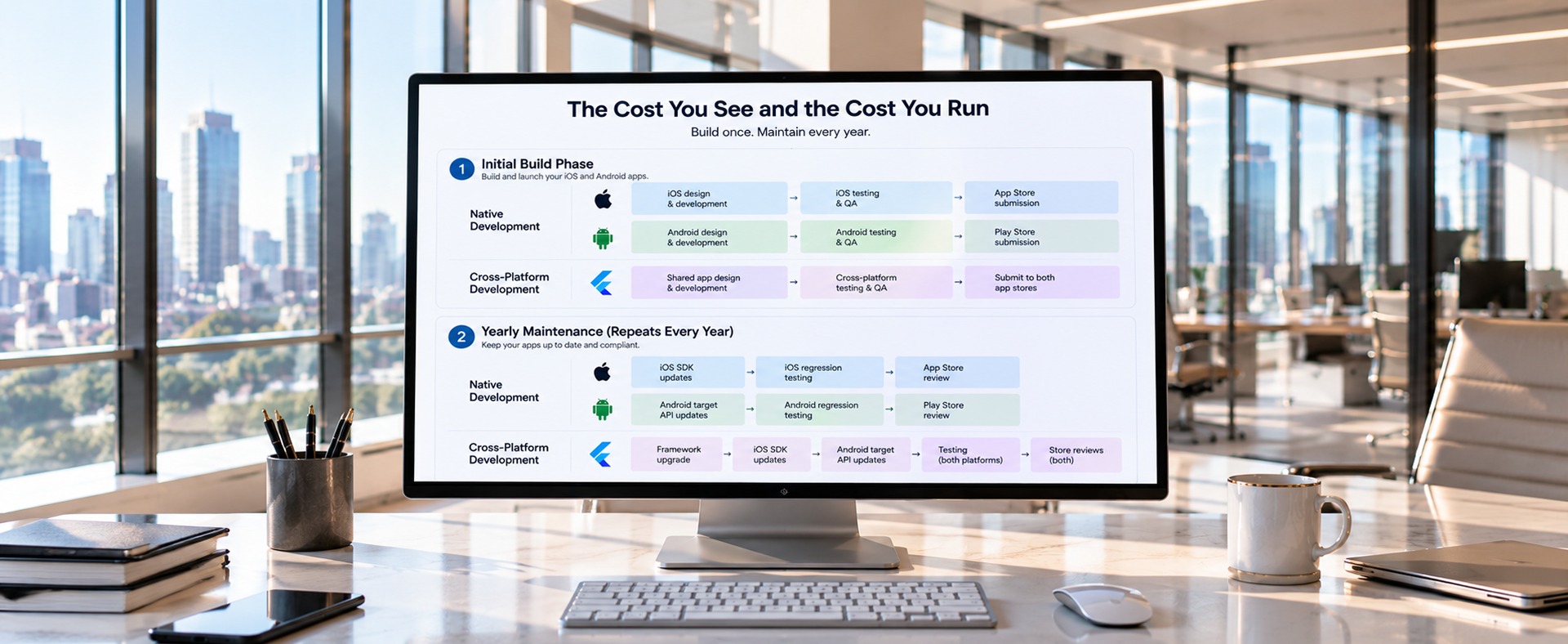
| Maintenance | Two release cycles | One release cycle, plus framework upgrades |
Flutter vs React Native vs native at a glance
| Factor | Native | Flutter | React Native |
|---|---|---|---|
| Language | Swift, Kotlin | Dart | JavaScript, TypeScript |
| Interface | Platform components | Draws its own pixels | Real native components |
| Best for | Device-first apps | Custom, brand-identical design | Teams with React skills |
| Tooling | Xcode, Android Studio | Flutter SDK | Expo framework |
| Known apps | Platform-specific apps | Google Pay, NotebookLM, BMW | Outlook, Teams, Amazon Shopping |
Neither approach wins every row. If you already run an app and suspect the stack is the problem, a technology stack assessment shows whether a rebuild is worth it before you commit.
Native App Development: Strengths and Trade-offs
Native app development gives you the most control over the device, at the cost of building everything twice.
Where native wins
- Full hardware access. Camera pipelines, Bluetooth Low Energy, NFC, sensors, and background tasks work without a middle layer.
- New OS features on day one. Native teams can use a new Apple or Google API the day it ships.
- Peak performance. Heavy graphics, AR, real-time audio, and video editing get the most headroom.
Where native costs you
Native teams build and test every feature twice, and the two apps can drift apart over time.
Native makes the most sense when the app itself is the product and it leans on the device. Our iOS app development services team takes that route for apps built around the camera, health data, or Apple Watch.
Cross-Platform Development: Strengths and Trade-offs
Cross-platform development lets one team ship iOS and Android from one codebase, and developer adoption keeps growing. In a 2023 survey of developers using cross-platform frameworks, 46% used Flutter and 35% used React Native.3 JetBrains says Kotlin Multiplatform usage more than doubled in a year among its Developer Ecosystem Survey respondents, from 7% in 2024 to 18% in 2025.4
Where cross-platform wins
- One codebase. Business logic, screens, and tests are written once.
- Same-day launches. iOS and Android users get new features at the same time.
- One team and one QA cycle. Fewer handoffs and fewer mismatched bugs.
Where cross-platform costs you
Cross-platform apps depend on the framework and its plugins. When iOS or Android changes, the team may wait for a plugin update or write a native module. Our cross-platform app development projects plan for that native layer from the start, rather than finding it mid-build.
Flutter vs Native: When Flutter Is the Right Call
Flutter is Google's open-source framework, and it comes close to native performance for most apps. Release builds compile Dart code ahead of time into native ARM machine code,5 and it draws every pixel itself, so screens look identical on both platforms.
Flutter's Impeller engine precompiles shaders at build time, which prevents stutter during animations. Impeller is the default renderer on iOS and on Android API 29 and later.6 Google Pay, Google Earth, and NotebookLM run on Flutter, and BMW, eBay, and Toyota appear in its showcase.7
Choose Flutter over native if
- Your brand needs a custom, pixel-identical design on both platforms
- The app uses rich animations, custom charts, or branded components
Choose native over Flutter if
Native wins when you need new OS features on day one or an exact platform feel. Either way, mobile app design should run in the same sprint as development, since design shapes the framework choice.
React Native vs Native: When React Native Is the Right Call
React Native is Meta's open-source framework, and it renders real native interface components from JavaScript or TypeScript. A React Native button is a native button.
React Native's old weakness was the asynchronous bridge between JavaScript and native code. The New Architecture, default since React Native 0.76, removes that bridge and uses direct communication through the JavaScript Interface (JSI).8 Microsoft Outlook and Teams, Amazon Shopping, and Shopify's Shop app all use it.9 For new apps, the React Native docs recommend starting with a framework such as Expo.10
Choose React Native over native if
- Your team already knows React and TypeScript
- You want to share logic with a React web app
- You want a native look without two native teams
A real example: Homes and Lands
Redefine built the Homes and Lands real estate app in React Native, covering listings, agent profiles, document scanning, and payments. Both platforms launched the same day, and the custom document scanner cleared both store reviews on the first submission. That is typical of our React Native app development services work: one codebase, with native code only where a feature needs it.
Performance in 2026: How Big Is the Gap?
In our experience, users of most business apps cannot tell a cross-platform app from a native one. Forms, feeds, catalogs, checkout, bookings, and dashboards run smoothly in Flutter and React Native on modern phones.
The performance gap between native and cross-platform shows up in four places:
- 3D graphics, AR, and games that push the GPU every frame
- Real-time audio or video processing
- Long background tasks, such as location tracking or Bluetooth sync
- Very long, image-heavy lists on low-end Android devices
App architecture also affects speed more than the framework does. If your users are on budget Android phones, test on those devices early. Our Android app development services team profiles on low-end hardware for exactly that reason.
"Ask which of your features need native code, not which framework is faster."The real question
How Much Does a Native vs Cross-Platform App Cost?
A cross-platform consumer app or startup MVP typically costs $40K to $120K and takes 8 to 14 weeks to reach both stores, based on Redefine's published mobile app development ranges.
| App type | Approach | Typical cost | Time to launch on both stores |
|---|---|---|---|
| Consumer app or startup MVP | Cross-platform | $40K to $120K | 8 to 14 weeks |
| Enterprise app (SSO, device management, offline) | Cross-platform | $80K to $250K | 12 to 20 weeks |
| Any app built fully native for iOS and Android | Native | Scoped individually, higher | Longer, two builds and two QA cycles |
A fully native build costs more because design, development, and QA happen twice, but it does not cost double. Backend work, integrations, and store compliance cost the same either way.
Yearly maintenance you should budget for
Apple and Google both set yearly SDK deadlines. Since April 28, 2026, iOS and iPadOS apps uploaded to App Store Connect must be built with the iOS 26 SDK or later.11 From August 31, 2026, new Google Play apps and updates must target Android 16 (API level 36) or higher.12 Native teams do that work twice. Cross-platform teams do it once, plus framework and plugin upgrades.
If budget is tight, MVP development on a cross-platform stack lets you test demand on both stores before you invest in native depth.
Which Approach Fits Your App?
The right approach depends on two things: how deeply the app uses the device, and how it should look.
Reading the signals in your feature list
Sort every planned feature by how much it depends on the device, then check the design direction.
Device features: which ones need native code?
| Feature | Needs native code? | Why |
|---|---|---|
| AR, 3D, real-time video | Yes | Needs full GPU and camera control |
| Home screen widgets, watch apps | Yes | Built with platform-only tools |
| BLE hardware pairing, background audio | Usually | Long-running OS tasks |
| Camera, GPS, biometrics, push | No | Mature plugins in both frameworks |
| Sign-up, catalogs, checkout, bookings | No | Standard screens and APIs |
Native-heavy apps: AR, widgets, watch apps, and hardware pairing
Why native app development fits these apps
When native-only features sit at the core of the app, most of the code is platform-specific anyway, so a shared codebase saves little. Fitness trackers, AR shopping, and hardware companion apps usually fall here.
Screen-and-data apps: commerce, bookings, service, and content
Why cross-platform development fits these apps
Most of these screens are forms, lists, and API calls, which Flutter and React Native handle well. A small native module covers the one or two features that need the device.
Design: platform-standard or brand-identical?
Platform-standard design: native or React Native
Following Apple's and Google's design guidelines
iOS users expect Apple's patterns, and Android users expect Material Design. Our iOS app design and Android app design teams design each platform to its own rules.
Brand-identical design: Flutter
Why Flutter keeps every screen identical
Consumer brands with a strong visual identity, such as retail, media, and banking apps, often want one design system across iOS, Android, and web. Flutter suits that because it does not depend on platform components.
Other Options: Kotlin Multiplatform, .NET MAUI, Hybrid Apps, and PWAs
Native, Flutter, and React Native are not the only choices. Four alternatives fit specific cases.
Kotlin Multiplatform
Kotlin Multiplatform shares business logic across iOS and Android while each platform can keep a native interface. It suits teams with strong Kotlin skills that want native screens without writing logic twice.
.NET MAUI
Microsoft's .NET MAUI builds native mobile and desktop apps for Android, iOS, macOS, and Windows with C# and XAML.13 It suits teams already invested in .NET.
Hybrid apps
Hybrid apps, built with tools such as Apache Cordova or Ionic, run web code inside an embedded browser view and usually feel less native than Flutter or React Native apps.
Progressive web apps
If you need reach without deep hardware access or a store listing, progressive web app development gives you an installable, app-like experience from one web codebase.
Native vs Cross-Platform Decision Checklist
Use this checklist before choosing between native and cross-platform development.
Planning AI features, such as on-device recognition or an in-app assistant? Check that the SDKs you need support your chosen framework. Our AI development services team scopes this alongside the app.
"The right build approach is the one that matches your feature list, not the one that wins the most benchmarks."A common mistake in mobile app planning
Frequently Asked Questions
Is a Flutter app a native app?
A Flutter app is not built with native UI components, but it compiles to native machine code and installs from the App Store and Google Play like any native app.
Is a native app more secure than a cross-platform app?
Not by default. App security depends on how data is stored, encrypted, and sent to the backend. Both approaches can use the platform keychain, biometrics, and certificate pinning.
Do cross-platform apps work offline?
Yes. Flutter and React Native apps can store data locally and sync when the connection returns. Offline sync needs planning in either approach.
What is the difference between hybrid and cross-platform apps?
Hybrid apps run web code inside an embedded browser view. Cross-platform apps built with Flutter or React Native render real native or compiled interfaces, so they usually perform better.
How much does a mobile app cost, and how long does it take?
At Redefine, a cross-platform consumer app or MVP typically costs $40K to $120K and takes 8 to 14 weeks. Enterprise apps run $80K to $250K over 12 to 20 weeks.
Which approach is best for a startup MVP?
Cross-platform development is usually best for a startup MVP, because one codebase reaches iOS and Android users at once on a single budget.
Can a mobile app share a backend with our website and internal systems?
Yes. A mobile app should share one API with your website and internal systems so data stays consistent. Our custom software development team builds the backend and the app in the same engagement.
The Honest Verdict
There is no single winner in the native vs cross platform app debate. There is a best fit for what your app has to do.
Cross-platform development with Flutter or React Native is the right call for most business apps that need iOS and Android on one budget. Native app development is the right call when the app lives on hardware, new OS features, or heavy graphics. Many strong apps use both: a shared cross-platform core with native modules where they matter, as Homes and Lands did with its document scanner.
Good mobile app development starts with the feature list, not the framework. You can see how we apply that approach across client projects in our work.
"Build once where you can. Build native where you must."The honest verdict
Not sure whether your app should be native or cross-platform?
Send us your feature list. We will mark which features need native code, recommend Flutter, React Native, or native, and outline a build and maintenance plan, even if the answer is the smaller project.
Request a mobile app project estimate
Sources & Citations
Primary research, official documentation, and platform policy pages used for the statistics and claims in this guide. Cost and timeline ranges come from Redefine's published mobile app development page (linked in the cost section), and the Homes and Lands example comes from Redefine's own project record.
- Statcounter Global Stats, "Mobile Operating System Market Share Worldwide": Android at 67.61% and iOS at 32.36% of worldwide mobile OS share, August 2026.
- Apple Newsroom, "App Store ecosystem reaches $1.4 trillion as developers thrive globally (June 2026)": Over $1.4 trillion in developer billings and sales facilitated by the App Store ecosystem in 2025.
- Statista, "Cross-platform mobile frameworks used by software developers worldwide, 2019 to 2023": Flutter at 46% and React Native at 35% of developers using cross-platform frameworks in 2023.
- JetBrains, Kotlin Multiplatform documentation, "Kotlin Multiplatform vs. React Native: A cross-platform comparison": Kotlin Multiplatform usage more than doubled among Developer Ecosystem Survey respondents, from 7% in 2024 to 18% in 2025.
- Flutter documentation, "Flutter FAQ": Release builds compile Dart code ahead of time into native ARM machine code on iOS and native machine code on Android.
- Flutter documentation, "Impeller rendering engine": Impeller precompiles shaders at build time and is the default renderer on iOS and Android API 29 and later.
- Flutter, "Flutter Showcase": Google Pay, Google Earth, NotebookLM, BMW, eBay, and Toyota listed as Flutter apps and users.
- React Native blog, "The New Architecture is Here (October 2024)": New Architecture default from 0.76, replacing the asynchronous bridge with JSI.
- React Native, "Who is using React Native?": Microsoft Outlook and Teams, Amazon Shopping, and Shopify's Shop app built with React Native.
- React Native documentation, "Get Started with React Native": Recommends a framework such as Expo for new React Native apps.
- Apple Developer, "Upcoming SDK minimum requirements": From April 28, 2026, iOS and iPadOS apps must be built with the iOS 26 and iPadOS 26 SDK or later.
- Google Play Console Help, "Target API level requirements for Google Play apps": From August 31, 2026, new apps and updates must target Android 16 (API level 36) or higher.
- Microsoft Learn, "What is .NET MAUI?": .NET MAUI builds native mobile and desktop apps with C# and XAML for Android, iOS, macOS, and Windows.
Product insights, no fluff
One short email a month on mobile apps, platforms, and product builds that pay off.
You're in, check your inbox to confirm.