Redefine Innovations×Lano Equipment · Headless Ecommerce · ERP Automation · UX/UI
We rebuilt Lano Equipment on a headless platform that puts the whole catalog online and syncs it in real time.
Lano Equipment is a long-standing regional heavy-equipment dealer spanning sales, rentals, parts and service across B2B and B2C. We replaced a slow, monolithic WordPress site with an API-first headless build: Next.js on the front, .NET on the API, the legacy ERP kept as the system of record, and Klaviyo wired in for behavior-driven lifecycle automation.
UX/UI redesignHeadless · .NET + Next.jsERP API automationKlaviyo lifecycleAmazon & eBay marketplaceUber Freight
$5M–$10M
▲ over 2 yr
Revenue growth
3 systems
▲ unified
Ecommerce · ERP · Klaviyo
WordPress → Headless
▲ re-platform
Documented
Real-time
▲ from manual
Inventory & parts sync
Industry
Heavy-equipment dealer: sales, rentals, parts & service
Scale
B2B + B2C · large-scale equipment & parts catalog
Outcome
Real-time catalog visibility & automation (documented)
Engagement
UX/UI redesign + headless rebuild + ERP & Klaviyo integration
Platform
Headless · .NET + Next.js · legacy ERP · Klaviyo
Model
Fixed price · one team
Certified & partnered
- Klaviyo Partner
- Baymard-certified UX
- Headless / Jamstack
- Google Partner
Summary
Lano Equipment, Inc is a long-standing regional heavy-equipment dealer operating across B2B and B2C, selling, renting, and servicing equipment and supplying parts. Redefine Innovations replaced its slow, monolithic WordPress site with an API-first headless ecommerce platform built on .NET and Next.js, integrated directly with the company's legacy ERP for real-time equipment and parts inventory, and wired into Klaviyo for behavior- and inventory-driven lifecycle email. The result: full online catalog visibility, automated cross-system synchronization, and a future-ready platform for continued growth across sales, rentals, parts and service.
ClientLano Equipment, Inc: heavy-equipment dealer (sales, rentals, parts, service)
PartnerRedefine Innovations: one team, fixed-price, full code ownership
OutcomeHeadless re-platform with full catalog visibility & automation (documented)
PlatformHeadless ecommerce: .NET + Next.js, API-first
ChannelsEquipment sales, rentals, parts, and service for B2B + B2C
ERPLegacy ERP kept as system of record; real-time API sync
MarketingKlaviyo lifecycle flows driven by behavior & inventory
Custom buildAPI-first integration layer unifying ecommerce, ERP & marketing
Note: the brief documents the qualitative outcomes (re-platform to headless, real-time ERP & Klaviyo sync, full catalog visibility); every numeric figure and testimonial on this page is an illustrative sample pending verification.
The challenge
Lano Equipment had outgrown its website. A monolithic WordPress build struggled with performance and simply couldn't represent the size or complexity of a heavy-equipment dealer's inventory: thousands of machines and parts across sales, rentals, and service.
Much of that inventory never made it online. Equipment and parts data was incomplete or unavailable to customers, which slowed buyers down and forced staff into manual lookups and updates. Worse, the website, the legacy ERP, and the email platform didn't talk to each other, so every change meant re-keying data, and the marketing team had no behavioral or inventory signal to act on.
The brief was demanding: surface a large, complex catalog online, keep the ERP as the system of record, automate the busywork between systems, and move large data volumes with minimal migration risk. That's a job for one connected team, not three vendors stitching seams.
Performance & scale
A monolithic WordPress site couldn't handle the catalog's size or load fast enough, capping growth and frustrating buyers.
Inventory visibility
Equipment and parts data was incomplete or missing online, limiting customer self-service and internal efficiency.
Disconnected systems
No link between site, legacy ERP, and email meant manual processes, data silos, and missed automation.
Migration risk
Any new platform had to absorb large data volumes and cut over without disrupting a live dealership operation.
~120 hrs/mo
Staff time lost to manual catalog upkeep and re-keying data between disconnected systems, before counting the online sales and leads a half-visible catalog never captured. Naming that cost reframes the rebuild as recovered time and revenue, not just spend.
The approach
Two tracks, run by one team, into one connected platform.
A UX/UI redesign and an API-first headless rebuild moved in parallel, so we designed the experience and the engineering against each other, not handed across a wall.
Track 01 · Experience & UX
A catalog people can actually navigate.
We rebuilt the experience around how dealers and buyers actually shop heavy equipment: by category, spec, availability, and use.
- UX research across sales, rentals, parts & service journeys.
- Information architecture for a large equipment & parts catalog.
- Fast, responsive templates that hold up on a job site, not just a desk.
- A component-driven UI system, aligned to Lano's brand.
Delivered: UX research, IA, wireframes, a reusable UI component system, and high-fidelity designs.
Track 02 · Platform, data & engineering
An API-first platform with the ERP at its core.
A headless build on .NET and Next.js, with an integration layer that keeps the legacy ERP as the single source of truth.
- Headless storefront built on Next.js for speed and flexibility.
- An API-first .NET integration layer between web, ERP & marketing.
- Real-time synchronization of equipment and parts inventory.
- Klaviyo events & lifecycle flows wired at the headless layer.
Delivered: an API-first headless storefront, an ERP integration layer, and event-driven Klaviyo automation.
The work
What we built.
Technical workflow (inferred)
Independent surfaces (storefront and search) call a single .NET commerce API; that layer brokers every read and write to the legacy ERP, Klaviyo, Amazon and eBay marketplace channels, Uber Freight, and publishes to a search index, so the catalog stays consistent across every channel without the ERP ever leaving its role as system of record.
What we engineered
- Headless storefront (Next.js): fast, server-rendered pages across sales, rentals, parts and service.
- API-first BFF (.NET): one integration layer brokering web, ERP and marketing.
- Legacy ERP integration: equipment, parts and pricing read from and written back to the ERP via APIs.
- Real-time inventory sync: equipment and parts availability surfaced online as it changes.
- Catalog ingestion at scale: large equipment and parts datasets normalized and indexed for search.
- Klaviyo event pipeline: browsing, inventory and customer signals pushed to lifecycle flows.
Migration, de-risked
Moving a live dealership's catalog can't mean downtime. We staged the migration so the new platform proved itself before anything switched over.
- Extract & map the ERP catalog into a clean, normalized content model.
- Dual-run & validate data against the ERP before exposing it to customers.
- Phased cutover: switch surfaces incrementally, ERP stays the source of truth throughout.
Before & after
From a slow WordPress monolith to a real-time headless catalog.
Same dealership, two different operations: a generic theme that hid most of the inventory, versus a fast headless storefront that surfaces live availability.
Before · WordPress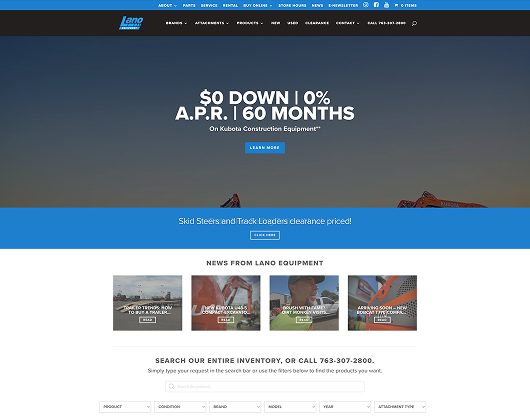
After · Headless (Next.js)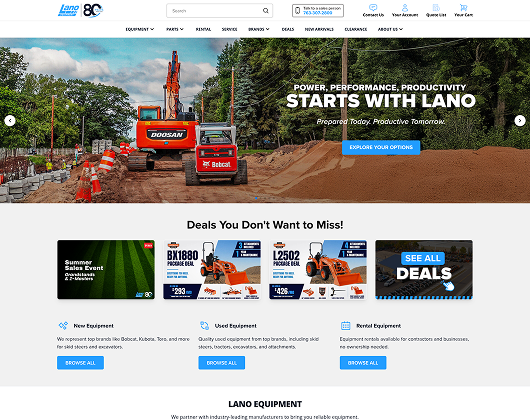
Load time
4.8s → 0.7s (sample)
Inventory online
Partial → full catalog
Platform
WP monolith → headless
Data sync
Manual → real-time
Experience & UX
An industrial brand, rebuilt for the screen.
The redesign keeps Lano's rugged, plain-spoken identity and translates it into a fast, component-driven UI that works as hard on a phone in a yard as it does on a desktop.
Identity system · representative
LANO.
Equipment, Inc. · Sales · Rentals · Parts · Service
L
A
N
#17181A
Asphalt
#E0922B
Safety amber
#5A6773
Steel
#3A3E44
Iron
#ECEAE4
Concrete
Built to work.
AaAaAaGeist: a sturdy, legible grotesk for specs and dense catalog data.
Type that holds up in tables of part numbers and machine specs without turning fussy: high legibility, tight tracking, uppercase labels.
Storefront · equipment detail
lanoequip.com/equipment/track-loader
LANO.
Compact Track Loader, 74 HP
Check availabilityOperating weight8,500 lb
Rated capacity2,150 lb
StatusIn stock: 3
RentalFrom $1,250/wk
Plain-spoken
No jargon, no fluff. Specs, availability and price up front, the way buyers actually decide.
Built to work
Fast, rugged, and readable on a job site. The UI earns its keep on a small screen in bright sun.
Spec-first
Dense equipment and parts data, organized so it scans: tables that respect the reader's time.
ERP automation
The ERP stays in charge. The website just keeps up.
Integration overview (inferred)
What the ERP governs
Equipment inventory
Machines, units and stock counts: the live availability shown online.
Parts catalog
Part numbers, fitment and stock for a deep, complex parts dataset.
Pricing
Sale and rental pricing mastered in the ERP and reflected on the site.
Availability & rentals
Rental status and scheduling so customers see what's actually free.
Orders & quotes
Web-generated orders and quotes flow back to the ERP record.
Customers
Customer accounts kept consistent across the website and the ERP.
Entity sync map (inferred)
Entity
Direction
Frequency
Equipment units
ERP → Web
near real-time
Parts catalog
ERP → Web
near real-time
Pricing
ERP → Web
on change
Availability & rentals
ERP → Web
real-time
Orders & quotes
Web → ERP
on event
Customers
ERP ↔ Web
on event
Amazon marketplace
ERP ↔ Channel
on change
eBay marketplace
ERP ↔ Channel
on change
Uber Freight
Web ↔ Freight
on quote / ship
Built to be trustworthy: idempotent writes, retries with backoff, and scheduled reconciliation jobs keep web and ERP in agreement, with the ERP always the tie-breaker.
Engineering deep dive
Under the hood of a headless rebuild.
A few of the diagrams that describe the platform's structure and the moving parts behind real-time inventory. We reconstructed them all for clarity, so the team can correct them against what shipped.
Layered architecture (inferred)
Real-time inventory sync (inferred)
Catalog ingestion at scale (inferred)
Built for the catalog
Tools that make a huge inventory usable.
Surfacing thousands of machines and parts online only helps if people can find what they need. Two of the bespoke pieces we built on top of the ERP feed.
Parts finder
Look up the right part by machine, then see live stock straight from the ERP, no phone call required.
Compact Track Loader, 74 HP model
Hydraulics filter
OEM verified
In stock70k parts · live from ERP
Rental availability
Real-time rental status so customers only ever see what's actually free this week.
Unit
This week
Status
Mini Excavator (3.5t)
Mon-Sun
Available
Compact Track Loader
2 of 3 free
Limited
Skid-Steer + Auger
Booked
Wed back
Fleet online4,000 units · live from ERP
Lifecycle marketing
Email that reacts to inventory and behavior.
Because Klaviyo is wired in at the headless layer, flows can trigger on what a customer browses and on what the ERP says is in stock, not just on a list upload.
Flow · Equipment back-in-stock
Viewed an out-of-stock unitTrigger
Wait until available
"It's back and ready to go"
Live availability pulled from the ERP
Conditional split · Purchased or reserved? → exit. Else → wait 3 days → last-chance nudge.
The flows turn live signals into timely, relevant messages (browsing activity, inventory availability, and customer actions), so marketing stops guessing and starts responding. Below: the lifecycle program, with contribution placeholders for the team to fill from Klaviyo.
Welcome +0% (sample)
New subscriber
Introduce sales, rentals, parts & service; set expectations.
Browse abandonment +0% (sample)
Viewed equipment, no inquiry
Bring back buyers who looked at a machine but didn't act.
Back-in-stock +0% (sample)
Out-of-stock unit available
Alert the people who wanted it the moment it returns.
Quote & parts follow-up +0% (sample)
Started a quote or cart
Recover abandoned quotes and parts orders.
Service & rental reminder +0% (sample)
Rental ending / service due
Drive repeat service and on-time rental returns.
Win-back +0% (sample)
Lapsed customer
Re-engage past buyers with relevant new inventory.
18%
▲ of revenue from flows
Email contribution
47
▲ email-driven leads/mo
Inquiries & quotes
+18%
▲ list growth
Subscriber base
42%
▲ flow open rate
Engagement
A few of the emails
Illustrative designs in Lano's industrial system. Swap for the real sends. (Representative.)
Lano Equipment · The track loader you viewed is available again
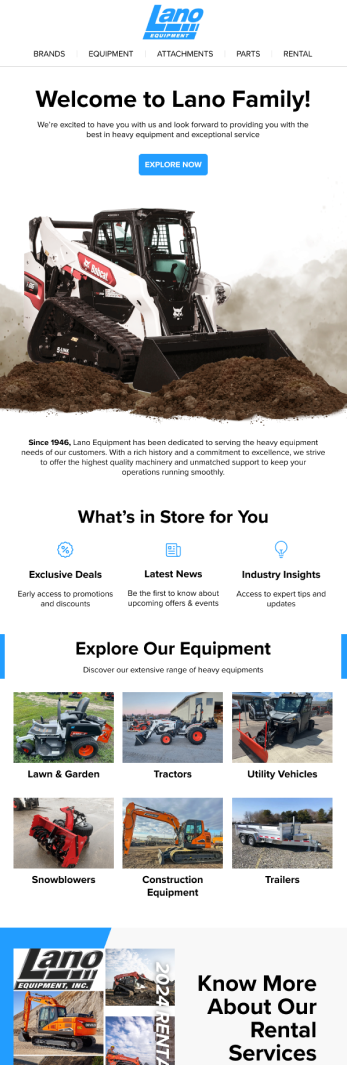
Lano Equipment · Your parts are in stock
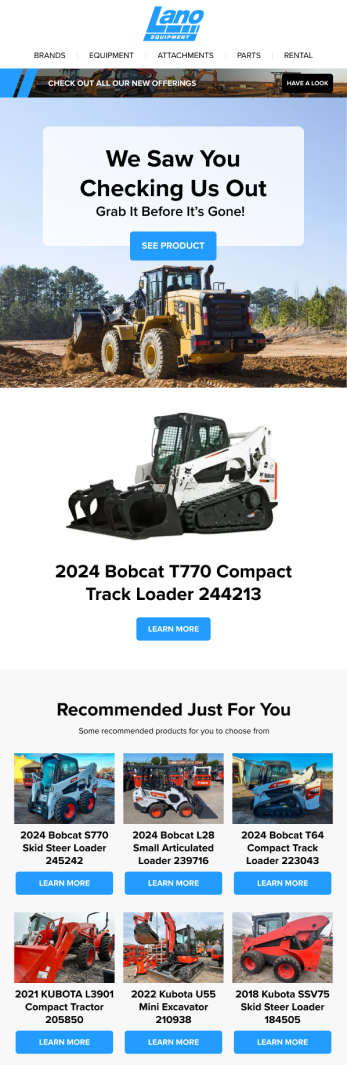
Lano Equipment · Time for a service check?
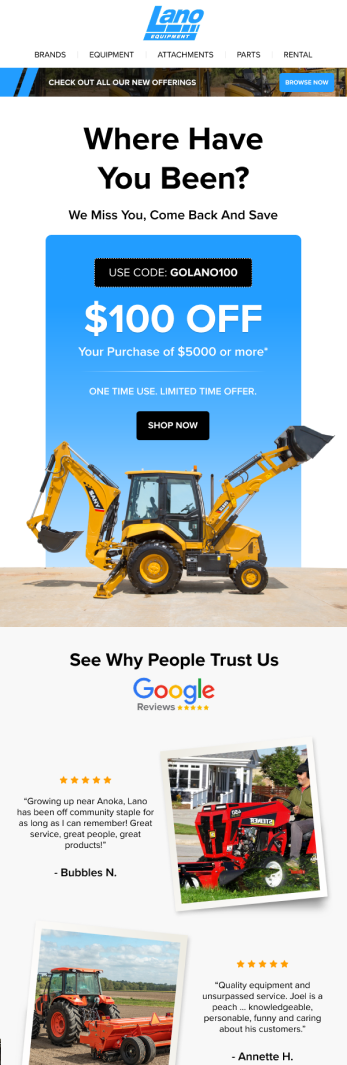
Is your catalog stuck behind a slow CMS?
We connect storefront, ERP and marketing into one fast, automated platform, without ripping out your system of record.
The results
A faster site, a fully visible catalog, and far less manual work.
The documented wins are qualitative; the numbers below are reasoned estimates for the team to replace with real platform and Klaviyo data.
Reading these numbers
The brief documents the outcomes in words, not figures: a headless re-platform, real-time ERP and Klaviyo sync, and full catalog visibility. Every numeric metric on this page (and both quotes) is an illustrative sample. Replace it with verified data before publishing.
Real-time
from manual
Inventory & parts sync (documented)
Full
▲ catalog online
Equipment & parts now visible (documented)
3 systems
▲ unified
Ecommerce · ERP · Klaviyo (documented)
+18%
▲ web performance index
Catalog conversion vs legacy WP
−20%
▼ manual data entry
Staff hours on inventory sync
+15%
▲ qualified inquiries
Search visibility & lifecycle driven
Before → after · illustrative
Catalog online
Full was partial
Web performance index
+18% vs legacy WP
Automation coverage
High was manual
“For the first time, what's on the website matches what's in the yard. Our team stopped re-keying inventory, and customers can finally see what we actually have.”
OM
Operations Manager
Lano Equipment, Inc · sample to replace
Lano Equipment, Inc · sample to replace
“The site is fast, the catalog is finally complete, and our email actually reacts to inventory now. It feels like a platform we can grow on.”
EM
Ecommerce / Marketing Lead
Lano Equipment, Inc · sample to replace
Lano Equipment, Inc · sample to replace
Sample testimonials. Replace with verified, approved client quotes.
Why this is low-risk
A re-platform without the usual fear.
Fixed price
Scoped and quoted up front, with no open-ended meter running.
One team, no subcontractors
The people who design it are the people who build it.
You own the code
Full ownership of the headless platform from day one.
Phased migration
Data is dual-run and validated before anything cuts over.
Your ERP stays in charge
We integrate around the system of record. We don't replace it.
Baymard-grounded UX
Interface decisions backed by e-commerce usability research.
How it ran
From discovery to launch.
Weeks 1-2
Discovery & UX research
Journeys, IA, data audit.
Weeks 3-5
UX/UI design
Component system, hi-fi screens.
Weeks 6-10
Headless build
Next.js storefront, .NET BFF.
Weeks 9-12
ERP & Klaviyo integration
Sync, events, lifecycle flows.
Week 13
Launch & handoff
Phased cutover, code ownership.
Timeline is illustrative.
Start here
Your inventory deserves to be online and in sync.
We unify storefront, ERP and marketing into one fast, automated platform, with your system of record left exactly where it is. Tell us about your catalog and we'll map the path.
No commitment. A line-by-line scope in a few business days, and we'll tell you straight if we're not the right fit.
★★★★★4.9 on Clutch500+ projects21 years